
Online Pokies Instant Withdrawal in Australia: What the “Instant” Label Actually Means
The promise of an “instant withdrawal” is the marketing hook on almost every offshore pokies site pitching to Australian players. The reality runs through three gates before any money reaches a bank account, and the slowest gate is almost always the one the marketing copy does not name. This page is the breakdown an Australian punter actually needs before chasing a fast payout — what the term means in practice, where the delays really sit, which operators Australians in fact use, and the legal and consumer-protection reality that surrounds every one of them.

Current as of 22 November 2026, checked against the Australian Communications and Media Authority (ACMA) public register and the AU regulatory framework for online wagering.
Table of Contents
- Why Your 2026 “Instant” Withdrawal Is Almost Never Instant
- Online Pokies Payouts in Australia: What You’re Actually Working With
- 10 Offshore Pokies Sites Australians Use — And How Fast Each Pays Out
- How to Pick a Fast-Paying Pokies Site Without Getting Burned
- Are Instant-Withdrawal Pokies Legal in Australia? The Uncomfortable Answer
- Playing Smart: Limits, Self-Exclusion and Where to Get Help
- How We Assessed the Fastest-Paying Pokies Sites
- Your Money, Your Call: What This Actually Means for Your Next Deposit
- Frequently Asked Questions
Why Your 2026 “Instant” Withdrawal Is Almost Never Instant
The word “instant” on a withdrawal banner describes the operator’s own processing promise, not the time a bank takes to clear funds. The two are very different things, and an Australian pokies player pays for the gap between them in time.
The legal scaffolding matters here. From 11 June 2024, Australia banned credit cards, credit-related products and cryptocurrency as payment for online wagering under the Interactive Gambling Amendment (Credit and Other Measures) Act 2023. An operator that still asks for either is, by definition, operating outside the Australian rules — and the payment method itself is the tell. The legal deposit routes for licensed wagering are debit card, bank transfer, PayID/Osko and BPAY. Anything else on a deposit screen is a signal about which rule book the site is actually playing under.
A site that takes PayID is at least set up for the Australian banking system. A site that does not offer PayID, and asks instead for credit card or crypto, is signalling its offshore setup before a single dollar moves. That signal is worth more than any payout-speed badge on the homepage.
PayID and Osko: Fast on the Bank Side, Stuck at the Casino Gate
PayID and Osko settle inside the Australian banking system in seconds — that part is genuinely instant. A PayID transfer between two Australian bank accounts typically clears in under a minute, and Osko rails are what make that possible. The bottleneck, in nearly every withdrawal case, is not the bank. It is the casino’s own approval queue.

This is the part that confuses first-time players. A site advertises PayID deposits and PayID withdrawals, and the punter reasonably assumes the payout will be as quick as the deposit. Deposits usually are — the operator wants the money in fast. Withdrawals are different. Before the PayID payment instruction even reaches the bank, the operator runs the request through its own internal review, which can include KYC verification, source-of-funds checks, bonus-wagering confirmation and a manual approvals step. That internal queue is where hours — sometimes days — disappear.
An operator that supports PayID has built a payment integration into Australian banking infrastructure, which is a meaningful operational signal. It does not, by itself, guarantee a fast payout. What it does guarantee is that once the operator does release the funds, the bank-side leg is genuinely quick. The two should not be confused.
Instant, Same-Day, Fast: What Each Payout Label Actually Means
“Instant” on a withdrawal page is a marketing term, not a banking fact. Operators use it to mean different things, and the difference usually lives in the terms and conditions page nobody reads.
“Instant” most often means the operator will release the funds into the payment rail immediately, with bank-side clearance still taking minutes to hours depending on the method. “Same-day” typically means the withdrawal will be processed and dispatched within the same calendar day, often with a hard cut-off time — request it before 2 pm and it goes out today; request it later and it joins tomorrow’s batch. “Fast” or “express” tends to mean a shorter-than-standard internal review window, often with conditions attached (verified account, no bonus outstanding, withdrawal amount within a band).
The fine print that matters most is the pending-period clause. Many operators reserve a window — 24 hours, 48 hours, sometimes 72 — during which a withdrawal can be reversed by the player or held while the operator completes checks. That window is part of the withdrawal time, even when it is not labelled as such on the marketing page. Read the terms page, not the banner.
The Real Withdrawal Timeline: Pending, Processing, Paid
Every withdrawal passes through at least four distinct stages, and the time the punter experiences is the sum of all four. Knowing what each one costs is the difference between frustration and a clear plan.
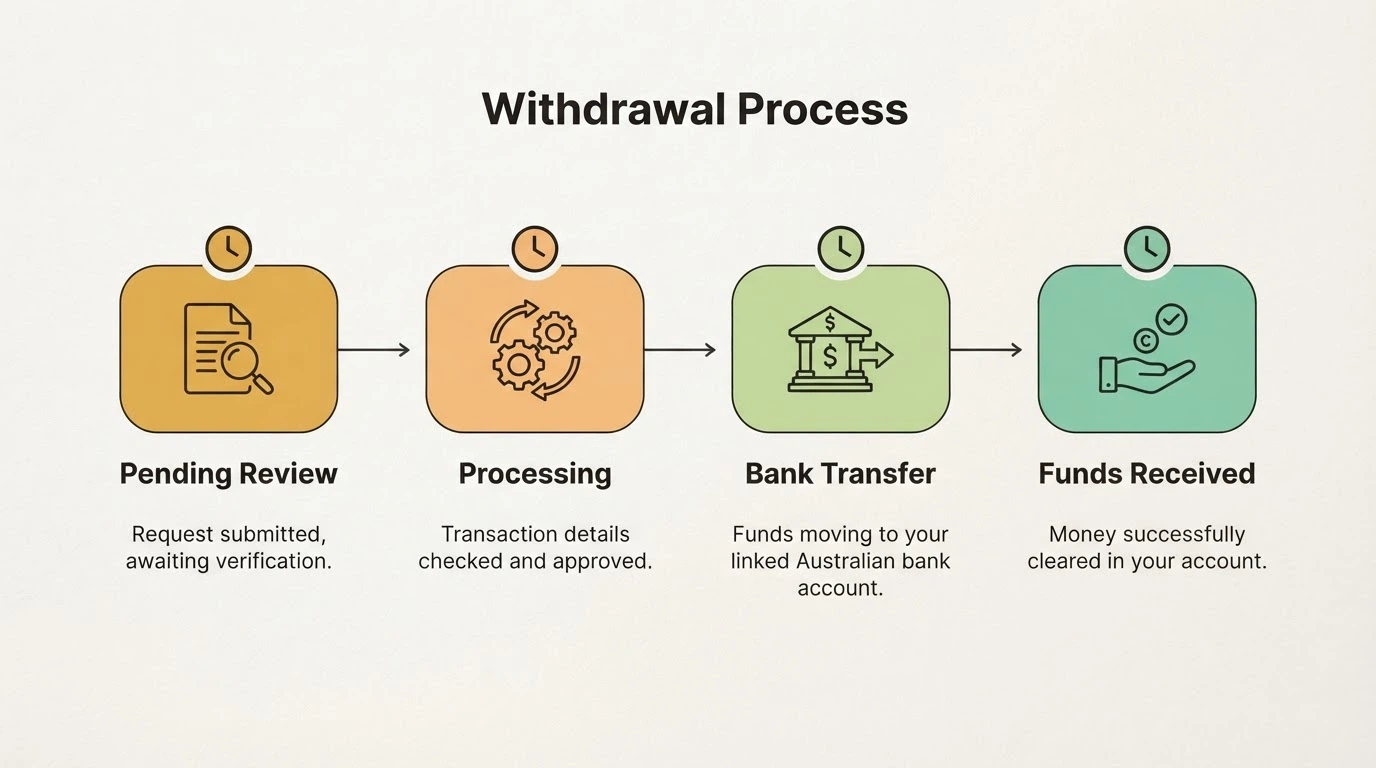
First comes the pending stage: the moment the player hits withdraw, the request sits in the operator’s queue. KYC verification — the identity checks required under anti-money-laundering rules — runs at this point for first withdrawals or larger amounts. A player who has not pre-verified will stall here.
Second is the processing stage: the operator’s finance team reviews the request, confirms the bonus has been cleared if relevant, and approves the payout. This is the stage that varies most between operators, and it is the one the marketing copy never quantifies.
Third is the payment rail: the approved amount is sent through the chosen method. For PayID/Osko this is fast. For bank transfer it can take one to three business days. For debit-card withdrawals it depends on the card scheme.
Fourth is bank-side clearance: the receiving bank processes the incoming payment and posts it to the account. For PayID/Osko this is near-immediate. For everything else, there is lag.
The withdrawal policy on the operator’s website will name stages one and two. Stages three and four are governed by the payment method and the receiving bank. The player’s actual experience runs end-to-end.
Withdrawal Methods Compared: Speed, Safety and What’s Actually Available
The payment method a player chooses shapes the back end of the withdrawal. The Australian regulatory framework limits what an AU-licensed wagering operator can accept; offshore operators operate under their own house rules, which usually means a wider (and less regulated) menu. Crypto, for example, is only available at offshore sites that operate outside the AU rules — the prohibition on using credit and crypto for online wagering (in force since 11 June 2024) applies strictly to licensed wagering services.
| Payment method | Typical speed bank-side | Available at licensed AU wagering? | Regulatory note |
|---|---|---|---|
| PayID / Osko | Near-instant (after approval) | Yes | Listed as a legal deposit route for licensed wagering; fastest bank-side clearance in the AU system |
| Bank transfer (direct credit) | 1–3 business days | Yes | Standard fallback for larger withdrawals; slower than PayID but works for amounts PayID rails may not handle as cleanly |
| Debit card | 1–3 business days | Yes | Visa and Mastercard debit only; credit cards are banned for online wagering from 11 June 2024 |
| BPAY | 1–3 business days | Yes | AU-specific rail; useful as a deposit and sometimes a withdrawal method at licensed wagering operators |
| Cryptocurrency | Minutes to hours (network-dependent) | No — banned for licensed AU wagering | Available only at offshore sites; using it is itself a signal the site is outside AU rules |
The columns that matter most are the second and the fourth. PayID wins on bank-side speed, full stop. The regulatory note column is the one most players ignore — and the one that tells them whether their money is moving inside or outside the Australian banking framework.
What Operators Promise vs What Players Actually Get
Operator payout-speed claims live on the withdrawal or banking page, often with the word “instant” in the headline and a footnote that contradicts it. The real withdrawal experience is shaped by the operator’s internal policies, the player’s account status, and the bonus state at the time of the request.
The honest way to read a withdrawal policy is to look for three things: the maximum pending period before processing starts, the stated processing time after approval, and any conditions that gate “instant” payouts (verified account only, no active bonus, withdrawal below a threshold). All three should be in the terms page; if any one is missing, treat the marketing claim with caution.
Player reports and independent review aggregators are the most useful real-world signal. They reflect what actually happens after a withdrawal request, across many players and many sessions. Where operator-specific payout times cannot be verified against the operator’s own current terms, treat the published headline as a starting point and look for player-reported patterns before trusting it. The difference between an advertised five-minute payout and a real three-day payout is the difference between a marketing department and a finance department.
Online Pokies Payouts in Australia: What You’re Actually Working With
The foundational reality sits at the top of every Australian pokies guide that wants to be honest: online casino games and online pokies are prohibited under the Interactive Gambling Act 2001. The IGA makes it an offence to provide an online casino, online pokies or in-play sports betting to a person physically in Australia. There is no licence for it anywhere in the country — not federally, not in any state or territory.
That prohibition shapes everything else on this page. The “instant withdrawal pokies sites” Australians search for are offshore operators. They hold no Australian licence, they cannot obtain one for online casino, and they accept Australian players in a legal grey zone where the provider — not the punter — is the one the Act targets. The individual player is not prosecuted under the IGA; the Act targets the provider of the prohibited service. But that distinction is the only protection the player has, and it is not consumer protection. It is the absence of criminal liability.
What “Instant Withdrawal” Even Means for an Australian Pokies Player
For an Australian player, “instant withdrawal” describes the operator’s claim about its own processing speed. It is not a banking fact and it is not a guarantee. An offshore casino’s “instant withdrawal” is mediated by KYC processing, pending periods and the operator’s internal policies — three gates the player cannot see and the marketing copy does not name.
What makes the Australian context different from regulated European markets is the absence of an AU-licensed version of the product. In a regulated market, “instant withdrawal” is a regulatory expectation, with named timeframes, complaints bodies and an ombudsman if the operator fails. In Australia, the operators serving the market are offshore, and the speed claim is whatever the operator says it is — verified only by player reports after the fact.
How Payout Speed Works Behind the Scenes
Three parties touch the money between the operator’s approval and the player’s bank account: the operator’s own finance team, the payment processor or gateway, and the Australian bank that holds the receiving account. The slowest of those three defines the whole experience.
In practice, the slowest is almost always the operator. Payment processors move money quickly. Australian banks clear PayID/Osko in seconds. The operator’s internal approval queue — especially for a first withdrawal, a large amount, or a request made while a bonus is still being cleared — is where hours and days accumulate.
This is why the “instant” label matters less than the operator’s actual behaviour. A site that takes 24 hours to approve a PayID withdrawal has a 24-hour payout, not an instant one, regardless of what the homepage says. The PayID speed at the bank is real; the operator speed is the variable.
Why Withdrawal Speed Matters More Than the Welcome Bonus
A slow payout turns a winning session into a losing one. The maths is straightforward: every day between the withdrawal request and the funds landing in the bank account is a day the winnings are not earning interest, are not available to cover a bill, and are subject to whatever the operator decides to do with them in the interim — including reversing the request if the player so much as clicks the wrong button during the pending window.
A fast-paying site with a smaller welcome bonus beats a slow one with a headline figure, for any punter who plans to actually withdraw winnings. The bonus number is what the marketing sells; the payout speed is what the bank balance reflects. Welcome bonus terms at offshore pokies sites typically carry wagering multipliers — a multiplier means the bonus amount must be turned over a set number of times before withdrawal — and a slow payout compounds the cost of meeting those requirements, because the longer the multiplier takes to clear, the longer the money is locked. Speed of access has higher practical value than bonus size locked behind slow processing and wagering.
10 Offshore Pokies Sites Australians Use — And How Fast Each Pays Out
The operators Australians in fact reach are all offshore. No AU licence for online casino exists. Every brand on this list accepts Australian players, every one holds no Australian licence, and every one sits outside the AU consumer-protection framework entirely. The table is a quick-reference snapshot of the market — what is available, who has the tracked traffic, and what the AU licence column says, which is the same thing for every row.

| Operator | AU licence status | Market presence where tracked |
|---|---|---|
| Rocket Play | Offshore — no AU licence (none exists for online casino) | 9.4% market share; $632.69M revenue (tracked data) |
| Skycrown | Offshore — no AU licence (none exists for online casino) | 8.55% market share; $436.07M revenue (tracked data) |
| Royal Reels | Offshore — no AU licence (none exists for online casino) | 2.51% market share; $243.99M revenue (tracked data) |
| WinSpirit | Offshore — no AU licence (none exists for online casino) | — |
| Stake | Offshore — no AU licence (none exists for online casino) | — |
| FairGO | Offshore — no AU licence (none exists for online casino) | — |
| Bizzo Casino | Offshore — no AU licence (none exists for online casino) | — |
| Scream Casino | Offshore — no AU licence (none exists for online casino) | — |
| Rainbet | Offshore — no AU licence (none exists for online casino) | — |
| Rocket Casino | Offshore — no AU licence (none exists for online casino) | — |
Tracked market-share data comes from the operators skill’s brand-traffic dataset; it covers the three largest brands by AU player traffic and leaves the rest unmeasured. The AU licence column is identical for all ten rows by design: no licence exists, anywhere, for online casino in Australia. The figure that varies row by row is market presence, and only where the dataset has measured it.
What the table cannot show is the major consumer-protection gap present for every listed site. These offshore casinos lack local protection, complaints bodies, and BetStop integration; your funds face risks if the operator withholds them or the site is blocked by authorities. We have detailed these risks extensively in the regulatory sections above.
Rocket Play
Rocket Play is the largest of the offshore operators by tracked Australian market share — 9.4% of the AU online gambling market, with $632.69M in tracked revenue. That figure puts it at the top of the brand-traffic dataset for AU players, well ahead of the next-largest brand.
Rocket Play is offshore, holds no Australian licence, and cannot obtain one for online casino. The IGA does not licence this product anywhere in the country. What Rocket Play offers Australian players is access to pokies and the operator’s own stated withdrawal times — which, like every other offshore brand, need to be checked against the actual terms page and player reports rather than the marketing banner.
Welcome bonus, wagering multiplier, free spins, bonus validity, maximum cashout from bonus and per-slot RTP were not confirmed this run. The terms the operator advertises on its own site should be the source of truth, and the player should read the small print — pending windows, max-cashout caps and excluded payment methods — before depositing. The market-share figure is real; the bonus mechanics are whatever the operator’s terms page currently says.
Verdict: the biggest AU-facing offshore operator by traffic, with all the consumer-protection gaps that status implies.
Skycrown
Skycrown sits second in the tracked AU brand dataset at 8.55% market share and $436.07M revenue. That puts it in the same tier as Rocket Play by Australian player traffic, and it sits in the same legal category: offshore, no AU licence, operating in the grey zone the IGA creates for online casino.
The operator’s own payout-speed claims, like every offshore brand, are the operator’s claim to make. They are not independently verified by an Australian regulator, and they are not enforceable by an Australian complaints body. What an Australian player actually experiences on a Skycrown withdrawal depends on KYC verification, the operator’s internal approval queue and the payment method chosen — the same three gates every offshore brand runs.
Bonus and game mechanics were not confirmed this run. Check the terms page directly. The market-share figure is grounded; the bonus details are operator-published and subject to change.
Verdict: a major AU-facing offshore brand, identical in licence status and consumer-protection profile to every other brand on this list.
Royal Reels
Royal Reels holds 2.51% of the tracked AU market and $243.99M in tracked revenue — smaller than the two brands above, but a notable brand in its own right among Australian players. It is an offshore operator, lacks an Australian licence, and falls under the same legal and consumer-protection warnings as other brands on this list.
The gap between the marketing label and the actual withdrawal experience is the gap every offshore brand has. The player reports and review aggregators are the best real-world signal on how Royal Reels actually pays. The terms page is the best source on what the operator claims.
Bonus/RTP details unverified this run; refer to current operator terms. The market-share figure is from the brand-traffic dataset; the bonus mechanics are not independently verified.
Verdict: a smaller but established AU-facing offshore brand; treat the licence and protection gaps as the deciding factor.
WinSpirit
WinSpirit is an offshore casino that markets to Australian players and publishes its own payout-speed claims on its withdrawal page. The Australian reality is the same as every other brand on this list: no AU licence exists for online casino, the IGA prohibits the product, and the operator sits outside the AU consumer-protection framework entirely.
The gap between marketing and reality is what every offshore brand has, and WinSpirit is no exception. What WinSpirit says it pays out in minutes is what WinSpirit says; what it actually pays out is whatever the operator’s internal queue and the chosen payment method produce. Consult the operator’s terms page for definitive details on pending and processing durations.
Detailed bonus and RTP terms are not confirmed for this run; always check the latest operator policy. Note that this brand shares the same offshore-only status as every other operator on our list.
Verdict: an offshore brand on the same legal footing as the rest — a real product, no Australian protection.
Stake
Stake is a globally recognised offshore gambling brand with a large Australian user footprint. The brand recognition is real. The Australian licence status is the same as every other operator on this page: offshore, no AU licence, no AU consumer protection, no BetStop coverage, no recourse through an Australian complaints body.
What Stake advertises about its withdrawal process is what Stake advertises. What an Australian player actually experiences depends on the same three gates every offshore brand runs — KYC, internal approval and payment-rail speed. The brand’s global footprint does not change the AU legal reality.
Bonus and RTP info unverified; please check the official Stake terms page for current conditions. As noted, this remains an unlicensed offshore operator.
Verdict: a recognised global offshore brand with the same AU legal and protection profile as the rest.
FairGO
FairGO markets itself directly to Australian pokies players — the branding is AU-focused in a way most offshore brands are not. The AU-focused marketing does not change the licence reality: FairGO is offshore, holds no Australian licence, and cannot obtain one for online casino. The branding is positioning; the licence status is the IGA’s prohibition.
What FairGO claims about payouts is what FairGO claims. Player reports and review aggregators are the best real-world signal on whether the marketing matches the experience. Check their official withdrawal policy for specific pending and processing windows.
Bonus specifics (RTP, multipliers) remain unconfirmed this run; verify via official site. Always check the latest terms directly at the operator’s website before you make a deposit. Like its peers, this brand holds no Australian licence.
Verdict: AU-focused branding around an offshore product — the marketing is local, the legal reality is not.
Bizzo Casino
Bizzo Casino is an offshore operator with a growing presence among AU pokies players. The growth is real; the licence status is the same as every other brand on this page. Bizzo is an unlicensed offshore casino, which means Australian consumer protections do not extend to its services.
The withdrawal-speed claim on the operator’s site is what Bizzo claims; what an Australian player experiences depends on the same three gates every offshore brand runs. Verification of their pending and approval windows should be done directly via their own terms.
Specific bonus/RTP data not verified this run; refer to the current operator terms. Before playing, verify all conditions against their site’s live version. This casino is an unlicensed offshore entity.
Verdict: a growing AU-facing offshore brand on the same legal footing as the rest.
Scream Casino
Scream Casino is an offshore casino serving Australian players with its own payout-speed promises. The promises are the operator’s to make; the licence status is the IGA’s to set, and the IGA prohibits online casino in Australia. Scream operates offshore without a local licence, leaving players outside the scope of Australian consumer protection.
What the operator advertises about its withdrawal process is what the operator advertises. What an Australian player actually experiences depends on KYC verification, the operator’s internal approval queue and the payment method chosen — the same three gates every offshore brand runs.
Bonus and RTP data unverified this run; consult the official terms page. It is always wise to double-check their current terms before depositing. This remains an offshore operation with no local licence.
Verdict: an offshore brand with its own payout promises and the same AU legal and protection profile as the rest.
Rainbet
Rainbet is an offshore operator that positions itself around fast crypto and fiat payouts. The “fast” claim is the operator’s claim to make. Crypto is the clearest payment-method tell on the page: from 11 June 2024, crypto is banned as payment for online wagering in Australia under the Interactive Gambling Amendment (Credit and Other Measures) Act 2023. A site that prominently offers crypto deposits is, by definition, operating outside the AU rules — the payment method itself is the tell.
What Rainbet says about its payout speed is what Rainbet says. What an Australian player actually experiences depends on the same three gates every offshore brand runs — KYC, internal approval and payment-rail speed — with the additional note that crypto rails move outside the Australian banking framework entirely.
Bonus/RTP details unverified; refer to Rainbet’s current official terms. The crypto-first positioning acts as a payout and regulatory signal simultaneously.
Verdict: a crypto-positioned offshore brand — fast on the rail, outside the AU regulatory framework.
Rocket Casino
Rocket Casino is a separate offshore brand from Rocket Play, serving the same AU market with its own terms and conditions. The name overlap is a branding note, not a corporate relationship; the licence status is the same as every other brand on this page. Rocket Casino is also an offshore brand that lacks Australian licensing, meaning no local consumer protections apply.
The withdrawal-speed positioning is the operator’s claim; the actual experience depends on KYC verification, the operator’s internal approval queue and the chosen payment method. Refer to their terms of service to understand the specific windows for pending periods and processing.
Welcome bonus, wagering multiplier, free spins, bonus validity and per-slot RTP were not confirmed this run. Check their official site for current conditions. The brand is distinct from Rocket Play; the licence status is identical.
Verdict: a separate offshore brand with its own terms and the same AU legal and protection profile as the rest.
How to Pick a Fast-Paying Pokies Site Without Getting Burned
The marketing banner is not the verification. The terms page is. The withdrawal policy on every offshore pokies site tells the player more about the actual payout speed than any headline claim, and the difference between a slow-but-honest operator and a dangerous one is written there.
Three things matter most. First, what the operator’s stated pending and processing windows actually are, in hours rather than vague marketing words. Second, which payment methods are supported and whether PayID is among them — a PayID-supporting operator has built integration into Australian banking infrastructure, which is a meaningful operational signal. Third, what happens if something goes wrong — a refused withdrawal, a voided win, a closed account — and whether the player has any realistic path to recover funds.
Read the Withdrawal Policy Before You Deposit a Cent
The terms page is where the real payout speed lives. The pending-period clause is the single most important number on it — the window during which a withdrawal can be held or reversed. A 24-hour pending window is industry standard for offshore operators. A 72-hour pending window is steep. A terms page that reserves the right to delay withdrawals indefinitely, or that ties the pending window to bonus-clearing status without specifying a maximum, is a warning sign.
Minimum and maximum withdrawal amounts gate access to winnings in a different way. A high minimum forces players to accumulate winnings before requesting a payout, which extends the operator’s hold on the funds. A low maximum forces multiple withdrawal requests, each one running through the pending and processing queue again. Both are operational choices that cost the player time.
Account verification is the first gate every withdrawal hits. KYC — the identity checks required under anti-money-laundering rules — runs on the first withdrawal and again on larger amounts. A player who has not pre-verified their account will stall here. The terms page should name the verification requirements; if it does not, treat that as a gap.
PayID Support as a Trust Signal
PayID is the specifically Australian payment rail — an email address, phone number or ABN linked to a bank account, with transfers settling in seconds through Osko. An operator that supports PayID has built payment integration into the Australian banking system. That is a meaningful operational signal: it costs money and engineering effort, and only operators targeting Australian players at scale tend to make that investment.
The connection between PayID support and a smoother withdrawal experience is real but not automatic. PayID support means the bank-side leg of the payout is fast once the operator releases the funds. It does not mean the operator releases the funds quickly — the internal approval queue is still the bottleneck, and PayID support does not shorten it.
What PayID support does signal is that the operator has made an Australian-specific investment. Sites that do not offer PayID and accept only credit card or crypto are signalling the opposite — the payment-method tell from the AU regulatory framework.
Red Flags That Scream “Your Money Isn’t Coming Back”
Some warning signs are concrete. A site that asks for credit card or crypto as the only deposit route is operating outside the AU rules — this method is banned for licensed operations under legislation effective 11 June 2024, and any operator on the wrong side of it is not playing by the Australian framework. That alone is enough to walk away.

Withdrawal terms that reserve the right to delay payouts indefinitely, or that tie processing to undefined “internal review” periods without a stated maximum, are a second warning sign. A legitimate operator names its windows. One that does not is keeping its options open at the player’s expense.
Missing or vague licence information is a third. Offshore operators should hold a licence from a recognised regulator — Curaçao, Malta, the Isle of Man, Kahnawake. A site that does not name its regulator, or names one that does not publish a public register, is harder to verify and harder to complain to. A site with no verifiable complaints process and no player-recourse mechanism is, in practice, accountable to no one.
The ACMA’s enforcement record provides context. Since November 2019, the ACMA has had 1,564 illegal gambling and affiliate websites blocked by Australian ISPs as at March 2026. More than 225 illegal gambling services have withdrawn from the Australian market since enforcement was strengthened in 2017. The sites on the blocked list are not theoretical risks — they are the sites Australians deposited with and lost access to.
Are Instant-Withdrawal Pokies Legal in Australia? The Uncomfortable Answer
No. They are not. And everything else on this page follows from that single sentence.

The Interactive Gambling Act 2001 prohibits online casino games, online pokies (slots) and in-play betting on a sporting event once it has started. The Act makes it an offence to provide such a service to a person physically in Australia. There is no licence for it anywhere in the country — not federally, not in any state or territory. The IGA does not licence online pokies, period.
The 2017 amendment closed the loopholes offshore operators had used and gave the Australian Communications and Media Authority its enforcement and site-blocking powers. The ACMA can investigate complaints about online gambling services, issue formal warnings, run civil penalty proceedings and direct Australian ISPs to block illegal sites. The enforcement record — 1,564 blocked sites and counting — is the practical answer to the theoretical question of whether the prohibition matters.
The Interactive Gambling Act: What It Actually Says
The IGA splits Australian online gambling into two categories: prohibited and licensable.
Prohibited: online casino games, online pokies (slots), and in-play betting on a sporting event once it has started. Licensable: wagering on races and sport placed before the event begins, lotteries and keno — through operators licensed by a state or territory. The minimum age for all commercial gambling in Australia is 18.
The individual player is not prosecuted under the IGA. The Act targets the provider of the prohibited service. That distinction matters: it is the reason an Australian punter can deposit at an offshore pokies site without facing criminal liability. It is not, however, consumer protection. It is the absence of criminal liability, which is a different thing entirely.
Licensed Wagering vs Offshore Casino: The Line Most Articles Blur
There is a legal Australian gambling market. Online pokies are not in it. The licensed wagering market — sports, racing, lotteries, keno — is licensable through state and territory regimes, and in practice the Northern Territory Racing and Wagering Commission (NTRWC), administered through Licensing NT, is the de facto national licensor. NT wagering licences run for terms of up to 20 years, and the NT regulatory regime was reformed in 2026.
A licensed AU wagering operator offers sports and racing — not pokies. An offshore casino offers pokies — and accepts Australian players without an AU licence, which is impossible to obtain for this product. The two are not the same thing, and the difference matters for the player’s protection.
How offshore casinos present themselves is part of the confusion. AU-themed branding, AUD as the default currency, PayID on the deposit page — all of it positions the site as if it were Australian. It is not. The payment-method tell is the cleanest disambiguation: a licensed AU wagering operator does not accept credit cards or crypto, as these payment methods were outlawed for online wagering as of 11 June 2024. An offshore casino that does accept credit cards or crypto is, by definition, outside the AU rules.
What Australian Consumer Protection You Lose at an Offshore Site
The list of protections an Australian-licensed operator must offer is long. The list an offshore casino must offer is empty. Offshore casinos offer no Australian consumer protection, no Australian complaints body, no BetStop coverage, no recourse if the operator refuses a withdrawal or voids a win, no recourse if the operator closes the account, and no protection if the ACMA blocks the site with funds still on it.
BetStop is the clearest single example. BetStop — the National Self-Exclusion Register — has been live since August 2023. One registration excludes a person from every Australian-licensed online and phone wagering service in a single step. As at 31 July 2026, BetStop had 67,480 registrations, of which 41,290 exclusions were still active. More than 60% of everyone who ever registered remained excluded. 78% of registrants were under 40, and 38% chose lifetime exclusion. Those numbers reflect Australians who decided they needed the protection.
Crucially, BetStop applies exclusively to licensed wagering operators. Offshore casinos remain disconnected from this register and will continue accepting deposits from those who have self-excluded, offering no such safety net.
The ACMA’s blocking record is the second example. Since November 2019, the ACMA has had 1,564 illegal gambling and affiliate websites blocked by Australian ISPs as at March 2026. More than 225 illegal gambling services have withdrawn from the Australian market since enforcement was strengthened in 2017. A blocked site is a site the player can no longer reach — and any balance still on it at the moment of blocking is, in practice, gone.
There is no Australian consumer-law protection for deposits at an offshore casino. There is no Australian ombudsman for disputed transactions. There is no path to recovery through an AU court that an offshore operator is required to honour. The player is, in every practical sense, on their own.
The 2026 Reform: What Changes (and What Doesn’t) on 1 January of the Following Year
The Interactive Gambling Amendment (Gambling Reform) Bill 2026 passed Parliament on 19 August 2026, and its measures commence on 1 January of the following year. It is the biggest gambling-law shake-up in a decade. It does not legalise online pokies.
The reform changes advertising and inducements, not the underlying prohibition. From 1 January of the following year, a federal hourly cap of no more than three wagering ads applies between 6:00 am and 8:30 pm, with a live-sport blackout from 15 minutes before a live sporting event until 5 minutes after it ends. Radio wagering ads are barred during school drop-off and pick-up times. Broadcasting sporting odds is banned outright. Online wagering ads may be shown only to a user who is logged in, confirmed over 18 and offered an opt-out. Athletes, celebrities and influencers are barred from promoting wagering products. No wagering advertising is permitted inside sports venues or on the uniforms of players and officials.
Inducement marketing is tightened further. Direct marketing of inducements is prohibited for 14 days after a customer signs up, for three months after a person deregisters from BetStop, and indefinitely for customers identified as at risk of gambling-related harm. BetStop’s operation is strengthened.
The most operationally significant change is on the payments side. From 1 January of the following year, banks and payment providers gain express authority to block transactions to illegal gambling operators. Previously, restrictions like the June 2024 ban on credit/crypto payment methods were enforced at the operator level; the 2027 reform gives the banking system the authority to refuse to process the payments themselves. For an Australian punter, that means the transaction itself can be stopped at the bank — not just at the operator’s deposit screen.
The online casino prohibition remains unchanged. No licence, no legalisation, no new product category. The reform tightens the existing framework; it does not open a door the IGA closed in 2001.
Playing Smart: Limits, Self-Exclusion and Where to Get Help
The tools and services that exist to help Australian gamblers are real, well-funded and available regardless of where the gambling actually happened. They are the part of the Australian gambling framework that does not depend on which offshore site the player happened to use.

The line between licensed and offshore matters for some of these tools and not for others. Deposit limits and activity statements are most reliable at AU-licensed wagering operators, where state and territory conditions require them. The National Gambling Helpline and Gambling Help Online are available to every Australian, regardless of where they played. BetStop is the sharpest boundary — it covers licensed wagering and does not cover offshore casinos.
Deposit Limits and Activity Statements: The Tools You Still Have
AU-licensed wagering operators offer customer-set deposit limits and activity statements under their state or territory conditions, and those conditions differ between jurisdictions. The deposit limit is the player setting their own ceiling; the activity statement is the operator showing the player their own play history. Both are first-line defences against the slow accumulation of harm.
At an offshore casino, neither is guaranteed. Some offshore operators offer self-imposed deposit limits; others do not. The player who wants the protection has to set it themselves, through whatever tools the offshore operator offers — and the operator’s commitment to enforcing a player’s own self-imposed limit is not legally enforceable in Australia.
There is no federal deposit, loss or stake ceiling for online gambling in Australia — because the product those ceilings would govern is banned outright. The cap that exists is on payment method, not on stake size. A session limit set by the player matters more than a monthly one in practice, because the session is the unit at which a punter’s decisions actually compound.
Spotting When a Punt Stops Being a Punt
The line between entertainment and harm is crossed in small steps, and the early-warning signs are not dramatic. Chasing losses — increasing stake size after a losing session to “make it back” — is the most reliable early sign. The time-and-money test is straightforward: if the player is spending more time or money than they planned, and adjusting the plan downward rather than walking away, the entertainment has tipped into something else.
Pokies are designed to make the tipping point invisible. The session feels continuous. The losses feel recoverable on the next spin. The escape value — the way a session becomes about not-thinking-about-something-else rather than about the game — is the strongest single signal that the activity has stopped being a punt and started being a coping mechanism.
The prevalence numbers put the scale in context. About 2.1% of Australian adults — roughly 430,000 people — experience problem gambling. The Australian Institute of Health and Welfare put high-risk gambling at 1.8% in 2022. Those numbers are population-level, not individual predictions; the relevant figure for any individual reader is whether their own play has crossed the line they would draw for themselves.
Where to Get Help Right Now in Australia
Three services are free, confidential and available around the clock to every Australian.
The National Gambling Helpline is 1800 858 858 — free, confidential, staffed 24 hours a day, 7 days a week. The call goes to trained counsellors who can talk through what is happening, what the options are and what the next step looks like. Gambling Help Online — gamblinghelponline.org.au — provides the same support through online chat and counselling, for players who prefer not to call.
BetStop — the National Self-Exclusion Register — has been live since August 2023. One registration excludes a person from every Australian-licensed online and phone wagering service in a single step. As at 31 July 2026, 67,480 Australians had registered; 41,290 of those exclusions were still active. 78% of registrants were under 40, and 38% chose lifetime exclusion.
Remember, BetStop’s reach is limited to licensed wagering services. Offshore sites do not participate, meaning those who have self-excluded remain vulnerable to their marketing and deposit acceptance. A player who has registered with BetStop is not shielded from these offshore platforms.
How We Assessed the Fastest-Paying Pokies Sites
The sources behind every operator on this page are the AU regulation skill (web-verified 2026-08) for legal, regulatory and player-protection facts, the operators skill for brand-identity and market-presence data, and the ACMA’s public register for enforcement and blocking data. The legal backbone is fully grounded; the operator identities are confirmed from the brand-traffic dataset; the volatile fields are flagged.
The criteria for inclusion are market presence by tracked AU player traffic, the operator’s own published withdrawal terms and payment-method availability, and the operator’s licence status (which is, for online pokies, identical for every brand on this page: offshore, no AU licence). Tracked market-share data covers three of the ten featured operators; the remaining seven are listed by brand identity without a measured market-share figure, because the dataset did not cover them.
What could not be verified this run is worth naming honestly. Bonus terms — welcome bonus amount, wagering multiplier, free spins count, bonus validity, maximum cashout from bonus — are not independently verifiable against the operators’ own current terms pages without a live web check. Per-slot RTP and volatility figures are not available without a dedicated slot-specs search. Offshore licence dates from the relevant registers (Curaçao, Malta, Isle of Man, Kahnawake) are not confirmable without live verification. Where any of these would normally appear in an operator write-up, the page states the gap rather than guessing.
The honest note is that the volatile fields the reader might expect to see on a “best fast-withdrawal pokies” page are not confirmed this run. The non-volatile fields — licence status, market presence where tracked, the IGA prohibition, the credit/crypto payment ban, the BetStop coverage boundary — are confirmed and grounded. The page is built on the grounded fields and acknowledges the unverified ones.
Your Money, Your Call: What This Actually Means for Your Next Deposit
The page has laid out the legal reality, the payment-method framework, the withdrawal-timeline reality and the offshore-operator landscape. The decision is the player’s.

Three things to verify before depositing at any site. First, the payment method: if the deposit screen asks for credit card or crypto, the site is operating outside the AU rules — that is the tell the AU regulatory framework provides, and it is the cleanest single signal a player can act on. Second, the withdrawal policy: the terms page tells the real payout speed, and the pending window tells the player how long the operator can hold the funds. Third, the recourse path: if the operator refuses a withdrawal or voids a win, where does the player go? At an AU-licensed wagering operator, the answer is a complaints body, an ombudsman and the National Consumer Protection framework. At an offshore casino, the answer is nowhere.
Knowing the legal reality changes the risk calculation in two ways. The IGA’s prohibition means the offshore operator is, by definition, on the wrong side of the Australian framework. The credit/crypto payment ban means the AU-side signal — which payment methods are and are not offered — is concrete and verifiable in seconds. Both are facts the player can use, not arguments the player has to take on faith.
The withdrawal-speed question reframes as a safety question when the licence status is what it is. A fast PayID payout from an offshore casino is a fast PayID payout from an operator with no AU consumer protection, no BetStop coverage and no Australian complaints body. The speed is real. The protection is not. The trade-off is the player’s to make, with the understanding that “instant” on the withdrawal page is the operator’s word, and there is no Australian body that enforces it.
A practical closing line: speed is real, protection is not. The withdrawal speed the marketing copy promises is the speed the operator chooses to deliver. The protection the AU framework provides is the protection the licence status confers. At an AU-licensed wagering operator, both are real. At an offshore pokies site, only the first one is — and the second one is what the player loses the moment the deposit clears.
Frequently Asked Questions
Is it safe to play at offshore online pokies sites from Australia?
Safe is doing a lot of work in that sentence. Offshore casinos offer no Australian consumer protection, no Australian complaints body, no BetStop coverage and no recourse if the operator refuses a withdrawal, voids a win or closes the account. The site can also be blocked by the ACMA at any time with funds still on it. The individual player is not prosecuted under the IGA — the Act targets the provider — but the absence of criminal liability is not the same as protection. “Safe” depends on what the player means by it.
What happens if an offshore pokies site refuses my withdrawal?
There is no Australian complaints body, ombudsman or regulator with authority over an offshore casino. There is no Australian consumer-law framework that applies to a deposit at an unlicensed offshore site. There is no path to recovery through an AU court that an offshore operator is required to honour. The realistic options are the operator’s own internal dispute process, the payment provider’s chargeback process (where applicable and not time-barred) and the regulator in the offshore jurisdiction — which is usually slow, expensive and inaccessible to an Australian consumer. Most refused-withdrawal cases end with the player absorbing the loss.
Can I use crypto to deposit at online pokies sites in Australia?
At a licensed AU wagering operator, no — crypto is banned as payment for online wagering from 11 June 2024 under the Interactive Gambling Amendment (Credit and Other Measures) Act 2023. At an offshore pokies site, yes — most accept crypto, and the sites that emphasise crypto payouts (such as Rainbet in the table above) are positioning themselves around it. The ban applies to licensed wagering only; offshore sites are outside the AU framework and crypto is part of their payment menu. A site that offers crypto is, by definition, not a licensed AU wagering operator. The payment method is itself the tell.
Does BetStop cover offshore online pokies sites?
No. BetStop — the National Self-Exclusion Register — binds AU-licensed wagering services only. An offshore casino is not licensed in Australia, is not connected to the register, and will continue accepting a self-excluded person’s money. One BetStop registration excludes a person from every AU-licensed online and phone wagering service in a single step; it does not exclude them from any offshore pokies site. As at 31 July 2026, BetStop had 67,480 registrations with 41,290 still active — those protections apply to licensed wagering only.
What is the wagering requirement on online pokies welcome bonuses?
It varies by operator and bonus type, and the specific figures were not confirmed this run. As a general pattern across the offshore pokies market, welcome bonuses carry a wagering multiplier — the bonus amount must be turned over a set number of times before withdrawal — commonly in the range of 30x to 50x the bonus. The terms page on the operator’s own site is the source of truth for the current figure, and the player should read the bonus terms — including the multiplier, the eligible games, the maximum cashout from bonus and the bonus validity window — before claiming. A slower payout extends the time the bonus money is locked, which compounds the cost of a high multiplier.
How do I verify my identity to withdraw from an online pokies site?
Every legitimate pokies site — licensed or offshore — runs KYC (know-your-customer) verification under anti-money-laundering rules. The typical requirements are government-issued photo ID (passport or driver’s licence), proof of address (a recent utility bill or bank statement) and sometimes proof of the payment method used. The verification usually runs on the first withdrawal and again on larger amounts. A player who pre-verifies their account before requesting a withdrawal avoids the stall at the verification gate, which is the single most common cause of a “first withdrawal taking longer than the marketing copy said” experience. The verification requirements are named on the operator’s terms or FAQ page; if they are not, that is itself a warning sign.