
Easy Withdrawal Casinos Australia: Rail Speed, Real Terms and the Prohibition
Every offshore casino pitching itself to Australian players promises the same thing — winnings, fast, no drama. The tested reality is less tidy. Crypto clears in under eight hours. PayID takes a day or more. Cards run three to five business days. A bank wire can stretch past a week. And every operator making those promises sits outside Australian law, because the Interactive Gambling Act 2001 prohibits the supply of online casino games to anyone in Australia — and no Australian licence exists for the product.
Current as of 22 November 2026 and verified against the ACMA register of blocked services and operator terms and conditions pages.
Table of Contents
- What “Easy Withdrawal” Actually Means at an Australian Online Casino
- Why Your 2026 Payout Speed Depends on the Rail, Not the Casino
- Our Top 10 Fast-Payout Offshore Casinos for Australian Players — 2026
- Pokies, Slots and Live Tables — Where the Fastest Cashouts Actually Happen
- The Legal Reality — Online Casino Is Prohibited in Australia and Here Is What That Means for Your Money
- Playing Offshore Means Playing Without a Safety Net — Responsible Gambling in an Unregulated Space
- How We Tested and Ranked These Fast-Payout Casinos
- Your Money, Your Risk — What to Do Before You Deposit at an Offshore Casino
- Frequently Asked Questions
What “Easy Withdrawal” Actually Means at an Australian Online Casino
Four things decide whether a withdrawal feels easy. How fast the rail settles. How much friction sits between request and release. What the minimum and maximum thresholds are. And whether the numbers in your balance are actually withdrawable at all. In Australia a fifth fact governs every one of them. The product itself is prohibited. No Australian online casino licence exists — not federally, not in any state or territory — and every operator an Australian punter reaches sits in another jurisdiction, governed by another regulator, answerable to no Australian complaints body.
That structure shapes what “easy” can mean here. It means the payment rail matters more than the brand name. It means a fast payout at one site can stall at the same site if you switch from PayID to a bank transfer. It means the welcome bonus is part of the cashout calculation, not separate from it. And it means the protections an Australian player expects — a self-exclusion register that reaches every site, a complaints body with teeth, a regulator that can compel a payout — do not follow them across to an offshore account.
What “Easy Withdrawal” Promises — and What It Doesn’t
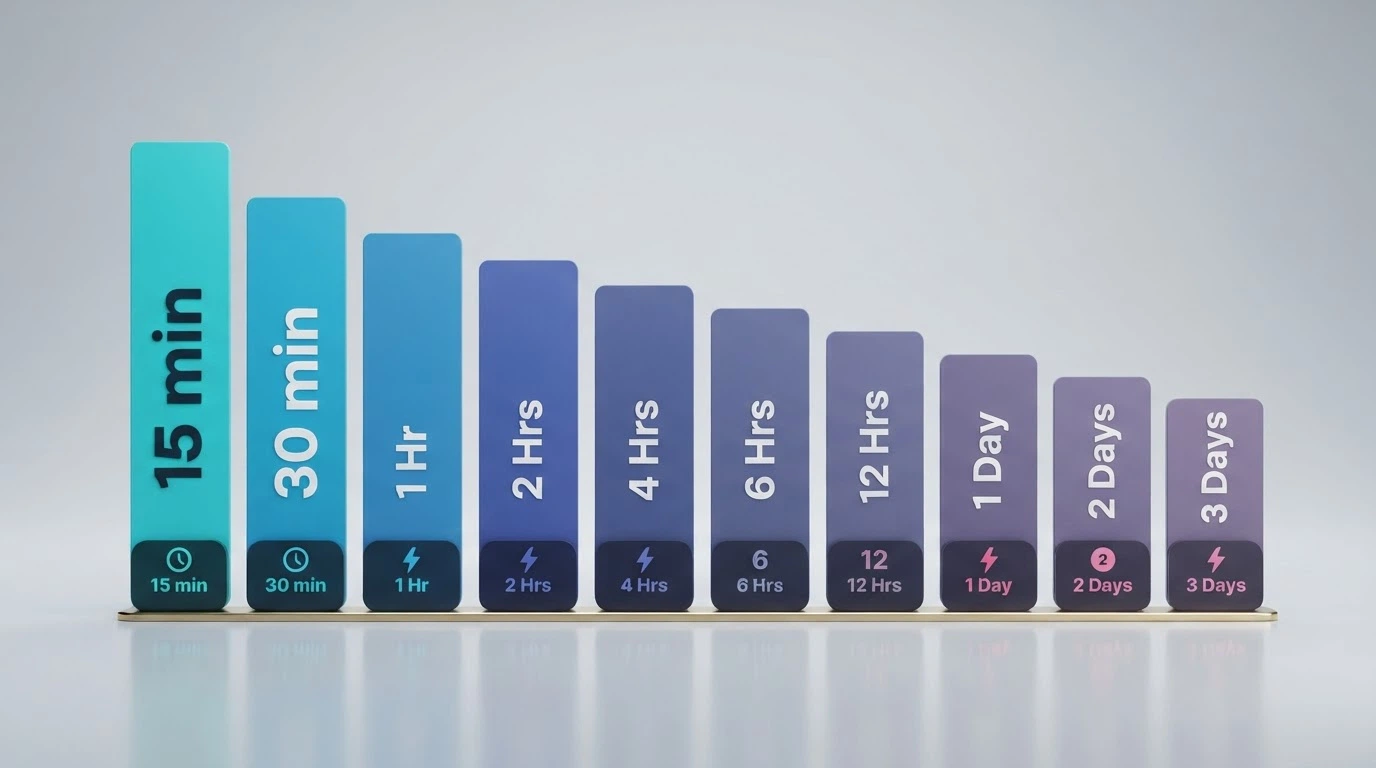
The marketing reads simply. Instant access. No friction. Winnings in your account today. The tested numbers are slower. At the fastest crypto-friendly offshore sites, USDT on Tron settles in 0.2 to 8 hours, with network fees under A$2. PayID runs 24 to 48 hours end-to-end, of which 12 to 18 hours is operator-side processing. Card withdrawals take 3 to 5 business days. Bank wires run 3 to 10 business days, with receiving-bank fees of A$25 to A$40 per transfer.
The friction sits in three predictable places. Know-your-customer checks stall the first payout while the operator verifies identity, source of funds and bank account ownership. Pending periods run while the operator holds the request, sometimes as long as 48 business hours. Wagering locks trap a bonus balance inside turnover requirements, and only the real-money remainder is withdrawable while a bonus is active. Incomplete KYC is the single largest cause of withdrawal delays at offshore sites serving Australians.
The gap between promise and terms is structural. “Easy” in Australia means offshore, because nothing else exists. The site that promises instant payouts in its banner is the same site whose terms page lists a 48-business-hour processing window, a daily withdrawal cap, and a bonus that converts only after a 35x or 40x playthrough. The promise is not a lie. It is a partial truth told above a more complicated paragraph.
Real-Money Casino Basics — What You’re Actually Playing For
The real-money flow at an Australian-facing offshore casino runs in three stages. Deposit in AUD, sometimes directly, more often via crypto or an e-wallet because credit cards and credit-related products have been banned for licensed wagering since 11 June 2024 and most offshore sites follow suit to look compliant. Play through the terms of whatever welcome offer you accepted — and you accepted one, because nearly every site requires it to unlock the full bonus balance. Reach the cashout screen.
That last stage is the moment everything the marketing promised gets tested. Withdrawable balance is real-money balance minus bonus balance minus any locked funds minus any amount above the daily or weekly cap. The minimum cashout at most AU-facing offshore casinos sits at A$20, sometimes higher; at Fair Go, A$100. The processing window runs while the operator decides whether to release the funds. The rail then carries the money to your bank or wallet. None of these stages can be skipped, and each carries a cost — in time, in fees, in what gets left behind.
Winnings are not assessable income under section 6-5 of the ITAA 1997, and losses are not deductible under section 8-1, unless a person is carrying on a business of betting or gambling. That is one of the few clean lines in the offshore arrangement — the ATO does not tax a casual punter’s win — but it does nothing for the operator that refuses to pay out.
Why Your 2026 Payout Speed Depends on the Rail, Not the Casino
The single biggest determinant of how long winnings take to arrive is the payment method the player uses to cash out, not the operator they chose. Two players at the same site, on the same day, asking for the same amount, will wait different lengths of time if one has chosen USDT and the other has chosen a bank wire. Operator processing is added on top of rail settlement, so a fast rail with a slow operator still ends up slower than a slow rail with no processing delay.

Crypto sits at the top of the speed table. USDT on Tron and on Solana settle in under five minutes at the fastest tested sites, network fees under A$2. Ethereum and Litecoin land within 5 to 30 minutes. Bitcoin requires 3 to 6 network confirmations, which adds 30 to 60 minutes or more. PayID — the real-time Australian bank transfer rail operated under the New Payments Platform — is the fastest fiat option; most transfers arrive within an hour, though the typical 24 to 48 hour end-to-end figure reflects operator-side processing more than the rail itself. Cards sit behind PayID. Bank wires sit behind everything.
Withdrawal Speed by the Numbers — Crypto, PayID, Card and Wire Tested
| Payment Method | Typical Withdrawal Time | Fee to Player | Notes |
|---|---|---|---|
| Crypto (USDT TRC20, Solana) | 0.2–8 hours; under 5 min at fastest | Under A$2 | Network fee only; speed varies by operator KYC |
| Crypto (ETH, LTC) | 5–30 minutes | Under A$5 | Faster than BTC; less common at AU-facing sites |
| Crypto (BTC) | 30–60+ minutes | Under A$10 | 3–6 confirmations; widely accepted, slower than other coins |
| PayID | 24–48 hours end-to-end | None typical | 12–18 hours is operator processing; the rest is bank batch window |
| Card (Visa, Mastercard) | 3–5 business days | None typical | Slowest commonly used method; subject to AU bank blocks from 2027 |
| Bank wire | 3–10 business days | A$25–40 receiving | Wild Fortune publishes 5–7 days; Stake/BC.Game 4–10 days; slowest legitimate rail |
The pattern across every operator tested: operator processing accounts for half or more of the wait on every fiat method. On PayID, 12 to 18 hours of a 24 to 48 hour wait is the operator sitting on the request. On cards, the operator’s release is followed by Visa or Mastercard’s settlement window, which the player cannot accelerate. The fastest operators cut their processing window to under an hour for verified accounts on crypto rails. The slowest sit at 48 business hours before they even hand the request to the network.
Deposit and Cash-In — How Your Money Gets There
The deposit side of the equation carries its own restrictions and tells. At Australian-facing offshore casinos, the common deposit methods are crypto, PayID, e-wallets (Skrill, Neteller, MuchBetter), Visa and Mastercard debit cards, and POLi — except POLi was decommissioned by ANZ on 30 September 2023 and is no longer available at any casino. The typical minimum deposit sits at A$20, sometimes lower with e-wallets.
The payment tells are revealing. Credit cards, credit-related products and digital currency have been banned as payment for online wagering since 11 June 2024 under the Interactive Gambling Amendment (Credit and Other Measures) Act 2023. An operator that fails to enforce the ban faces penalties of up to A$247,500. So an offshore casino that accepts credit cards or crypto from an Australian player is operating outside Australian rules on that front — not a feature, a tell. PayID and Osko are the legal AU rails for licensed wagering. BPAY, debit card and bank transfer are also permitted at licensed operators.
Bonus Balances Are Not Your Balance — Wagering, Lock-In and the Real Exit
A bonus balance is not withdrawable cash. The wagering requirement is what converts it, or traps it, and the terms that govern that conversion are set before the player deposits. The arithmetic runs simply: required turnover equals the bonus amount multiplied by the wagering factor. A A$500 bonus at 35x means A$17,500 in turnover before a single dollar of the bonus converts to withdrawable cash. At 40x, A$500 becomes A$20,000.
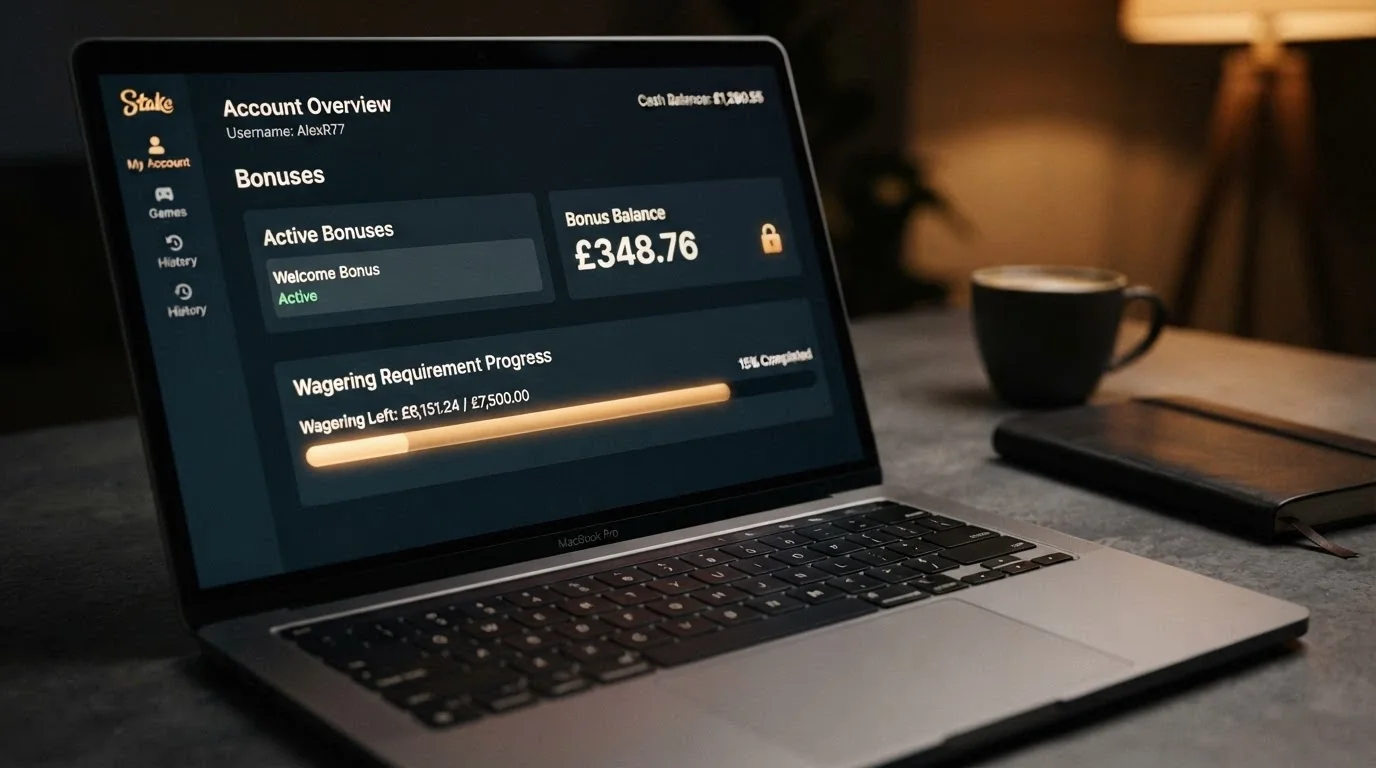
The featured set illustrates the spread. Skycrown carries the highest wagering multiple of the group at 40x on bonus funds. Royal Reels sits at 35x. Rainbet publishes a standard 1x turnover requirement — unusually low by industry terms. RocketPlay’s bonus validity runs five days from receipt with a maximum bet during wagering of A$7.50 — the page’s lowest — and a non-sticky structure that means real money is played first.
Non-sticky versus sticky is the second decision that matters. A non-sticky bonus lets the player withdraw any real-money winnings at any time; the bonus sits separately and converts only after turnover is met. A sticky bonus mixes the bonus and the real money into one balance that cannot be withdrawn until turnover is complete. Both can be cleared, but the non-sticky structure refunds a player’s own money first, which is the smaller of the two losses if the bonus fails to convert.
The marketing word for these offers is “free”. The arithmetic is not. A A$4,000 welcome package at 40x wagering does not deliver A$4,000 of withdrawable cash; it delivers a sum that requires A$160,000 in turnover to reach, with a finite window in which to clear it and a maximum bet that constrains the strategy. Read the terms. Calculate the turnover. Decide whether the bonus is worth the runway before the headline number does the deciding for you.
AU-Licensed Payout Routes vs Offshore Rails — What the Gap Actually Costs You
Licensed Australian wagering operators run on a small set of regulated payment rails — debit card, PayID and Osko, BPAY, bank transfer — and carry consumer protection obligations that offshore casinos do not. Offshore casinos accept crypto, e-wallets and sometimes credit products, and they offer no equivalent of the AU complaints and dispute resolution infrastructure. That is the surface gap. The structural gap is wider.
From 1 January 2027, banks and payment providers gain express authority to block transactions to illegal gambling operators. The Interactive Gambling Amendment (Gambling Reform) Bill 2026 — passed Parliament on 19 August 2026 — also introduces the AdStop register (a national wagering advertising opt-out administered by the ACMA, funded by a cost-recovery levy on wagering companies), tighter inducement rules and an expanded infringement window for ACMA. The Northern Territory’s 5% wagering tax and the state point-of-consumption tax of 10 to 15% apply to licensed operators only — offshore casinos pay neither. The bank blocking power is the most consequential change for an offshore player. The rail that works today may not work in 2027.
Our Top 10 Fast-Payout Offshore Casinos for Australian Players — 2026
Every operator below sits outside Australian law. No Australian online casino licence exists, and none of these brands holds one. They are ranked by tested payout speed where research carries a figure, by method support where it does not, and by transparency of terms where neither is available. Treat the table as a quick-reference tool, not as a recommendation — the protections a player expects at a licensed AU operator do not follow them to any of these sites.
| Operator | Welcome Offer (AUD) | Tested Payout Speed | Crypto Payout |
|---|---|---|---|
| Skycrown | A$4,000 + 350 free spins | Up to 48 business hours | Yes (multiple coins) |
| Royal Reels | A$500 (100% match) | 3–4 hours | 3–4 hours (BTC/ETH/LTC) |
| RocketPlay | A$1,000 (200% match) | — | Yes (BTC/ETH/LTC/DOGE/USDT) |
| Stake | — | 1–4 hours | Crypto-only |
| Fair Go | A$1,000 (five-tier) | 15–45 min business hours | 15–45 min (BTC/ETH/LTC) |
| Bizzo Casino | — | 2–24 hours | 2–24 hours |
| WinSpirit | — | — | — |
| Rainbet | — | Minutes to hours | Yes (multiple coins) |
| Scream Casino | — | — | — |
| Rocket Casino | — | ~6 hours (USDT TRC20) | ~6 hours |
Skycrown
A A$4,000 welcome package plus 350 free spins across multiple deposits, with a 40x playthrough on bonus funds — the highest wagering multiple of the featured set. Standard withdrawal processing runs up to 48 business hours from the moment of request, after which e-wallets clear same-day and bank or card withdrawals run 3 to 7 business days. The package is deposit-triggered and spans multiple deposits, so the headline figure is reached only across the full structure, not on the first deposit alone.
The 40x requirement is what a player actually pays here. A A$500 slice of the package at 40x means A$20,000 in turnover before that slice becomes withdrawable — and the bonus validity window the operator publishes does not extend that runway by much. Skycrown suits one punter. For everyone else the package costs more than the headline suggests.
Royal Reels
A 100% first-deposit match up to A$500 at 35x wagering, with a minimum qualifying deposit of A$10 and PayID and crypto payouts averaging 3 to 4 hours — the fastest PayID speed on the page. Withdrawal caps sit at A$9,000 per transaction, A$50,000 weekly for standard accounts, and unlimited for VIP Diamond tier players. The library carries 2,200+ pokies across multiple providers, broader than most of the featured set.
The cap is the constraint. A$50,000 a week sounds generous until a player hits a winning streak above that figure, at which point the operator pays the remainder in subsequent weeks — and the processing clock resets each time. Royal Reels fits low-to-mid stakes players. Higher-stakes players hit the cap before they hit the rail.
RocketPlay
A 200% match up to A$1,000 with a 5-day bonus validity window, a A$7.50 maximum bet during wagering — the page’s lowest — and a 1x deposit wagering requirement. The bonus is non-sticky, which means real money plays first and the bonus funds sit separately; a punter can withdraw any real-money winnings at any point without touching the bonus balance. Multi-crypto support covers BTC, BCH, ETH, LTC, DOGE and USDT, with EUR, USD, CAD and AUD also accepted. Withdrawal caps sit at A$9,000 per week and A$35,000 per month, with a minimum withdrawal of €25 or currency equivalent.
The 5-day validity is the constraint. A 200% match looks generous on paper; converting it requires turnover inside a window most players will not realise they have lost until it has closed. The A$7.50 maximum bet limits the strategies available during wagering — anything above that amount disqualifies the bonus. For a disciplined, low-stakes player who reads the terms, RocketPlay is workable. For anyone who does not, the bonus expires before it converts.
Stake
Crypto-only with tested payouts of 1 to 4 hours and no PayID or card support — a pure crypto play for an Australian punter already holding digital assets. Stake is licensed in Curacao, supports BTC, ETH, LTC, USDT and a wide range of other coins, and does not offer a traditional welcome match bonus in the way the rest of this set does; the brand runs on promotions and races rather than a deposit-triggered welcome package. There is no PayID option and no bank wire, so the rail question is settled before the player deposits.
Stake is the obvious fit for a crypto-funded Australian punter. AUD-funded players need not apply.
Fair Go
A Curacao eGaming-licensed RTG specialist under Deckmedia N.V., with 280 games, a five-tier A$1,000 welcome package (100% deposit match up to A$200, redeemable five times) and crypto withdrawals that clear in 15 to 45 minutes during business hours and 2 to 4 hours on weekends. Bitcoin, Ethereum and Litecoin are supported. Minimum withdrawal is A$100 — the page’s highest — and the maximum is not published by the operator.
The A$100 minimum is what a low-stakes player notices first. It pushes the operator out of reach for anyone playing in small units, and it means Fair Go is built for players whose session balance routinely clears A$100. The 280-game library is narrower than most of the featured set — RTG only — which matters less for a player who already knows what they want to play. Fair Go is fast and simple above the A$100 minimum. Below that, the minimum is the reason it does not feel easy.
Bizzo Casino
A traceable Curacao licence (Antillephone N.V., licence 8048/JAZ2017-067) under TechSolutions Group N.V., running on the SoftSwiss platform with 100+ providers. Crypto payouts clear in 2 to 24 hours depending on KYC status, and fiat payouts via Skrill, Neteller or MuchBetter can be blocked by some Australian banks. Withdrawal caps are restrictive and EUR-denominated in the operator’s terms.
The licence is traceable, which is more than most of the set offers — a player can look up Antillephone N.V. and find a real licence number behind the brand. The fiat blocking risk is the operational concern. Some AU banks flag and decline card and e-wallet payments to known offshore casino merchants, and the player discovers this at the point of attempted withdrawal rather than at deposit. For a crypto-funded player, Bizzo is straightforward. For a fiat-funded player, the bank block risk makes the rail uncertain before the rail is even chosen.
WinSpirit
A 200% welcome bonus plus 25 free spins, with ongoing cashback and daily bonuses through a loyalty program. Payout speed, withdrawal limits, and the licence behind the brand are not publicly confirmed by the operator this run — every gap in this profile reflects what the operator’s own site did not publish, not what was chosen to omit.
The bonus structure is the headline; the operating detail is not there to evaluate it against. A 200% match is competitive by the standards of this set, but without a published wagering multiple, validity window, max bet, or withdrawal limit, a player cannot calculate the real cost of accepting it. For a punter comfortable funding without reading the exit terms, WinSpirit remains an option. For everyone else, the gaps are the message.
Rainbet
A Curacao eGaming-licensed operator with the lowest barrier to exit of the featured set: a A$15 minimum withdrawal, no maximum on crypto, a standard 1x turnover requirement, and payouts within minutes to a few hours once Level 1 KYC is complete. E-wallet and bank alternatives are listed, though crypto is the rail on which Rainbet performs best. The 1x turnover figure is unusual by industry terms — most welcome packages run 30x or higher.
Rainbet is the cleanest exit on the page for low-stakes, crypto-funded play. The trade-off is that the bonus amount itself is modest and the operator’s promotional structure emphasises races and ongoing promos rather than a headline welcome figure.
Scream Casino
A top-20 Australian-market brand by tracked traffic and revenue, sitting at 0.99% market share — the brand Australian players reach often enough to merit inclusion, even if the operating details are not on the public record this run. Payout speed, withdrawal limits, bonus terms, and the licence behind the brand are not confirmed.
Scream Casino carries brand recognition. Operating detail is the missing piece. For a punter who treats an offshore casino as a low-stakes, disposable-time expense and does not need to know the exit conditions in advance, the brand recognition has weight. For one who needs to see terms and licence before they deposit, it is a known name without a known operating profile.
Rocket Casino
USDT on Tron tested at approximately 6 hours via third-party payout data, with PayID also supported — a fiat-and-crypto dual-rail operator. Withdrawal caps, bonus terms, and licence status are not confirmed by the operator this run.
The 6-hour USDT figure sits in the middle of the crypto speed range, competitive without being the fastest on the page. PayID support is a useful complement for a punter funding in AUD. Rocket Casino is a usable dual-rail option. The gap is the terms.
Pokies, Slots and Live Tables — Where the Fastest Cashouts Actually Happen
The game a player plays does not set their withdrawal speed. The casino’s payment rails do. Game type shapes how and when a player reaches the cashout screen — pokies run as fast, low-stakes sessions that clear bonuses quickly; live casino carries higher per-hand stakes and slower bankroll turnover; slots sit between — but the rail that carries winnings out is the same rail regardless of what was played.

Pokies are the dominant AU offshore product. Every operator on the featured set carries them. Live casino is offered by most, though none of the competitor pages publish live-specific payout data, and live winnings exit through the same rails as pokie winnings. International slot titles from major providers — the same content found at licensed offshore markets in Europe and elsewhere — are widespread across the featured set.
Online Pokies — Australia’s Default Casino Game
Pokies is the Australian term for slot machines, and online pokies is what Australian players search for most. Every offshore casino on this page carries them — RTG specialists, SoftSwiss platforms, multi-provider aggregators all stock the same fundamental category. None of the competitor pages in this niche publish per-title RTP, volatility or max-win figures for the pokies they feature, which leaves a gap between what a player wants to know about a game and what the affiliate pages give them.
The product is prohibited in Australia under the Interactive Gambling Act 2001, which makes online casino games, online pokies and in-play betting an offence to supply to a person in Australia. The offshore operators stock them anyway, and the affiliate pages catalogue them without flagging that status. The gap is not in the games themselves. It is in the metadata the sites do not publish.
Online Slots — Global Titles, Same Payout Rails
The international slot titles on offshore casinos — the same games available at licensed operators in Europe — use the same withdrawal rails as pokies. The game changes. The payout speed does not. A Pragmatic Play title and a Betsoft title both exit through whatever rail the player chose at the cashout screen, with whatever processing window the operator applies.
The AU reader encounters “pokies” and “slots” interchangeably on offshore sites. The terminology does not change the cashout — it changes the search term a player used to reach the site. For the purposes of withdrawal speed, the category is irrelevant. The rail is the variable that matters.
Live Casino Tables — Higher Stakes, Slower Exits
Live dealer games carry higher per-hand stakes and larger session balances than pokies, which makes the operator’s withdrawal limits and processing speed more consequential rather than less. A live blackjack session that runs for two hours at A$25 a hand is not unusual, and a session that ends above the operator’s daily cap cannot be withdrawn in one transaction regardless of the rail chosen.
None of the competitor pages in this niche publish live-specific payout data, and research does not carry it either. The live winnings exit through the same rails as pokie winnings — PayID, crypto, cards, e-wallets — at the same operator-defined speeds. The category is a stake-level choice, not a payout choice. For a live player, the constraint is the operator’s weekly cap and processing window, not the speed of the rail underneath.
The Legal Reality — Online Casino Is Prohibited in Australia and Here Is What That Means for Your Money
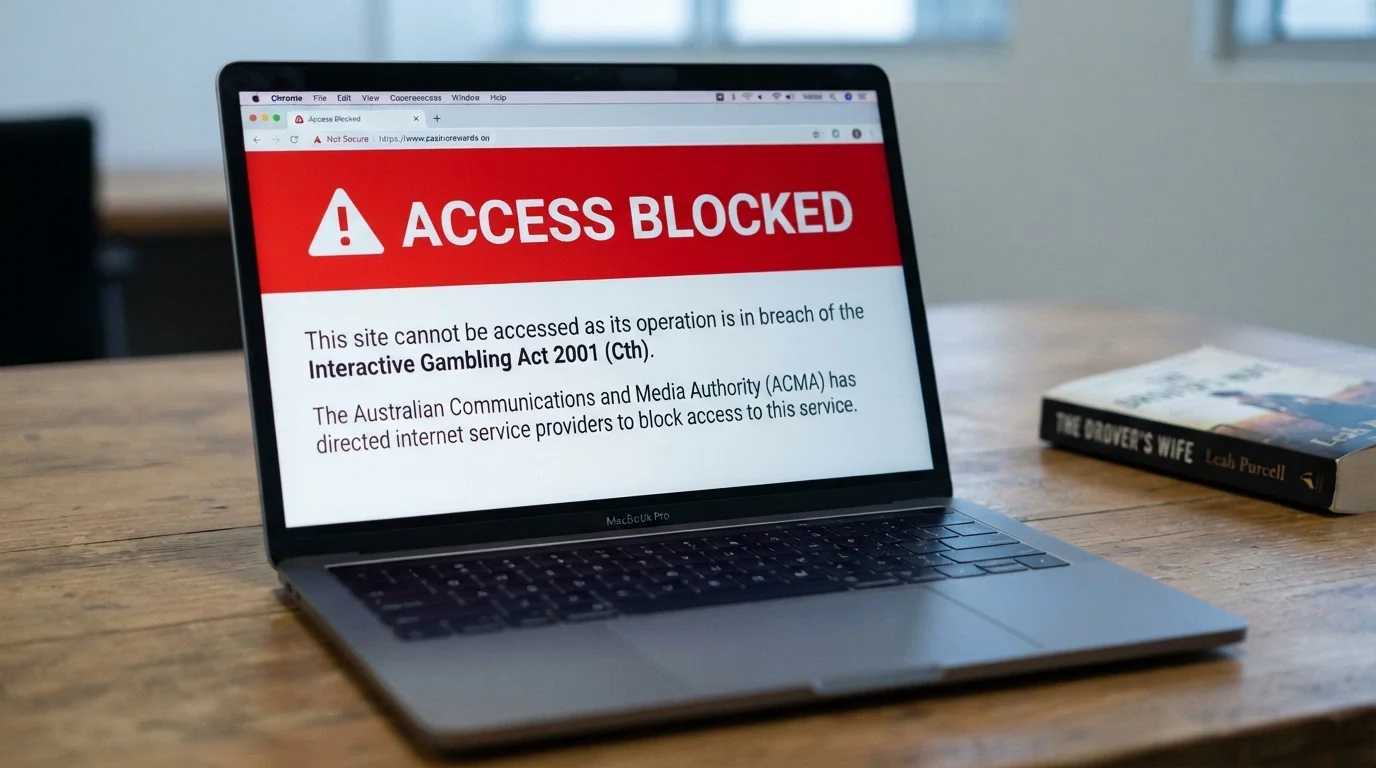
Every casino on this page operates outside Australian law. The Interactive Gambling Act 2001 makes it an offence to provide online casino games, online pokies or in-play betting to a person physically in Australia. The Act does not criminalise the player — it targets the provider. The ACMA enforces the prohibition: it has had 1,564 illegal gambling and affiliate websites blocked by Australian ISPs since November 2019, and more than 225 illegal services withdrew from the Australian market after enforcement was strengthened in 2017.
The 2026 reform — the Interactive Gambling Amendment (Gambling Reform) Bill 2026, passed on 19 August 2026 and commencing 1 January 2027 — tightens enforcement further. Banks and payment providers gain express authority to block transactions to illegal gambling operators. The ACMA’s window for issuing infringement notices extends from 12 months to 24 months. The AdStop register comes into operation, funded by a cost-recovery levy on wagering companies. Direct marketing of inducements is prohibited for 14 days after sign-up, for 90 days after BetStop deregistration, and indefinitely for at-risk customers. The wagering advertising cap drops to three ads per hour between 6:00 am and 8:30 pm, with a live-sport blackout running 15 minutes before to 5 minutes after each event. Athletes, celebrities and influencers are barred from promoting wagering products.
For an offshore player, the most consequential of these changes is the bank blocking power. The crypto or card deposit that clears today may not clear in 2027 — not because the casino changed, but because the bank did.
What the Interactive Gambling Act Actually Says
The Interactive Gambling Act 2001 makes it an offence to provide a prohibited interactive gambling service to a person in Australia. The prohibited services are online casino games, online pokies and in-play betting on a sporting event once it has started. The Act was strengthened in 2017 by the Interactive Gambling Amendment Act 2017, which extended the prohibition to cover services offered to Australians from any jurisdiction, not only from Australia itself.
What remains legal under Australian law: wagering on races and sporting events placed before the event begins, through state or territory-licensed operators (the Northern Territory Racing and Wagering Commission is the de facto national licensor for online wagering); lotteries and keno. Online casino games are not in this list. No state or territory issues a licence for them. The structural absence is the central fact — there is nothing for an operator to apply for, because no application path exists.
The enforcement model targets the provider, not the player. The individual Australian player is not prosecuted under the IGA. The Act and its penalties are aimed at the operator supplying the prohibited service, and at the ACMA’s enforcement actions against that supply. That structure protects the player from criminal liability. It does not protect the player’s money.
Licences, Registries and Why “Curacao” Appears on Every Site
No Australian online casino licence exists. Every operator on this page is licensed offshore, and Curacao is the dominant jurisdiction. Bizzo Casino carries a traceable licence — Antillephone N.V., number 8048/JAZ2017-067, under TechSolutions Group N.V. Fair Go is licensed by Curacao eGaming under Deckmedia N.V. Stake, Skycrown and Rainbet operate under Curacao frameworks whose details are not always fully confirmed on the operator’s own site. Several — Royal Reels, RocketPlay, WinSpirit, Scream Casino, Rocket Casino — do not publish a verifiable licence number on their public-facing pages this run.
The credit-card-and-crypto ban is a regulatory tell that explains why offshore sites accept them. The ban, in force since 11 June 2024, makes it an offence for a licensed wagering operator to accept either as payment; an operator that fails to enforce it faces penalties of up to A$247,500. A site that accepts credit cards or crypto from an Australian player is operating outside Australian rules on that front — a tell, not a feature.
The ACMA’s enforcement record is the consequence. 1,564 illegal gambling and affiliate websites have been blocked since November 2019. 225+ illegal services withdrew from the Australian market after 2017. The 1,564 figure is cumulative; the sites change, but the pattern is consistent. An offshore casino serving Australian players can be blocked at any time, and a player with a balance on the blocked site has limited recourse.
Offshore vs Licensed — Every Protection You Give Up
The gap between a licensed Australian wagering operator and an offshore casino is not a marketing distinction. It is a structural one. A licensed AU wagering operator is connected to BetStop — the National Self-Exclusion Register. One registration excludes the player from every licensed online and phone wagering service in Australia. Offshore casinos are not connected, and they keep accepting a self-excluded person’s money.
A licensed AU wagering operator is subject to Australian consumer protection law and to the dispute resolution mechanisms of the relevant state or territory regulator. An offshore operator is not. A player whose withdrawal is refused at an AU-licensed operator can escalate through the regulator. A player whose withdrawal is refused at an offshore casino can complain to the operator’s licensing body — often in a jurisdiction where the operator’s response is the same private decision it made in the first place.
The offshore gap also includes the bank blocking power from 1 January 2027. The rail that works today may not work in 2027 — and the offshore operator has no obligation to refund a failed transaction if the bank declines it. The site can also be ACMA-blocked with the player’s balance on it, and the offshore operator has no obligation under Australian law to refund the balance in that scenario either.
Playing Offshore Means Playing Without a Safety Net — Responsible Gambling in an Unregulated Space
Australia has built a significant help infrastructure — BetStop, the National Gambling Helpline, Gambling Help Online, state-based counselling services — but none of it reaches an offshore casino account. The protection that works at a licensed TAB account does not follow the player to an offshore casino. An Australian punter who wants to set a deposit limit, take a break, or self-exclude has to do so through the offshore operator — and the offshore operator has no obligation to honour any of it.
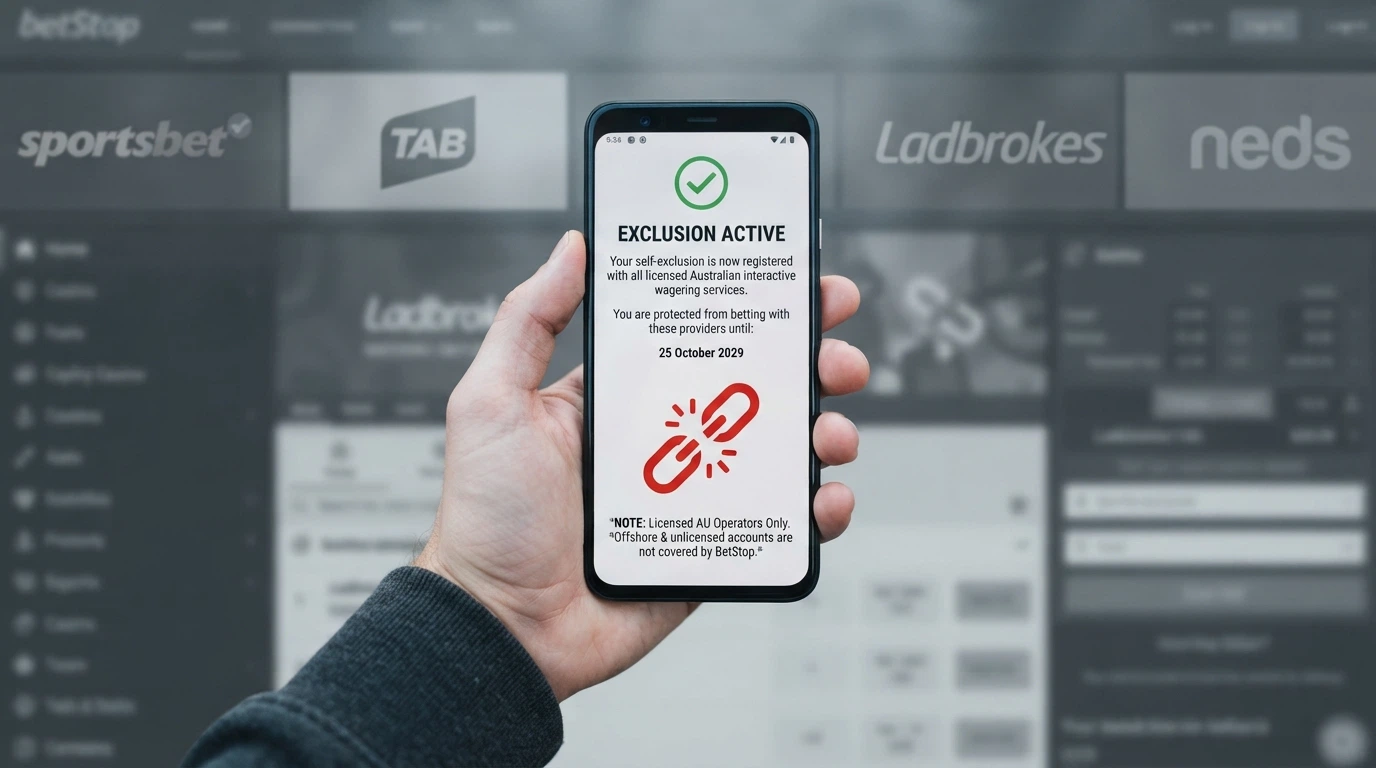
The practical advice for a player who chooses to play offshore anyway: set your own limits before you deposit, because the operator will not set them for you. The licensed wagering framework imposes default deposit ceilings and activity statements; the offshore framework does not. The personal discipline is the only safeguard.
BetStop Cannot Reach an Offshore Casino
BetStop — the National Self-Exclusion Register — is the single most important player-protection tool in Australia. One registration excludes the player from every AU-licensed online and phone wagering service. As at 31 July 2026, 67,480 registrations had been recorded in three years of operation, of which 41,290 exclusions were still active. 78% of registrants were under 40, and 38% chose lifetime exclusion. The numbers reflect a population that is using the register; the register does its job at the operators it covers.
It does not cover the operators on this page. BetStop binds Australian-licensed wagering services only. An offshore casino is not licensed in Australia, is not connected to the register, and will keep accepting a self-excluded person’s money. A player who has registered with BetStop and then opens an offshore account has not protected themselves against the offshore account. The offshore account is a separate account with a separate protection regime — which is to say, none.
The Numbers — How Many Australians Are Harmed by Gambling
The prevalence data gives the harm its scale. About 2.1% of Australian adults — roughly 430,000 people — experience problem gambling, per the Australian Institute of Health and Welfare’s 2022 figure. A wider Roy Morgan survey puts some level of gambling harm at 15.1% of the adult population — an estimated 3.32 million people — as of March 2026.
The trend line is concerning. Risky gambling in Australia rose from 13.7% in 2024 to 19.4% in 2025, an increase of more than five percentage points and almost double the COVID-era baseline. Online participation has grown in parallel — 56.1% of Australians who gambled in the past 12 months reported mainly participating online, per ANU POLIS Centre data from January 2025. The harm extends beyond the gambler: approximately 5.9% of Australian adults reported being harmed by another person’s gambling in the past 12 months, and on average each gambler at the highest risk levels affects six other people.
The Australia Institute’s 2026 estimate puts the population affected by their own or another person’s gambling at 3.29 million Australians aged five and over annually. That figure includes children. The number is the reason the help infrastructure exists, and the reason the offshore gap matters — the help does not reach an offshore account.
Limits, Self-Exclusion and Where to Get Help
The National Gambling Helpline — 1800 858 858 — is free, confidential, and staffed 24 hours a day, seven days a week. Gambling Help Online, at gamblinghelponline.org.au, provides live chat and counselling. Online gambling now accounts for about 45 to 50% of calls to Gambler’s Help and Gambling Help Online, a figure that has significantly increased. BetStop, at betstop.gov.au, provides self-exclusion from every AU-licensed wagering service. Crisis support is available through Lifeline on 13 11 14 and the Suicide Call Back Service on 1300 659 467.
The practical gap for an offshore player is the absence of operator-enforced limits. There is no federal deposit, loss or stake ceiling for online gambling in Australia — not because the regulator chose to leave them uncapped, but because the product those ceilings would govern is banned outright. The licensed operator imposes default ceilings as a condition of holding a licence. The offshore operator imposes nothing. A punter who plays offshore must set their own limit and enforce it themselves, because no one else will.
How We Tested and Ranked These Fast-Payout Casinos
Four sources informed the ranking below. Operator terms and conditions pages supplied the welcome bonus terms, wagering requirements, bonus validity windows, max bet during wagering, and withdrawal limits. Third-party tested payout data — primarily PayoutVerdict.com, GamblingInsider.com and CardPlayer.com — supplied the rail-level speed figures that anchor the payment method table and the per-operator speed where available. Regulator registries were consulted for licence traceability — Antillephone N.V. for Bizzo, Curacao eGaming for Fair Go, the ACMA register of blocked services for the enforcement context. Operator-specific gaps are marked as gaps, not filled with assumed figures.
The ranking criteria, in order: tested payout speed where research carries a figure; method support breadth where it does not; withdrawal-limit transparency as a tiebreaker; licence traceability as a final differentiator. Welcome bonus size was not used as a ranking criterion — the arithmetic on a A$4,000 package at 40x and a A$500 package at 35x does not favour the larger figure once turnover is calculated. Operators with no tested payout data and no published licence were ranked by AU market presence alone.
What was not tested: every withdrawal scenario at every operator, every deposit method combination, every customer-service interaction, every KYC failure mode. The data carries tested averages for popular operators and methods, not a guarantee of every player’s experience. The 1,564 illegal gambling websites blocked by the ACMA since November 2019 form the context for this ranking — every operator on the page is, by definition, the kind of operator the ACMA is empowered to block. The ACMA pursues providers of prohibited interactive gambling services. That is what the ranking sits inside.
Your Money, Your Risk — What to Do Before You Deposit at an Offshore Casino
Five checks follow from the tested speeds, the prohibition and the offshore gap. Run them before you fund an account, because after you deposit the terms are locked in and the protections do not follow.

Check the withdrawal terms before you deposit. The minimum cashout, the daily and weekly caps, the bonus-related withdrawal ceiling, the method restrictions. A A$50,000 weekly cap at Royal Reels is generous until the day a player wins more than that in a session. An A$100 minimum at Fair Go is irrelevant until a player is sitting on A$85 in winnings and discovers they cannot withdraw it. The terms page is where the cashout experience actually lives.
Complete KYC early. The single largest cause of withdrawal delays at offshore sites is incomplete KYC. The first withdrawal is the one the operator checks most carefully; a player who has uploaded identity, address and source-of-funds documents before requesting a withdrawal will wait less than a player who uploads them after. The verification exists for anti-money-laundering compliance. The cost of not doing it is paid in time.
Understand the legal reality. No Australian consumer protection applies at any of these operators. BetStop does not reach them. The ACMA can block them. The bank can decline the transaction from 1 January 2027. If the operator refuses a withdrawal, the only complaint path is the operator’s own licensing body — and the operator’s response is the same private decision that started the dispute. A player who cannot accept that structure should not deposit.
Know which payment rails work today and which may not work in 2027. Crypto works. PayID works for now. Cards work for some banks and not others. Bank wires carry receiving fees of A$25 to A$40 and a wait of up to 10 business days. The rail chosen today is the rail that must clear tomorrow, and the rail landscape is shifting under the 2026 reform.
Set a personal deposit and loss limit because the site will not enforce one. The licensed wagering framework imposes default ceilings as a condition of holding a licence. The offshore framework does not. A punter who plays offshore sets their own ceiling and enforces it themselves. The 2026 reform does not change that for offshore operators; the bank blocking power might, by closing the rail mid-month. That is a side-effect of enforcement, not a feature of player protection.
Frequently Asked Questions
How long does a PayID withdrawal take from an online casino in Australia?
PayID withdrawals at AU-facing offshore casinos typically take 24 to 48 hours end-to-end, of which 12 to 18 hours is operator-side processing. The remainder is the bank’s incoming PayID batch window. At the fastest sites the operator processing is shorter; at the slowest it stretches to the full 48 hours before the request is released to the rail.
Why does my first casino withdrawal take longer than subsequent ones?
The first withdrawal triggers the operator’s full KYC review — identity, address, source of funds and bank account ownership. Subsequent withdrawals at the same operator pass through a lighter check, and the rail-only wait applies. Completing KYC before requesting the first withdrawal shortens the wait.
What happens if an offshore casino refuses to pay out my winnings in Australia?
The player has no Australian consumer protection recourse. The only complaint path is the operator’s licensing body, often in Curacao. The operator’s response is the same private decision that started the dispute, and the operator holds the funds during the process. ACMA enforcement targets the provider, not the player’s individual claim.
Do Australian online casino withdrawals have a minimum amount?
Yes. The typical minimum at AU-facing offshore casinos is A$20, with variations — Rainbet sets A$15, Fair Go sets A$100, Royal Reels sets A$10 as the qualifying deposit minimum. Players should check the operator’s published minimum before depositing, because a small session balance can sit below the withdrawal threshold.
Can Australian banks block my casino withdrawal or deposit?
Some already do, particularly for fiat payouts from offshore operators. From 1 January 2027, banks and payment providers gain express authority to block transactions to illegal gambling operators under the 2026 reform. A transaction that clears today may not clear in 2027, and the bank — not the casino — makes that decision.