
Crypto Casinos for Australians: What the Offshore Market Actually Looks Like
 Available in AU
Australians deposited an estimated A$36 billion into gambling between March 2025 and March 2026 — the highest per-capita figure of any country. Crypto casino dollars sit inside that sum, and every one of them went to an offshore operator offering a product that no licence in Australia permits. There is no Australian-licensed online casino. There cannot be one: the Interactive Gambling Act 2001 prohibits the product federally and in every state and territory. The crypto payment ban that took effect on 11 June 2024 closed the only legal loophole that touched the licensed wagering sector — and the offshore market filled the vacuum that remained.

This page is the comparison a player actually needs. It ranks the offshore crypto casinos that hold the largest share of Australian-adjacent traffic, names the enforcement numbers behind the prohibition, breaks down what a welcome bonus really costs after wagering requirements, and explains how fast crypto withdrawals actually arrive — measured, not promised. The page reads as a ranking because that is what readers came for. It also reads honestly about the legal reality, because no offshore casino can offer an Australian player the protections that BetStop, the ACMA complaints process, or a licensed operator’s dispute resolution provide.
Verified against ACMA enforcement data and the Interactive Gambling Act 2001 as of 18 October 2026.
Table of Contents
- What a Crypto Casino Actually Is — and Why Australians Use Them
- Why Your Crypto Deposit Is a Regulatory Tell, Not Just a Payment Method
- The Legal Reality: Every Crypto Casino You Access Is Offshore and Unlicensed
- Top 10 Crypto Casinos for Australian Players in 2026
- How to Tell a Legitimate Crypto Casino from a Trap
- Why That Welcome Bonus Is Smaller Than It Looks
- How Fast Your Crypto Withdrawal Actually Arrives
- Crypto Pokies Australians Are Actually Playing in 2026
- New Crypto Casinos in 2026: Fresh Sites Worth a Look
- Staying in Control When the Safety Net Doesn’t Reach Offshore
- How We Evaluated These Crypto Casinos
- What This Means for Your Money: Offshore Crypto Casinos Are a Risk You Choose
- Frequently Asked Questions
What a Crypto Casino Actually Is — and Why Australians Use Them
A crypto casino is an online gambling site where deposits, gameplay stakes and withdrawals run through cryptocurrency rather than fiat currency. The distinguishing features are practical, not decorative: blockchain settlement instead of bank rails, provably fair verification on certain games, and a deposit path that does not pass through a card processor. The Australian player’s relationship with the genre is unusual because the Australian licensed market simply does not offer it.
Australians turn to offshore crypto casinos for three reasons that recur across competitor research, and one reason that never appears in marketing. Speed is the first — a USDT TRC-20 transfer confirms in under two minutes, and a Bitcoin Lightning payment settles in under five seconds. Privacy is the second — many offshore sites allow email-only registration and do not request identity documents until a withdrawal threshold is reached. Bonus size is the third — the headline numbers at offshore crypto casinos reach A$30,000, well past anything offered by Australian-licensed wagering operators. The fourth reason, the one no operator advertises, is access: there is no licensed alternative, so a player who wants online pokies or live casino games is choosing between offshore and nothing.
The trade-off is everything those features cost in return. No offshore crypto casino offers BetStop coverage. No offshore operator is subject to Australian consumer law. No offshore site can be compelled by ACMA to pay out a disputed balance — ACMA’s power is to block the site, which returns nothing to the player. Offshore casino play sits in a permission gap: not criminalised for the individual, but fully outside the regulatory frame that Australian gambling operates inside.
The Difference Between a Crypto Casino and a Regular Online Casino
The technical differences between a crypto casino and a fiat online casino are sharp at the edges, with a soft middle. Deposit rails diverge first: crypto casinos accept Bitcoin, Ethereum, USDT and Litecoin directly to a wallet address, while fiat casinos route through PayID, cards or bank transfer. POLi, the instant bank-deposit service that Australian players used for years, was decommissioned on 30 September 2023 — so AUD deposits at offshore sites now run through PayID, cards or crypto.
Settlement speed diverges most visibly. A Bitcoin on-chain transfer costs A$1 to A$5 and confirms in 10 to 30 minutes. A Bitcoin Lightning payment settles in under five seconds for less than one cent. USDT on the TRC-20 network and Litecoin both confirm in under two minutes. The contrast against fiat rails is stark: a card deposit is instant but a card withdrawal takes three to five business days; a bank transfer is slower in both directions. Crypto reverses that asymmetry — deposits and withdrawals move at blockchain speed.
Provably fair verification is the third difference and the genuinely crypto-native one. The mechanic combines a server seed, a client seed and a nonce, hashed and committed before play, then verifiable after each round by the player. It is a trust tool that fiat casinos do not have, because fiat operators cannot expose their random number generation without breaking terms with their game providers.
Custody is the fourth — and the most uncomfortable. A fiat casino holds deposits in a bank account under a corporate entity; a crypto casino holds deposits in a hot wallet controlled by the operator. Self-custody is possible only if the player withdraws to their own wallet between sessions, and most players do not. The practical effect: a crypto casino account is, technically, an IOU from an offshore company denominated in a volatile asset. That is not a deal-breaker — it is just a different shape of trust.
Why Australians Keep Turning to Offshore Crypto Casinos
The Australian licensed market does not offer the product. Online casino games, online pokies and in-play sports betting are prohibited federally under the Interactive Gambling Act 2001, and no state or territory issues a licence for them. Licensed Australian wagering operators are barred from accepting crypto under the Interactive Gambling Amendment (Credit and Other Measures) Act 2023, which took effect on 11 June 2024 and carries penalties of up to A$247,500 for breaches. The result is a closed door with one obvious gap: every offshore casino accepting Australian players sits in that gap.
The gap exists because the IGA targets the provider, not the player. No Australian has been prosecuted for accessing an offshore casino. The practical consequence — and the one that drives Australian traffic to offshore sites — is that prohibition does not equal prevention. A player who wants to play online pokies from Australia in 2026 has, as a matter of law and of marketplace fact, exactly one option: an offshore operator offering an unlicensed, prohibited product.
The motivation mix is consistent across competitor research and player surveys. Privacy — no Australian bank statement, no credit card trail — matters to a meaningful slice of players. Speed matters to another slice, especially those who have waited five business days for a withdrawal from a fiat offshore site and want to know if crypto is faster. Bonus size matters to a third slice — A$30,000 headline offers simply do not exist in the licensed Australian market. And access — the absence of a licensed alternative — is the background condition that makes all three motivations lead to the same destination.
Why Your Crypto Deposit Is a Regulatory Tell, Not Just a Payment Method
The Interactive Gambling Amendment (Credit and Other Measures) Act 2023 banned credit cards and digital currency as payment for licensed online wagering, commencing 11 June 2024. The ban applies only to operators licensed in Australia. An Australian who is asked for a crypto deposit by a gambling site is being served by someone outside the Australian rules. The payment method is itself a tell.
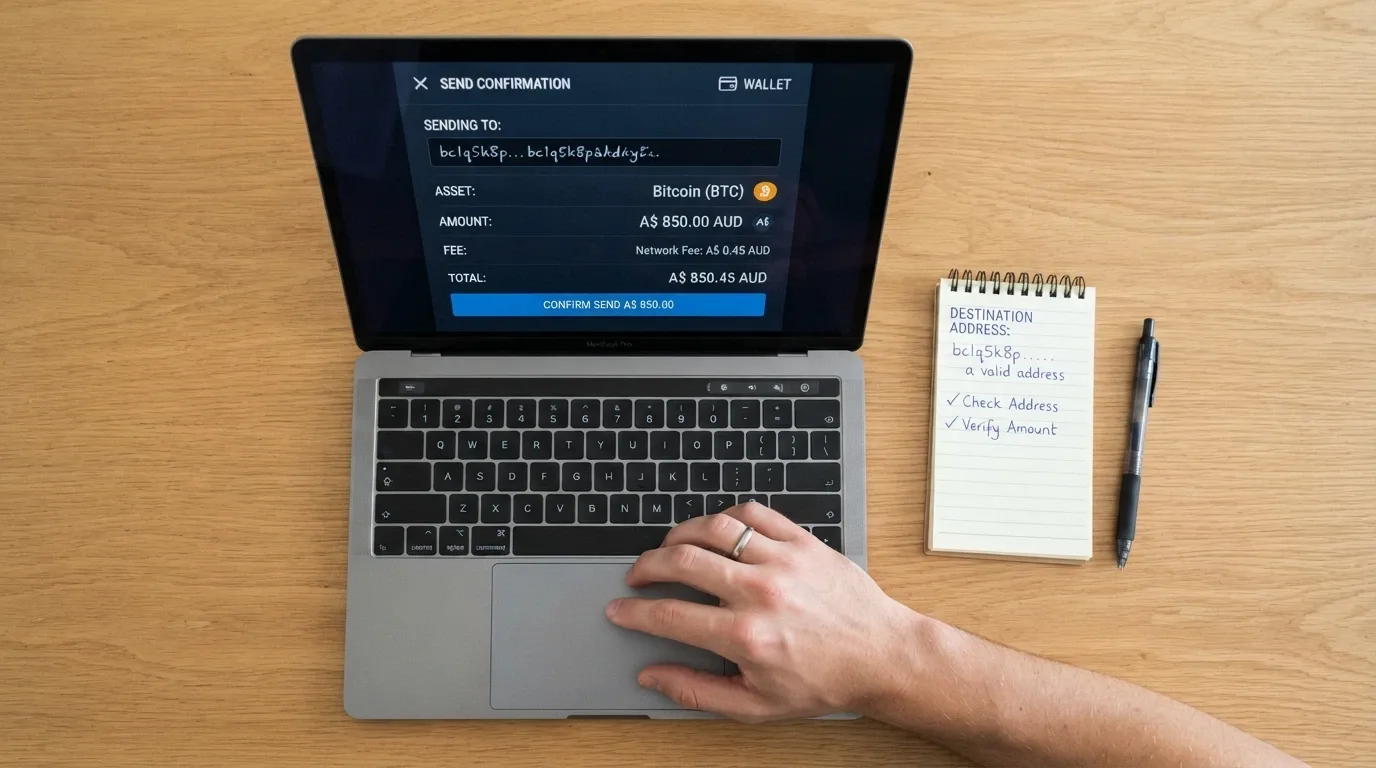
Three layers follow. First, the prohibition has teeth: operators that breach the ban face penalties of up to A$247,500. Second, the prohibition has limits: it does not reach offshore operators, who set their own payment policies. Third, the prohibition has a consequence for the player — every crypto casino an Australian accesses is, by construction, unlicensed under Australian law. The deposit rail is the diagnostic.
The coins that Australian-facing offshore casinos actually accept are predictable. Bitcoin and Ethereum are universal. USDT on the TRC-20 network is the practical favourite for Australian players because TRC-20 confirmation is fast, fees are negligible, and the coin is pegged to the US dollar — eliminating the volatility risk that makes Bitcoin deposits awkward for a casual player. Litecoin rounds out the standard four. Coins outside that quartet are rarer, and their acceptance is usually a feature of newer operators trying to differentiate.
No-KYC variants of offshore crypto casinos are real but never absolute. Email-only registration is widely available, and several operators do not request identity documents at deposit. The no-KYC promise breaks at withdrawal — every reputable licensed Bitcoin casino requires identity verification before processing withdrawals above a threshold, typically A$2,500 to A$5,000 in cumulative lifetime withdrawals. The threshold is set by the operator, not by regulation, and a casino that promises “no KYC ever” is either small enough that no withdrawal has triggered the limit, or dishonest about what happens when a player wins enough to cash out.
Bank-level friction adds a layer that most competitor pages do not cover. CommBank and Westpac restrict outbound transfers to crypto exchanges without making the restriction public — payments get held, then returned days later. ANZ and NAB flag transfers without fully blocking, which means a customer can usually complete the transaction but with a compliance record. ING and Macquarie are the most permissive of the retail banks. The 2026 reform will tighten this further: from 1 January 2027, banks gain express authority to block transactions to illegal gambling operators, and the practical friction of moving AUD to crypto will rise.
What “No KYC” Actually Means at an Offshore Crypto Casino
No-KYC at an offshore crypto casino means email registration and deposit without identity verification. It does not mean anonymous play forever, and it does not mean a casino will not request documents when a player tries to withdraw a meaningful amount.
The registration-only promise is straightforward. An email address, sometimes a username, and the casino issues a deposit address. There is no name on file, no address, no date of birth. The operator cannot file a suspicious-matter report with AUSTRAC on a customer it cannot identify, and the player does not need to upload a driver’s licence to spin a pokie. This is the feature that competitors pitch as “anonymous gambling” — and for the first deposit, the first session and the first small withdrawal, it is.
The withdrawal threshold is where the promise breaks. Reputable offshore casinos implement KYC at a cumulative withdrawal threshold of A$2,500 to A$5,000 — the exact figure varies by operator, and most do not publish it in advance. At that threshold, the casino requests a government-issued photo ID, proof of address and sometimes a selfie holding the ID. The check takes hours to days. A casino that promises no KYC ever is either operating below the threshold most of the time, or will request documents when a player actually tries to cash out a balance that matters.
The genuinely privacy-respecting operators behave predictably. Bitz Casino offers email-only registration with daily withdrawals up to A$300,000 and runs under an Anjouan licence — its KYC posture is the registration email until a withdrawal hits the threshold. Pubs Casino advertises no KYC and instant withdrawals under a Tobique Gaming Commission licence. Stake offers anonymous play with optional KYC — the player chooses when to verify, and the operator respects that choice. The pattern holds across the better-run sites: privacy is real at the deposit end, conditional at the withdrawal end, and never absolute.
How Australian Banks Are Making Crypto Deposits Harder
The friction between Australian retail banks and crypto exchanges is the practical barrier that the offshore casino marketing does not name. A player who wants to deposit at an offshore crypto casino from Australia must first get AUD into crypto, and the bank is the gatekeeper at that step.
CommBank and Westpac restrict outbound transfers to crypto exchanges. The restriction is not public — payments get submitted, then held, then returned days later with a generic message. The customer is left to interpret the cause. ANZ and NAB flag transfers without fully blocking, which means a player can usually complete the transaction but ends up with a compliance note on file. ING and Macquarie are the most permissive: transfers to AUSTRAC-registered exchanges like CoinSpot and Independent Reserve process normally.
The cleanest deposit-and-withdraw route in 2026 runs through an Australian-regulated exchange. The inbound chain is AUD bank transfer to CoinSpot or Independent Reserve, swap to USDT on the TRC-20 network, then send the USDT to the casino’s deposit address. The outbound chain reverses it: USDT TRC-20 from the casino to the exchange, swap back to AUD, then transfer to the bank. The full round trip takes minutes on the crypto legs and one to two business days on the AUD legs.
From 1 January 2027, banks and payment providers have express authority to block transactions to illegal gambling operators. The law does not distinguish between gambling deposits and crypto purchases, and the practical effect is that a transfer to an exchange may attract scrutiny if the receiving exchange has been associated with gambling-related transactions. A player building the deposit route now is buying optionality for two years of use — the route narrows after that.
The AUSTRAC Travel Rule and What It Means for Your Crypto Casino Deposits
AUSTRAC’s Travel Rule kicks in at A$10,000, triggering additional reporting requirements for crypto transactions. The rule applies to Australian-registered digital currency exchanges, not to the casino itself — but a player moving more than A$10,000 through an exchange will generate a record.
The mechanics are unglamorous. Above A$10,000, the exchange collects and transmits identifying information about the originator and beneficiary of the transfer. The information is reported to AUSTRAC, not to the casino. A player who buys A$12,000 of USDT on CoinSpot, sends A$8,000 to one offshore casino and A$4,000 to another, has generated a single Travel Rule report — the split happens at the wallet level, not at the exchange level.
The reporting threshold is meaningful for the player who moves large sums. Lightning Network payments and smaller UTXO-based transfers sit below the threshold by design — a Lightning channel of A$100 here and A$300 there does not aggregate into a Travel Rule event. The threshold also matters for the player who keeps deposits under A$10,000 per transaction at the exchange and uses the casino’s own wallet for the rest. There is no law against structuring deposits; the law is about the exchange reporting what passes through it.
The honest framing is that AUSTRAC oversight is real but not invasive for a player moving modest sums through an Australian-registered exchange. The reporting applies to the exchange, not to the player directly. The Travel Rule is one reason offshore operators prefer USDT TRC-20 — the transactions move on-chain without routing through AUSTRAC-regulated intermediaries, and the casino’s own reporting obligations sit with its Curaçao or Anjouan regulator, not with AUSTRAC.
The Legal Reality: Every Crypto Casino You Access Is Offshore and Unlicensed
The Interactive Gambling Act 2001 makes it an offence to provide an online casino, online pokies or in-play sports betting to a person in Australia. No licence for online casino exists in the country — not federally, not in any state or territory. This is not a grey area, and the language competitors use to soften it (“not explicitly illegal for players”, “grey market”) misrepresents what the statute says.
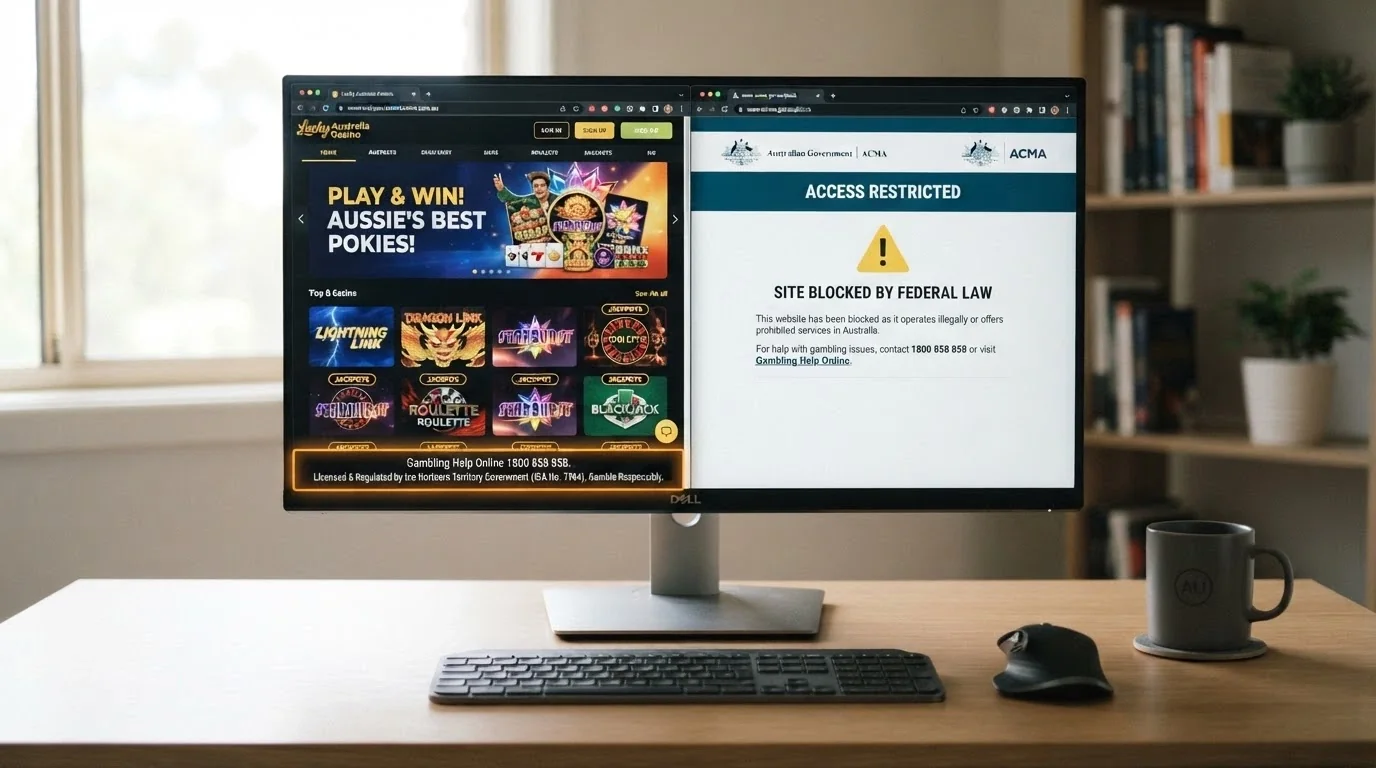
The ACMA’s enforcement record is the proof that the prohibition is active. Since its first blocking request in November 2019, the ACMA has had 1,788 illegal gambling and affiliate websites blocked by Australian internet service providers as of August 2026. More than 230 illegal gambling services have voluntarily withdrawn from the Australian market since the ACMA began enforcing in 2017. The blocking is DNS-level and is not presented here as beatable — the point is that the regulator acts, and the action has consequences.
The player is not prosecuted. The IGA targets the provider, and no Australian has been charged for accessing an offshore casino. That is the legal safe harbour. What the safe harbour does not include is any of the protections a licensed Australian wagering customer takes for granted: no ACMA complaints body that can recover money, no BetStop self-exclusion that reaches the offshore site, no Australian consumer law that compels a payout, and no recourse when an operator closes an account or voids a win. The site can be blocked at any time, with a balance on it. The blocking returns nothing to the player.
The 2026 reform tightens the picture further. The Interactive Gambling Amendment (Gambling Reform) Bill 2026 passed Parliament on 19 August 2026 and its measures commence on 1 January 2027. From that date, banks and payment providers receive the blocking authority described above. The advertising and inducement rules — caps on wagering ads, a live-sport blackout, bans on athlete and influencer promotion — apply to Australian-licensed operators, but the bank-blocking power is the change that most directly affects an offshore crypto casino player: the deposit path may narrow, and the friction a player navigates around today becomes harder in 12 months.
The Interactive Gambling Act 2001: What the Law Actually Says
The IGA’s structure separates the provider offence from the player safe harbour, and the offshore loophole is the space between them. Section 8AA of the Act makes it an offence to provide a prohibited interactive gambling service to a person in Australia. The penalty attaches to the provider, not to the customer. A player accessing an offshore casino is not committing an offence under the Act.
The 2017 amendments closed some of the offshore loopholes by giving ACMA enforcement and ISP-blocking powers, but the underlying distinction — provider liability, player non-liability — remained. The 2024 credit and crypto measures added the payment-method prohibition: licensed wagering operators cannot accept credit cards or crypto. The 2026 reform layered on the advertising and inducement rules, plus the bank-blocking authority that starts in January 2027. None of these amendments changed the player safe harbour.
The framing for a player is plain. The offshore casino offering Australian players online pokies is in breach of the IGA — whether deposits arrive via PayID or via USDT TRC-20, the IGA does not distinguish between fiat-funded and crypto-funded interactive gambling services. The player is not in breach. The player is also not protected. Those two facts coexist, and a page that names only one of them is either marketing or a press release.
ACMA’s Enforcement: 1,788 Sites Blocked and Counting
The ACMA’s blocking power is real, active and continuing. As of August 2026, 1,788 illegal gambling and affiliate websites have been blocked at the DNS level by Australian ISPs at ACMA’s direction. The number has grown steadily since the first blocking request in November 2019. More than 230 services have voluntarily withdrawn from the Australian market since 2017 — a figure that captures operators who decided the regulatory pressure was not worth the Australian traffic.
The practical meaning for a player is concrete. A site that is on the ACMA blocked list becomes inaccessible through standard Australian ISP connections. Funds on that site do not return to the player — ACMA cannot compel a payout from an offshore operator. The blocking is a defensive measure for the Australian market, not a recovery mechanism for individual players. A player with a balance on a blocked site has, in practical terms, lost it.
The 2027 escalation changes the dynamic at the deposit end. As noted, banks gain the authority to block transactions to illegal gambling operators from 1 January 2027. The blocking authority applies at the payment rail — the bank, the card processor, the payment platform — and operates independently of the ACMA’s DNS-level site blocking. The combined effect of DNS blocking and payment blocking is that the offshore casino’s Australian traffic faces two independent barriers rather than one.
The 2026 Gambling Reform: What Changes on 1 January 2027
The Interactive Gambling Amendment (Gambling Reform) Bill 2026 passed Parliament on 19 August 2026. The measures commence on 1 January 2027. The reform is law, not speculation, and the start date is fixed.
The advertising rules apply to Australian-licensed operators and to advertising that reaches an Australian audience. No more than three wagering advertisements per hour between 6:00 am and 8:30 pm. A live-sport blackout: no wagering ads from 15 minutes before until 5 minutes after a live sporting event. Radio advertisements barred during school commute hours. Broadcasting sporting odds is banned outright. Online advertisements only to logged-in, confirmed-over-18 users who have not opted out. No advertisements inside sports venues or on player or official uniforms. Athletes, celebrities and influencers are barred from promoting wagering products.
The inducement rules restrict how Australian-licensed operators can market welcome offers and referral bonuses. Direct marketing of inducements is prohibited for 14 days after a customer signs up, for three months after a person deregisters from BetStop, and indefinitely for customers identified as at risk of gambling-related harm. The rules apply to licensed operators. An offshore casino advertising a welcome bonus to Australians is breaking the prohibition itself, not merely an advertising rule.
The bank-blocking power is the change that matters most for the offshore crypto casino player. From 1 January 2027, banks and payment providers have express authority to block transactions identified as flowing to illegal gambling operators. The mechanism is at the payment rail. The practical effect is that an AUD transfer to an exchange, or a card payment to a known gambling merchant, may be declined outright. The deposit path that works in 2026 may not work the same way in 2027 — and the page does not speculate beyond what the law says.
Top 10 Crypto Casinos for Australian Players in 2026
The table below ranks the offshore operators that hold the largest share of Australian-adjacent traffic in the operators-skill dataset. Every operator is offshore, unlicensed in Australia, and offering a product prohibited under the Interactive Gambling Act 2001. Market share is the ranking basis. Revenue is annual. Australian legal status is the same line for every operator, and the line is the same for a reason.

| Operator | Market Share (%) | Annual Revenue (A$) | Australian Legal Status |
|---|---|---|---|
| Rocket Play | 9.4 | A$632.69M | Offshore — prohibited in Australia (Curaçao licence, unconfirmed this run) |
| Skycrown | 8.55 | A$436.07M | Offshore — prohibited in Australia (Curaçao licence, unconfirmed this run) |
| Royal Reels | 2.51 | A$243.99M | Offshore — prohibited in Australia (Curaçao licence, unconfirmed this run) |
| WinSpirit | 1.55 | A$110.3M | Offshore — prohibited in Australia (licence not confirmed) |
| Stake | 1.28 | A$115.67M | Offshore — prohibited in Australia (Curaçao Gaming Authority, geo-blocks AU IPs) |
| Rainbet | 1.28 | A$83.13M | Offshore — prohibited in Australia (licence not confirmed) |
| Scream Casino | 0.99 | A$94.87M | Offshore — prohibited in Australia (licence not confirmed) |
| FairGO | 0.8 | A$69.11M | Offshore — prohibited in Australia (licence not confirmed) |
| Bizzo Casino | 0.57 | A$51.38M | Offshore — prohibited in Australia (licence not confirmed) |
| Rocket Casino | 0.57 | A$43.22M | Offshore — prohibited in Australia (licence not confirmed) |
The table tells the reader what the operators-skill data carries and nothing more. Per-operator bonus terms, wagering requirements, withdrawal caps and game counts were not confirmed this run for the 10 priority-set operators; the columns that would carry them are absent rather than fabricated. Where licence jurisdiction is reported, the line states whether that jurisdiction was confirmed this run or carried over from search results; where it is not confirmed, the cell says so plainly. The operator write-ups below the table fill in what the table cannot, including the data gaps and what they mean for a player comparing options.
Rocket Play is the largest by market share — 9.4% of AU-adjacent traffic — and posts A$632.69M in annual revenue, more than the next four operators combined. The number tells the reader the brand has reach; it does not tell the reader anything about payout speed, bonus fairness or dispute resolution. The Curaçao licence reported in competitor material is unconfirmed this run and would need to be verified on the operator’s own site before a player treats it as authoritative. Bonus terms, wagering requirements, validity windows and game counts for Rocket Play were not surfaced in research this run, and the absence is worth naming: a comparison page that had those numbers would be a better page, and the reader should know they are not seeing them here.
Skycrown sits at 8.55% market share with A$436.07M revenue — the second-largest operator in the ranking by both measures. Same data shape as Rocket Play: Curaçao licence reported but unconfirmed this run; bonus and game specifics not confirmed this run. Skycrown’s position in the ranking is market position, not a judgement on player experience. The two operators share a common shape — large offshore brands running on Curaçao licences, serving Australian traffic at scale, with the specific terms of their offers unverified.
Royal Reels rounds out the top three at 2.51% market share and A$243.99M revenue. The brand carries an Australian-coded name and markets to Australian players, which is a positioning fact rather than a legal one. The operator is offshore, unlicensed in Australia, and offers a prohibited product to Australian players under the IGA. The Curaçao licence reported in competitor material is unconfirmed this run. The brand’s familiarity to Australian players should not be confused with regulatory standing — no offshore operator has regulatory standing in Australia, because no licence exists.
Stake is the operator that Australians most commonly recognise — and the one they cannot reach without workarounds. Founded by Australian entrepreneurs Ed Craven and Bijan Tehrani, Stake holds a Curaçao Gaming Authority licence and operates under one of the more recognisable names in offshore crypto gambling. The site geo-blocks Australian IP addresses due to regulatory concerns, which means an Australian player accessing Stake is doing so through a method that the operator itself does not endorse for Australian customers. The 1.28% AU-adjacent market share and A$115.67M revenue figure capture the traffic that does reach Stake from Australia despite the geo-block. Stake offers anonymous play with optional KYC — the player chooses when to verify — and integrates a sportsbook alongside the casino. The honest framing: Stake is the best-known operator in the offshore crypto space and is, by its own design, not directly available to Australian players.
Rainbet and WinSpirit are mid-tier operators by market share — Rainbet at 1.28% (A$83.13M revenue) and WinSpirit at 1.55% (A$110.3M revenue). Both are offshore, unlicensed in Australia, and offering a prohibited product. Licence jurisdiction was not confirmed for either this run; a player who wants to verify either operator’s standing would need to check the operator’s own site. Bonus terms, wagering requirements and game counts were not surfaced for either. The ranking is market position, not endorsement.
Scream Casino sits below the 1% market-share threshold with A$94.87M revenue. The brand carries a louder marketing voice than its market share would predict, which is itself a signal: high marketing spend relative to traffic share often correlates with aggressive bonus terms and high wagering requirements. The page does not have Scream’s specific terms to confirm or refute that pattern — the data was not surfaced this run — but the pattern is worth noting. Licence jurisdiction unconfirmed.
FairGO carries the most Australian-coded branding of any operator in the ranking — the name suggests an Australian-facing identity — and is fully offshore. The 0.8% market share and A$69.11M revenue are modest by the table’s standards, but the brand recognition among Australian players is outsized relative to the share figure. The branding is a positioning choice, not a legal one. The operator is offshore and unlicensed in Australia. Licence jurisdiction was not confirmed this run.
Bizzo Casino and Rocket Casino round out the list at 0.57% market share each — A$51.38M and A$43.22M revenue respectively. Both are offshore and unlicensed in Australia. Licence jurisdiction was not confirmed for either this run. The two brands share a sub-1% share and modest revenue, and a player comparing them on the available data has essentially nothing to differentiate on beyond brand recognition. Rocket Casino’s name is similar to Rocket Play — they are different operators, not rebrands — and the reader should not conflate them.
How to Tell a Legitimate Crypto Casino from a Trap
The word “legitimate” carries different meanings at an offshore crypto casino than it does at an Australian-licensed operator. Legitimate in the offshore context means the casino has a verifiable licence from a recognised regulator, publishes provably fair verification on its in-house games, processes withdrawals within a reasonable timeframe, and responds to player disputes through a defined channel. It does not mean the casino is legal in Australia, because no offshore casino is. It does not mean the casino is safe for the player, because no offshore casino carries Australian consumer protection.
The first check is the licence. A Curaçao licence is the most common at offshore crypto casinos serving Australian traffic — all 15 top-ranked Bitcoin casinos on competitor listicles hold Curaçao licences and are not on the ACMA blocked list as of August 2026. Curaçao’s master-licence system delegates enforcement to sub-licence holders, and the player should verify the licence number on the regulator’s own register rather than trusting the casino’s footer. Shuffle Casino’s verifiable registration under Natural Nine B.V., Curaçao number 160998, is the kind of detail a player can check; a footer that names a regulator without a registration number is weaker.
Anjouan and Tobique are the newer alternatives. The Government of the Autonomous Island of Anjouan, Union of Comoros issues licences that Bitz Casino operates under, with email-only registration and daily withdrawals up to A$300,000. The Tobique Gaming Commission regulates Pubs Casino and Wild Fortune; Wild Fortune’s Tobique licence is verifiable. Both jurisdictions are less established than Curaçao, and a Curaçao licence carries marginally more enforcement history behind it — but neither is a substitute for Australian consumer protection.
The second check is provably fair verification. Provably fair is a cryptographic commitment scheme: the casino commits to a server seed before play, the player provides a client seed, and a nonce generates the outcome. After the round, the player can verify that the server seed matches the commitment and that the outcome was determined by the inputs. The mechanism works on in-house games — crash, dice, mines, plinko. It does not work on third-party slots from providers like Pragmatic Play, NetEnt or Play’n GO, because those providers generate outcomes independently and do not expose their seeds. Provably fair is a genuine trust innovation; it is not a universal guarantee across every game on the casino.
The red flags are concrete. A casino that displays no licence in its footer is one to avoid. A casino that promises “no KYC ever” with no withdrawal cap is one to avoid — the cap will appear when a player tries to cash out. A casino with a pattern of withdrawal complaints on player forums is one to avoid. A casino with no operator address, no corporate registration and no named regulator is one to avoid. An AU domain or AUD display proves nothing about legal status — the operator can be offshore and still accept Australian dollars as a display currency.
The Licence Check That Actually Matters
A Curaçao licence obliges an operator to maintain segregated player funds, submit to periodic audits and report certain categories of complaint to the regulator. It does not oblige the operator to pay out a disputed balance to an Australian player — the Curaçao regulator’s enforcement power stops at Curaçao’s borders, and a player who escalates a complaint through Curaçao’s channels is relying on an offshore process with no Australian enforcement backstop. The licence is a process, not a guarantee.
The four sub-licence structure under Curaçao’s master-licence system is the detail that matters. Curaçao issues master licences to a small number of holders, who in turn issue sub-licences to operators. The operator’s footer typically names the sub-licence holder, not the master. To verify, a player checks the regulator’s public register for the operator’s company name and registration number — Shuffle Casino’s Natural Nine B.V., registration 160998, is the kind of verifiable record the register carries. A footer that names “Curaçao” without a registration number or company name is a softer claim.
Anjouan’s licensing regime is newer and less documented than Curaçao’s. The Government of the Autonomous Island of Anjouan, Union of Comoros issues licences, and Bitz Casino operates under one. The Anjouan register is less developed than Curaçao’s, and a player verifying an Anjouan licence has fewer public sources to check against. The regime is real; the verification infrastructure is thinner. Tobique is similar — the Tobique Gaming Commission regulates Wild Fortune and Pubs Casino, and Wild Fortune’s Tobique licence is verifiable. Both alternatives work; neither substitutes for Australian regulation.
The page’s recommendation is structural rather than brand-specific. Verify the licence on the regulator’s register, not on the casino’s footer. Check that the company name matches the footer entity. Confirm the licence is current — some operators carry expired registrations. Treat the licence as a process indicator, not a guarantee.
Provably Fair Games: What the Term Means and How to Check It
Provably fair is a commitment-verification scheme that lets a player confirm a game outcome was not manipulated after the bet was placed. The mechanic has three inputs: a server seed committed by the casino before play, a client seed provided by the player (or generated by the player’s browser), and a nonce that increments with each bet. The combination is hashed before the round, and the hash is shown to the player. After the round, the casino reveals the server seed, and the player can verify that the hash matches and that the outcome was determined by the inputs.
The verification runs in two stages. First, before the session, the player confirms that the server seed hash the casino committed to matches a hash the player can independently compute. Second, after each round, the player verifies that the outcome was derived from the revealed server seed, the client seed and the nonce. A mismatch at either stage means the casino manipulated the outcome.
The game types that support provably fair verification are typically the in-house titles: crash, dice, mines, plinko, hilo. These are games the casino builds and operates, so the casino controls the seeds. Third-party slots from providers like Pragmatic Play, NetEnt and Play’n GO do not expose their random number generation — those providers generate outcomes independently and do not provide seeds for player verification. A casino that runs 6,000 third-party slots and 30 provably fair in-house games offers provably fair verification on 30 games, not on 6,000.
The limits of provably fair are worth naming. Provably fair confirms the outcome was not manipulated after the bet. It does not confirm the house edge — the casino can still build a 3% edge into the game’s payout table, and provably fair does not detect that. It does not confirm the casino will pay out a winning balance — provably fair is a game-level tool, not a withdrawal-level one. It does not protect a player whose account has been closed or whose withdrawal has been refused. Provably fair is one layer of trust; it is not the whole stack.
Why That Welcome Bonus Is Smaller Than It Looks
Welcome bonuses at offshore crypto casinos are marketing, and the marketing number is the smallest real number on the page. A 200% match up to A$10,000 sounds generous until the wagering requirement is applied to the bonus amount, the game-weighting rules are checked, and the validity window is examined against the volume of play required to clear it. Offshore crypto casinos reach headline numbers up to A$30,000 — but the real cost of claiming the bonus is the turnover multiple, and that cost is what shrinks the headline figure.

Wagering requirements multiply the real cost. A 40x wagering requirement on a A$10,000 bonus requires A$400,000 of turnover before the bonus converts to withdrawable cash. At a A$1 spin on a pokie contributing 100% to wagering, that is 400,000 spins. At five seconds per spin, that is 555 hours of continuous play — and a validity window of seven days makes that volume mathematically impossible for a single player. The wagering multiple is the real number; the bonus cap is the headline.
Game-weighting rules narrow the contribution that different games make toward clearing a bonus. Pokies typically contribute 100% — every dollar wagered counts in full. Table games like blackjack and roulette often contribute 10% to 20%, or zero. Live dealer games are usually weighted at 10% or excluded. A player who tries to clear a bonus at a table game is effectively multiplying their required turnover by five to ten, and most do not realise the weighting until they have already lost the bonus.
The validity window is the third constraint. A 40x wagering requirement on a A$10,000 bonus with a seven-day expiry is, as the math above shows, mathematically impossible to clear for a single player playing at standard volume. A 30-day window is tight but achievable for a high-volume player. A 90-day window is realistic for most players. The shorter the window relative to the wagering requirement, the more the bonus is a marketing gesture than an achievable offer.
“No withdrawal limits” is the term that matters more than the match percentage. Lucky Block offers a 200% match up to A$10,000 with 50 free spins and no withdrawal fees or limits. The absence of a max cashout cap on the bonus is what makes the offer usable — a 200% match with a 5x max cashout cap would return a maximum of A$500 from a A$10,000 bonus playthrough, regardless of what the player wins during the wagering period. The bigger match percentage is irrelevant if the cashout cap converts the bonus into a token amount.
Free Spins Offers: What the Spin Count Hides
Free spin offers are the second tier of crypto casino welcome packages, and the spin count is the marketing number rather than the real one. The real value of a free spin package depends on three variables: the spin value, the eligible games and the wagering requirement on spin winnings.
Spin value is the per-spin stake that the casino sets. Most offshore crypto casinos default to A$0.10 to A$0.20 per spin unless stated otherwise — 100 free spins at A$0.10 per spin is A$10 of total stake, and the value of any winnings depends on what the pokie returns. Lucky Block’s 50 free spins are advertised without a stated per-spin value, which means the player should check the eligible game’s minimum stake and the casino’s per-spin allocation before claiming. LuckyRollers’ 100 free spins plus 5 free bets is a larger package, but the same caveat applies.
Eligible games are usually restricted. Most offshore crypto casinos lock free spin winnings to one or two specific pokies, often a low-RTP title from Pragmatic Play or BGaming. A 100-spin package on a 94% RTP pokie is worth less than the same package on a 96.5% RTP pokie, and the difference compounds across the wagering requirement. The player should check which game the spins are locked to before claiming.
Wagering requirements on free spin winnings are typically higher than on deposit-match bonuses. A 40x wagering requirement on deposit-match bonus funds is standard; a 50x to 65x wagering requirement on free spin winnings is common. The reason is structural: free spin winnings are uncapped by deposit size, and the casino prices the higher wagering to recover the upside. Lucky Block’s no-withdrawal-limits structure is the exception — if a player wins on a Lucky Block free spin and there is no max cashout cap, the wagering requirement is the only constraint.
How Fast Your Crypto Withdrawal Actually Arrives
Crypto withdrawal speed varies enormously by coin, network and operator. The marketing claim of “instant withdrawal” almost never means instant arrival — the operator-side approval queue runs before the blockchain broadcast, and the approval queue is where delays live. The real numbers, measured rather than promised, are what this section carries.
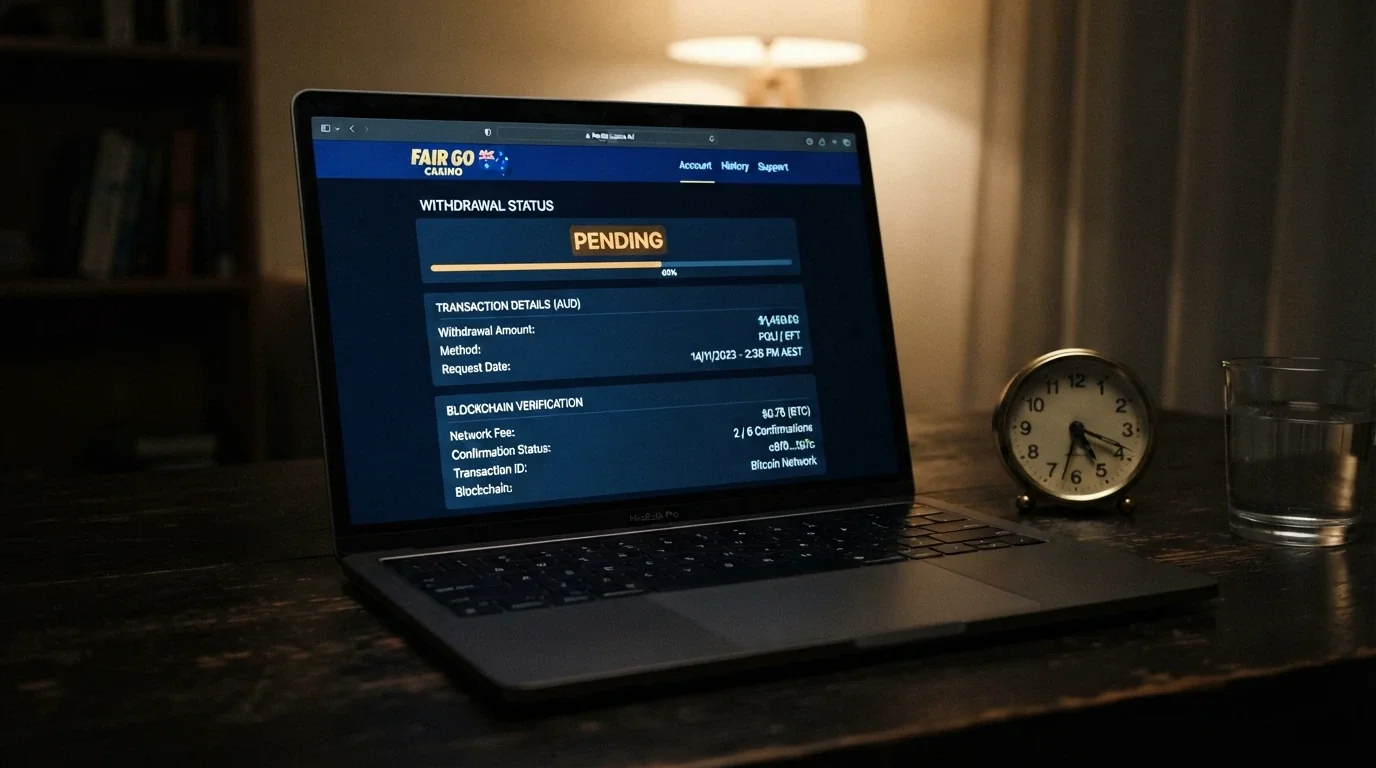
Bitcoin on-chain is the slowest standard rail. A standard on-chain transaction costs A$1 to A$5 in fees and confirms in 10 to 30 minutes. The 30-minute figure is the realistic one — network congestion, fee market dynamics and the operator’s broadcast timing all add latency. BC.Game recorded a Bitcoin on-chain withdrawal in 3 minutes 47 seconds on a Saturday, which is fast by on-chain standards; CryptoRoyal’s BTC withdrawal ran 34 minutes from request to blockchain broadcast, which is closer to typical.
USDT TRC-20 is the fastest standard rail at offshore crypto casinos for Australian players. TRC-20 confirmation runs under two minutes, and fees are negligible. LuckyRollers’ USDT TRC-20 payouts were tested at approximately 3 minutes end-to-end. The coin is pegged to the US dollar, which removes the volatility risk that makes Bitcoin withdrawals awkward — a player does not need to worry about the coin’s price moving while the transaction confirms.
Litecoin is the third fast rail, with confirmation under two minutes. LTC carries lower fees than BTC and runs on a network with less congestion. It is less commonly accepted than USDT TRC-20 at offshore crypto casinos, but the operators that do accept it offer fast settlement.
Bitcoin Lightning is the fastest option available, with settlement in under five seconds and fees of less than one cent. The Bitcoin Lightning Network processed 237,000 payments with a 99.94% success rate and an average settlement time of 1.86 seconds in a recent 30-day pilot. The fastest Lightning-to-Australia payout logged was 4 minutes 11 seconds from a Sydney IP — that figure includes the operator’s approval and the network’s settlement. Lightning acceptance is not universal; a player who wants Lightning payouts needs an operator that supports it.
Wild Fortune’s tested average of 5 hours 24 minutes per crypto withdrawal is the figure that anchors the slow end of the spectrum. Wild Fortune holds a verifiable Tobique Gaming Commission licence, so the figure is not a red flag for an unlicensed operator — it is a red flag for payout speed at this specific operator. The lesson: licence verification and payout speed are separate dimensions, and a licensed operator can still be slow.
Why “Instant Withdrawal” Almost Never Means Instant
“Instant withdrawal” in crypto casino marketing means the casino will process the withdrawal request instantly — not that the funds will arrive in the player’s wallet instantly. The two stages are distinct: operator-side approval and blockchain-side settlement. The approval stage is where most delays occur.
Every reputable offshore crypto casino runs an approval queue. The queue can be automated or manual; manual queues are slower. A request submitted at 3:00 am local time on a weekend may sit in the queue until business hours. Automated queues run 24/7 but still include risk checks — unusual withdrawal patterns, bonus abuse flags, KYC threshold triggers all route through the queue. The approval stage is where BC.Game’s 3 minutes 47 seconds and CryptoRoyal’s 22 to 34 minutes live.
KYC is the second delay. Reputable offshore casinos require identity verification before processing withdrawals above A$2,500 to A$5,000 in cumulative lifetime withdrawals. The check is triggered when a player’s cumulative withdrawals cross the threshold, not on a per-withdrawal basis. The first withdrawal may pass without KYC; the fifth or tenth may not. The KYC process requests a government-issued photo ID, proof of address and sometimes a selfie holding the ID — and the check runs hours to days.
Network congestion is the third variable. Bitcoin on-chain fees rise and confirmation times stretch when the network is busy. A player requesting a BTC withdrawal during a peak fee market may wait hours for confirmation. USDT TRC-20 and Litecoin are less affected by congestion than BTC; Lightning is essentially immune.
The honest summary: instant withdrawal at an offshore crypto casino means the operator has accepted the request. It does not mean the funds are in the player’s wallet. The realistic expectation for a small first withdrawal at a well-run operator is minutes to an hour; for a withdrawal that crosses the KYC threshold, it is hours to days.
The Deposit-and-Withdraw Route That Works in Australia Right Now
The cleanest deposit-and-withdraw route in 2026 runs through an Australian-regulated exchange. The chain is AUD bank transfer to the exchange, swap to USDT TRC-20, send to the casino. The outbound chain reverses it: USDT TRC-20 from the casino to the exchange, swap to AUD, transfer to the bank.
CoinSpot and Independent Reserve are the two Australian-regulated exchanges that work cleanly for this purpose. Both hold AUSTRAC registration, both accept AUD deposits from Australian retail banks, and both support USDT TRC-20. The exchange layer is where AUSTRAC’s A$10,000 Travel Rule reporting applies — transfers above A$10,000 through the exchange generate a report. The casino itself does not see the report; AUSTRAC does.
Bank selection matters at the AUD legs. ING and Macquarie process transfers to AUSTRAC-registered exchanges without friction. ANZ and NAB flag transfers without fully blocking — a compliance note ends up on file, but the transfer completes. CommBank and Westpac restrict transfers to crypto exchanges — payments get held and returned days later. A player who banks with CommBank or Westpac has a practical incentive to switch to ING or Macquarie for the deposit path, or to fund a CoinSpot account via a different mechanism.
The route narrows from 1 January 2027. As described, banks gain the authority to block transactions to illegal gambling operators, and the law does not distinguish between a transfer to a crypto exchange and a transfer to a casino. An exchange that has been associated with gambling-related transactions may attract blocking, and a player who has built a deposit route that depends on a specific bank’s permissiveness should plan for the route to change.
Crypto Pokies Australians Are Actually Playing in 2026
Crypto pokies are online slots played at an offshore crypto casino. The term is a deposit-method label rather than a game-quality label — the game software is the same as at fiat online casinos, with the same providers supplying both. Pragmatic Play, NetEnt, BGaming and Play’n GO all distribute to crypto and fiat operators. The difference is the deposit rail and the operator’s licence status, not the game.
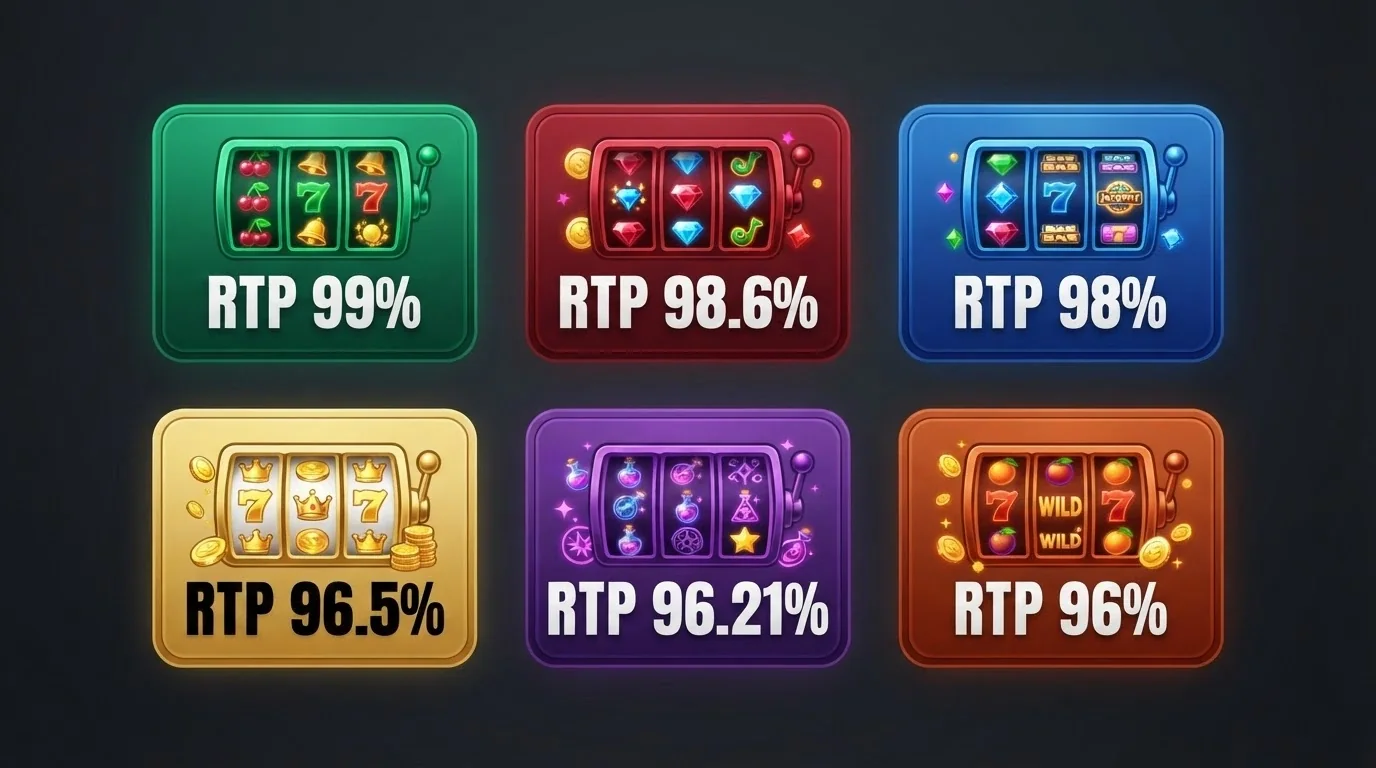
The table below carries the per-title RTP, volatility and max win for the ten titles with confirmed figures in research. RTP is the long-run return to player as a percentage of wagered amount; volatility is the distribution of wins across sessions; max win is the largest multiple of the bet the game pays out on a single spin. The figures are what the providers publish; the comparison is what the player makes.
| Pokie Title | Provider | RTP (%) | Volatility | Max Win |
|---|---|---|---|---|
| Mega Joker | NetEnt | 99.00 | Low | 2,000x |
| 1429 Uncharted Seas | Thunderkick | 98.60 | — | — |
| Blood Suckers | NetEnt | 98.00 | Low | 900x |
| Gates of Olympus 1000 | Pragmatic Play | 96.50 | High | 15,000x |
| Sleeping Dragon Ultra Dark | Pragmatic Play | 96.50 | High | — |
| Cosmic Clusters | Pragmatic Play | 96.45 | High | 5,000x |
| Book of Dead | Play’n GO | 96.21 | High | 5,000x |
| Temple of Power | BGaming | 96.03 | Very High | 15,000x |
| Crypto Bro | AvatarUX | 96.00 | — | 20,000x |
| Crypto Crown 20 | AvatarUX | 96.00 | High | 5,000x |
Mega Joker leads the table at 99% RTP in Supermeter mode — the highest figure among widely available pokies at offshore Australian-facing casinos. The game runs low volatility, which means frequent small wins rather than rare large ones. The 2,000x max win caps the upside but the 99% RTP means the long-run return is the closest to break-even available on any pokie most players will encounter. The combination — high RTP, low volatility — is what makes Mega Joker the standard against which other pokies are measured.
Blood Suckers at 98% RTP and 1429 Uncharted Seas at 98.6% RTP are the next tier of high-return pokies. Both are NetEnt and Thunderkick originals respectively, both run low volatility, and both deliver returns above the typical 96% market average. The max win figures (900x for Blood Suckers) are modest — these are games that pay out often and small, not rarely and large. A player who values session length over single-spin upside will recognise this profile.
Book of Dead at 96.21% RTP, high volatility and 5,000x max win is the popular benchmark — it sits at near-market-average return, high variance and a respectable max win. Gates of Olympus 1000 (96.50% RTP, high volatility, 15,000x max win) and Cosmic Clusters (96.45% RTP, high volatility, 5,000x max win) carry the Pragmatic Play profile: high variance, big max wins, and a long-run return that is solid but not exceptional. Temple of Power at 96.03% RTP with very high volatility and 15,000x max win is the high-end variance pick. Sleeping Dragon Ultra Dark, released on 23 July 2026, joins the table at 96.50% RTP with high volatility.
The session loss calculation below uses Book of Dead as the representative RTP — 96.21% — to give a reader a concrete sense of what a session costs. The calculation assumes illustrative figures the player can substitute for their own; the formula is the constant.
A session of 1,000 spins at A$1 per spin on Book of Dead, at the game’s published 96.21% RTP, carries an expected loss of A$37.90. The arithmetic: 1,000 spins multiplied by A$1 per spin equals A$1,000 in total wagered; A$1,000 multiplied by the house edge (1 minus 0.9621, or 3.79%) equals A$37.90. That is the statistical cost — the average over many sessions at the stated assumptions. A single session will deviate from the average; a player who wins A$200 in a session has beaten the average, and a player who loses A$300 has lost more than the average. The figure is what a session costs in expectation, not what any particular session costs.
Crypto Bro and Crypto Crown 20 round out the table from AvatarUX — both at 96% RTP, with Crypto Bro’s 20,000x max win the highest in the table. The 96% RTP is below the table’s high-RTP cluster (98% to 99%) and above the typical market floor of around 94%. The 20,000x max win on Crypto Bro is the headline; the 96% RTP means the long-run return is solid but not exceptional.
The figures above are the published provider RTPs. A casino can configure some games at lower RTP variants — Pragmatic Play releases Gates of Olympus 1000 and Sleeping Dragon Ultra Dark at 96.50% as the default, with 95.50% and 94.50% variants in circulation. A player who wants to verify the RTP on the game they are playing should check the in-game information panel, where the provider’s RTP for that configuration is displayed.
What RTP Actually Means for Your Session — Not the Casino’s Lifetime
RTP is a long-run average, not your evening’s return. A 96% RTP means that, across millions of spins, the game returns A$96 for every A$100 wagered. Across a session of 1,000 spins, the actual return can be anything from zero to a multiple of the wager — and most sessions will not return exactly 96% of what was wagered.
The house edge is the complement. RTP of 96% means house edge of 4% — the casino retains A$4 on average for every A$100 wagered, across millions of spins. The 4% is not a fee per session; it is the average outcome that the game’s mathematics produces. A single session does not pay a 4% fee; it pays whatever the volatility and the outcomes produce, and the average emerges only across a very large number of sessions.
Volatility interacts with RTP to shape a session. A high-volatility pokie at 96% RTP can produce sessions with zero returns and sessions with returns many times the wagered amount; the average across all sessions is 96%, but any individual session can be far from that figure. A low-volatility pokie at 96% RTP produces sessions that cluster closer to the average — small wins and small losses accumulate toward the 96% line, and the player’s bankroll moves slowly. The combination a player prefers depends on what they want from a session: long, slow play (low volatility) or the chance at a large win (high volatility).
The highest-RTP titles give the player a long-run edge closest to break-even. Mega Joker’s 99% RTP means the house edge is 1% — the smallest available on widely accessible pokies. Blood Suckers at 98% RTP and 1429 Uncharted Seas at 98.6% RTP are the next tier. These titles are the player advantage in a long-run sense, but the advantage is small (1% to 2%) and only emerges over millions of spins. A single session at Mega Joker is not guaranteed to return 99% of what was wagered; the 99% is what millions of sessions produce on average.
New Crypto Casinos in 2026: Fresh Sites Worth a Look
New crypto casinos in 2026 typically offer larger welcome packages, more modern platforms and a longer list of accepted coins than established operators. The trade-off is the absence of track record — no withdrawal history, no player disputes resolved publicly, and a shorter regulatory paper trail. A player who wants the bigger bonus and the modern UI gets both, and gets the absence of proof that the operator pays out.
The launches noted in research carry specific dates that the player can verify. Temple of Power, a BGaming pokie, was released on 1 April 2026 — a new title rather than a new casino, but the release is part of what makes a new casino’s library fresh. Sleeping Dragon Ultra Dark from Pragmatic Play launched on 23 July 2026, joining the high-volatility cluster at 96.50% RTP. Gates of Olympus 1000 is the 2026 Pragmatic Play upgrade of a popular title, with the RTP and volatility profile carried forward from the original.
The practical approach to a new casino is conservative. A small first deposit tests the withdrawal path — a player who deposits A$50, plays briefly and requests a withdrawal learns whether the operator pays out, how long the approval queue takes, and whether KYC is triggered at the threshold. The first withdrawal is the diagnostic. A player who skips the test and deposits A$5,000 on the first session has skipped the diagnostic and committed the bankroll before knowing whether the operator will return it.
The new-casino calculus is asymmetric. The upside is a bigger welcome package and a fresher platform; the downside is the absence of evidence. The player who treats the welcome package as the entire reason to choose a casino is buying marketing rather than service. The player who uses the welcome package as a reason to test the operator’s withdrawal path is making a reasonable use of the offer.
Staying in Control When the Safety Net Doesn’t Reach Offshore
The Australian player-protection framework is real and effective for licensed wagering — and none of it covers an offshore crypto casino. BetStop, the National Self-Exclusion Register, held 59,830 registrations with 37,247 active exclusions as of 31 March 2026. The register binds every Australian-licensed online and phone wagering service in a single step: one registration excludes a player from every licensed operator, and licensed operators must not accept them or send them marketing. Seventy-eight per cent of registrants were under 40, and 38% chose lifetime exclusion.
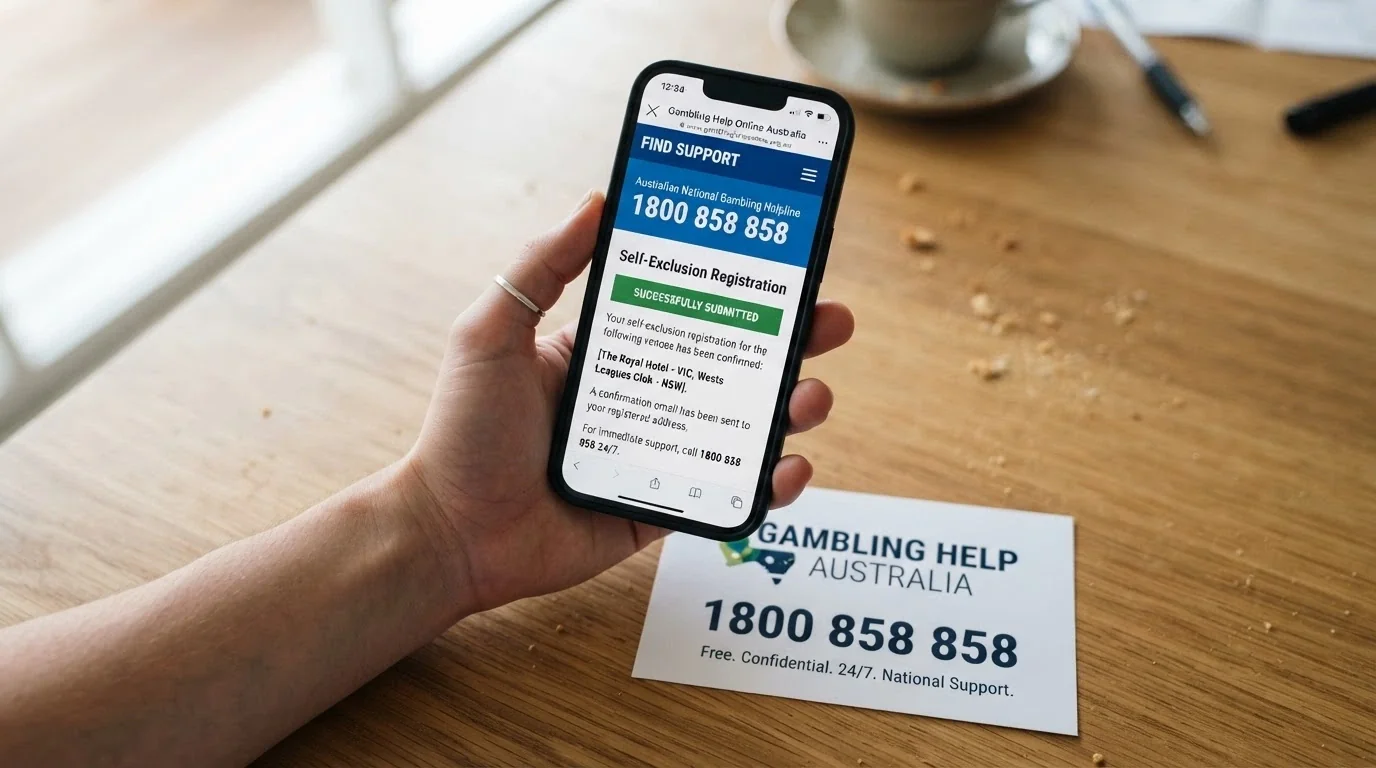
BetStop’s boundary is hard. The register covers Australian-licensed wagering services only — online sportsbooks and racing operators licensed by a state or territory. An offshore crypto casino is not licensed in Australia, is not connected to BetStop, and will keep taking a self-excluded person’s money. The protection BetStop offers does not reach the offshore market, and a player who registers on BetStop believing they have closed off all gambling access has not closed off the offshore casino access that this page is about.
The gambling-harm prevalence figures put the stakes in scale. The Roy Morgan Gambling Harm Index for March 2026 shows 15.1% of the Australian adult population — 3.32 million people — experiencing some level of gambling harm. Of those, 13.0% (2,857,000 people) are experiencing harm from their own gambling. Approximately 5.4% of the Australian population (1,177,000 people) are experiencing harm from other people’s gambling. The Australian Institute of Health and Welfare put high-risk gambling at 1.8% of adults in 2022. The annual health loss from gambling-related harm is estimated at over 400,000 Years Lived with Disability — a figure that captures the long-tail cost beyond the immediate financial loss.
Australians lost A$36.0 billion to gambling between March 2025 and March 2026 — the highest per-capita figure of any country. The figure aggregates every form of gambling: pokies at clubs and pubs, casino table games, lottery, wagering. The share that went to offshore crypto casinos is not separately reported, but it is a slice of the A$36 billion and it went to operators that offer no Australian consumer protection.
The help infrastructure is real. The National Gambling Helpline is 1800 858 858 — free, confidential, 24 hours a day, 7 days a week. Online chat and email counselling are available through Gambling Help Online. The helpline routes to state-based services and to financial counselling. The helpline is the help resource for any Australian, regardless of whether they play at a licensed or offshore operator. The page names it because the alternative is to leave a reader without a number to call.
Tools You Can Use Even at an Offshore Crypto Casino
Operator-side tools exist at most offshore crypto casinos, and they work regardless of licence jurisdiction. Deposit limits, loss limits, session timers and reality checks are standard features. The player who wants a deposit cap can set one in their account settings, and the cap is enforced by the operator — not by an Australian regulator, but by the operator’s own systems.
Self-exclusion requested directly to the operator is the tool that mirrors BetStop, with one critical difference. A player who emails an offshore casino’s support and asks to be self-excluded is making a request the operator can choose to honour or to ignore. Australian consumer law does not compel the offshore operator to comply, and the operator’s compliance is reputational rather than legal. Most well-run operators honour the request — Wild Fortune, Pubs Casino and Stake all run self-exclusion processes — but a player who is relying on the tool is relying on the operator’s goodwill.
Session time reminders and reality checks are the lower-friction tools. A 30-minute reality check that pops up during a session gives the player a moment to decide whether to continue. A session timer that logs out after two hours caps the loss exposure. The tools are imperfect — a player can dismiss a reality check and keep playing — but they are available, and an operator that offers them is signalling at least a baseline of player-protection intent.
The cold reality is that none of these tools is enforceable by an Australian regulator. The ACMA cannot compel an offshore casino to honour a deposit limit. AUSTRAC oversight does not extend to operator-side responsible-gambling tools. BetStop does not reach the site. A player at an offshore casino is operating without an Australian regulatory safety net, and the tools that work — operator-set limits, session timers, self-exclusion requested directly — work because the operator chooses to honour them, not because anyone compels them.
How We Evaluated These Crypto Casinos
The ranking is built on the operators-skill dataset — market share and annual revenue for offshore operators carrying Australian-adjacent traffic. Market share is the primary ranking basis. Revenue is reported alongside as a scale indicator. Neither figure is a judgement on player experience; both are positional.
The regulatory checks are limited and explicit. The ACMA blocked-list status of each operator was not queried this run — the page notes that all 15 top-ranked Bitcoin casinos on competitor listicles are offshore, Curaçao-licensed and not on the ACMA blocked list as of August 2026, but does not confirm each priority-set operator’s individual status. Licence jurisdiction was confirmed in research for Stake (Curaçao Gaming Authority), Wild Fortune (Tobique Gaming Commission), Metaspins (Curaçao, Metaspins N.V.), Shuffle (Curaçao, Natural Nine B.V., registration 160998), Bitz (Anjouan, Union of Comoros) and Pubs (Tobique Gaming Commission). For Rocket Play, Skycrown, Royal Reels, Rainbet, WinSpirit, Scream Casino, FairGO, Bizzo Casino and Rocket Casino, licence jurisdiction was not confirmed this run; the operator write-ups state that plainly.
The bonus and withdrawal data was sourced from competitor reviews and operator snippets, with gaps noted. Lucky Block’s 200% match up to A$10,000 with 50 free spins and no withdrawal limits is confirmed. LuckyRollers’ 100% up to 30,000 USDT with 100 free spins and 5 free bets is confirmed. BC.Game’s 4 deposit bonuses and 8,400+ game count are confirmed; per-tier bonus amounts are not. For the 10 priority-set operators, bonus terms were not confirmed this run.
The criteria that ordered the ranking are market share first, then confirmed licence jurisdiction and bonus data where available. Market share is not a quality judgement — it is a positional fact. A player who chooses an operator by market share is choosing by reach, not by service quality.
What this evaluation does not cover is real-time solvency, pending player complaints, live ACMA blocking status for specific operators, and the bonus terms that were not surfaced. The page names these gaps because a reader acting on a ranking should know what the ranking is built on and what it is not.
What This Means for Your Money: Offshore Crypto Casinos Are a Risk You Choose
The legal reality does not stop Australians from playing at offshore crypto casinos. No Australian has been prosecuted, and the prohibition targets the provider, not the player. The decision to play is the player’s, and the consequences of that decision are the player’s as well.
The concrete risks are not speculative. No Australian consumer protection applies to an offshore casino — the ACMA cannot compel a payout, Australian consumer law does not reach the operator, and there is no Australian complaints body that can mediate a dispute. No BetStop coverage — self-exclusion registered on BetStop does not reach an offshore casino, and a self-excluded person can deposit and play at an offshore site without restriction. No guaranteed withdrawal — the operator can refuse a withdrawal, void a win or close an account, and the player has no recourse. The site can be blocked by the ACMA at any time, and a blocked site returns nothing to a player with a balance on it.
The practical steps that reduce risk are not complicated. A small first deposit tests the withdrawal path before committing the bankroll. A player who deposits A$50, plays briefly and requests a withdrawal learns whether the operator pays out, how long the approval queue takes, and whether KYC is triggered at the threshold. The test is cheap; the absence of the test is expensive. An operator with a verifiable licence and a public dispute history is preferable to an operator without one — the verifiable licence means a regulator exists, even if that regulator is offshore; the public dispute history means the operator has been seen responding to complaints, which is a signal that complaints get responses.
The 2027 escalation narrows the picture. From 1 January 2027, banks have the authority mentioned above to block transactions to illegal gambling operators. The deposit route that works through ING or Macquarie in 2026 may attract blocking once the bank-blocking power is in force. The exchange layer (CoinSpot, Independent Reserve) may see heightened scrutiny if transfers to those exchanges have been associated with gambling. The friction that is moderate in 2026 becomes meaningful in 2027.
The page’s final judgement is plain. The information is here — the prohibition, the enforcement record, the offshore status of every operator in the ranking, the bonus terms that were and were not confirmed, the payout speeds that were measured, the player-protection tools that do and do not reach the offshore market. The choice is the reader’s. The National Gambling Helpline is 1800 858 858 — free, confidential, 24/7 — for any reader who is making that choice and finding it harder than expected.
Frequently Asked Questions
Do Australian banks block transactions to crypto casinos?
Australian banks do not currently block transactions to crypto casinos outright, but they create friction at the AUD-to-crypto step. CommBank and Westpac restrict outbound transfers to crypto exchanges — payments get held and returned days later. ANZ and NAB flag transfers without fully blocking. ING and Macquarie are the most permissive. From 1 January 2027, banks gain express authority to block transactions to illegal gambling operators, and the practical friction at the deposit path is expected to rise materially under that new power.
What happens if an offshore crypto casino refuses my withdrawal?
There is no Australian consumer protection that compels the operator to pay. The ACMA cannot recover your money, Australian consumer law does not reach the offshore operator, and there is no Australian complaints body that can mediate a dispute. The operator may demand additional KYC documents as a precondition; the operator may cite a bonus term violation; or the operator may simply not respond. A player who has tested the withdrawal path with a small deposit before committing a larger bankroll has the diagnostic; a player who has not tested the path learns the answer at the moment the operator refuses.
Do I have to pay tax on crypto casino winnings in Australia?
Betting and gambling winnings are not assessable income for an ordinary punter under section 6-5 of the ITAA 1997, and gambling losses are not deductible under section 8-1. No Australian case has held the winnings of an ordinary punter assessable. The exception is a person carrying on a business of betting or gambling — professional gamblers whose activity rises to the level of a business may have assessable income and deductible losses under different rules. The Northern Territory levies a 5% wagering tax on operators; states levy point-of-consumption taxes of 10–15% on operators. The player does not pay these.
What is the safest way to deposit crypto at an Australian-facing casino?
The cleanest route in 2026 runs through an Australian-regulated exchange: AUD bank transfer to CoinSpot or Independent Reserve, swap to USDT on the TRC-20 network, then send the USDT to the casino’s deposit address. ING and Macquarie process the AUD leg without friction; ANZ and NAB flag it; CommBank and Westpac restrict it. The outbound chain reverses: USDT TRC-20 from the casino to the exchange, swap to AUD, transfer to the bank. AUSTRAC’s Travel Rule applies at A$10,000 — transfers above the threshold through an Australian-registered exchange generate a report.
Why are no crypto casinos licensed in Australia?
The Interactive Gambling Act 2001 prohibits online casino games, online pokies and in-play sports betting to people in Australia. No licence for online casino exists federally or in any state or territory — because the product is prohibited outright, there is no licence to issue. The Interactive Gambling Amendment (Credit and Other Measures) Act 2023 added a prohibition on credit cards and cryptocurrency as payment for licensed wagering, commencing 11 June 2024. The result: every crypto casino an Australian player can access is an offshore operator offering a prohibited product, and the Australian licensed market has no crypto casino to offer because the product itself is banned.
No-Deposit Bonuses at Crypto Casinos: Do They Exist for Australians?
No-deposit bonuses at offshore crypto casinos serving Australian players are rare, and the ones that exist carry strings that outweigh the headline. A genuine no-deposit bonus gives a player a small cash or spin amount without requiring a deposit — the player registers, claims the bonus, and plays without funding the account. The bonus is real money, but its withdrawal is conditional on the operator’s terms.
The strings are predictable and severe. Wagering requirements on no-deposit bonuses typically run higher than deposit-match wagering — 50x to 80x is common. Maximum cashout caps are tight — A$50 to A$100 from a A$10 no-deposit bonus is a typical structure. Eligible games are restricted to a single low-RTP title or a small set of slots. The validity window is short — 24 to 72 hours.
For the 10 operators in this comparison, no-deposit bonuses were not confirmed this run for any of them. The absence is worth stating plainly: a comparison page that had no-deposit offers for these brands would be a better page, and the reader should not assume the offers exist. The broader offshore market does feature no-deposit offers — competitor listicles mention them for brands not included here — but these operators as a whole do not have one to recommend.
The safety net question is the honest framing. A no-deposit bonus at an unlicensed offshore casino carries no consumer protection — the operator is not subject to Australian consumer law, the ACMA cannot compel a payout, and BetStop does not reach the site. A player who wins on a no-deposit bonus and then hits a withdrawal refusal has no recourse. The bonus is small money, but the risk is asymmetric: the player risks nothing on deposit and risks everything on the payout.
“Crypto Pokies” vs Regular Pokies: Is There a Difference?
The game is the same. Pragmatic Play’s Book of Dead, NetEnt’s Blood Suckers and BGaming’s Temple of Power are distributed to crypto casinos and fiat casinos from the same provider, on the same server, with the same mathematics. The provider does not publish a “crypto version” and a “fiat version” with different RTPs; the game runs at the configured RTP regardless of how the player funds the account. “Crypto pokies” is a deposit-method label, not a game-quality label.
The real differences are at the rails and at the operator. The deposit rail at a crypto casino is blockchain-based; at a fiat casino, it is a bank transfer or card payment. The withdrawal rail at a crypto casino runs in minutes; at a fiat casino, it runs in days. Provably fair verification is available on in-house crypto-native titles at some crypto casinos; fiat casinos do not offer it because the verification would require exposing game-provider seeds.
The operator-side differences are sharper. An Australian-licensed operator does not offer online pokies at all — online casino games are prohibited under the IGA. A fiat online casino accessible to an Australian player is, by definition, offshore. A crypto online casino accessible to an Australian player is also offshore. The two are different in deposit mechanics and similar in legal status: both are unlicensed under Australian law, both fall outside BetStop coverage, and both offer products the IGA prohibits.
The honest framing: “crypto pokies” is shorthand for online pokies played at an offshore casino with a crypto deposit rail. The game is the same. The deposit method is faster and more private. The regulatory status is the same as at any other offshore casino accessible to an Australian player.
Prepared by the Instant Withdrawal Casinos AU editorial staff.