
50 Free Spins No Deposit Australia in 2026: What’s Really on the Table
A 50-free-spin offer promises a simple thing — fifty free spins at an Australian online casino, no deposit required. The reality is more layered. Every operator that markets itself to Australian players under this banner sits outside Australian law, which means the decision a player faces is not which casino wins on terms but whether the offer is worth the trade-offs the law itself imposes. This page lays out the offers that exist this year, the mechanics that decide what is actually withdrawable, and the consumer-protection gap a player steps into the moment they sign up. It is not a recommendation. It is what a careful reader needs to know before clicking.
Data current as of 16 October 2026; licence claims verified against the ACMA register and the Interactive Gambling Act 2001.
Table of Contents
- Why Your 50 Free Spins No Deposit Bonus Is Smaller Than It Looks
- How Australian Players Actually Claim 50 Free Spins in 2026
- The Fine Print That Decides What You Keep
- Top 10 Casinos with 50 Free Spins No Deposit in 2026
- The Pokies Behind Your 50 Free Spins — Why Game Choice Matters
- Why New Casinos Rarely Deliver Better 50-Free-Spins Deals
- Crypto, Payments and Getting Money Out of an Offshore Casino
- Why Every 50-Free-Spins Casino Here Operates Outside Australian Law
- Responsible Gambling — Help That Actually Works for Australians
- How We Evaluated These 50-Free-Spins Offers
- What You Should Actually Do About 50 Free Spins No Deposit
- Frequently Asked Questions
Why Your 50 Free Spins No Deposit Bonus Is Smaller Than It Looks
A 50-free-spins no-deposit offer sounds like free money. Forty or fifty spins at A$0.10 to A$0.20 per spin amounts to A$5 to A$10 in nominal value, before any win is even counted. Most no-deposit bonuses in the Australian-facing market in 2026 sit at A$0.20 per spin, which puts a “50 free spins” headline at roughly A$10 of spin value. From there the arithmetic gets less friendly. The same offer, in the same terms, typically carries a 35× wagering multiplier on winnings and a maximum cashout cap of A$50 to A$100. A player who wins A$8 from the spins must turnover A$280 before a cent becomes withdrawable, and then only up to the cap. That is the gap between the headline and the take-home, and it is where most readers stop reading the offer they were about to claim.
Australian players find these offers on affiliate aggregators — PokiesAustralia, SlotsPeak, PlayNoDeposit, GamblingInsider, CasinosHub, BonusBruce — rather than through any licensed Australian channel. The reason is straightforward: no Australian licence exists for online casino or online pokies. The product is banned. Every operator that surfaces on these affiliate pages is an offshore entity registered in Curaçao or Anjouan, and the offer itself is the legal grey edge that has grown up in the gap between the IGA prohibition and the offshore jurisdiction’s willingness to accept Australian customers.
The cluster matters. Of the roughly 50 no-deposit free-spin offers marketed under Australian-facing affiliate pages this year, only six — six of thirty-one offers tested in one industry methodology run — produced a real bonus credit on sign-up. The rest hid a token deposit behind a “no deposit” banner, capped withdrawals at A$30 to A$50, voided payouts under irregular-play clauses, or carried stale bonus codes that did not credit anything at all. The headline is broad. The actual deliverable is narrow.
No-Deposit Means No Deposit — the Real Terms
The “no deposit” mechanic is not a gift. It is a marketing decision wrapped in three brakes, each of which reduces the real take-home. The first is wagering. No-deposit free-spin offers in the Australian market typically carry a 30× to 60× playthrough on winnings, with 30× to 35× considered the reasonable end of the range and 50× or above practically unclearable for a player who is not committing a long session to the same pokie. Most no-deposit casinos cluster the requirement higher — 40× to 60× is the everyday band rather than the exception.
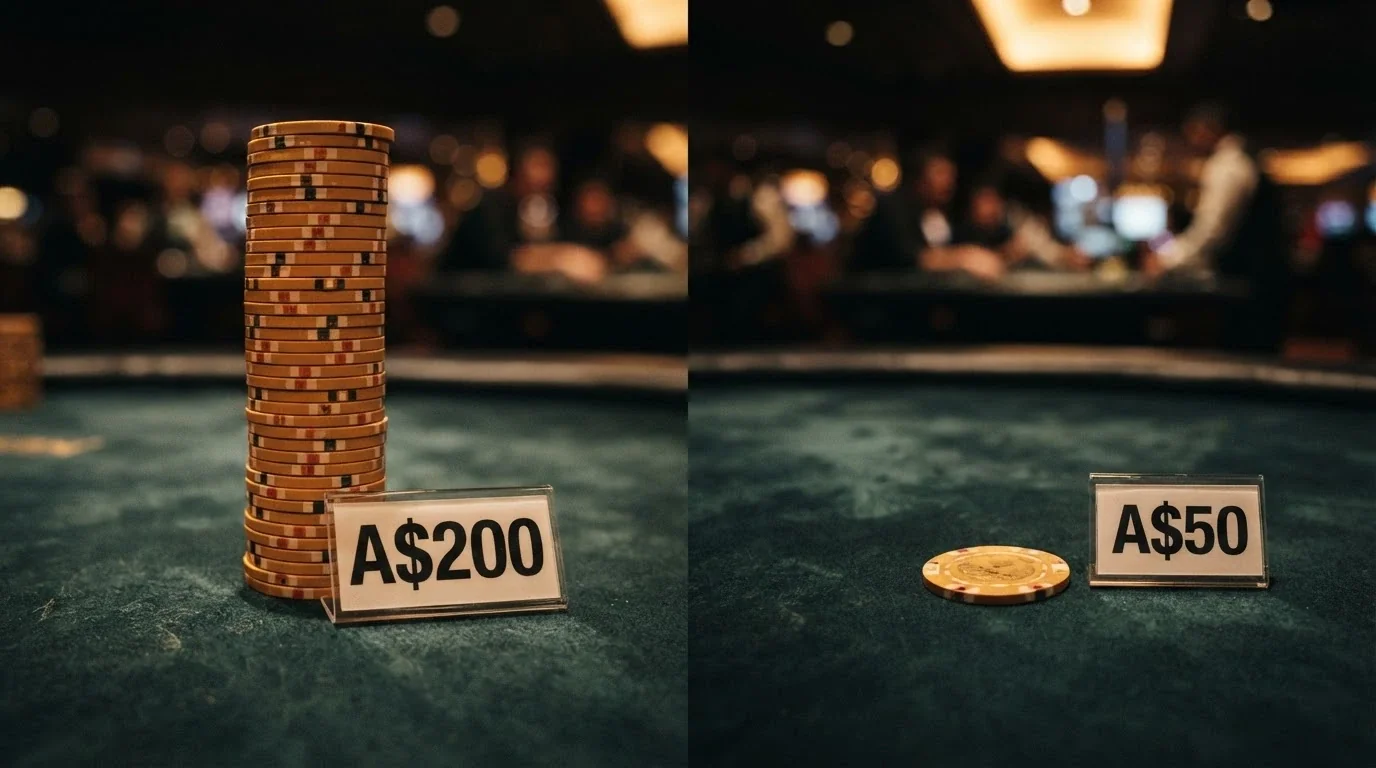
The second brake is the cashout cap. The typical max-withdrawal from no-deposit free-spin winnings in Australia ranges from A$50 to A$200, with most offers settling at A$50 to A$100. A cap of A$100 on a single offer means that even a freak run on a high-volatility pokie produces, at most, A$100 in real money regardless of what the reels displayed.
The third brake is the spin value itself. Most no-deposit free-spin offers credit at A$0.10 to A$0.20 per spin. A 50-free-spin offer at A$0.20 per spin amounts to A$10 in total spin value — a thin nominal worth before any win even registers. When the marketing material writes “50 FREE SPINS” in caps, it is naming the count, not the dollar. The dollar is on the next line, and it is smaller.
Sign-Up vs Registration — How Eligibility Works
The trigger that releases the free spins is one of two things. On the simpler offers, signing up with an email, password and a handful of personal details is enough — the spins credit automatically to a named pokie. On more conditional offers, a bonus code is required, either pasted into the registration form or entered at the cashier. A code that is wrong, stale, or entered at the wrong stage is the most common reason a player reaches the lobby with no spins credited at all.
Either way, identity verification runs before withdrawal, not before the spins credit. KYC checks — photo ID, proof of address, sometimes a selfie or a copy of the payment method — activate when a player requests a withdrawal. Offshore operators run the check in-house; turnaround varies from a few hours to several business days. Bonus credit comes first; the verification step gates what comes out.
Two restrictions recur on most offers. New-player-only is universal — a returning account holder at the same operator cannot re-claim. One-per-household, IP or device fingerprint is standard, and a second account opened to claim the same bonus will be voided. The terms matter at the registration stage. A player who does not read them discovers them at the withdrawal stage.
How Australian Players Actually Claim 50 Free Spins in 2026
The practical claim path is short — two to three minutes from landing page to credited spins — and the surrounding context matters more than the steps. The Australian-facing casino market is an offshore market. Every operator in this space is registered in Curaçao or Anjouan. None holds an Australian licence, because none can. The product is prohibited under the Interactive Gambling Act 2001. The pokies you will see in the lobby are the same ones players in other offshore markets see, marketed under Australian-friendly language — pokies, not slots; PayID and Osko where the operator chooses to accept them; deposits in Australian dollars where the operator supports AUD.
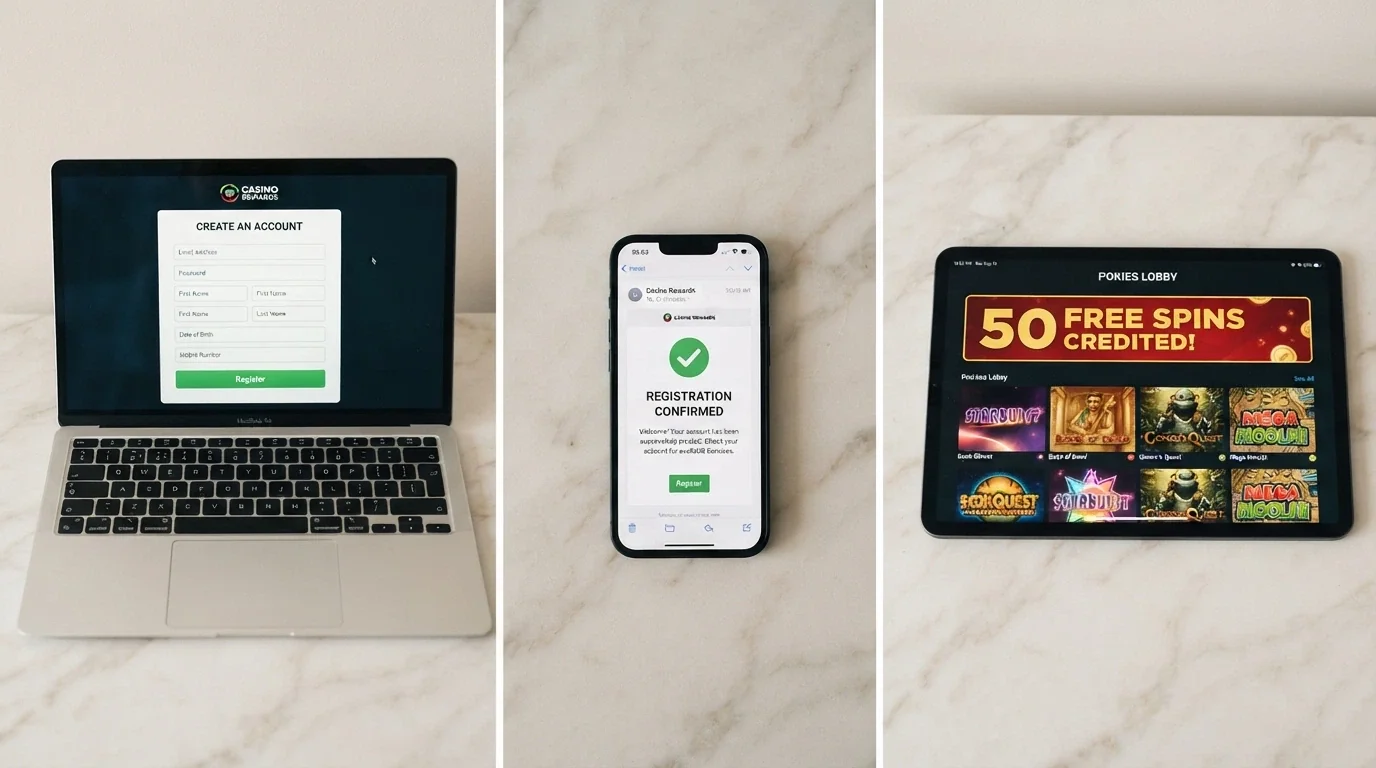
The claim flow itself is plain. Pick an operator, register with details that pass KYC later, enter a bonus code if the offer requires one, wait for the spins to credit to a named pokie, and play through them before the expiry window closes. The friction is not in the claim. The friction is in what happens afterwards — and what does not happen if the operator decides not to pay.
The Claim Process Step by Step
- Pick an operator whose bonus terms are publicly published, in clear language, with a real wagering multiple and a stated cashout cap. A page that does not show the terms before sign-up is a page to leave.
- Register with the Australian details you can later verify — a real name, address and date of birth that match a photo ID. KYC runs at withdrawal, and a mismatch at that stage voids winnings.
- Enter the bonus code in the registration form or at the cashier, depending on what the offer specifies. A wrong field voids the bonus. A stale code voids the bonus. A code that the offer did not require is irrelevant — pasting one in when none was needed does not credit extra spins.
- Verify identity before the first withdrawal. Photo ID, proof of address, and sometimes a payment-method check. The longer this is left, the longer the first withdrawal takes.
- Open the named pokie. The spins credit to a specific title. Playing a different game with the active bonus either voids the bonus or contributes 0% to wagering, depending on the operator’s weighting rules.
Six of the thirty-one offers tested across twenty-four operators in one industry methodology run produced a real bonus credit on sign-up. The common thread on the ones that worked: a publicly published bonus code, a clear wagering multiple, no hidden deposit, and a stated eligible game. The twenty-five that did not work shared the opposite — buried deposit requirements, A$30 to A$50 caps, irregular-play clauses that voided small payouts, and codes that had expired.
Mobile Casinos and App Access for Free Spins
The mobile path for an Australian player on an offshore casino is the mobile browser, not the app store. Real-money casino apps from offshore operators are not carried in the Apple App Store or the Google Play Store for Australian customers. The stores’ content policies restrict real-money gambling apps to operators licensed in the app user’s jurisdiction, and no offshore casino holds an Australian licence. What an Australian player gets instead is the casino’s mobile site, accessed through Safari or Chrome on iOS or through the system browser on Android, with the lobby and the live games running in-browser without a download.
The experience is functional. The same pokies load, the same bonuses credit, and the same KYC checks apply at withdrawal. The differences from a desktop session are cosmetic — a smaller lobby view, touch-screen spin controls, and the absence of a separate app icon. For a 50-free-spin offer, where the play session is short and the game is locked to a single pokie, the mobile experience is more than adequate.
The Fine Print That Decides What You Keep
A bonus headline tells a player what is on offer. The fine print tells the player what is actually deliverable. Four terms do almost all the work on a no-deposit free-spin offer in the Australian-facing market: the wagering multiple, the maximum cashout cap, the expiry window, and the eligible-game list. Each one operates as a brake on the headline, and the four together reduce a nominal A$10 spin value to something closer to A$5 to A$15 in expected take-home on a typical session.
The comparison block below summarises the typical band for each mechanic on Australian-facing offshore offers, where research actually carries a figure.
| Bonus Type | Typical Wagering | Typical Max Cashout | Typical Validity |
|---|---|---|---|
| No-deposit free spin | 30×–60× on winnings | A$50–A$100 | 24–72 hours per spin batch |
| Deposit-triggered welcome | 30×–40× on bonus + FS | A$100–A$5,000 | 7–14 days |
| No-deposit free chip | 30×–60× on chip amount | 5× chip value (A$150–A$180 typical) | 7 days |
The brackets are wide because the offshore market is wide. A 30× playthrough at one operator and a 60× playthrough at another is the difference between a clearing path and a clearing impossibility.
Wagering Requirements — 30× to 60× Decoded
A wagering requirement is the multiplier the operator applies to your winnings — or, on deposit offers, to the bonus — before any of it becomes withdrawable. A 35× playthrough on A$8 of free-spin winnings is A$280 of total stake that must pass through the eligible game before withdrawal unlocks. At A$0.20 per spin, that is 1,400 spins. At a five-second spin interval, that is just under two hours of continuous play on a single title. A 60× multiplier on the same A$8 is A$480 of stake — 2,400 spins, four hours of play on the same pokie with no break in the requirements.
The 30× to 35× band is the practical floor for a reasonable clearing path. A player who can sustain four to five hours of focused play on a single high-RTP pokie can usually clear an offer at this multiple without losing the entire spin value to the house edge during the playthrough. Anything above 50× is what the industry calls “unclearable” for most players — the house edge compounded over thousands of spins eats the bankroll before the wagering target is met. FairGO’s 60× no-deposit wagering sits at the upper end of this trap. Royal Reels’ 30× free chip and 35× deposit bonus sits at the reasonable end.
The arithmetic compounds. Even on a 96% RTP pokie — the floor for most modern online pokies — a player loses 4 cents of every dollar wagered in expectation. On A$280 of turnover, the expected loss during the playthrough is roughly A$11.20, which exceeds the A$8 starting win. The bonus is mathematically a negative-expected proposition before the cashout cap even applies.
Maximum Cashout Caps — the A$50–A$200 Ceiling
The cashout cap is the figure that decides what a freak win is worth. A 2,100× max-win hit on Big Bass Bonanza at A$0.20 per spin is theoretically a A$420 single-spin result. With a A$50 cashout cap on a no-deposit bonus, the operator pays A$50 regardless of what the reels displayed. The rest disappears. A A$100 cap recovers more, but the principle is the same — the operator sets a ceiling, and the ceiling binds.
For a 50-free-spin offer at A$0.20 per spin, the realistic cap range on the Australian-facing market is A$50 to A$100. The lower figure is more common. A player who values the offer at “the chance to win up to A$100” is reading the terms accurately; a player who values the offer at “whatever the pokie pays out” is reading the marketing.
The FairGO ~5× chip rule sits at the upper end. A A$30 free chip with a 5× cashout cap pays a maximum of A$150 — and the cap binds before the wagering does on any reasonable multiplier. RocketPlay’s A$300 cap on its 100-spin welcome is deposit-triggered rather than no-deposit, which is why it sits higher than the no-deposit band; it reflects a higher-confidence customer, not a more generous operator.
Expiry — 24 Hours to 14 Days
Expiry comes in two forms. The first is the spin-use window — the time between the spins crediting and the spins disappearing. The shorter end is 24 hours; the longer end is 72 hours. The second is the wagering-completion window — the time after the spins are used during which the player must clear the wagering requirement before the bonus and any associated winnings expire. The shorter end is 3 days; the longer end is 14 days.
RocketPlay’s 24-hour batch delivery window is the tight end of the spectrum. A player who lets the first day’s 20 spins expire without using them loses those 20 — and the next day’s 20 credits on schedule, but the original 20 are gone. SkyCrown’s 14-day bonus validity is the loose end. A player who uses the spins on day one has two weeks to clear the wagering on the winnings, which is workable on a 40× playthrough at moderate session lengths.
The arithmetic tightens fast. A 24-hour spin-use window with a 3-day wagering-completion window on a 60× playthrough is a near-impossible clearing path — the spins must be used and the requirement cleared in roughly four days, with no room for a missed session. A 7-day spin-use window with a 14-day wagering-completion window on a 35× playthrough is workable for a player who can run two to three sessions on the eligible pokie.
Which Games Count Toward Clearing Your Spins
The eligible-game list is where the operator funnels every player into a single category. Pokies contribute 100% to wagering requirements on almost every Australian-facing offshore bonus. Table games contribute 5% to 10%. Live dealer games are almost always excluded. A player who tries to clear a pokie bonus at the blackjack table — even a low-house-edge variant — will need to wager ten to twenty times as much to clear the same requirement, because the contribution rate is a fraction.
The more specific version is the game-lock. SkyCrown locks its free spins to four named titles — Wolf Treasure, Coin Volcano, 15 Dragon Pearls and Mighty Wild: Panther — one per deposit tier. RocketPlay locks its welcome free spins to Aztec Magic. Royal Reels locks its 50 deposit spins to a featured pokie. FairGO locks its no-deposit coupons to RTG pokies. The operator picks the title because the title serves the operator: a high-volatility pokie with a large max-win figure and a modest base-game return is the slot where the marketing line “win up to 5,000× your stake” lives, and it is also the slot where the average player loses their bonus bankroll fastest during the playthrough.
Game weighting shapes the clearing path in a way the bonus terms rarely explain. A player who picks a low-volatility, high-RTP pokie within the eligible range — Starburst at 96.09% with low volatility, for instance — gives themselves a flatter session and a longer runway against the house edge. A player who picks a high-volatility title is chasing a max-win figure the cashout cap will not honour.
Top 10 Casinos with 50 Free Spins No Deposit in 2026
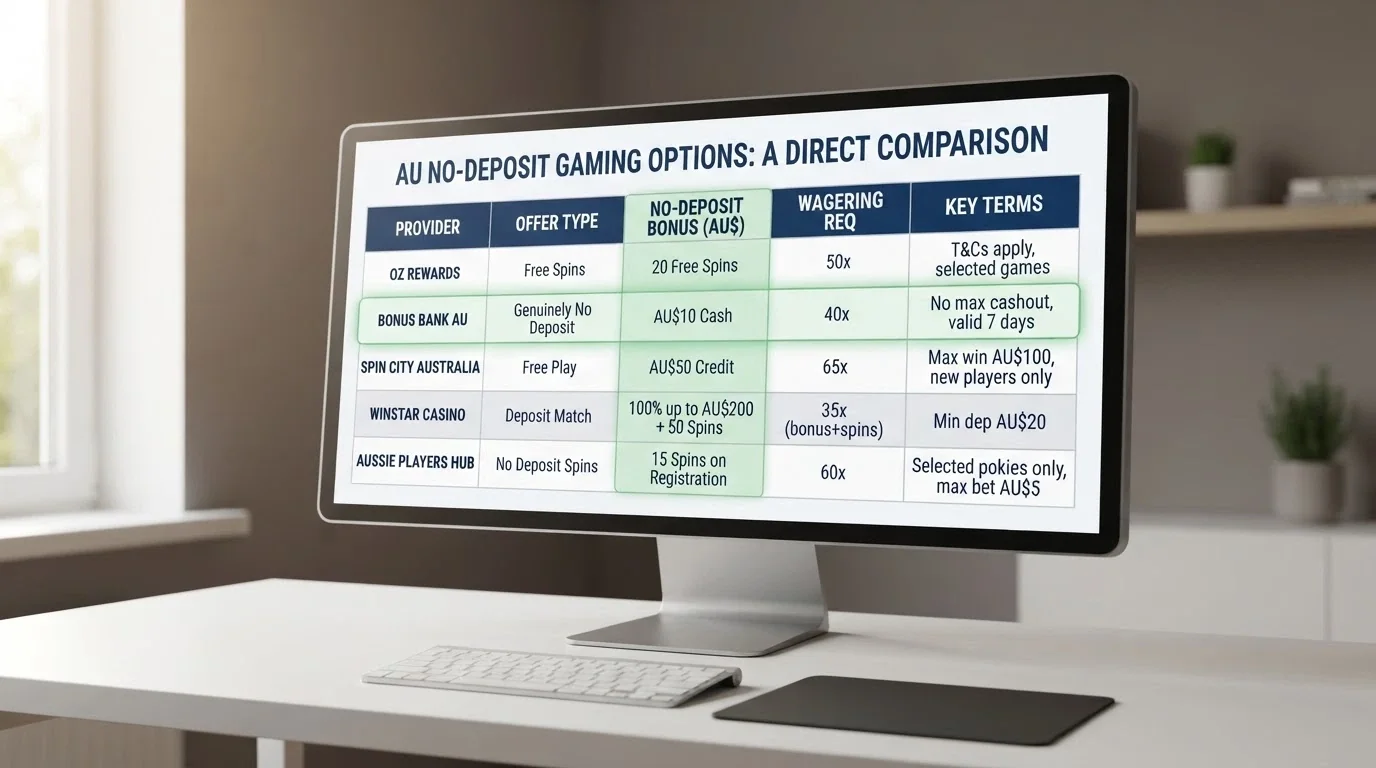
The table below lists the ten operators an Australian player is most likely to meet when searching, ranked by industry aggregators. The crucial reading is the third column: only one operator in this set — Bizzo Casino — carries a confirmed 50-free-spins no-deposit offer matching the intent. The others offer deposit-triggered alternatives or carry no confirmed offer terms at all. Every operator is offshore. No operator in this set holds an Australian casino licence, because no Australian casino licence exists.
| Casino | Status in Australia | Welcome Offer | Wagering on Free-Spin Winnings |
|---|---|---|---|
| RocketPlay | Offshore, no AU licence | 100% up to A$1,000 + 100 FS (first deposit) | 40× |
| SkyCrown | Offshore, no AU licence | 450% up to A$8,000 + 400 FS (four deposits) | 40× |
| Royal Reels | Offshore, no AU licence | A$10 NDB free chip + 100% up to A$500 + 50 FS | 30×–35× |
| FairGO | Offshore, no AU licence | Deposit match at 30×; no-deposit coupons at 60× | 60× |
| Bizzo Casino | Offshore, no AU licence | 50 FS no deposit | 40× |
| Stake | Offshore, no AU licence | — | — |
| WinSpirit | Offshore, no AU licence | — | 45× |
| Scream Casino | Offshore, no AU licence | — | — |
| Rainbet | Offshore, no AU licence | — | — |
| Rocket Casino | Offshore, no AU licence | — | — |
The dash in the offer and wagering columns is the honest reading where research carries no confirmed figure. Treat the empty cells as “check the operator’s terms page directly” rather than “no offer exists”.
RocketPlay
RocketPlay’s headline is a 100-free-spin welcome on Aztec Magic (BGaming), delivered as twenty per day for five days. The cadence is the unusual feature — the operator stretches the bonus across a working week rather than crediting all 100 at once, which keeps the player returning each day. The bonus terms on the spins themselves are 40× on winnings with a A$300 maximum win from the FS allocation, and each day’s twenty-spin batch is valid for 24 hours from the moment it credits.
This is a deposit-triggered offer, not a no-deposit one. The first-deposit match is 100% up to A$1,000 with 100 free spins, and subsequent deposits across the four-tier welcome total up to A$6,000 plus 300 free spins. Wagering on most deposit bonuses runs 30× to 40×.
For a player whose priority is a generous deposit welcome with structured daily delivery rather than a true no-deposit bonus, RocketPlay’s terms are clear and the cadence is unusual enough to feel like a feature. It is a volume-driven welcome package, not the no-deposit hit the title might imply.
SkyCrown
SkyCrown runs the heaviest deposit welcome in this set. Four deposits stack to a 450% match up to A$8,000 plus 400 free spins, with each deposit tier attaching its spins to a specific pokie: 125 on Wolf Treasure (IGTech) at first deposit, 75 on Coin Volcano (Booongo) at second, 50 on 15 Dragon Pearls (Booongo) at third, and 150 on Mighty Wild: Panther (Voltent) at fourth. The wagering on both bonus and free-spin winnings is 40×. The maximum bet during bonus play is A$7.50, with a A$10 ceiling for high rollers. The bonus validity is 14 days for the standard bonus and 5 days for the high-roller version.
The free-spin terms include a A$100 maximum cashout on no-deposit bonuses — a cap that does not apply to the deposit-triggered welcome but indicates where the operator sits on no-deposit generosity. The total welcome cap is A$5,000, with A$750 the cap on regular bonuses.
SkyCrown is not a 50-free-spins no-deposit operator. It is a deposit-welcome operator with the highest headline match in the set and a clearly published set of game-locked free spins. The trade-off is clear: you are looking at a four-tier welcome package rather than a risk-free spin bundle.
Royal Reels
Royal Reels is the only operator in this set with a confirmed no-deposit free chip — A$10 at 30× wagering, credited on sign-up. The welcome match runs 100% up to A$500 plus 50 free spins on the first deposit (A$30 minimum), and the three-deposit structure totals up to A$2,500 plus 50 free spins. The wagering on the bonus amount is 35×; the wagering on free-spin winnings matches. The free spins credit at A$0.20 per spin on a featured pokie, and there is a A$5 per-spin cap during bonus play.
The A$0.20-per-spin detail is the most useful figure on the page for a player comparing offers. Most operators omit spin value from their bonus terms; Royal Reels publishes it. A player who plans to clear a bonus can calculate the actual turnover required at the stated spin value, which is the difference between an informed session and a guess.
For a player whose priority is a true no-deposit chip with reasonable wagering, Royal Reels sits at the friendlier end of the offshore market. The 50 free spins themselves are deposit-triggered, not no-deposit, but the A$10 chip gives a player a risk-free look at the lobby before funding anything.
FairGO
FairGO is an RTG-only casino — every no-deposit coupon locks to RealTime Gaming pokies, and the no-deposit wagering sits at 60× on both free chips and free-spin winnings. That is well above the 30× to 35× reasonable band and well into the trap zone where the playthrough eats the bankroll before the cashout cap binds.
The no-deposit max cashout is roughly five times the chip value — so a A$30 chip caps at A$150 to A$180 in real-money withdrawal. The deposit-match welcome runs at 30×, which is reasonable, but the no-deposit end of the offer is the part a player encounters first.
For a player who values RTG pokies specifically — the catalogue is narrower than a multi-provider lobby, but the games are consistent — FairGO is a known name in the Australian-facing market. The 60× wagering remains a significant barrier for players hoping for a realistic clearing path.
Bizzo Casino
Bizzo is the only operator in this set with a confirmed 50-free-spins no-deposit offer matching the search. The offer sits at 40× wagering per QR Solutions and the listing holds validity through 31 December 2026. The other key terms — the eligible pokie, the maximum cashout, the spin value per spin — are not surfaced in this run’s research and should be checked directly on the operator’s terms page before claiming.
The wagering figure sits in the middle of the range — higher than the 30× to 35× reasonable band, lower than the 60× trap. For a player whose priority is exactly the offer as written — fifty free spins without a deposit — Bizzo is the clearest match in this set. We flag it with the usual caveat for any offshore operator: no ACMA recourse if the withdrawal stalls, no BetStop coverage, and no Australian consumer-protection framework behind the offer.
Stake
Stake is a Curaçao-licensed operator with a broad international footprint, but the specific terms this page needs — a confirmed 50-free-spins no-deposit offer aimed at Australian players — did not surface in this run’s research. No welcome-bonus specifics, no free-spin count, no wagering multiple and no cashout cap are documented for the Australian-facing version of the site.
For a player who arrives at Stake through a non-bonus route — cryptocurrency staking, sportsbook play, or general casino play outside a free-spin promotion — the operator is functional. For anyone specifically seeking a free-spin offer, the absence of confirmed terms makes it impossible to verify if the site provides the value they need.
WinSpirit
WinSpirit sits at 45× wagering on free-spin winnings per the QR Solutions listing, with offer validity through October 2026. The catalogue features pokies with high-90s RTP, which is consistent with the modern multi-provider lobby. Welcome-bonus structure, free-spin count, cashout cap and game-provider specifics are not surfaced in this run’s research.
The 45× wagering sits between Bizzo’s 40× and FairGO’s 60× — in the middle of the band, with a single-digit edge over FairGO and a small disadvantage against Bizzo. The October 2026 validity window is shorter than Bizzo’s end-of-year window by roughly two months, which matters for a player who plans to clear the offer slowly.
Scream Casino
Scream Casino carries no confirmed bonus terms in this run’s research. No welcome bonus, no free-spin count, no wagering multiple, no cashout cap, no game-provider confirmation and no licence jurisdiction are documented. The only confirmed fact is the offshore status — no Australian casino licence, because no Australian casino licence exists.
The absence is the message. A player who arrives at Scream Casino through a search should treat the missing terms as a caution flag rather than a research gap to fill later. The terms page on the operator’s site is the only authoritative source, and an operator that does not publish its terms before sign-up is an operator whose withdrawal behaviour cannot be predicted from outside.
Rainbet
Rainbet is in the same position as Scream Casino — no confirmed bonus terms surfaced in this run’s research. No welcome bonus, no free-spin count, no wagering, no cashout cap, no game providers, no licence jurisdiction. The operator exists in the Australian-facing affiliate ecosystem; the terms do not exist in this run’s data.
A player who arrives at Rainbet through this search should read the absence of data as the absence of a confirmed offer rather than as a “no offer exists” claim. Some operators run unpublicised bonus codes through affiliate partners; the absence from a research run is not the same as the absence from the operator’s actual terms.
Rocket Casino
Rocket Casino is a separate brand from RocketPlay — the names overlap, the two are not the same operator. No confirmed bonus terms surfaced for Rocket Casino in this run’s research. No welcome bonus, no free-spin count, no wagering, no cashout cap, no game providers.
For a player comparing the two, the distinction matters. RocketPlay’s terms are well-documented — 100 free spins on Aztec Magic, 40× on FS winnings, A$300 FS cap, 24-hour batch delivery. Rocket Casino’s terms are not documented at all. The two should not be conflated.
The Pokies Behind Your 50 Free Spins — Why Game Choice Matters
Free spins land on a single pokie the operator picks. The RTP, volatility and max win of that pokie determine what the spins are actually worth — and the difference between the best and worst title in a typical operator’s free-spin allocation is more than the headline number suggests. A 0.70% RTP gap between the top and bottom of the table below is a A$2 difference in expected value on every A$280 of turnover, which is the difference between a clearing path that holds and a clearing path that fails halfway through.

The table below lists six pokies with confirmed RTP data that Australian-facing casinos lock free spins to.
| Pokie | Provider | RTP | Volatility | Max Win |
|---|---|---|---|---|
| Big Bass Bonanza | Pragmatic Play | 96.71% | High | 2,100× |
| Book of Dead | Play’n GO | 96.21% | High | 5,000× |
| Sweet Bonanza | Pragmatic Play | 96.51% | High | 21,100× |
| Wolf Gold | Pragmatic Play | 96.01% | Medium | 2,500× |
| Starburst | NetEnt | 96.09% | Low | 500× |
| Gates of Olympus | Pragmatic Play | 96.50% | High | 5,000× |
A 0.70% RTP gap is not the only difference that matters. Volatility changes the shape of the session. A low-volatility title like Starburst pays out often, in small amounts, and gives a player a long runway against the house edge. A high-volatility title like Sweet Bonanza pays out rarely, in large amounts, and produces a session that is more likely to either bust out early or hit a feature round that the cashout cap will not honour.
Pragmatic Play, Play’n GO and the Dominant Providers
Four of the six pokies in the table above are Pragmatic Play titles. Book of Dead is Play’n GO. Starburst is NetEnt. The concentration matters because the operator’s free-spin allocation tends to lock to a specific provider’s catalogue, and the player who understands the provider’s house style picks their session accordingly.
Pragmatic Play’s high-volatility profile is the dominant shape of the modern free-spin allocation. Big Bass Bonanza, Sweet Bonanza and Gates of Olympus all carry the high-volatility classification and the headline max-win figures that operators like to advertise. The marketing line “win up to 21,175× your stake” comes from a Sweet Bonanza feature hit that the no-deposit cashout cap will not honour — which is the gap between the operator’s marketing promise and the player’s real take-home.
The operator’s incentive to lock spins to a high-volatility title is structural. A high-volatility game produces a longer tail of bonus-credit-burning sessions and a smaller number of large-payout sessions, most of which the cashout cap absorbs. The marketing number is the headline. The clearing arithmetic is the operator’s advantage.
Free-Play Mode — Practice Before You Play
Demo mode — sometimes called fun mode or free play — is the version of the same pokie that runs on play-money credit rather than real money. The mechanics, the bonus rounds, the RTP and the volatility are identical. What changes is the stake: nothing is at risk, and nothing is won.
For a player who has 50 free spins locked to a specific pokie they have never played, demo mode is the risk-free way to learn the title before the bonus clock starts. A short demo session — ten or fifteen minutes — is enough to understand the bet sizing, the bonus-round trigger, the feature-buy option (where it exists) and the hit frequency. The information transfers directly to the real-money session.
The major providers — Pragmatic Play, Play’n GO, NetEnt — all build demo mode into the game client by default. The same applies to BGaming, the provider behind RocketPlay’s Aztec Magic allocation. An Australian player who has two hours before a free-spin expiry window closes can spend the first fifteen minutes in demo mode and the remaining hour-and-forty-five in real-money play with a clearer sense of what the pokie does.
Why New Casinos Rarely Deliver Better 50-Free-Spins Deals
The new-casino pitch is familiar — a fresh brand, a launch bonus, terms that look generous because the operator has not yet been forced to tighten them. The Australian-facing market in 2026 runs through this cycle regularly: a new offshore operator launches, runs a 50-FS NDB or a heavy deposit welcome, services a cohort of affiliate-driven sign-ups, and either tightens terms as the player base ages or exits the market once the ACMA’s blocking list catches up. The player who arrives at the launch bonus sees a better deal than the player who arrives twelve months later on the same brand — and the player who arrives twelve months later sees a better deal than the player who arrives three years later, if the brand survives that long.
The reason new casinos rarely deliver better 50-free-spins deals in the structural sense is that the licence gap is identical. A new Curaçao-registered operator and a five-year-old Curaçao-registered operator both sit outside Australian law. The wagering band on no-deposit bonuses — 40× to 60× for most operators — is the same. The cashout cap range — A$50 to A$100 — is the same. The spin value — A$0.10 to A$0.20 — is the same. The eligible-pokie lock is the same. The newness is the marketing angle; the terms are the industry standard.
Where a new entrant differs is on transparency. A new operator with publicly published terms, a clear wagering multiple, a stated cashout cap and a real money bonus credit on sign-up is a better candidate than an established operator whose terms have drifted over time. An established operator with audited payout histories and a working complaints process is a better candidate than a new operator with none of those. The decision is not about brand age. It is about what the operator publishes.
Crypto, Payments and Getting Money Out of an Offshore Casino
The payment infrastructure for offshore casino play from Australia operates outside the framework that governs licensed wagering. The Interactive Gambling Amendment (Credit and Other Measures) Act 2023 banned credit cards, credit-related products and digital currency (crypto) as payment for licensed online wagering in Australia from 11 June 2024, with penalties of up to A$247,500 for non-compliant operators. The ban applies to the licensed market. Offshore casinos are not bound by it, and most of them accept cryptocurrency deposits as a default payment route.
The practical effect is a split system. A player placing a bet with a Northern Territory-licensed bookmaker on a pre-event sporting outcome uses debit card, bank transfer, PayID, Osko or BPAY. A player funding an offshore casino account from Australia typically uses debit card, bank transfer or cryptocurrency — and the cryptocurrency option, which the licensed market bans, is the offshore market’s preferred route for players who value speed and a degree of payment-method anonymity.
From 1 January 2027, banks and payment providers gain express statutory authority to block transactions to illegal gambling operators. The practical effect on offshore casino deposits remains to be tested. The licensed-side ban on credit and crypto is already in force.
Deposit Methods Australian Players Actually Use
Debit card and bank transfer work at almost every offshore casino. PayID and Osko — the near-instant Australian bank transfer rails — are less common on offshore sites, because most offshore operators route deposits through international payment processors rather than the Australian instant-payment infrastructure. Cryptocurrency is widely accepted and is the default for many Curaçao-licensed operators, despite the domestic ban that applies only to licensed wagering.
The anonymity trade-off is the unspoken part of the crypto route. Cryptocurrency deposits bypass the Australian banking system entirely, which means a player who funds an offshore casino with Bitcoin or USDT does not appear in their bank’s transaction history. The primary risk is the absence of any bank-side recourse if the operator refuses a withdrawal; unlike a debit card transaction, an on-chain transfer leaves you with no chargeback path.
Withdrawal Speed and the Offshore Payout Gap
Getting winnings out is where offshore status bites hardest. The licensed wagering market is bound by Australian consumer-protection law, by state and territory complaints bodies, and by the ACMA’s enforcement reach. The offshore market is bound by the operator’s own terms and by the consumer-protection framework of the licence jurisdiction — Curaçao or Anjouan, both of which offer minimal player protection compared to the Australian standard.
Typical offshore withdrawal timelines run from one to five business days after the KYC check clears, with some operators running faster on cryptocurrency payouts and slower on bank transfers. Verification holds are common — a player who passes KYC at registration can still face a second verification pass at withdrawal, particularly on a first payout. The site can be blocked by the ACMA at any time, and a blocked site with a balance still on deposit is a balance the Australian player has no domestic mechanism to recover.
The honest framing is that the withdrawal gap is the largest single risk on a 50-free-spin offer. The bonus terms are published. The clearing arithmetic is published. The payout behaviour is not, and the operator’s track record is the only predictor a player has.
Why Every 50-Free-Spins Casino Here Operates Outside Australian Law
Online casino and online pokies are prohibited in Australia under the Interactive Gambling Act 2001. The prohibition is not a grey area and not a loophole. It is a flat ban on the provision of interactive gambling services — defined to include online casino games, online pokies and in-play sports betting — to any person in Australia. There is no licence for it. Not federally, not in any state or territory. A page about “licensed Australian online casinos” describes something that does not exist.
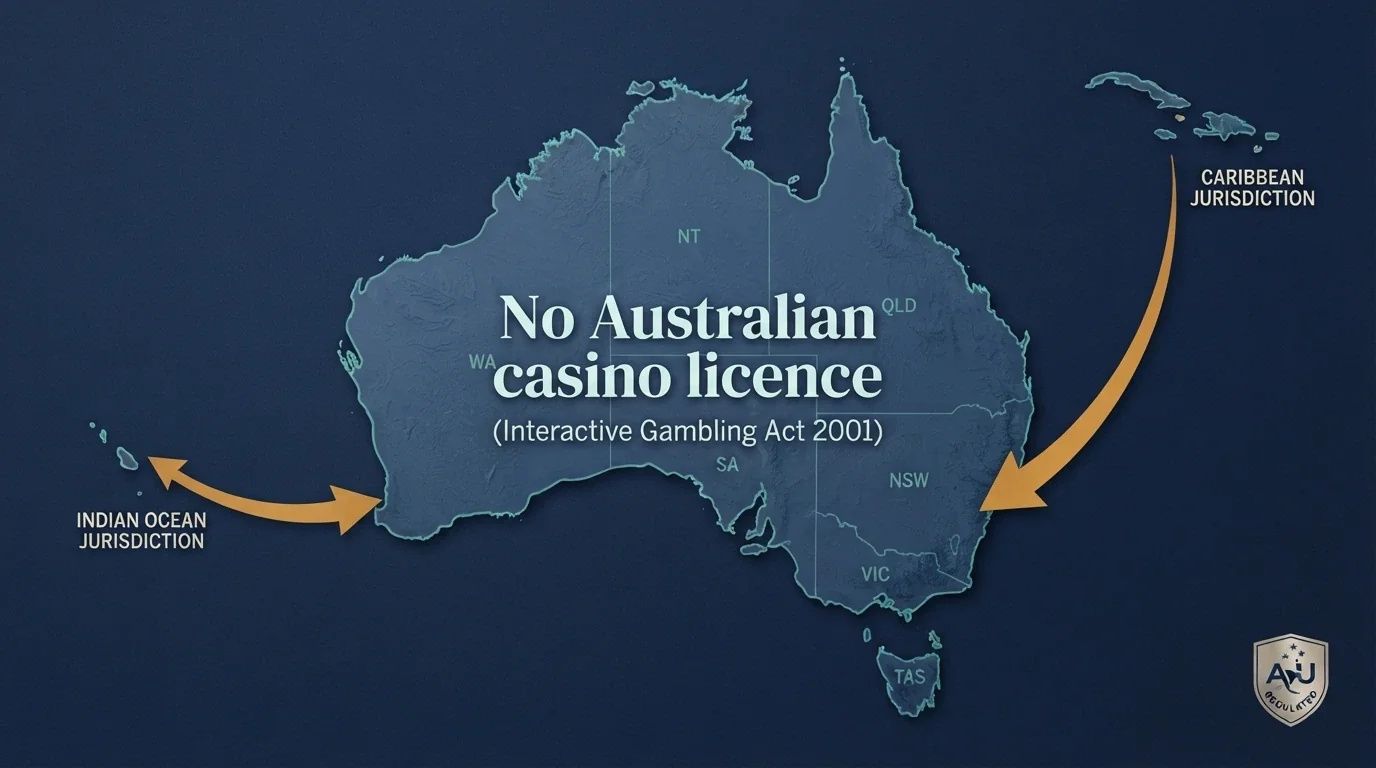
The Interactive Gambling Amendment Act 2017 strengthened the prohibition by giving the ACMA the power to direct Australian internet service providers to block illegal gambling websites and to issue formal warnings and civil penalty proceedings against operators. Since the ACMA’s first blocking request in November 2019, 1,564 illegal gambling and affiliate websites have been blocked, and more than 225 illegal services have withdrawn from the Australian market entirely.
The 2026 reform package — the Interactive Gambling Amendment (Gambling Reform) Bill 2026 — passed Parliament on 19 August 2026 and commences on 1 January 2027. The reform does not legalise online casino. It tightens the existing prohibition’s enforcement, restricts advertising, and gives banks and payment providers express authority to block transactions to illegal operators. The 1,564-blocked-sites figure is the existing enforcement record; the reform is the next step.
The Interactive Gambling Act — What It Actually Prohibits
The IGA 2001 prohibits the provision of online casino games, online pokies and in-play sports betting to persons in Australia. What it does not prohibit is wagering on sporting events and races placed before the event begins, lotteries, and keno — all of which can be offered by operators licensed by an Australian state or territory. The Northern Territory Racing and Wagering Commission (NTRWC), administered through Licensing NT, is the de facto national licensor for online wagering, with licences running up to twenty years. A bet on a horse race or a sporting event placed with an NT-licensed bookmaker before the event starts is legal. A spin on an online pokie at an offshore casino is not.
The ACMA enforces the prohibition. It investigates complaints, issues formal warnings, refers operators for civil penalty proceedings, and directs ISPs to block illegal sites. The penalty runs to A$247,500 per offence for an operator that accepts credit cards or crypto as payment for licensed wagering, with parallel civil penalty tracks for the underlying prohibition. The individual player is not prosecuted — the IGA targets the provider. The player’s exposure is the loss of consumer protection, not the loss of liberty.
The 2026 Gambling Reform — What Changes in 2027
The Interactive Gambling Amendment (Gambling Reform) Bill 2026 passed Parliament on 19 August 2026 and commences on 1 January 2027. The reform does not change what is licensed; it changes what is advertised, what inducements can be offered, and what payment providers can block.
Wagering advertising on broadcast television is restricted to no more than three advertisements per hour between 6:00 am and 8:30 pm, with a complete blackout from fifteen minutes before a live sporting event until five minutes after it ends. Radio advertisements are barred during school commute hours. Broadcasting sporting odds is banned outright. Online advertisements require logged-in, age-confirmed users with an opt-out path. Wagering advertising is banned inside sports venues and on the uniforms of players and officials. Athletes, celebrities and influencers are barred from promoting wagering products.
Direct marketing of inducements is prohibited for fourteen days after a customer signs up with a licensed wagering provider, for three months after a person deregisters from BetStop, and indefinitely for customers identified as at risk of gambling-related harm. The inducement ban closes a specific loophole in the licensed market; the offshore market is unaffected because the offshore operators are not subject to the IGA in the first place.
Banks and payment providers gain express statutory authority to block transactions to illegal gambling operators. AdStop — a national wagering-advertising opt-out register administered by the ACMA — is funded by a cost-recovery levy on licensed wagering providers, though it is not expected to be operational by the 1 January 2027 commencement date.
No BetStop, No ACMA, No Recourse — the Offshore Gap
Three protections exist in the licensed Australian wagering market. None of them reach an offshore casino.
BetStop, the National Self-Exclusion Register, launched on 21 August 2023 and covers approximately 150 licensed wagering providers in a single registration. As of 31 March 2026, 59,830 people had registered, with 37,247 active exclusions. A person self-excluded through BetStop cannot open an account or place a wager with any of the 150 covered providers for the duration of their registration, which can run from three months to a lifetime. The exclusion does not reach offshore casinos. A self-excluded Australian can still open an account and play at any offshore site in this comparison.
The ACMA enforces the prohibition on the supply side. It cannot recover money for an individual player who has been refused a withdrawal by an offshore operator. The agency’s enforcement tools are blocking requests, formal warnings, civil penalty proceedings and referral for prosecution — none of which put money back in a player’s account. A player who wins A$300 from free spins at an offshore casino and is refused the withdrawal has no domestic complaints body to approach.
Australian consumer-protection law — the Australian Consumer Law, the state and territory fair-trading Acts, the ePayments Code — does not apply to an offshore operator with no Australian presence. The operator is bound by the consumer-protection framework of its licence jurisdiction, which for Curaçao and Anjouan is materially weaker than the Australian standard. The site can be blocked by the ACMA at any time. A blocked site with a balance still on deposit is a balance no domestic mechanism can recover.
The gap is the structural feature of offshore play. It is not a footnote; it is the trade-off the player makes the moment they sign up.
Responsible Gambling — Help That Actually Works for Australians
The licensed Australian wagering market has a harm-minimisation infrastructure the offshore market does not. BetStop covers approximately 150 licensed providers; the National Gambling Helpline runs 24 hours a day, 7 days a week; Gambling Help Online provides chat and counselling. None of these tools reach an offshore casino. The harm-minimisation infrastructure that exists works only inside the system it was built for, and the offshore system is outside it.

The numbers behind the infrastructure matter. About 2.1% of Australian adults — roughly 430,000 people — experience problem gambling, with high-risk gambling at 1.8% (Australian Institute of Health and Welfare, 2022). As of March 2026, 15.1% of the Australian adult population — an estimated 3.32 million people — experience some level of harm from their own gambling behaviours or those of people close to them (Roy Morgan). Of those, 13.0% experience harm from their own gambling and 5.4% from other people’s gambling. Between March 2025 and March 2026, Australians lost A$36.0 billion to gambling, with losses increasing every year since the COVID-19 pandemic. On a per-person basis, Australians lose more to gambling than any other country.
BetStop, Helplines and Where to Get Support
The National Gambling Helpline is 1800 858 858 — free, confidential, staffed 24 hours a day, 7 days a week. Gambling Help Online (gamblinghelponline.org.au) provides online chat and counselling. BetStop (betstop.gov.au) registers a person for self-exclusion from all approximately 150 licensed wagering providers in a single step, for a minimum of three months and up to a lifetime. As of 31 March 2026, 59,830 people had registered with BetStop, with 37,247 active exclusions.
BetStop does not cover offshore casinos. A self-excluded Australian can still open an account and play at any offshore operator in this comparison. The only path to self-exclusion from an offshore casino is manual: contact the operator’s support team, request account closure, request self-exclusion. The operator is not statutorily required to honour the request; many do, some do not. The Australian licensed system’s protections end at the licensed border.
For a player who is concerned about their own gambling or someone else’s, the helpline is the first call. The BetStop registration is the second. The offshore operator’s support inbox is a third option that may or may not produce a result.
The Harm in Numbers — What the Data Says
The Australian Institute of Health and Welfare’s 2022 estimate of 2.1% problem gambling prevalence — roughly 430,000 adults — is the conservative end of the harm figure. The Roy Morgan Gambling Harm Index from March 2026 reports a broader 15.1% of adults experiencing some level of harm, which translates to roughly 3.32 million people. Of those, 13.0% — an estimated 2.86 million — experience harm from their own gambling, and 5.4% — an estimated 1.18 million — experience harm from someone else’s gambling.
The dollar figure sits behind the prevalence figure. Between March 2025 and March 2026, Australians lost A$36.0 billion to gambling. The Australia Institute’s National Gambling Toll reports the figure is increasing every year since the COVID-19 pandemic. On a per-person basis, Australians lose more to gambling than any other country. The figure includes legal forms of gambling — pokies at clubs and pubs, the TAB, lotteries — and the offshore market that operates outside the data collection.
The numbers are a context for the free-spin offer, not a separate topic. The same offshore casino that markets a 50-FS NDB is one of the access points into a market that produces these harm figures. The free-spin offer is a marketing funnel, not a neutral product, and the data behind the funnel is the data a player should read before entering it.
How We Evaluated These 50-Free-Spins Offers
The operators in this comparison were sourced from affiliate databases and public bonus pages active in the Australian-facing market — PokiesAustralia, GamblingInsider, SlotsPeak, PlayNoDeposit, CasinosHub, BonusBruce and similar aggregators. Each operator was checked against the ACMA register of blocked services and against the licence-status records on the operator’s own terms page. The evaluation criteria were the wagering multiple, the maximum cashout cap, the bonus expiry window, the spin value per spin, the eligible-game list, and the transparency of the bonus terms.
The legal-framing criterion is the one no competitor page applies. Every operator in this set is offshore. None holds an Australian casino licence. None is connected to BetStop. None is subject to ACMA enforcement on behalf of an individual player. The evaluation includes this fact as a primary criterion rather than a footnote, because it is the largest single determinant of what a player can expect if a withdrawal stalls.
The limitations are honest ones. Offshore operators change terms without notice. The research is a snapshot at the time of writing, not a continuing audit. Bonus codes expire. Eligibility rules shift. A player who arrives at any of the operators in this set should re-check the bonus terms on the operator’s site before claiming, and should treat the figures in this comparison as a starting point rather than a guarantee.
What You Should Actually Do About 50 Free Spins No Deposit
The honest summary is that a 50-free-spins no-deposit offer exists in the Australian-facing market — Bizzo is the clearest match in this set — and that every other offer on the search is either deposit-triggered, thinly documented, or both. The real take-home on any of these offers, after a 35× to 60× playthrough on A$10 of spin value and a A$50 to A$100 cashout cap, is somewhere between A$0 and the cap. The expected loss during the playthrough on a 96% RTP pokie exceeds the expected win for most players at any multiple above 30×, before the cap binds.

The offshore risk is structural. No BetStop coverage. No ACMA recourse. No Australian consumer-protection law. No guarantee the operator will pay. The site can be blocked with a balance still on deposit. The licence jurisdiction is Curaçao or Anjouan, both with weaker player-protection frameworks than the Australian standard.
If a player decides to claim, the decision is which operator carries the lowest wagering multiple, the clearest published terms, and a real bonus credit on sign-up. Royal Reels’ A$10 no-deposit chip at 30× wagering is the friendliest no-deposit offer in the set. Bizzo is the closest match to the offer as written at 40×. FairGO’s 60× is the steepest end and the hardest to clear. The remainder of the set is thin on documented terms.
If a player decides not to claim, the licensed wagering market is the only regulated path. Pre-event wagering on racing and sport with a Northern Territory-licensed bookmaker is legal, regulated, BetStop-covered, and ACMA-enforced. Online casino and online pokies are not. This offer does not describe a regulated product, and no operator in this set describes a regulated product.
For anyone concerned about their own gambling or someone else’s, the National Gambling Helpline is 1800 858 858 — free, confidential, 24 hours a day. Gambling Help Online is at gamblinghelponline.org.au. BetStop is at betstop.gov.au. The licensed system has the tools; the offshore market does not connect to them.
Frequently Asked Questions
Can I win real money from 50 free spins no deposit?
Yes — winnings from the spins are real-money credit, not bonus credit, and are withdrawable once the wagering requirement is cleared and any maximum cashout cap is honoured. The standard cap on the Australian-facing market runs from A$50 to A$200, with most offers settling at A$50 to A$100. A freak win above the cap is paid at the cap; the rest disappears.
Do I need a bonus code to claim 50 free spins no deposit?
Some offers require a bonus code at registration or at the cashier; others credit automatically on sign-up. The bonus terms page on the operator’s site is the only authoritative source. A code that is wrong, stale, or entered at the wrong stage voids the bonus. A code that the offer did not require does not credit extra spins.
What is the difference between no-deposit and deposit-based 50 free spins?
A no-deposit offer credits the spins on sign-up without requiring a deposit. A deposit-based offer requires a minimum deposit — typically A$10 to A$30 — before the spins credit. Both apply wagering on winnings and a maximum cashout cap; deposit-based offers typically run higher spin counts and lower wagering multiples. The distinction is at the claim stage, not the withdrawal stage.
What happens if I try to withdraw more than the maximum cashout cap?
The operator pays the cap amount and forfeits the remainder. The cap binds regardless of the win size, the eligible pokie’s max-win figure, or how the bonus terms are marketed. A player who values the offer at “the chance to win up to A$100” is reading the terms accurately; a player who values it at “whatever the pokie pays” is reading the marketing.
Can I use 50 free spins no deposit on mobile?
Yes. The same spins credit on the mobile site as on the desktop site, accessed through the device’s browser. Real-money offshore casino apps are not available in the Australian Apple App Store or Google Play Store. The mobile-browser experience is the standard path and is adequate for a 50-free-spin allocation on a single pokie.
Are wager-free 50 free spins available in 2026?
Wager-free free spins are the variant the search sometimes promises and rarely delivers. The pitch is that any winnings from the spins are withdrawable as cash with no playthrough requirement. It is a real category at some European-licensed casinos and at the better-run Curaçao sites that target UK and European markets. For the Australian-facing offshore market in 2026, no checked operator offers truly wager-free 50 free spins. The standard Australian-facing offers all attach a playthrough on winnings, with 30× at the lower end and 60× at the higher end. The term survives in search because it is the variant a player most wants — and a few offshore operators use it loosely, attaching a 1× to 5× playthrough and labelling the result as “low wagering” or “almost wager-free”. For an Australian player, “wager-free” should mean exactly zero playthrough on winnings. Anything labelled as such should be checked against the bonus terms page directly before claiming.