
What 200 Free Spins No Deposit in Australia Actually Mean in 2026
The phrase “200 free spins no deposit Australia” sounds like a gift. Two hundred chances to win real money, no payment required. Strip the landing-page gloss, though, and the offer is two separate instruments glued into one headline: a fixed-value spin pack tied to specific pokies, plus a bonus wallet sitting between the winnings and any withdrawal. What you actually receive is a credit with conditions, not a present. The dollar value of 200 spins at AU$0.10 is $20 of action, not $200, and every step between the first spin and a payout carries a rule the casino controls.

This page is the honest breakdown. Every brand Australians reach when they search for 200 free spins operates offshore, because no Australian licence exists for the product they offer. The marketing is the product, and the conditions are the cost. Below, you will find how the mechanism works, what the numbers actually do to your winnings, which offshore casinos carry the most Australian traffic, where the ACMA has been blocking sites, and what protection you have when an offshore operator decides to keep your balance.
Current as of 16 October 2026. Operator and licence data cross-checked against the ACMA’s public register and current AU market-share data.
Table of Contents
- The “Free Spins” Label Versus the Real Instrument
- Why Your 2026 Free Spins Are Worth Less Than You Think
- The Offshore Reality: Every “Australian” Free-Spin Casino Operates Beyond ACMA’s Reach
- The Legal Reality: Online Casino Is Prohibited in Australia
- Free Spins on Mobile: Convenience Without a Local Safety Net
- New Casinos: Why Fresh Brands Push Free-Spin Offers Hardest
- Staying Safe: Responsible Gambling When the Safety Net Has Holes
- How We Evaluated These Casinos
- The Bottom Line: What an Australian Player Should Actually Do About Free-Spin Offers
- Frequently Asked Questions
The “Free Spins” Label Versus the Real Instrument
A free spin is not a chip. It is a single play on a nominated pokie at a nominated denomination, supplied by the house. In Australia, that denomination sits at AU$0.10 to AU$0.20 per spin, which means 200 free spins at the bottom of that range equals $20 of theoretical gameplay, and at the top end $40. The casino picks the title, the spin value, the games where the winnings can be wagered, and the maximum you can ever cash out. The player picks the order in which to press the button.
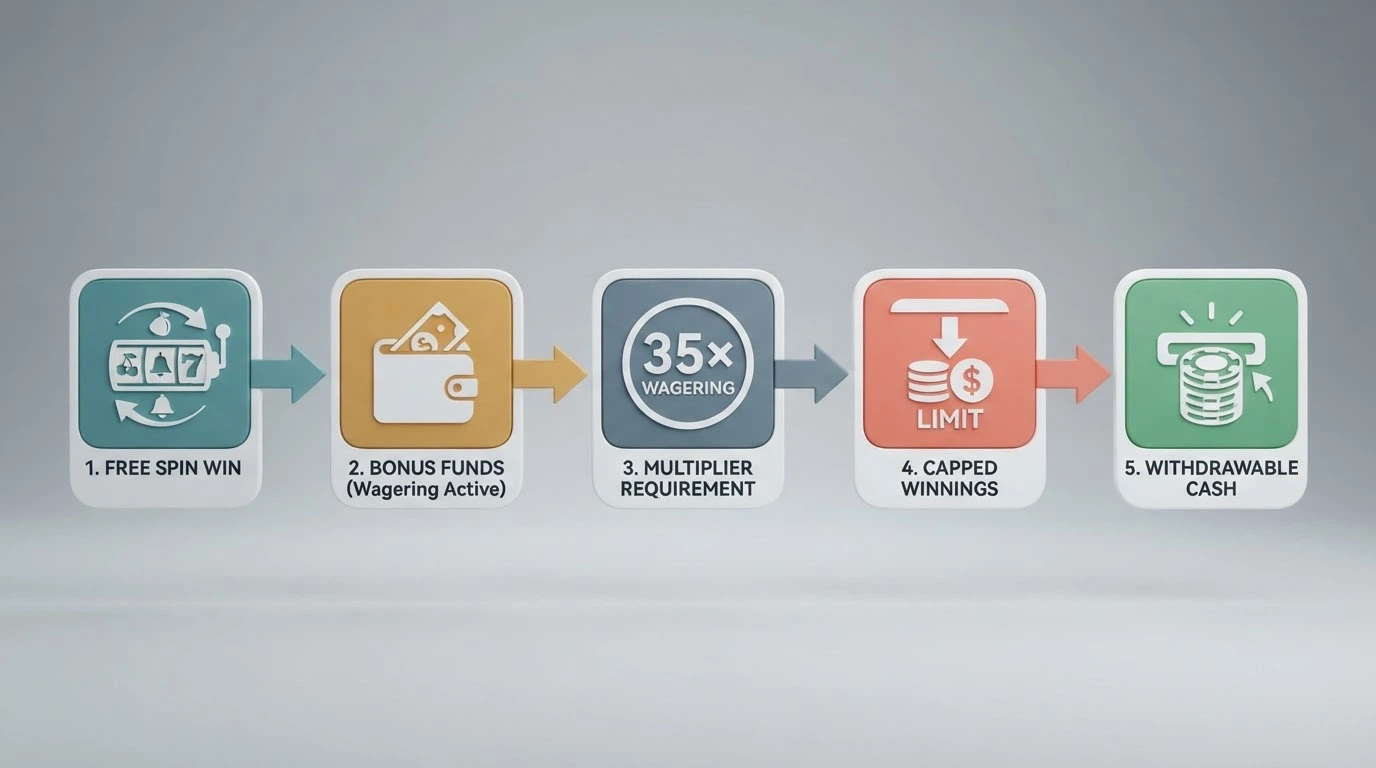
When the spins run, winnings drop into a bonus wallet, not your cash balance. That is the first condition, and it sits before every other one. To convert those bonus funds into withdrawable money you have to clear a wagering requirement (often 30× to 40× the winnings), respect a maximum cashout ceiling (commonly $50 to $100, sometimes $200 on larger promotions), and do it all inside an expiry window that can be as short as 24 hours. The phrase “real money” in these offers is conditional. Until those gates are passed, you are playing with house scrip.
This is why the headline number, the 200, is a spin count, not a dollar amount. A genuine $200 free chip with no deposit is almost never realistic at a legitimate casino. The 200 figure is the marketing ceiling, the spin denomination is the real value, and the conditions are what the casino actually sells.
Pokies, Slots, and the Australian Terminology Tangle
Pokies is the Australian word for slots. The two mean the same thing, and free-spin offers target pokies players specifically because pokies contribute 100% toward wagering requirements. Table games, crash titles and live casino games contribute 0% to 20%, which means you cannot meaningfully grind out a wagering requirement on them. The offer is built around the local term, and the local term is built around the product that satisfies the wagering.

That is also why the eligible-game list is shorter than players expect. If a casino gave you 200 free spins to spend on a low-contribution or zero-contribution game, the wagering would never clear. So the spins are tied to one or two specific pokies, usually a high-RTP or new-release title, and the choice is the casino’s, not yours.
Why Your 2026 Free Spins Are Worth Less Than You Think
Four deductions eat into the headline value, and the reader who understands them is the reader who keeps their money. Spin denomination first: 200 spins at AU$0.10 is $20 of action, at AU$0.20 it is $40. Compare that to the AU$50 to $200 range typical of Australian no-deposit bonuses in 2026, and the spin pack sits at the cheaper end. The headline is the most generous figure on the page.

Wagering second. The wagering requirement applies to your winnings, not to the spin value. If you win AU$8 from 40 free spins and the requirement is 35×, you must wager AU$8 × 35 = AU$280 before any of it can be withdrawn. That is a multiple larger than the win itself, played through one bet at a time on the eligible pokies. The chain is mechanical: spins convert to bonus funds, bonus funds pass through the wagering, and only what survives the wagering reaches a wallet you can withdraw from.
Max cashout third. Even after you clear the wagering, the casino caps what you can take out. For no-deposit chips the ceiling is commonly $50 to $100, sometimes $200 on larger promotions. The ceiling is the real product size, not the sticker on the offer. The spin headline is not the payout.
Expiry fourth. Spins often expire in 24 to 72 hours; cash credits expire in 7 to 14 days. If you have not cleared the wagering in that window, the bonus wallet and everything in it disappears. The clock is part of the offer, and a player who starts the bonus late is a player who loses the bonus.
Game restrictions sit underneath all of this. Free spins are tied to one or two specific pokies. The wagering, when it applies to a bonus credit, contributes 100% on pokies and as little as 0% on other games. So the wagering can only be cleared on the games the casino chose, with bets the casino set. The combination of restrictions turns a marketing headline into a narrow, time-bound, capped credit instrument.
No-Deposit Spins: The Core Mechanic
No-deposit means no payment method is required to claim the spins. The registration alone triggers the offer. You create an account, confirm your email or phone number, and the spins appear in the lobby, often credited automatically, occasionally behind a button you click, occasionally behind a code you enter in a field during sign-up. No card, no bank transfer, no PayID. The word “no-deposit” describes the claim stage, not the withdrawal stage.
That distinction matters. To withdraw any winnings from a no-deposit bonus you will almost always face a Know Your Customer (KYC) check, even at offshore operators. KYC means submitting identification documents, proof of address, and sometimes a payment method on file. Offshore operators’ practices vary widely. Some verify early, some verify at withdrawal, some verify only when a payout crosses a threshold. The rule holds regardless: no identity check, no withdrawal, and the identity check is the casino’s right to demand, not the player’s right to refuse.
No-Wagering Free Spins: The Holy Grail That Rarely Exists
No-wagering (or “wager-free”) free spins mean any winnings land directly in your cash balance, withdrawable on the spot. It is the structure every player wants and almost no no-deposit offer provides. The reason is simple: wagering is where the casino earns its margin on the bonus. A wager-free offer is a guaranteed loss-leader, and operators do not run those without a compensating deposit requirement elsewhere.
What does exist, and what is often dressed up to look wager-free, is a standard offer with a low print wagering figure. The way to tell the difference: look for explicit language that winnings are paid as cash, withdrawable without playthrough. If the terms describe a bonus wallet, a playthrough multiple, or any “conversion” step, the spins are not wager-free. If the marketing says “no wagering” but the terms page says otherwise, the terms page is what binds.
Sign-Up Spins: What “On Registration” Actually Triggers
The sign-up flow is the front door. You arrive at the casino, click register, enter an email, choose a password, fill in the basic details (name, date of birth, country), and submit. The bonus field is usually one of the early steps, and it is where a promo code, if any, gets entered. Some casinos auto-credit the spins to your account on successful registration. Others require an email confirmation or SMS code before the spins appear. Either way, the trigger is sign-up, and the spins arrive attached to that account.
The KYC check, as above, sits at the withdrawal stage rather than the registration stage. Offshore operators may verify identity only when a player requests a withdrawal, and the verification can require documents the player did not submit at sign-up. A player who created an account with throwaway details will find that account unusable at the payout step.
Promo Codes and Bonus-Headline Spins
Some free-spin offers are gated by a promo code. The code is entered during registration, in a field labelled “bonus code,” “promo code,” or “referral code.” If the field is left empty, the spins typically do not appear. Some casinos allow a code to be entered in the cashier after registration, but only before the first deposit. Once the account is active and the bonus is “consumed” (claimed or expired), no retroactive code entry is possible.
Promo codes exist for channel tracking. An affiliate site, a comparison publisher, or an influencer distributes the code so the casino can attribute the sign-up to that source. A public code and an influencer exclusive are mechanically identical; only the distribution channel differs. The code itself does not change the offer’s value.
“Real Money” Spins: What the Phrase Actually Means
“Real money” in free-spin offers is conditional, not absolute. Winnings sit in a bonus wallet until wagering is met, a max cashout (frequently $50 to $100 on no-deposit cash, $100 to $200 on large spin packs) is respected, and identity checks pass. Until those conditions are satisfied, the balance is house scrip, not real money. Once they are, the surviving balance is real money, withdrawable subject to the casino’s payment terms.
This is the single most misunderstood phrase in the bonus market. Players who read “real money” as a current state, rather than a possible outcome, are the ones who feel cheated when the casino refuses a withdrawal that they believed was already theirs.
Which Pokies Your Free Spins Will Actually Work On
Casinos attach free-spin offers to specific titles for a reason. High-RTP, high-volatility pokies produce memorable wins that get shared; new-release titles need exposure to build a player base. The eligible-game list is narrow by design. Below are the titles most commonly tied to Australian free-spin offers, with the specifications a player can verify on the provider’s own information page or in any reputable database.

| Pokies Title | Provider | RTP (%) | Volatility | Max Win |
|---|---|---|---|---|
| Book of Dead | Play’n GO | 96.21 | High | 5,000× |
| Starburst | NetEnt | 96.09 | — | 500× |
| Big Bass Bonanza | Pragmatic Play | 96.71 | Medium–High | 2,100× |
| Gates of Olympus | Pragmatic Play | 96.50 | High | 5,000× |
| Sugar Rush 1000 | Pragmatic Play | 96.53 | High | 25,000× |
| Sweet Bonanza 1000 | Pragmatic Play | 96.53 | High | 25,000× |
| Gates of Olympus 1000 | Pragmatic Play | 96.50 | High | 15,000× |
| Cosmic Clusters | Pragmatic Play | 96.45 | High | 5,000× |
| Big Bass Bonanza 1000 | Pragmatic Play | 96.51 | High | 20,000× |
The numbers carry a caveat: some providers ship multiple RTP configurations of the same game, and casinos sometimes run the lower configuration. A 96.5% RTP is the industry baseline; a 94% configuration cuts the expected return noticeably. Book of Dead and Starburst are the two most commonly encountered titles on this list, and both have versions where the published RTP sits below 96%. Always check the in-game paytable before assuming the headline figure applies.
The Offshore Reality: Every “Australian” Free-Spin Casino Operates Beyond ACMA’s Reach
No Australian-licensed online casino exists. The Interactive Gambling Act 2001 prohibits the supply of online casino games and online pokies to anyone in Australia, and no state or territory issues a licence for the product. Every operator that offers 200 free spins to an Australian player is therefore an offshore operation, typically licensed in Curaçao, Kahnawake, or another international jurisdiction, and none of them is regulated by an Australian authority.
The table below lists the ten most-trafficked offshore brands serving Australian players, drawn from AU market-share data. Legal status is the same for all of them: offshore, no Australian licence. The differences lie in traffic weight, confirmed specifics, and how much of the headline offer can be verified.
| Operator | Legal Status in Australia | Market Share (%) | Estimated AU Revenue (AU$) |
|---|---|---|---|
| Rocket Play | Offshore, no AU licence | 9.40 | 632,690,000 |
| Skycrown | Offshore, no AU licence | 8.55 | 436,070,000 |
| Royal Reels | Offshore, no AU licence | 2.51 | 243,990,000 |
| WinSpirit | Offshore, no AU licence | 1.55 | 110,300,000 |
| Stake | Offshore, no AU licence | 1.28 | 115,670,000 |
| Rainbet | Offshore, no AU licence | 1.28 | 83,130,000 |
| Scream Casino | Offshore, no AU licence | 0.99 | 94,870,000 |
| Fair Go Casino | Offshore, no AU licence | 0.80 | 69,110,000 |
| Bizzo Casino | Offshore, no AU licence | 0.57 | 51,380,000 |
| Rocket Casino | Offshore, no AU licence | 0.57 | 43,220,000 |
The column on legal status is uniform because the law is uniform. The column on revenue shows where Australian play concentrates: the top three brands take roughly half the measured market between them. The columns that vary case by case, wagering, max cashout, expiry, providers, are the columns where most brands are unconfirmed. That is the gap the operator-by-operator breakdown below fills.
Royal Reels: High-Value Players, $200 Max Cashout
Royal Reels ranks ninth in the AU offshore set by market share (2.51%) but pulls AU$243.99M in revenue, the third-highest revenue figure in the table. That gap between share and revenue points to a higher-value customer base: fewer players, bigger deposits, more action per head. The casino’s no-deposit bonus carries a 30× to 40× wagering requirement on the bonus amount and a $200 maximum cashout ceiling, both at the more generous end of what Australian-facing operators offer. The expiry sits at 7 to 14 days, standard for the market. The licence jurisdiction is not confirmed this run, and the operator should be treated as offshore in the sense that no Australian regulator oversees it.
Royal Reels suits a player who expects to actually clear a bonus and reach a withdrawal, because the $200 ceiling is higher than the $50 to $100 floor that most no-deposit offers set. The cost is the wagering multiple, which sits on the bonus amount rather than winnings and runs heavy. A player who finds the wagering too steep is a player who should not chase the $200 ceiling.
Skycrown: The $436M Traffic Giant with an Unconfirmed Welcome
Skycrown is the second-highest-revenue brand in the AU offshore set at AU$436.07M, behind only Rocket Play. Its market share of 8.55% places it firmly in the top tier of where Australian players go. What is missing is everything specific to the free-spin offer: wagering, max cashout, eligible pokies, and the licence jurisdiction are not confirmed this run. The brand is a destination with traffic, and the player who arrives there needs to read the current terms page rather than rely on a second-hand summary.
Skycrown suits a player comfortable verifying terms on the spot. It is not the right destination for a player who wants a published, third-party-confirmed offer before signing up, because that confirmation does not exist for this brand yet.
Fair Go Casino: The Only Confirmed No-Deposit Free-Spin Offer
Fair Go is the only brand in this set with a verified no-deposit free-spin offer. The brand operates from a .com.au domain, signals direct Australian targeting, and runs on the RTG (RealTime Gaming) platform. The offer itself is 77 free spins no deposit, with 60× wagering on winnings and a $180 maximum cashout. The wagering sits at the upper end of the market range, well above the 30× to 40× that standard free-spin offers carry. The $180 ceiling is high.
The trade-off is the wagering. 60× on winnings is steeper than what most operators set, and a player who wins small will find the playthrough larger than the win itself. The $180 ceiling helps: it is high enough that a player who clears the wagering has a real number waiting at the end. The expiry is not confirmed for this specific offer, which is a gap the player should verify before claiming. Royal Reels delivers more ceiling; Fair Go delivers more certainty that an offer exists at all.
Bizzo Casino: Mid-Tier Traffic, Thin Confirmed Detail
Bizzo ranks nineteenth by AU market share (0.57%) with AU$51.38M in revenue, putting it in the lower tier of the featured set. No no-deposit free-spin specifics are confirmed this run: the offer, wagering, max cashout, expiry, licence jurisdiction, and game providers all need direct verification on the brand’s own terms page. Bizzo is an active brand with Australian traffic, but the data on the offer itself does not yet exist.
A player drawn to Bizzo by reputation should treat the absence of confirmation as the message: read the current terms before committing registration details.
Rocket Casino: Lean Share, Unconfirmed Offer
Rocket Casino sits at the edge of the featured set (0.57% market share, AU$43.22M revenue) with no confirmed no-deposit specifics this run. It is the second-smallest brand in the table and the one a reader should expect to need the most up-front verification on. The brand exists, Australians play there, and nothing more specific can be said without checking the current terms.
Stake: The Crypto-Focused Contender with a Confirmed Curaçao Licence
Stake is the only featured operator with a confirmed licence jurisdiction (Curaçao), and it runs a crypto-native model that sets it apart from the rest of the set. Its AU market share (1.28%) and revenue (AU$115.67M) place it in the middle of the table. The no-deposit free-spin specifics are not confirmed this run, and Stake’s brand is built more around deposit-based crypto play than around no-deposit acquisition. A reader who values the licence certainty will find more of it here than at any peer in the set.
Stake suits a player already comfortable with crypto deposits who wants to know the licence jurisdiction up front. The credit-card and crypto ban that took effect on 11 June 2024 means an Australian cannot legally use crypto at a licensed Australian wagering provider, but Stake operates outside Australian law by definition. The brand’s compliance is Curaçao’s, not Australia’s.
WinSpirit: Mid-Table Operator with No Confirmed Free-Spin Detail
WinSpirit holds 1.55% of the AU offshore market and AU$110.3M in revenue, putting it in the upper-middle tier of the set. No no-deposit specifics are confirmed this run. The brand is active and the traffic is real, but the offer details need to be checked on the operator’s own terms page.
Rainbet: Lean-Share Operator, Unverified Bonus Terms
Rainbet carries 1.28% AU market share and AU$83.13M revenue. No no-deposit offer, wagering, max cashout, expiry, licence jurisdiction, or provider mix is confirmed this run. The brand exists in the AU set, and that is all the current data supports.
Scream Casino: Low-Share Operator, Unconfirmed Bonus Terms
Scream Casino holds 0.99% of the AU market and AU$94.87M revenue. No no-deposit specifics are confirmed this run. The brand rounds out the lower tier of the set and should be treated the same as any other brand with unconfirmed terms: the data is not there, the player needs to check directly.
Rocket Play: The $633M Leader with an Unconfirmed Welcome Offer
Rocket Play is the highest-revenue offshore brand serving Australian players, at AU$632.69M, with a 9.4% market share that places it first in the table. It is the brand Australians most often reach when they search for offshore casinos. Its no-deposit free-spin offer is not confirmed this run, which makes it the most consequential gap in the data: the biggest destination in the market has no third-party-verified free-spin terms.
A player who arrives at Rocket Play expecting a specific offer is a player who should read the terms on the day they sign up, not the day they saw an ad. The traffic weight is real; the offer detail is not.
The Legal Reality: Online Casino Is Prohibited in Australia
The Interactive Gambling Act 2001 (IGA) makes it an offence to provide an online casino, online pokies or in-play betting to a person physically in Australia. There is no federal licence for these products, and no state or territory issues one either. The product is banned outright, not licensed with conditions. A page about “the best licensed Australian online casino” is describing something that does not exist.
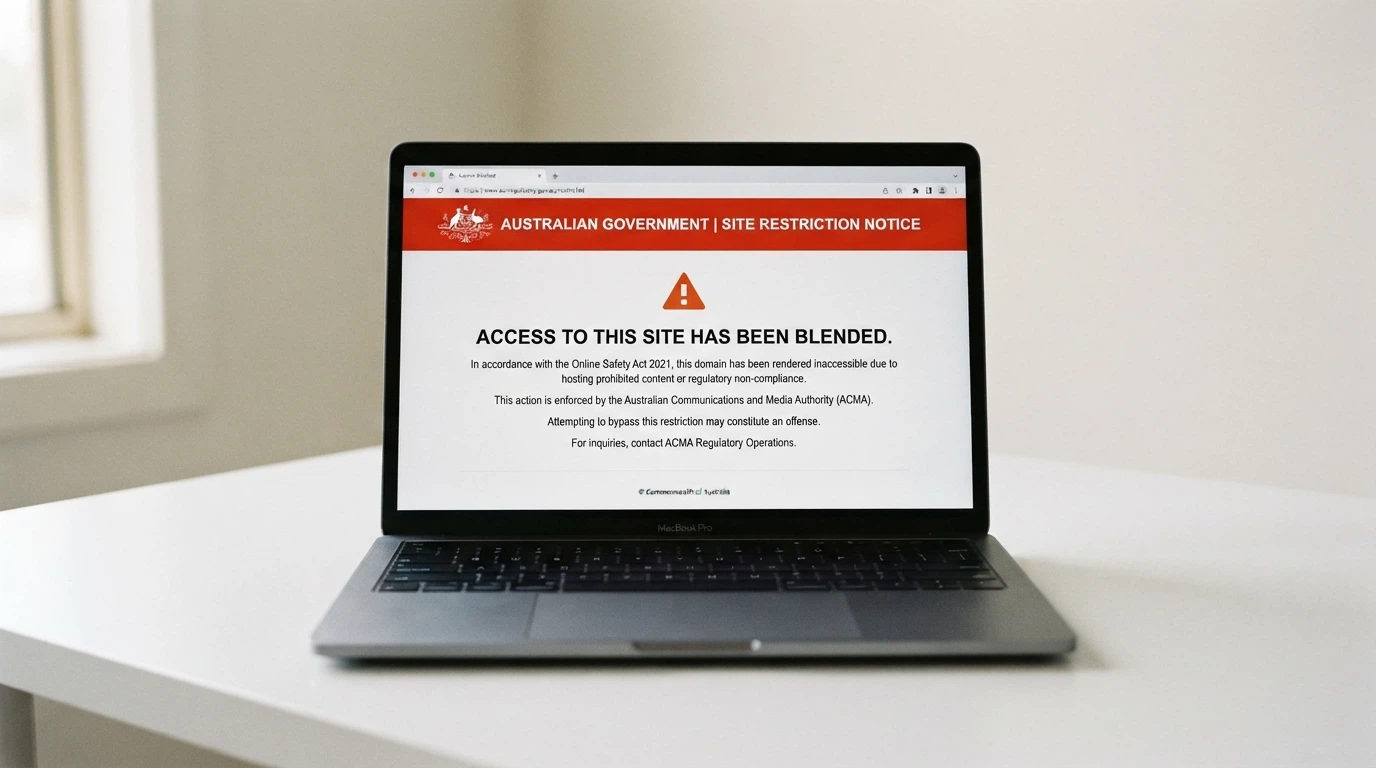
The ACMA enforces the prohibition. It investigates complaints, issues formal warnings, commences civil penalty proceedings, and directs Australian internet service providers to block illegal sites. Since its first blocking request in November 2019, the ACMA has blocked 1,564 illegal gambling and affiliate websites. More than 225 illegal services have withdrawn from the Australian market since enforcement was strengthened in 2017.
The individual player is not prosecuted under the IGA. The Act targets the provider. But the player using an offshore site forfeits the protections the Australian system would otherwise offer: Australian consumer protection law does not reach the operator, BetStop does not exclude them, there is no complaints body that can recover money, and the site can be blocked at any time with a balance still on it. The lack of prosecution is not the same as safety.
The Interactive Gambling Act: What It Prohibits and What It Doesn’t
The IGA prohibits online casino games, online pokies, and in-play betting on a sporting event once it has started. The Interactive Gambling Amendment Act 2017 strengthened the original Act by closing loopholes that offshore operators had used, and gave the ACMA the enforcement and blocking powers it now exercises.
What is permitted and licensable is narrower than most readers expect. Wagering on horse races and sporting events placed before the event begins is legal through state and territory-licensed operators. Lotteries and keno are permitted. The Northern Territory Racing and Wagering Commission (NTRWC) acts as the de facto national licensor for online wagering, because the NT’s licensing regime attracted most of Australia’s online bookmakers. None of that permits an online casino. The line between “wagering” and “casino” is the line between legal and illegal in this market.
ACMA Enforcement: 1,564 Blocked Sites and Counting
The ACMA’s enforcement is the most visible deterrent in the market. Since November 2019, it has directed Australian ISPs to block 1,564 illegal gambling and affiliate websites. Since 2017, more than 225 illegal services have withdrawn from the Australian market rather than face the blocking and penalty action. The numbers are cumulative and ongoing.
Blocking is not unbeatable. DNS-level blocking stops most Australian players from reaching the site through their normal internet provider, but VPNs, mirror domains, and direct IP access can route around it. The practical risk for a player is not that the block stops them playing; it is that the block lands mid-session, with a balance still on the site. A site blocked in Australia does not return your money. The casino is offshore, the operator has no Australian obligation, and the funds are now sitting in an account you cannot reach.
The 2026 Advertising Reform and What It Changes for Free-Spin Offers
The Interactive Gambling Amendment (Gambling Reform) Bill 2026 passed Parliament on 19 August 2026, with its measures commencing 1 January 2026. The reform touches the free-spin market directly through three mechanisms.
First, advertising caps. From 1 January 2026, no more than three wagering ads per hour between 6:00 am and 8:30 pm, and no wagering advertising from 15 minutes before a live sporting event until 5 minutes after it ends. Free-spin offers cannot be marketed inside that window.
Second, inducement cooling-off periods. From 1 January 2026, direct marketing of inducements is prohibited for 14 days after a customer signs up, for three months after a person deregisters from BetStop, and indefinitely for customers identified as at risk of gambling-related harm. A casino that emails a 200-free-spins offer to a player who registered yesterday is breaking the new rules.
Third, bank authority to block transactions. From 1 January 2026, banks and payment providers gain express authority to block transactions to illegal gambling operators. Combined with the existing credit-card and crypto ban, the practical effect is that Australian banks can refuse to send money to known offshore casinos. The free-spin offer itself does not require a deposit, but any subsequent deposit a player tries to make may be intercepted at the bank.
Fourth, the triple-lock system. Social media, streaming and other online platforms can only show gambling ads to logged-in users verified as over 18, with an opt-out option. The marketing channel narrows further.
The Credit-Card and Crypto Payment Ban: A Tell for Rogue Operators
Since 11 June 2024, credit cards, credit-related products and digital currency (crypto) have been banned as payment for online wagering in Australia, under the Interactive Gambling Amendment (Credit and Other Measures) Act 2023. An operator that fails to enforce the ban faces penalties of up to $247,500.
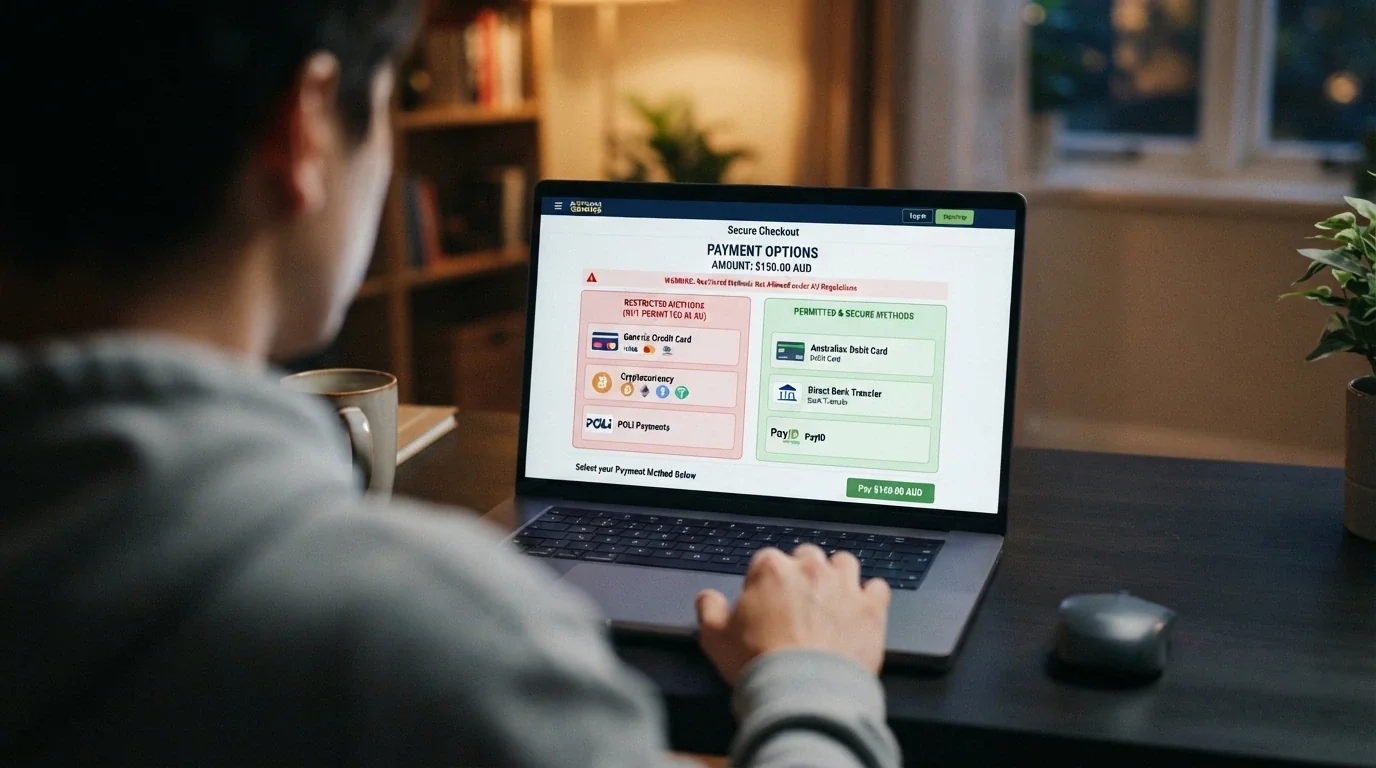
The legal deposit routes for licensed wagering in Australia are debit card, bank transfer, PayID/Osko, and BPAY. No credit. No crypto. An Australian player who lands on a casino payment page and sees a credit-card option or a Bitcoin/Ethereum option is being served by an operator that has chosen to ignore Australian rules. The credit-card and crypto ban is a tell. Offshore casinos that serve Australians will often still offer those options, because their compliance regime is Curaçao’s or Kahnawake’s, not Australia’s. The player can read the payment page as a compliance check: Australian-compliant operators offer what the IGA permits; everyone else offers what the offshore licence permits.
Free Spins on Mobile: Convenience Without a Local Safety Net
Most Australians who reach an offshore casino do so on a phone. The mobile experience is what the offshore market has spent the last decade perfecting: browser-based play that mirrors the desktop lobby, touch-optimised pokies, deposit flows built around mobile wallets, and the same 200-free-spins offer delivered to a phone screen.
A mobile-friendly casino site or a dedicated app does not change the legal reality. The casino is still offshore, the licence is still Curaçao’s or Kahnawake’s, and the ACMA’s blocking powers still apply. The mobile channel is a delivery mechanism, not a regulatory layer. The same offshore risks apply, and the same protection gaps apply.
The app-store layer adds a thin secondary check. Apple’s App Store and Google Play each have their own review policies for gambling apps, and an app that has passed those reviews is at least subject to platform-side scrutiny. The review is not an Australian gambling-licence requirement, and an app on the store is not an Australian-licensed casino. The scrutiny is commercial, not regulatory.
New Casinos: Why Fresh Brands Push Free-Spin Offers Hardest
A new casino has one problem: nobody knows it exists. The cheapest way to fix that is a generous no-deposit offer, because the offer is the marketing. The player who signs up for 200 free spins is the player the casino has acquired without paying an affiliate or an advertising network. The free spins are the customer-acquisition budget, and the bonus terms are the cost of that budget.
This is why new-casino free-spin offers tend to carry larger spin counts than established-brand offers. The casino is spending against a customer it has not yet monetised, and the larger headline helps the offer travel further through affiliate sites and search results. The terms, however, are often tighter than the headline implies.
Launch No-Deposit Offers: Bigger Headlines, Tighter Conditions
A launch offer is a balance of three forces. The casino wants the headline large enough to attract sign-ups. The casino wants the wagering heavy enough that most players will not clear it. The casino wants the expiry short enough that the player feels pressure to play before the bonus expires. The arithmetic produces offers with large spin counts, high wagering multiples (40× to 60× is common at no-deposit casinos), and expiry windows of 24 to 72 hours on the spins themselves.
The comparison to an established brand is straightforward: the new casino gives more spins and asks for more playthrough in less time. An established brand gives fewer spins and asks for less playthrough over more days. Which is better depends on the player’s appetite for pressure. A player who wants time to read the terms and play carefully will prefer the established brand. A player chasing a large headline will prefer the launch offer and should expect the wagering to swallow most of the winnings.
Staying Safe: Responsible Gambling When the Safety Net Has Holes
Australian responsible-gambling infrastructure is built for the licensed wagering system. BetStop, the National Gambling Helpline, deposit limits, activity statements, and take-a-break tools are the protections the licensed market offers. None of them reach an offshore casino.
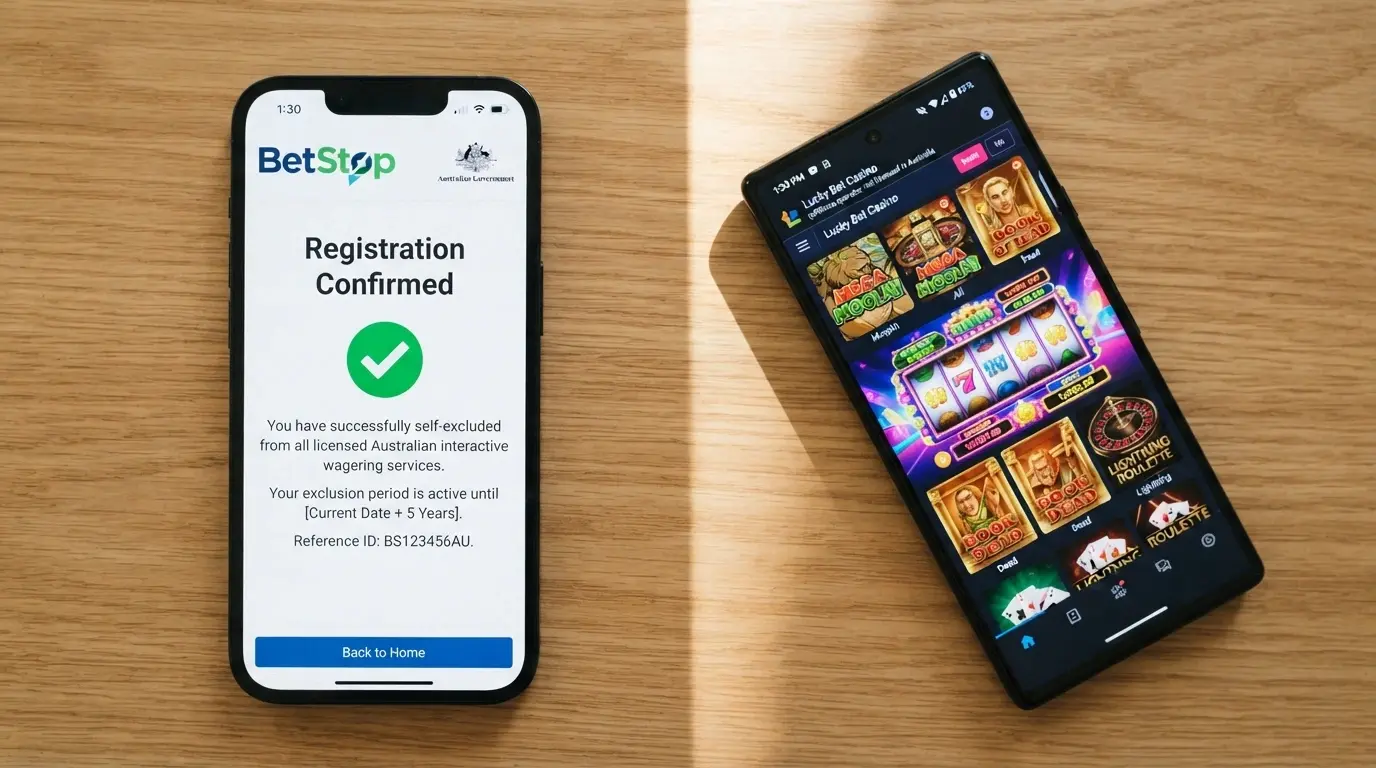
BetStop, the National Self-Exclusion Register, launched on 21 August 2023 and excludes a person from every Australian-licensed online and phone wagering service in a single registration. To the end of Q3 FY 2025–2026 (31 March 2026), 59,830 people had registered with BetStop, with 37,247 active exclusions and 22,583 completed or cancelled. The exclusions run from a minimum of three months to a lifetime, and a person cannot apply for removal in the first three months. BetStop is the single strongest consumer protection in Australian gambling, and it binds roughly 150 licensed wagering providers.
The gap is at the offshore casino. An offshore operator is not connected to BetStop, has no obligation to check it, and has no incentive to honour it. A self-excluded Australian can install an offshore casino app, deposit, claim a free-spin offer, and lose money with no Australian body able to intervene.
About 2.1% of Australian adults, roughly 430,000 people, experience problem gambling, and the Australian Institute of Health and Welfare put high-risk gambling at 1.8% in 2022. The offshore market sits outside the data-collection infrastructure that produces those numbers, so the offshore harm figure is unknown. The licensed-market figure is the floor.
Self-Exclusion at Offshore Casinos: The BetStop Gap
A BetStop registration is a single action that excludes a person from every Australian-licensed wagering provider. That is its strength and its limit. The strength is the coverage of every licensed bookmaker in the country. The limit is the boundary of “licensed.” An offshore casino is not a licensed Australian wagering provider, so BetStop does not exclude from it.
The practical effect: a person who has registered with BetStop, who has decided that wagering is harming them, who has chosen to exclude themselves, can still open an offshore casino account, claim a free-spin offer, deposit, and play. The offshore operator will not check the BetStop register because the register is not theirs to check, and they will not refuse service because there is no Australian regulator behind the refusal.
The protection gap is the difference between a self-exclusion that works and a self-exclusion that is honoured only where the law requires it. Offshore operators have no such requirement.
Practical Harm-Reduction for Free-Spin Players
The licensed-market tools do not reach offshore casinos, so the protection has to be personal. The following are the steps a player can take regardless of where they play:
- National Gambling Helpline: 1800 858 858, free, confidential, staffed 24 hours a day, 7 days a week. The line is staffed by counsellors who can help with problem gambling, debt, and family impact.
- Gambling Help Online: the online counselling and chat service, reachable through gamblinghelponline.org.au. The same counsellors, the same confidentiality, accessible from a phone or a computer.
- Self-imposed deposit limits: set a weekly or monthly cap at your bank, not at the casino. A bank-level limit survives an offshore casino ignoring your account-level setting.
- Session tracking: record every session in a notepad or spreadsheet. The casino’s activity statement does not include offshore play, so the only record is the one you keep.
- BetStop registration: if the wagering has moved from entertainment to compulsion, registering with BetStop is the strongest step available. It will not stop offshore play, but it will stop licensed Australian wagering, and the decision itself is the protection.
The harm prevalence data is real. 2.1% of Australian adults, roughly 430,000 people, are in problem-gambling territory. The free-spin offer is the entry point for many of them, because the “no deposit” wording lowers the barrier to trying it. The barrier that matters is the one the player sets, not the one the casino removes.
How We Evaluated These Casinos
The ten featured operators were drawn from AU market-share data and search-result analysis, not from a paid placement or a promotional relationship. Each brand was checked against the ACMA’s public enforcement record to confirm it is not on the whitelist of licensed providers (there is no whitelist for online casino, because no Australian licence exists for the product).
What was evaluated: confirmed legal status (offshore, no Australian licence), market share, estimated AU revenue, and any specific free-spin terms that could be verified. The wagering, max cashout, expiry, licence jurisdiction, and provider mix are reported only where research confirmed them this run. Where confirmation is missing, the page says so. Fair Go’s 77-free-spin offer with 60× wagering and a $180 ceiling is the most concrete verified detail in the set; Royal Reels’ 30× to 40× wagering and $200 ceiling comes from a published source. The remaining specifics across most brands are unconfirmed and need direct checking on the operator’s terms page.
What was not evaluated: no deposits were made, no withdrawals were tested, no KYC processes were walked through, and no game providers were independently audited. The page is a snapshot of publicly available information at a single point in time, not a live test of operator behaviour. The brands are ranked by market share as the input recorded it, not by an editorial score.
The Bottom Line: What an Australian Player Should Actually Do About Free-Spin Offers
The 200 in the headline is a spin count. At AU$0.10 per spin, the dollar value of the action is $20. At AU$0.20, it is $40. The casino picks the spin value, the eligible pokies, the wagering, the max cashout, and the expiry. The player picks when to press the button. Every gate between the first spin and a withdrawal is a gate the casino controls.
The legal reality is that no Australian licence backs this product. Every operator offering 200 free spins to an Australian player is offshore, unregulated by Australian authorities, and outside the reach of Australian consumer protection. The ACMA has blocked 1,564 illegal gambling sites since November 2019. The credit-card and crypto ban has been in force since June 2024. The 2026 reform adds advertising caps, inducement cooling-off periods, and bank-blocking authority from 1 January 2026.
The protection gap is the gap between what BetStop does and what an offshore casino ignores. Self-exclusion works at licensed Australian wagering providers. It does not work at offshore casinos, because the offshore casino has no obligation to check it.
The informed play, then, is to verify every term before claiming: the wagering multiple, the max cashout ceiling, the eligible games, the expiry window, and the licence jurisdiction. Treat the winnings as conditional credit with a hard ceiling, not as real money that belongs to you. Know that the helpline (1800 858 858) is free, confidential, and 24/7, and that the line exists for the moment the offer stops being entertainment and starts being compulsion. And never deposit more than the offer is worth to chase a withdrawal, because the offer is worth $20 to $40 of action, the ceiling is $50 to $200, and the rest of what you deposit is your money at the house edge.
Frequently Asked Questions
Are 200 free spins no deposit bonuses legal in Australia?
No. Online casino games and online pokies are prohibited under the Interactive Gambling Act 2001, and no Australian licence exists for either product. Every operator offering 200 free spins to an Australian player is offshore, typically licensed in Curaçao or Kahnawake, and is not regulated by an Australian authority. The ACMA enforces the prohibition by blocking sites, issuing penalties, and referring operators for civil action.
Can I withdraw winnings from 200 free spins without making a deposit?
Yes, in principle, and only after every condition is met. The winnings land in a bonus wallet, not your cash balance, and must clear a wagering requirement (commonly 30× to 40× on winnings for free spins) before they can be withdrawn. A maximum cashout ceiling, often $50 to $100, then caps the amount you can take out. A KYC identity check at the withdrawal stage is also standard, even at offshore operators.
Why do casinos offer 200 free spins if they lose money on the deal?
They rarely lose money overall. The free-spin offer is a customer-acquisition tool: the casino spends against a player it has not yet monetised, on the expectation that some percentage will deposit after the bonus expires. The wagering requirement and the max cashout ceiling are calibrated so that most players clear neither, and the average loss on the bonus is small relative to the lifetime value of a converted player.
What happens if an offshore casino blocks my account while I still have bonus funds?
The casino keeps the funds. Offshore operators offer no Australian consumer protection, no complaints body that can order a payout, and no obligation to return a balance on a blocked account. If the ACMA blocks the site itself, your account is unreachable through normal Australian ISPs. The funds are not recoverable through any Australian channel, and the offshore operator has no incentive to refund them voluntarily. Treat any balance at an offshore casino as funds you may not be able to access.
Do I need to verify my identity to cash out free-spin winnings?
Almost always. KYC checks are standard at the withdrawal stage even at offshore casinos, and they require identification documents, proof of address, and sometimes a payment method on file. Some offshore operators verify early, some only at withdrawal, and some only when a payout crosses a threshold. The rule is consistent: no verification, no withdrawal.
Does registering with BetStop block my account at an offshore casino?
No. BetStop, the National Self-Exclusion Register, binds Australian-licensed wagering providers only. Offshore casinos are not connected to the register and do not check it. A self-excluded Australian can still open an account at an offshore casino, claim a free-spin offer, deposit, and play. BetStop stops licensed Australian wagering; it does not stop offshore play.
Casino Apps Versus Mobile Browser: Does Either Offer More Protection?
Neither the dedicated app route nor the mobile browser route confers Australian regulatory protection. An iOS or Android app downloaded from an official store is reviewed by Apple or Google for compliance with their own platform rules, which include age-gating and content restrictions. An APK downloaded directly from a casino website bypasses that review entirely.
The practical difference: an app from the store can be removed by the platform if it violates the platform’s rules. An APK lives on the phone until the player deletes it, and the casino can update it without any intermediary. The mobile-browser route sits in between: the casino site is blocked by ISPs at the DNS level if the ACMA has actioned it, but the casino can spin up a mirror domain and route around it.
No route offers Australian consumer protection. The platform review is a check on commercial behaviour, not on gambling law. A self-excluded Australian who installs an offshore casino app will find that the app does not check BetStop and does not care that the player has registered for self-exclusion. The app takes the deposit and runs the spins regardless.