
The Pokies That Pay, the Sites That Don’t Lie, and What a “Best Paying” Pokie Actually Costs You in 2026
The phrase “best paying online pokies Australia” gets thrown around like a marketing slogan, and most pages answering it are doing exactly that — selling. The reader is supposed to scroll past a comparison table, click the top result, and trust that the headline number (a 99% RTP, a 300% welcome bonus, a 9-minute withdrawal) means what it sounds like. None of those three numbers means quite what it sounds like, and the difference is where the player’s money goes.

This page is built around that difference. Every figure comes from publicly available testing data, the ACMA’s published enforcement record, or the operator’s own terms page — not from the marketing layer that sits on top. The aim is to show what a “best paying” pokie site in Australia actually delivers in 2026: the RTP numbers that hold up, the wagering traps that quietly bleed a welcome bonus dry, the withdrawal speeds that work in real banking hours, and the offshore status that no Australian-facing review can honestly omit. Where a figure is missing from the source set, the cell stays empty rather than fabricated, because a guess dressed as a number is worse than an honest gap.
Data current as of 3 November 2026 and verified against the Australian Communications and Media Authority (ACMA) register, the Curaçao Gaming Control Board public licence search, and the Malta Gaming Authority licence register.
Table of Contents
- Why “Best Paying” Means More Than a Big RTP Number in 2026
- The Top-Paying Pokies Sites Australian Players Actually Use in 2026
- SkyCrown: 96.42% Platform RTP with 9-Minute PayID Withdrawals
- RocketPlay: 300% Welcome Bonus Across 5,000+ Pokies
- Royal Reels: A$10 No-Deposit Bonus After Phone Verification
- Stake: Crypto-First Platform with a Very Large Pokies Catalogue
- Fair Go: AUD-Focused Platform with A$20 Minimum Deposit
- Wild Tokyo: 8,000+ Pokies and a Three-Deposit Welcome Package
- King Billy: MGA-Licensed Operator with 30x Wagering on Bonus Only
- NeoSpin: 400% Welcome Match and 22-Minute PayID Processing
- Rocket Casino: Modern Slots Collection with Variable Welcome Offers
- Bizzo Casino: Curaçao-Licensed Operator with a Broad Catalogue
- How Fast Your Winnings Actually Land in Your Bank Account
- Mobile Pokies: Apps vs Browser — Does It Change What You Get Paid
- The Highest-RTP Pokies You Can Spin Online Right Now
- When the Pokies Stop Being a Game: Warning Signs and Where to Get Help
- The Offshore Reality: Why Every Pokies Site an Australian Visits Is Unlicensed
- How We Evaluated These Pokies Sites: Sources and Criteria
- Your 2026 Pokies Strategy: What to Actually Do with This Information
- Frequently Asked Questions
Why “Best Paying” Means More Than a Big RTP Number in 2026
A pokie that returns 99% of every dollar sounds unbeatable. A 300% welcome bonus sounds generous. A 9-minute withdrawal sounds instant. None of these numbers is wrong, and none of them is the whole story. A “best paying” pokie site in Australia is the site where, after you account for the volatility that a 96% RTP hides, the wagering that a 300% bonus attaches, and the offshore licence that a 9-minute PayID withdrawal does not undo, you walk away with the largest share of what you put in. That is four numbers in one, and it is the four this section unpacks.
What “Best Paying” Actually Measures for Online Pokies
RTP — return to player — is the share of all wagered money a pokie pays back over a very large number of spins, usually millions. A 96% RTP means the machine keeps 4 cents of every dollar across that sample. On any given session, with any given player, that 4% can show up as a long dry spell, a fast drain, or a freak winning streak that distorts the next hundred spins. The number is real, but it describes a population, not your evening.

That is why the same 96% RTP can feel like two different games. Hit frequency and volatility are the hidden half: how often a spin pays anything, and how lumpy those payouts are when they do. Mega Joker’s headline 99% RTP only delivers that figure under Supermeter play at maximum bet — base-game play returns between 76.9% and 85.1%, which is the same machine behaving like a much worse one. A 99% number with a 5% hit rate is not the same product as a 96% number with a 35% hit rate, and no single statistic captures the difference.
Then there is payout speed, which is not part of the RTP at all but is part of whether a site “pays” you. A A$500 win that lands in your bank in 9 minutes is paid; the same win stuck in a pending state for three working days is money you can’t use, can’t reinvest, and can’t withdraw elsewhere if the operator goes quiet. And finally, the bonus. A welcome package worth A$2,000 is not worth A$2,000 — it is worth A$2,000 minus the expected loss you take clearing the wagering requirement, which at 35x bonus only on a 96.42% platform means roughly A$2,506 in expected loss on A$70,000 of qualifying play. The “free” money is the most expensive money on the page.
How Individual Pokie RTP Compares to Casino-Wide Payout Rates
A platform RTP is the average return across the games a casino stocks — a single number that smooths over hundreds of individual titles. SkyCrown’s tested 96.42% platform RTP across 50 sampled pokies is a respectable figure, but it is the mean of a distribution that runs from the high-80s to the high-90s. Pragmatic Play, Hacksaw Gaming and Play’n GO all deploy their high-RTP variants at SkyCrown, which is why the platform average sits where it does — but a player loading a lower-RTP variant of the same provider’s game is feeding a worse machine with the same bankroll.
The gap between the best single pokie and the casino’s floor is wider than the platform RTP suggests. A 99% title like Book of 99 sits next to a Mega Moolah variant at 88.12%, and the difference is a 10.88 percentage-point spread in the house edge for what looks like a similar product from a similar lobby. A platform RTP is a useful one-line summary, but it tells you nothing about which game you will actually load at 11pm on a Tuesday. That choice is yours, and the 96% number does not make it for you.
No-Deposit Bonuses vs Deposit-Match Offers: Which One Actually Pays Better
A no-deposit bonus looks like the only free lunch in online gambling. Royal Reels’ A$10 no-deposit credit, released after phone verification, is the cleanest example in the featured set — real money credited before a deposit, with a 30x wagering requirement to clear before withdrawal. The catch is that A$10 in bonus funds, played through 30x at a 96% RTP, produces roughly A$2.88 in expected return after the wagering, and any winnings are usually capped. Jackpot Jill’s wager-free spins solve the wagering problem in one stroke but install a A$200 maximum-win cap per set, which is its own ceiling.
Deposit-match offers, by contrast, look larger and behave differently. A 100% match up to A$2,000 returns more nominal bonus money but asks for 35x wagering on the bonus, which on A$2,000 is A$70,000 in qualifying play — and the expected loss across that play at 96.42% platform RTP is roughly A$2,419, larger than the bonus itself. The choice between a A$10 no-deposit and a A$2,000 deposit match is not between “free” and “paid” — it is between a small, capped upside and a large, negative-expectation grind. For most players, the no-deposit has a better expected return per dollar of time and risk, and that is before considering the offshore status of every site offering it.
Free-Play and Demo Mode: What It Tells You About a Pokie’s Real Payout
Every serious pokie site offers a demo mode, and almost every player ignores it. That is a missed window. Demo play runs on the same math engine as real-money play — same symbols, same reels, same RNG seed — which means a session in demo mode is a genuine read on a pokie’s volatility, hit frequency and feature frequency. A player who spends an hour on Gates of Olympus in demo mode will know whether the game pays in small drips or sits dormant for fifty spins before a 50x tumble, and that knowledge is worth more than any published RTP number, because it is the player’s own experience rather than a population average.
What demo mode does not tell you is the real-money RTP, because it doesn’t reflect the real-money sample size. The headline 96.50% on Sweet Bonanza 1000 is a figure computed over millions of spins, not the hundred or two you can run in an afternoon. Demo also can’t tell you whether a casino is running the high-RTP variant or a lower-RTP rebrand — the same title can ship at 96.50% or 94.50% depending on the operator’s configuration, and demo mode rarely labels which one is loaded. Use it to learn the rhythm; use the published RTP to pick the title; use real-money play with a hard deposit limit to test whether the operator is actually running the version it claims.
The Wagering Trap: Why a Big Bonus Number Does Not Guarantee a Big Payout
The arithmetic is the argument. SkyCrown’s 100% up to A$2,000 at 35x bonus only requires A$70,000 in qualifying play before a dollar can be withdrawn. King Billy’s A$2,500 + 250 free spins at 30x bonus only asks for A$75,000. Wild Tokyo’s three-deposit package up to A$3,300 + 450 free spins at 50x on both cash and FS winnings, with a 5-day expiry, demands A$165,000 in bonus clearing plus a separate A$112,500 on the free-spin winnings — all within five days. The headline number is the smallest number on the page.
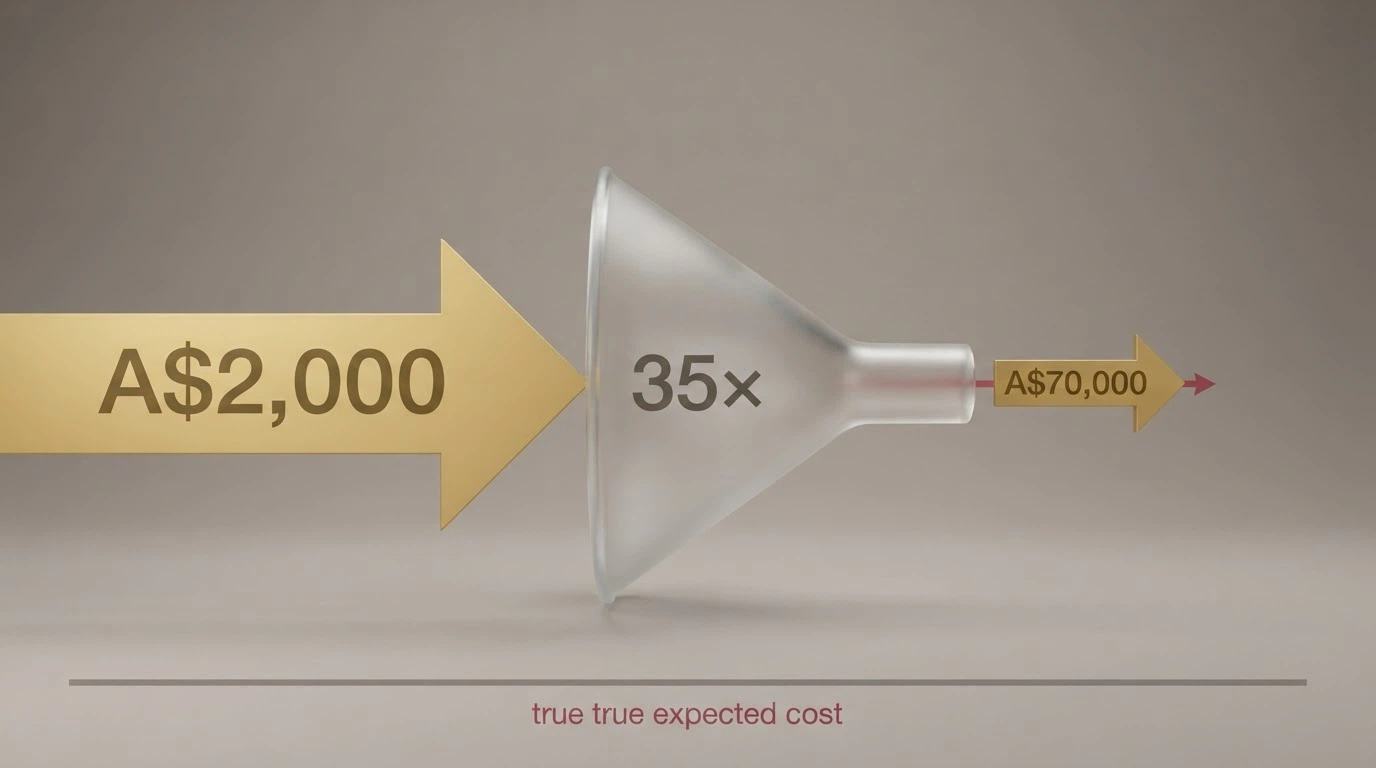
The expected loss behind the bonus tells the same story from the other side. Taking the SkyCrown package: A$70,000 in qualifying play at 96.42% RTP produces an expected loss of A$2,506 — more than the bonus itself. The bonus is not a gift; it is a trade, and the trade is “you give us 4% of A$70,000 in exchange for the chance to keep a A$2,000 credit if you happen to be ahead after grinding it through.” Most players are not ahead after grinding it through. The 30-day expiry at King Billy and the 5-day expiry at Wild Tokyo exist because the operator knows the math, and the math is on its side.
The Top-Paying Pokies Sites Australian Players Actually Use in 2026
Every site in the table below is offshore-licensed. No Australian-licensed online pokies site exists — the Interactive Gambling Act 2001 prohibits the product outright, and the ACMA actively blocks the domains. The ranking is built on four signals: tested platform RTP, real PayID withdrawal times, wagering fairness on the welcome offer, and pokies catalogue depth. Where research did not return a verified figure, the cell is empty rather than estimated, because an empty cell is honest and a guessed cell is not.
| Operator | Licence | Welcome Bonus | Wagering | Free Spins | Pokies Count |
|---|---|---|---|---|---|
| SkyCrown | Curaçao (OGL/2023/176/0095) | 100% up to A$2,000 | 35x bonus only | 100 FS | 4,200+ |
| RocketPlay | Curaçao (OGL/2024/1307/0748) | 300% up to A$7,500 | 45x bonus | 150 FS | 5,000+ |
| Royal Reels | Curaçao (ACMA-blocked) | A$10 no deposit (phone verify) | 30x bonus | — | 5,400+ |
| Stake | Curaçao | VIP / reload-race structure | varies | — | very large |
| Fair Go | Curaçao | deposit match + spins | ~35x–45x | included | wide AU library |
| Wild Tokyo | Curaçao | up to A$3,300 + 450 FS | 50x (cash + FS) | 450 FS | 8,000+ |
| King Billy | MGA | A$2,500 + 250 FS | 30x bonus only | 250 FS | — |
| NeoSpin | Curaçao | 400% up to A$10,000 | 50x bonus (per tranche) | — | 5,000+ |
| Rocket Casino | Curaçao | — | — | — | — |
| Bizzo Casino | Curaçao | — | — | — | — |
How the Ranking Works: The Four Things We Measured
Platform RTP is the first signal because it is the only one that covers the entire library rather than a single title. SkyCrown’s 96.42% across 50 sampled pokies is the highest tested in the featured set; NeoSpin’s 96.44% is a hair higher but on a smaller tested sample. Wild Tokyo’s 96.49% is the highest of the three, though the platform’s wagering terms drag the effective return down. Where a platform RTP was not tested, the cell stays empty, because a single title’s published number is not the same evidence.
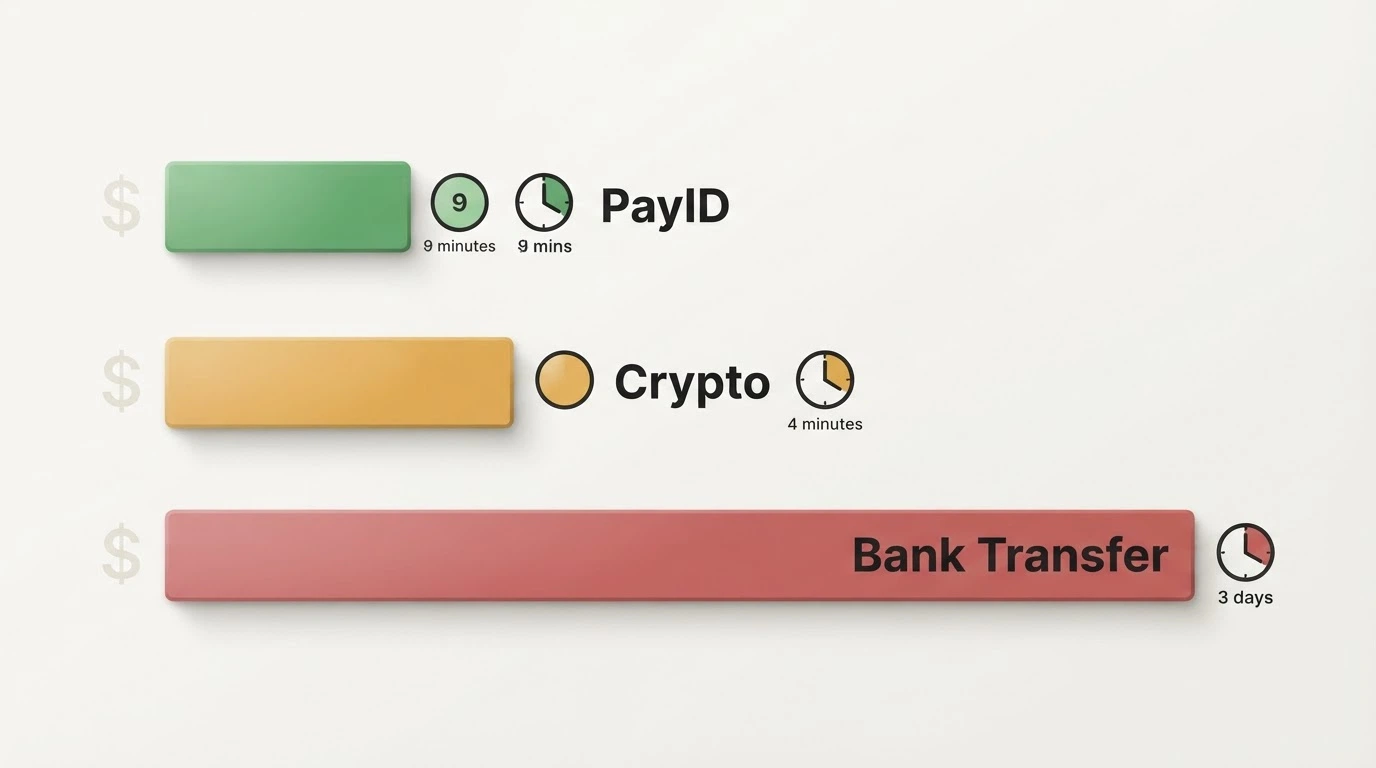
Withdrawal speed is the second, and it is the figure operators lie about most consistently. The ranking uses independently tested PayID times, not the “instant” or “24 hours” claims on the homepage. SkyCrown’s 9-minute average from 14 tests and 4-minute fastest is genuinely fast; Royal Reels’ 4 hours 12 minutes on a weekday is what an Australian bank actually delivers when it bothers to. RocketPlay’s ~25 minutes across three tests and NeoSpin’s ~22 minutes fall in the middle, both well ahead of bank transfer. Crypto is faster than PayID for every operator that supports it, and bank transfer is the slowest rail by a wide margin.
Wagering fairness is the third. A 30x bonus-only requirement is the fairest number in the featured set — King Billy and Royal Reels both sit at that mark. A 35x bonus-only figure is the market median, carried by SkyCrown. 45x at RocketPlay is heavy but not abusive; 50x at Wild Tokyo and NeoSpin is the top of the range and the one that costs the player the most. The catalogue depth ranking rounds out the four: 8,000+ at Wild Tokyo, 5,400+ at Royal Reels, 5,000+ at RocketPlay and NeoSpin, 4,200+ at SkyCrown, and a “very large” descriptor at Stake that no public count has pinned down.
Desktop Site vs Mobile App: Does the Platform Change What You Get Paid
It does not, and that is the short answer. The RTP, the bonus terms, the wagering multiples and the withdrawal options are identical on desktop and mobile at every operator in the featured set, because they are the same product running on the same server with the same RNG seed. The only things that change are the interface and the workflow — a withdrawal submitted on a phone goes through the same KYC queue, hits the same PayID endpoint, and arrives in the same bank account.
Where the platforms diverge is in the dedicated-app question. Most offshore operators in the featured set run browser-based mobile play rather than native apps, partly because app-store policies in Australia push back against unlicensed gambling apps. Where a native app exists, it offers push notifications for reload bonuses and a stored login; where it doesn’t, the mobile browser is the universal fallback. Neither path changes what you are paid.
SkyCrown: 96.42% Platform RTP with 9-Minute PayID Withdrawals
SkyCrown runs the highest tested platform RTP in the featured set and the fastest PayID withdrawal on record. Across 14 PayID tests, the average payout cleared in 9 minutes, with a fastest single withdrawal of 4 minutes — the kind of speed that makes a difference when you want to move money out before the operator changes its mind. USDT-TRC20 crypto withdrawals averaged 4 minutes across 12 tests, which is the practical floor for any rail.
The library carries 4,200+ pokies from a deep provider mix, and the operator stocks Pragmatic Play, Hacksaw Gaming and Play’n GO at their high-RTP variants — meaning the 96.50% Sweet Bonanza 1000 on the SkyCrown platform is the high version, not the 94.50% rebrand that some operators run by default. The welcome package is 100% up to A$2,000 plus 100 free spins at 35x bonus only, with a A$30 minimum deposit. Wagering is at the market median — not the friendliest in the set, but far from the steepest, and the bonus-only structure (rather than deposit-plus-bonus) keeps the qualifying play number down.
The withdrawal ceiling is the part that bites. SkyCrown caps at A$5,000 daily, A$10,000 weekly, A$15,000 monthly, with a A$30 minimum on MiFinity and A$100 on bank transfer. A large jackpot win collects across three to four weeks, not in a single payout. The licence is Curaçao OGL/2023/176/0095, held by Hollycorn N.V. — offshore, not Australian, and the ACMA can block the domain at any time. For a player prioritising tested platform RTP and real-world PayID speed over jurisdictional protection, SkyCrown delivers. For one who wants an AU-licensed option, no such option exists.
RocketPlay: 300% Welcome Bonus Across 5,000+ Pokies
RocketPlay’s headline figure is the largest deposit-match percentage in the featured set: 300% up to A$7,500 plus 150 free spins at 45x wagering on the bonus. On a A$2,500 deposit that is A$7,500 in bonus money requiring A$337,500 in qualifying play — the largest single welcome-package qualifying-play number in the table. The math on that is unforgiving: at any tested platform RTP below 97%, the expected loss across A$337,500 is larger than the bonus itself.
What RocketPlay delivers in return is depth. The 5,000+ pokies count is one of the largest in the set, PayID deposits credit in approximately 52 seconds (tested), and withdrawals averaged roughly 25 minutes across three tests. The daily withdrawal cap sits at A$5,000, and PayID clears for most Australian banks in under an hour. The licence is Curaçao OGL/2024/1307/0748, held by Scores55 Tech B.V. — a separate licence from SkyCrown’s, and one tied to a different corporate vehicle.
The wagering cost is what most review pages skip. At 45x on the bonus amount, the A$7,500 maximum match needs A$337,500 in play to clear. The expected loss across that volume at 96% RTP is A$13,500 — meaning the player is statistically A$6,000 behind before the first spin is even placed. A 300% bonus is a marketing number, not a player-favourable one, and the wagering structure is the reason. RocketPlay is the right pick for a player who values catalogue size and PayID speed over bonus economics.
Royal Reels: A$10 No-Deposit Bonus After Phone Verification
Royal Reels is the only featured operator offering a genuine no-deposit entry point, and it is also one of the few in the set where the ACMA has moved to block the domain. The A$10 no-deposit bonus, released after a phone-verification step, is real money — credited before any deposit, playable on the 5,400+ pokie library from 40+ providers, and subject to 30x wagering on the welcome bonus. That wagering is the friendliest figure attached to any welcome offer in the set.
The trade-off is in withdrawal speed and jurisdictional cover. PayID withdrawals on Royal Reels tested at 4 hours 12 minutes on a weekday — slower than SkyCrown, RocketPlay or NeoSpin, and reflecting a different operational cadence. Crypto withdrawals clear in under an hour, which is the faster rail. The Curaçao licence is displayed, the operator is undisclosed, and the ACMA has the brand on its blocking list — meaning the domain can go dark at any time and any balance on the account is at the operator’s discretion.
For a player testing an offshore platform for the first time, Royal Reels offers the lowest entry cost in the set. For a player planning a long-term relationship, the ACMA-blocking status is the headline risk, and the 4-hour PayID is the operational one.
Stake: Crypto-First Platform with a Very Large Pokies Catalogue
Stake is the crypto-native option in the featured set — deposits and withdrawals run through Bitcoin, Ethereum, Litecoin and USDT rather than PayID or bank transfer, and the platform is built around a VIP and reload-race bonus structure rather than a fixed welcome package. The 1.28% Australian market share puts it at #12 nationally, ahead of most Curaçao-only operators in the region. The licence is Curaçao, held by Medium Rare N.V.
The catalogue is the draw. Stake runs a very large pokies library, exact counts not pinned down by public testing, with the same provider depth as the larger Curaçao brands. The bonus structure is the difference: there is no headline 100% match, no A$2,000 ceiling, no fixed wagering multiple. Instead, players participate in reload races, rakeback and VIP-tier rewards that scale with volume. For a high-volume crypto player, the effective return is competitive. For a casual player depositing A$50, the welcome offer barely exists.
Withdrawal speed is fast for crypto but irrelevant for PayID — Stake is not a PayID operator. The speed story is settled at the blockchain level, not the banking level, which is the operator’s design choice and the player’s prerequisite. Stake suits a player who already holds crypto and is comfortable never touching a fiat rail.
Fair Go: AUD-Focused Platform with A$20 Minimum Deposit
Fair Go is the AUD-native option in the set — PayID-style rails, deposits and withdrawals denominated in Australian dollars, and an A$20 minimum deposit that is the lowest in the featured list. The Curaçao licence is held by Deckmedia N.V., the AU market share is 0.80%, and the library is curated for an Australian-facing audience rather than a global crypto crowd. The welcome offer sits in the 35x–45x wagering range, with free spins included as part of the package rather than as a separate headline.
The trade-off is catalogue depth. Fair Go runs a wide AU-facing pokies library but is not a 5,000+ or 8,000+ platform — the count is modest by Curaçao standards. E-wallet withdrawals are faster than bank transfer at Fair Go, which is the same pattern as every other operator in the set but worth flagging for a player without a crypto wallet. For an Australian player who wants to deposit in AUD, withdraw in AUD, and avoid the crypto rail entirely, Fair Go is the most domestically comfortable of the featured brands.
Wild Tokyo: 8,000+ Pokies and a Three-Deposit Welcome Package
Wild Tokyo runs the largest pokies catalogue in the featured set at 8,000+ titles, and the platform RTP tested at 96.49% — fractionally above SkyCrown. The welcome package is up to A$3,300 + 450 free spins across three deposits, with 50x wagering on both the cash bonus and the free-spin winnings, and a 5-day wagering expiry. The expiry is the part that demands attention.
50x wagering across a three-deposit package on an 8,000-title library, with five days to clear it, is the steepest time-pressure combination in the set. A player who doesn’t clear the requirement inside that window forfeits the bonus and any winnings tied to it. At a 96.49% platform RTP, the expected loss across the qualifying play is larger than the bonus value for most players, and the 5-day window means the player is pushed to high-volume, fast-spinning play rather than considered session management. The catalogue depth is the genuine asset; the bonus terms are the genuine cost.
The licence is Curaçao, the platform RTP is real, and the catalogue is broad. For a player prioritising game selection over bonus economics, Wild Tokyo is the largest in the set. For one chasing fair wagering, it is the worst.
King Billy: MGA-Licensed Operator with 30x Wagering on Bonus Only
King Billy is the only Malta Gaming Authority-licensed operator in the featured set, which is a different regulatory regime from Curaçao and carries a different complaint and dispute pathway. The welcome package is A$2,500 + 250 free spins across four deposits, at 30x wagering bonus only — the friendliest wagering figure attached to any deposit-match offer in the table. The minimum deposit is A$30 and the wagering expiry is 30 days, the longest in the set.
The MGA licence is not an Australian one. Dama N.V. is the operator, and the licence binds King Billy to Maltese regulatory oversight rather than Australian consumer law. For a player prioritising a single strong European regulator over a Curaçao seal, the MGA framework offers a more formal complaint mechanism and stricter segregation of player funds than the typical Curaçao licence. The wagering terms reinforce the same message: 30x bonus only, with 30 days to clear, is the most player-respectful welcome offer in the table.
The catalogue depth was not surfaced by independent testing this run, and that is the genuine gap in the King Billy profile. For a player prioritising licensing rigour and bonus fairness, King Billy is the strongest pick. For one prioritising catalogue size or tested platform RTP, the data is thinner.
NeoSpin: 400% Welcome Match and 22-Minute PayID Processing
NeoSpin carries the highest deposit-match percentage in the set: 400% up to A$10,000, at 50x wagering per tranche, on a 5,000+ pokie library. The platform RTP tested at 96.44%, and PayID withdrawals cleared in approximately 22 minutes — the second-fastest PayID figure in the set, behind SkyCrown’s 9-minute average. The licence is Curaçao.
A 400% match on a A$2,500 deposit is A$10,000 in bonus money requiring A$500,000 in qualifying play at 50x — the largest single qualifying-play number any bonus in the table generates. At a 96.44% platform RTP, the expected loss across A$500,000 is roughly A$17,800. The bonus is not a gift. It is a high-volume commitment that few players clear profitably, and the per-tranche structure spreads the requirement across deposits rather than reducing it.
For a player with a large bankroll who values a high PayID speed and a deep catalogue over the bonus arithmetic, NeoSpin’s 22-minute PayID is genuinely competitive. For one chasing a fair welcome offer, the 50x wagering is the cost of the headline number.
Rocket Casino: Modern Slots Collection with Variable Welcome Offers
Rocket Casino runs a strong modern slots lineup with a Curaçao licence, and its welcome offer varies — the figure on the homepage in 2026 is not pinned down by public testing this run, and the wagering structure changes with the active promotion. Withdrawal speed is average for the set, neither the fastest nor the slowest. The catalogue leans toward contemporary pokies releases rather than legacy titles.
The variability of the offer is the main editorial point. A welcome package that changes between visits means the player must check the current terms at sign-up, not trust a review that captured last month’s promotion. A reader who loaded Rocket Casino expecting the 300% match RocketPlay runs would find a different number, and the bonus economics shift with it. For a player who is comfortable reading the active terms page before depositing, Rocket Casino is a reasonable modern-slot pick. For one who wants a published, tested welcome offer, the absence of a fixed figure is the gap.
Bizzo Casino: Curaçao-Licensed Operator with a Broad Catalogue
Bizzo Casino is the thinnest profile in the set, and that is worth saying directly. Curaçao-licensed under TechSolutions Group N.V., with 0.57% Australian market share, Bizzo runs a broad catalogue but the welcome bonus, wagering multiple, free-spin count, PayID withdrawal time and pokies count were not carried by research this run — meaning the specific terms need to be confirmed on the operator’s own page at the moment of deposit. The licence is verifiable, the operator is real, and the brand is active, but the testing depth is shallower than for the other nine operators in the table.
For a player who has already used Bizzo and knows the active offer, this is a known-quantity decision. For a new player, the verification step is on them rather than on this page. Treat the operator as one of the set, but check the current terms before committing a deposit.
How Fast Your Winnings Actually Land in Your Bank Account
The advertised withdrawal speed is the number an operator puts on its homepage. The real withdrawal speed is the number an independent test measures when an actual bank account is on the other end. The two rarely agree, and the gap is what determines whether a win is paid tonight or next week.
What Real Payout Testing Shows: Advertised vs Actual Withdrawal Times
SkyCrown’s homepage promises fast payouts; the tested average across 14 PayID withdrawals was 9 minutes, with a fastest single transaction at 4 minutes. That is the genuine figure. RocketPlay’s ~25-minute average across three tests is the second-fastest. Royal Reels’ 4 hours 12 minutes on a weekday is what PayID actually looks like at a slower operator, and it is still faster than the “1–3 business days” most operators cite in their terms page. NeoSpin’s ~22 minutes is competitive with RocketPlay. Wild Tokyo, King Billy, Fair Go, Stake, Rocket Casino and Bizzo did not return tested PayID averages in the research set, and the absence is noted rather than filled in.
Same-method times vary between operators for reasons that have little to do with the payment rail itself. PayID is PayID — the speed is set by the receiving bank’s Osko implementation, which is near-instant for most Australian banks. What slows a payout is the queue inside the operator: how many withdrawal requests are ahead of yours, how the KYC review is staffed, and whether the operator runs a manual approval step for amounts above a threshold. A 9-minute SkyCrown and a 4-hour Royal Reels are both running on PayID, and the difference is the operator’s internal workflow.
PayID, Crypto and Bank Transfer: Which Withdrawal Method Is Fastest
PayID, with Osko settlement, is the fastest fiat rail in Australia. The tested range runs from SkyCrown’s 9-minute average to Royal Reels’ 4-hour weekday average, with RocketPlay and NeoSpin in the 20–25-minute range. For most Australian banks, PayID with Osko clears in under a minute once the operator releases the funds, and the variability is in the operator’s release step rather than the bank.
Crypto, specifically USDT-TRC20, is the speed benchmark across the set. SkyCrown’s USDT-TRC20 payouts averaged 4 minutes across 12 tests — the practical floor for any withdrawal method at any operator. The cost is the crypto prerequisite: the player needs a wallet, needs to manage the on-chain confirmation step, and accepts that a TRC20 transaction is not a PayID payment for the purposes of bank reconciliation. For a player with an existing crypto setup, the speed is unbeatable. For a player who has never held USDT, the setup cost eats the time saving.
Bank transfer is the slow lane. SkyCrown’s bank transfer minimum is A$100, and the clearing time is 3 days. The wire is real, the funds are real, and the speed is the cost of using a rail that most Australian banks still treat as a cross-border transfer even when both endpoints are domestic. For a player moving a large jackpot payout where PayID’s daily cap would force multiple transactions, bank transfer is the only way to consolidate. For routine withdrawals, it is the worst option in the set.
Withdrawal Caps and Daily Limits: What Can Actually Stop You Cashing Out
A A$10,000 jackpot win on a site with a A$5,000 daily cap does not arrive in a single payment. SkyCrown’s limits — A$5,000 daily, A$10,000 weekly, A$15,000 monthly — mean a A$30,000 win collects over two weeks, and a A$100,000 progressive jackpot win collects over seven weeks. RocketPlay’s A$5,000 daily cap produces the same shape of delay. Minimum withdrawal amounts are set by method: A$30 on MiFinity at SkyCrown, A$100 on bank transfer at SkyCrown, with method-level minimums varying across the rest of the set.
The caps are not a problem for a casual player withdrawing A$200 after a winning session. They are a problem for a player who hits a large multiplier on a high-volatility pokie and discovers that the win is paid in monthly instalments, not in a lump. Anyone chasing a progressive jackpot — Mega Moolah’s Mega tier, which seeds at €1,000,000 and hits every 6–8 weeks — needs to check the cap structure before they need it, not after.
Mobile Pokies: Apps vs Browser — Does It Change What You Get Paid
The mobile experience is the dominant one for online pokies in 2026, and the difference between a native app and a mobile browser is smaller than the marketing for either makes it sound. The RTP, the bonus terms, the wagering requirements, the KYC process, the withdrawal options and the supported payment methods are identical on both paths, because they sit behind the same account, the same operator, and the same server. A spin on iOS Safari produces the same outcome as a spin on the same operator’s desktop Chrome client, and a withdrawal requested from a phone hits the same PayID endpoint as one requested from a desktop.

The Best-Paying Pokies Sites on Mobile: What Is Actually Available
Every operator in the featured set supports mobile browser play at minimum, and that is the universal baseline. Dedicated native apps are less common among offshore operators, partly because Apple’s App Store and Google Play enforce stricter policies against unlicensed gambling apps than a mobile browser does. Where a native app exists, it offers push notifications for reload bonuses and a stored login — small conveniences rather than payout-changing features. Where it doesn’t, the mobile browser is the player-facing surface, and it does the same job.
The practical question is whether the operator’s mobile interface is good enough to deposit, verify, browse the lobby, spin, request a withdrawal, and upload KYC documents from a phone screen. The featured set all clear that bar, with variation in interface polish rather than functional gaps. For a player who has never used a mobile casino before, the experience is closer to a mobile banking app than to a desktop client translated down — and that is the right comparison to make.
Mobile Browser vs Native App: Performance, Game Count and RTP
Browser play is the universal fallback. A pokie that runs in a desktop browser will run in a mobile browser on the same operator, with the same game count, the same RTP, and the same bonus access. The performance is dependent on the phone rather than the platform: a 2019 device will stutter on a feature-heavy Megaways title regardless of whether it’s loading through Safari or a native app. A 2024 device will run the same title without issue through either path.
Native app advantages are push notifications (so the player knows about a reload race or a free-spin drop), a stored login (no password re-entry on each visit), and in some cases a slightly faster lobby load because the app caches the game library locally. None of these change what the player is paid. Where a native app genuinely diverges from a browser is in-game catalogue: a few operators run a smaller mobile library than their desktop one, and the high-RTP variant of a Pragmatic Play title may be available in the browser but not the app. The general case is parity, and the exception is worth checking before committing to a long session on mobile.
The Highest-RTP Pokies You Can Spin Online Right Now
The table below is built only from the titles research verified with a published RTP, provider, volatility and max win. Where research did not return a volatility or max win for a specific title, the cell is empty rather than estimated — and the absence of a figure is the honest answer, not a guess dressed as a number.
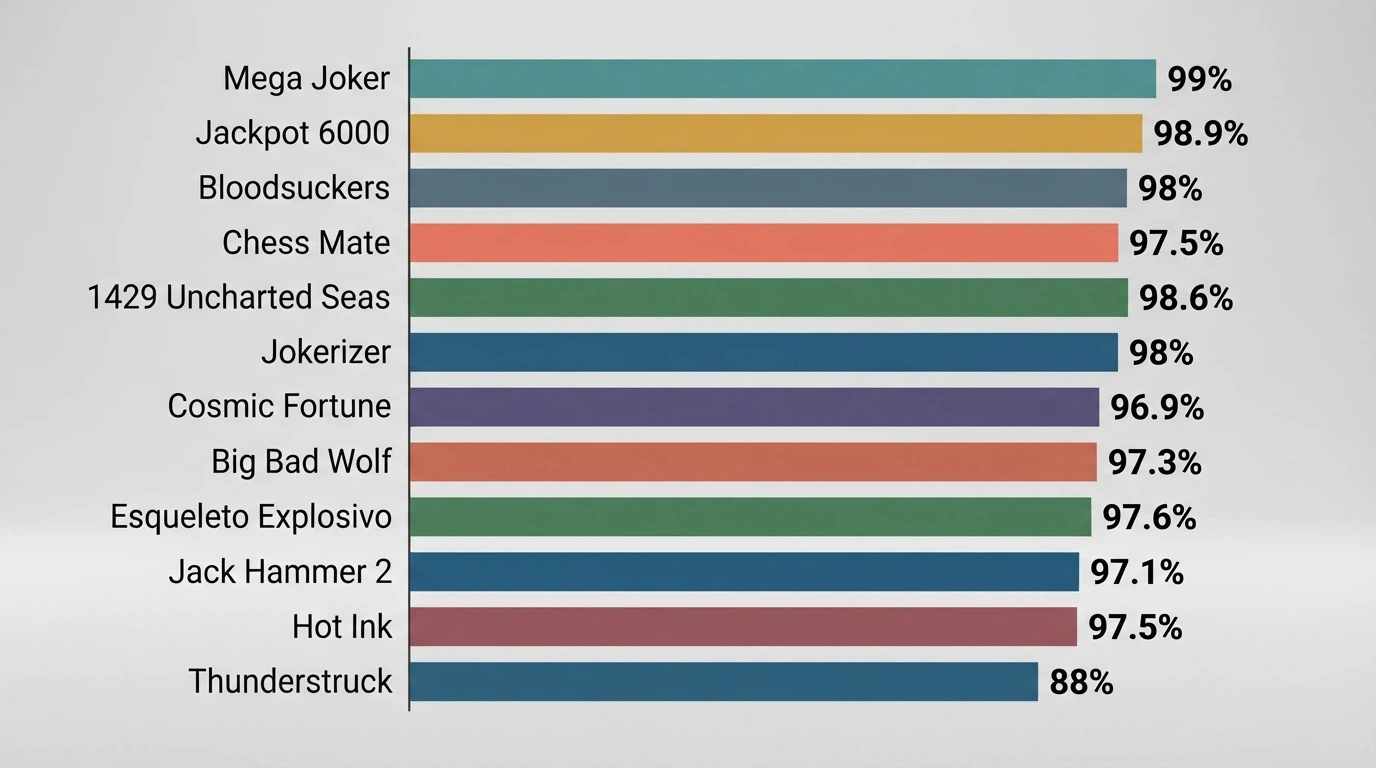
| Pokie Title | RTP | Provider | Volatility | Max Win |
|---|---|---|---|---|
| Mega Joker | 99.00% | NetEnt | — | — |
| Book of 99 | 99.00% | Relax Gaming | — | — |
| 1429 Uncharted Seas | 98.60% | Thunderkick | — | — |
| Blood Suckers | 98.00% | NetEnt | Low | 900x |
| White Rabbit Megaways | 97.72% | Big Time Gaming | High | 13,000x |
| Immortal Romance | 96.86% | Microgaming | Low–Medium | — |
| Big Bass Bonanza | 96.71% | Pragmatic Play | Low–Medium | 2,100x |
| Sweet Bonanza | 96.51% | Pragmatic Play | High | 21,100x |
| Gates of Olympus | 96.50% | Pragmatic Play | High | 5,000x |
| Book of Dead | 96.21% | Play’n GO | High | — |
| Starburst | 96.09% | NetEnt | Low | 500x |
| Mega Moolah | 88.12% | Microgaming | — | — |
How Volatility Shapes Your Pokies Session: Low, Medium and High Variance Explained
Two pokies with the same 96% RTP can play like two completely different games. The number that separates them is volatility, and it is the figure most players misunderstand most often. Low-volatility pokies — Starburst, Blood Suckers, Big Bass Bonanza — pay out frequently and in small amounts, keeping the balance on a slow drift that produces long sessions and few dramatic moments. High-volatility pokies — Sweet Bonanza, Gates of Olympus, Book of Dead, White Rabbit Megaways — sit dormant for long stretches and then pay in large bursts, producing short sessions with one or two memorable spins and a lot of quiet in between.
The bankroll implication is direct. A A$100 bankroll on Starburst will run for several hundred spins at minimum-bet levels; the same A$100 on Sweet Bonanza might vanish in fifty spins or produce a 50x tumble on spin thirty-one. The expected return over a million spins is the same, but the player experience is not. For a player with a small bankroll and a desire for long sessions, low-volatility pokies with high RTP — Blood Suckers at 98.00% — are the rational pick. For a player chasing a single large payout and willing to fund a longer dry spell, high-volatility titles like White Rabbit Megaways at 13,000x max win are the alternative.
Matching volatility to bankroll is the most underrated decision in online pokies. A high-volatility title with a small bankroll is a fast way to lose; a low-volatility title with a large bankroll is a slow way to be bored. The RTP is the same, but the player experience is the difference between a session that lasts and a session that ends.
Progressive Jackpots vs High-RTP Pokies: Two Very Different Bets
A 99% RTP pokie and a progressive jackpot pokie are not the same product with a different number — they are two different products, optimised for two different outcomes. A high-RTP pokie returns most of what it takes in across a large sample. A progressive jackpot pokie takes a slice of every wager and routes it to a prize pool that seeds at a meaningful figure and pays out rarely.
Mega Moolah is the clearest example. The advertised RTP is 88.12%, but the base-game RTP is roughly 85–87% — the remaining 3–5% is the jackpot contribution, the slice that funds the four-tier progressive system (Mini, Minor, Major and Mega). The Mega tier seeds at €1,000,000 and pays out roughly every 6–8 weeks. A player spinning Mega Moolah at 88.12% RTP is paying 11 percentage points of house edge for the chance to be the person who lands the Mega seed reset — a 1-in-50-million-scale outcome that no published RTP captures.
Book of 99 at 99.00% is the comparison case. A 99% RTP means the machine keeps 1% of every dollar wagered, with no jackpot contribution and no rare-burst mechanic. A player spinning Book of 99 is paying for a long, low-edge session; a player spinning Mega Moolah is buying a lottery ticket. The rational pick depends on what the player is actually buying — a high expected return or a long-shot payout. They are not interchangeable, and no review that calls Mega Moolah “best paying” on the strength of its headline jackpot figure is doing the comparison honestly.
Mega Joker’s 99% RTP: What the Fine Print Actually Says
Mega Joker is the most-cited high-RTP pokie in the Australian market, and the 99% figure is real — but only under conditions most players will never meet. The full 99% RTP applies in Supermeter mode at maximum bet, with the optimal strategy executed on every decision point. Base-game play, with regular bet sizes and no Supermeter engagement, returns between 76.9% and 85.1% — a figure that is lower than most of the standard 96% titles in the same lobby.
The implication is direct. A player loading Mega Joker at A$1 per spin and never engaging the Supermeter is feeding a machine that keeps 15–23 cents of every dollar. The “99% RTP” on the game’s marketing page is not the figure that player is seeing; the figure that player is seeing is closer to 80%. The conditions are not hidden, but they are not surfaced either, and the gap between the headline and the experience is one of the clearest examples on this page of a single statistic hiding the reality behind it.
For a player willing to learn the Supermeter strategy, willing to bet the maximum, and willing to accept the variance that comes with it, Mega Joker delivers 99%. For a casual player, the same game delivers 80%. The number is the same on the marketing page; the experience is not.
When the Pokies Stop Being a Game: Warning Signs and Where to Get Help
This section exists because the rest of this page is about how to find the best-paying pokie site, and the best-paying site is irrelevant to a player who has lost control of the spending that funds it. The numbers below come from Australian prevalence surveys and the ACMA’s own register, and they are included because no honest guide to online pokies in Australia can omit them.
The Numbers Most Pokies Guides Leave Out: Gambling Harm in Australia Right Now
The Problem Gambling Severity Index — the standard Australian measure — has tracked an increase in problem gambling across the last three reporting years: 1.9% of adults in 2022–23, 2.4% in 2023–24, and 2.9% in 2024–25, the last figure representing roughly 622,000 Australian adults. That is a year-on-year increase, not a one-year spike, and it sits alongside a separate Roy Morgan figure: 15.1% of Australian adults — an estimated 3,320,000 people — are experiencing some form of gambling harm as of March 2026. Of those, 13.0% are harmed by their own gambling and 5.4% by someone else’s.
Risky gambling, defined as PGSI 1+, climbed from 13.7% in 2024 to 19.4% in 2025 — almost one in five Australian adults. Online gambling now accounts for 56.1% of all gambling activity among those who gambled, and total participation in 2025 sat at 58.8% of adults. The data is current, the trend is upward, and the offshore nature of the product means the player-protection regime that covers licensed wagering does not extend to the sites in this article.
The harm is not evenly distributed. The 78% of BetStop registrants who are under 40, the 38% who chose lifetime exclusion, the 622,000 problem gamblers and the 3.32 million experiencing harm — these are not separate populations. They overlap, and the growth in the PGSI-positive rate is the figure to watch.
Where to Get Help: Helpline, BetStop and the Tools You Actually Have
Three concrete steps exist for an Australian player who is concerned about their own gambling or someone else’s. The first is the National Gambling Helpline on 1800 858 858 — free, confidential, staffed 24 hours a day, seven days a week. The second is Gambling Help Online at gamblinghelponline.org.au, which offers live chat, email counselling and forums. The third is BetStop, the National Self-Exclusion Register, which went live in August 2023 and has recorded 67,480 registrations as at 31 July 2026, of which 41,290 exclusions remain active.

BetStop binds Australian-licensed wagering services only. An offshore casino is not connected to the register and will continue to accept deposits from a self-excluded person — the operator has no obligation under Australian law to honour an Australian self-exclusion, and most do not check against the register. That is the offshore gap, and it is the one the 2027 reform package begins to close by giving Australian banks the authority to block transactions to illegal gambling operators.
For a player who has registered with BetStop and is still able to deposit at an offshore site, the practical answer is the deposit-limit tool at the offshore site itself — most Curaçao-licensed operators offer a self-set deposit cap, and using it is a real step. The licensed-wagering alternative is to set a deposit limit at the sportsbook or racing book, where the customer-protection framework is enforceable. Neither path replaces the helpline, and the helpline is the first call to make when the play stops being entertainment.
The Offshore Reality: Why Every Pokies Site an Australian Visits Is Unlicensed
The Interactive Gambling Act 2001 makes it an offence to provide online casino games or online pokies to a person in Australia. There is no licence — federal, state or territory — for online pokies anywhere in the country. Every operator in the table above is offshore. Every brand in this article is offshore. The product is prohibited in Australia, and the prohibition is enforced.
The Interactive Gambling Act: Why Australia Licensed Zero Online Pokies Sites
The IGA was passed in 2001 and strengthened by amendment in 2017. It prohibits the provision of online casino games and online pokies to anyone in Australia, and the prohibition covers every operator regardless of where the operator is incorporated. What is licensed is wagering on races and sport placed before the event begins, lotteries and keno — those products are permitted and licensed by state and territory regulators, with the Northern Territory Racing and Wagering Commission (NTRWC) acting through Licensing NT as the de facto national licensor for online bookmakers.
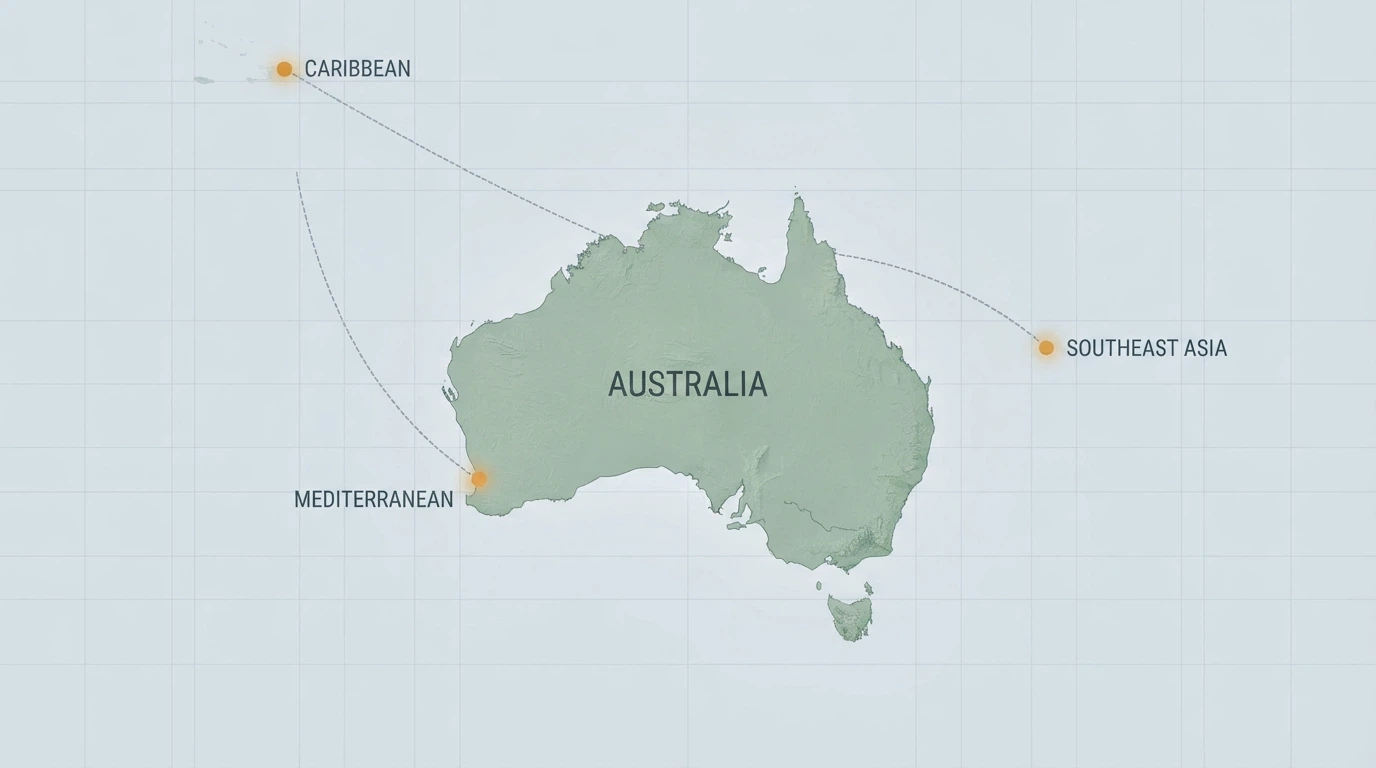
The gap that matters for this page is the absence of an online casino licence. An Australian player who wants to bet on a horse race or a sports match can do so through a licensed bookmaker, with Australian consumer protection, BetStop coverage, and the full suite of responsible-gambling tools. The same player who wants to spin a pokie online has no licensed option. The licensed market does not include the product.
ACMA Enforcement at Scale: 1,564 Sites Blocked and 225 Services Gone
The Australian Communications and Media Authority enforces the prohibition. Since its first blocking request in November 2019, the ACMA has had 1,564 illegal gambling and affiliate websites blocked by Australian ISPs as of March 2026, and more than 225 illegal services have withdrawn from the Australian market since the 2017 enforcement strengthening. The blocking pipeline is ongoing, and the blocks cover both operator domains and affiliate marketing sites that promote them.
The 11 June 2024 payment-method ban sharpened the teeth further. Credit cards, credit-related products and cryptocurrency are banned as payment for online wagering, with penalties up to A$247,500 for operators that fail to enforce the ban. An Australian who is asked for a credit card or crypto deposit by a gambling site is being served by someone outside the Australian rules — the payment method is itself a tell. The 2026 reform package, commencing 1 January 2027, adds a further mechanism: Australian banks gain the authority to block transactions to illegal gambling operators, which is the first time the prohibition has had a direct banking-rail enforcement layer.
What Using an Offshore Casino Actually Means for Your Money
The IGA targets the provider, not the player. An individual Australian is not prosecuted for spinning a pokie at an offshore site. That is the legal position, and it is the position most offshore operators will point to when reassuring a new account. The practical position is different.
An offshore casino is not connected to BetStop, and the operator has no obligation to honour an Australian self-exclusion. The operator is not covered by Australian consumer law, and a refused withdrawal or a voided win has no Australian recourse — the dispute goes to the Curaçao Gaming Control Board or the Malta Gaming Authority, depending on the licence, and the resolution is rarely fast. The domain can be blocked at the DNS level at any time, and a balance on the account when the block lands is, in practice, at the operator’s discretion. The site can change its terms, void bonuses, or close the account, and the player has no domestic authority to appeal to.
“Not illegal for you” is not the same as “safe”, and the difference is the entire reason this section exists. A player using an offshore casino is taking on real risk that an Australian-licensed wagering customer does not take on, and that risk is invisible until it isn’t. The 2027 reform, by giving banks the authority to block transactions, begins to close the gap — but in 2026, the gap is still open.
How We Evaluated These Pokies Sites: Sources and Criteria
The data on this page comes from four sources, used in this order: the ACMA register and published enforcement record, used to verify that no operator in the featured set holds an Australian licence and to confirm blocking status where applicable; the Curaçao Gaming Control Board and Malta Gaming Authority public licence registers, used to verify the licence numbers and operating entities cited; independent payout testing data, used for platform RTP figures, withdrawal speed averages and PayID processing times; and each operator’s own terms page, used for welcome bonus structures, wagering requirements, free-spin allocations, and withdrawal limits.
The operator set is the ten brands in the table above. The ranking criteria are platform RTP where tested, real PayID withdrawal times from independent testing rather than advertised claims, wagering fairness on the welcome offer, and pokies catalogue depth as a proxy for high-RTP variant availability. There is no proprietary weighting formula: the criteria are listed, the evidence is cited, and the ordering reflects the combined signal. Where a figure was not available from any of the four sources, the cell is empty.
The legality framing — that every operator in the set is offshore and that the player is using an unlicensed product — is stated throughout, not buried in a footnote. The offshore status is not a sidebar to the ranking; it is the operating context, and any reader who lands on this page should leave understanding that no operator here is Australian-licensed for online pokies, because no such licence exists.
Your 2026 Pokies Strategy: What to Actually Do with This Information
A reader who has made it this far has the four numbers, the ten operators, the high-RTP titles, and the offshore context. What follows is the order to use them in.
Pick a pokie by verified RTP, not by marketing claim. The table in the section on high-RTP titles is the shortlist; the research-verified providers are NetEnt, Relax Gaming, Thunderkick, Pragmatic Play, Play’n GO, Big Time Gaming and Microgaming. A pokie outside that list may be excellent, but its RTP is not on this page, and the page’s job is the verified set, not the global catalogue. Check the volatility before loading the game — a 99% RTP on a high-volatility title is a different bet from a 98% RTP on a low-volatility title, and the bankroll implication is direct.
Read the wagering number before the bonus number. A A$2,000 bonus at 35x bonus only is A$70,000 in qualifying play and a negative expected value; a A$500 bonus at 30x bonus only is A$15,000 in qualifying play and a smaller negative expected value. The bonus number is the smallest number on the bonus page. The wagering is the cost. The expected loss is the answer.
Choose a withdrawal method matched to the operator’s tested speed, not its advertised one. PayID on SkyCrown clears in 9 minutes; PayID on Royal Reels clears in 4 hours. Both operators claim “fast payouts” on their homepages, and both are telling the truth by their own definition. The tested figure is the one that matters. Crypto is faster than PayID for every operator that supports it, and bank transfer is the slow lane for every operator.
Never deposit through a method the law bans. Credit cards and crypto are banned as payment for online wagering in Australia from 11 June 2024, and the prohibition is enforced through the operator. A site that asks for a credit card or a crypto deposit from an Australian is operating outside the Australian rules, and the payment method is itself the tell. The ban does not extend to every offshore site, but the principle — that the rail you deposit through reflects the regulatory environment you are playing in — is sound.
Set a deposit limit before the first spin. Most operators in the set offer a self-set deposit cap; use it. A A$200 weekly cap that the player cannot override is a different tool from a A$200 weekly cap that the player can raise at any time, and most offshore operators run the latter. A hard limit set at sign-up, before the first session, is the responsible-gambling mechanism that is hardest to bypass and easiest to forget.
Check the one number on every pokie before loading it: the RTP variant the operator is running. Sweet Bonanza ships at 96.51% in the high-RTP variant and 94.50% in the lower rebrand. The lobby icon usually doesn’t tell you which one is loaded. The game’s information panel does, on every serious operator. Two percentage points of RTP is the difference between a 4% house edge and a 6% house edge, and over a session of a few hundred spins, it is the difference between a small loss and a larger one.
The one number to check on the operator, before the first deposit, is the licence and the withdrawal cap. A Curaçao licence is not an Australian one. An A$5,000 daily cap is a multi-week payout on a large jackpot. A 4-hour PayID is not a 9-minute PayID. These figures are in the table at the top of this page, and they are the difference between a player who is choosing with information and a player who is choosing on marketing copy.
Frequently Asked Questions
Are gambling winnings taxable in Australia?
Gambling winnings are not assessable income under section 6-5 of the ITAA 1997, and gambling losses are not deductible under section 8-1. The exception is a person carrying on a business of betting, in which case the ATO’s IT 2655 treats the activity as assessable. Recreational players — the audience for online pokies — do not pay tax on pokie wins and cannot offset losses against other income.
How do wagering requirements affect the real value of a pokies bonus?
A wagering requirement multiplies the bonus amount by a fixed factor and demands that total in qualifying play before a withdrawal. A A$2,000 bonus at 35x bonus only is A$70,000 in play, and at a 96% platform RTP the expected loss across that play is roughly A$2,800 — more than the bonus itself. The bonus is not free money; it is a trade with a negative expected value for the player.
What is the difference between high RTP and progressive jackpot pokies?
A high-RTP pokie returns most of what it takes in across a large sample — Book of 99 at 99%, Blood Suckers at 98%. A progressive jackpot pokie routes 3–5% of every wager to a prize pool — Mega Moolah at 88.12% base RTP, with the Mega tier seeding at €1,000,000 and paying out every 6–8 weeks. High RTP is a low-edge product; progressive jackpots are a lottery ticket with a worse base return.
Do credit cards work for online gambling deposits in Australia?
No. Credit cards, credit-related products and cryptocurrency are banned as payment for online wagering in Australia from 11 June 2024 under the Interactive Gambling Amendment (Credit and Other Measures) Act 2023. Penalties for operators that fail to enforce the ban are up to A$247,500. An operator requesting a credit card or crypto deposit from an Australian is operating outside the Australian rules.
Can I use PayID to deposit and withdraw at online pokies sites?
Yes, at the operators that support it. SkyCrown, RocketPlay, Royal Reels, NeoSpin, Fair Go and most of the featured set support PayID for both deposits and withdrawals, with tested withdrawal times ranging from 9 minutes (SkyCrown) to 4 hours 12 minutes (Royal Reels). Crypto is faster — USDT-TRC20 on SkyCrown averaged 4 minutes — but PayID remains the dominant fiat rail.
What is BetStop and does it cover offshore pokies sites?
BetStop is the National Self-Exclusion Register, live since August 2023 and administered by the ACMA, with 67,480 registrations as at 31 July 2026 and 41,290 active exclusions. It binds Australian-licensed wagering services only. An offshore casino is not connected to the register and will continue to accept deposits from a self-excluded person. The 2027 reform gives Australian banks the authority to block transactions to illegal operators, which begins to close that gap.