
What an A$5 Deposit Actually Buys at an Australian Online Casino
A$5 sounds like a small, safe way to test an online casino. For an Australian player in 2026, it is mostly a search-results artefact: every “A$5 deposit casino” page that ranks at the top of a search is pointing at an offshore site, on a route that a fiat AUD deposit cannot actually take. The deposit works for the operator’s marketing, not for the player who expects to fund an account, claim a welcome offer and play.

A$5 buys something. It does not buy very much, and it does not buy what the page that sent you here implied. This article is what the deposit really gets a player in 2026, why most methods refuse to take it, and what the offshore route costs the person paying for it.
Verified as of 30 October 2026 against the ACMA enforcement register and operator terms.
Table of Contents
- The A$5 Casino Deposit in Australia: What It Actually Buys in 2026
- How to Move A$5 Into an Australian Online Casino (And Why Most Methods Say No)
- Australia’s Lowest-Deposit Online Casinos: The 2026 Ranking
- The Pokies You Can Actually Spin With a $5 Deposit
- Why Your $5 Deposit Rarely Unlocks a Casino Bonus in Australia
- $5 Deposit Mobile Casinos: Low-Stakes Play on Your Phone in 2026
- Is a $5 Deposit Online Casino Legal in Australia? The Uncomfortable Answer
- New $5 Deposit Casinos Launching for Australian Players in 2026
- Playing Within Your Limits: Responsible Gambling at Low-Stakes Casinos
- How We Evaluate $5 Deposit Casinos for Australian Players
- What to Do With Your $5: The Verdict on Low-Deposit Casino Play in Australia
- Frequently Asked Questions
The A$5 Casino Deposit in Australia: What It Actually Buys in 2026
The $5 Deposit Floor: Why It Exists as a Marketing Number
The A$5 minimum on the page you clicked exists because the operator wants to rank for an Australian player who is shopping on price. A$5 deposits work — the search box takes them, the affiliate tracker sees them, and the landing page that optimises for “lowest deposit casino Australia” wins the click. What does not exist, on the licensed Australian market, is a regulator-approved place to spend it. No online casino licence exists in Australia, so every site with a polished “A$5 deposit” button is either offshore or dressed up to look like one. The marketing floor is doing one job; the rail behind it has a different one.
The structural reason A$5 fiat so rarely clears comes down to processing cost. A A$5 debit-card ticket carries roughly A$0.40 to A$1.00 in processor and interchange fees, a cost ratio of eight to twenty per cent on the transaction itself. Payment service providers know the maths is uneconomic on a single ticket that small, so they cap it: per-transaction floors at Australian-facing casinos sit between A$10 at the soft end and more commonly A$20. Some PSPs — Visa among them, in effect — will pass the AUD 10 minimum as the published floor for casino merchants. A player depositing less means the request is rejected at the processor level, before the casino ever sees it. The A$5 number lives on the affiliate page because the affiliate page can write anything; the actual transaction gets stopped at the door.
Neosurf and PayID sit elsewhere on the spectrum. Neosurf vouchers sold at the Australian retail floor start at A$10, which the few operators that accept them honour. PayID is faster and A$20 at the casinos that carry it. Bitcoin, USDT and a handful of altcoins are the only places a true AU$5 deposit lands today — a point the next sections take up in detail.
There is no honest AU$5 fiat-deposit casino for Australian players in 2026. The figure is a search-result marketing claim, not a product — a ranking claim dressed as a transactional fact. Understanding that one thing changes how every block that follows on this page is read.
A$5 vs A$10 vs A$20: The Real Deposit Tiers That Matter
Once this search-result marketing claim is named, what an Australian player actually encounters at the deposit screen falls into three tiers, each with a different door and a different prize.
The lowest genuine tier is the crypto route, and the practical entry point there is around A$5 in USDT-TRC20 once gas is accounted for. Bitcoin works on paper down to fractions of a cent, but the network fee on a Bitcoin transaction makes anything under A$5 economically silly. USDT on the Tron rail clears fast, costs almost nothing to move, and is the deposit method that survives at the bottom of the price ladder. It is also the only sub-A$10 route that processes without a fight, which is why almost every “true A$5 deposit casino” claim is shorthand for “cryptocurrency accepted”. There is no Australian consumer-protection help for it, but the rails work.
The middle tier runs A$10–A$20 by fiat. Neosurf vouchers bought in Australian retail and online start at A$10, and the operators that take them honour the floor. Cards — Visa and Mastercard debit, primarily — settle somewhere between A$10 and A$20 depending on the casino. PayID, the fastest domestic rail, sits at A$20 on the casino side even though the NPP clearing time is under a minute. The A$10–A$20 band is where most “low-deposit” Australian-facing casinos list their play-minimums, even when the figure they advertise in headline copy is A$5.
The third tier, A$20–A$30, is the lowest threshold at which a welcome bonus typically triggers. Eight of fifteen Australian-facing offshore brands in a recent survey enforced a higher minimum for bonus eligibility than for play — a player deposits A$20, claims to have triggered a 100% match, and finds the smaller print has quietly required A$30 to release the bonus money. The deposit gets the player through the door; the bonus minimum lives in the next room.
What $5 Gets You: Spins, Time, and Expected Value at Minimum Stake
Translate A$5 into what it spends, and what it costs to spend it. Five dollars at a minimum bet of $0.10 buys fifty spins. At $0.25 — the floor on heavier titles like Wolf Gold — it buys twenty. Those numbers are not just arithmetic; they are the entire session. At five seconds per spin, fifty spins is four minutes, twenty rolls is one minute forty. A bonus-eligible bank with A$5 in it is not a night at the pokies; it is two coffees’ worth of time.
At a 96% return-to-player — the lower band of “good pokies” — every dollar spun through returns an average of $0.96, so the expected loss on fifty $0.10 spins at 96% RTP is roughly $0.20. The session runs about four minutes. Cost per minute: around five cents in expected house edge. No headline pays back more than the math allows, no matter what the bonus copy reads like. The A$5 in the wallet is a tiny ticket into a machine with a fixed edge, and the edge takes its share first.
The deposit is a trial, not an investment. It is useful for one thing: deciding whether the operator under test feels worth a larger top-up. Read it that way, and A$5 turns out to be a fine price for a smoke test. Expect it to do anything else, and the maths punishes the expectation.
How to Move A$5 Into an Australian Online Casino (And Why Most Methods Say No)
The Fiat Problem: Why Cards and Bank Transfers Block Small Deposits
Cards and Australian bank rails are not rejecting A$5 out of malice; they are following cost logic. A A$5 debit card transaction costs the merchant the same interchange and processing fee as a A$50 one — the figure is small in dollar terms, huge in percentage terms. Per-transaction floors exist because a casino merchant cannot make money at the bottom of the price ladder when PSPs take their cut on every ticket. The federal layer sits underneath that: since 11 June 2024, credit cards and credit-related products have been banned as a payment method for any licensed Australian wagering service. Offshore casinos accept them anyway, which is itself a flag — a payment method banned for the licensed market is not how an Australian legal operator would move money.

Bank transfers and BPAY sit above card rails in minimum terms. Direct debit — which is how many offshore casinos try to claim “Australian bank account” coverage — either comes through the New Payments Platform as PayID/Osko and applies the casino’s A$20 floor, or it queues in standard bank-transfer windows with a wider minimum and a slower settlement. There is no Australian domestic rail that receives a A$5 deposit at an offshore casino on a regular basis.
Cryptocurrency: The Only True Sub-A$10 Deposit Route in 2026
Crypto is the one category where A$5 actually lands. Bitcoin on the right network clears almost any size; USDT on the Tron rail (USDT-TRC20) clears with negligible fees at any meaningful size; Ethereum L2 and Solana sit somewhere behind. The reason crypto gets a separate treatment from everything else is that there is no intermediary doing a per-ticket cost check, no PSP floor, and no Australian bank holding the deposit. The player is paying their own gas; the casino is receiving a confirmed on-chain transfer in the player’s currency of choice.
The ruling numbers across the offshore set tell the story. Stake accepts BTC deposits down to roughly A$0.10 in BTC-equivalent, though the network fee makes anything under a few dollars uneconomic. BC.Game starts near A$1 in USDT. Bitcasino is closer to zero. The practical floor is around A$5 in USDT-TRC20 once gas is accounted for. That is the genuine A$5 deposit in 2026 — a Tron-network USDT transfer, at a casino licensed everywhere except Australia.
The trade-off is the trade-off of a non-bank rail. There is no consumer-protection help for a crypto transaction. There is no chargeback, no disputing an offshore operator if a withdrawal is refused. The Interactive Gambling Act 2001 specifically treats crypto as a banned payment method for licensed Australian wagering, which is why licensed bookmakers will not touch it. Any site that accepts it is officially outside the Australian rules, and the player collects no local recourse for being treated in kind.
PayID Deposits Under A$20: The Casino-Side Floor
PayID is the fastest legitimate Australian rail. It clears in under sixty seconds through the New Payments Platform, real-time and tied to a BSB-and-account or a phone number or an ABN — most players see it from inside their own banking app. For an Australian-facing offshore casino, that is the technology of choice at the deposit screen, and it delivers exactly what the marketing implies: a mobile flow that feels like sending a friend money.
The number to remember is A$20. Australian-facing offshore casinos that accept PayID enforce a casino-side floor of A$20 for deposits, and for withdrawals the turnaround most players see in testing is two to four hours — sometimes faster for crypto-funded accounts converted on the way out, sometimes slower when an operator queues an identity check the first time a withdrawal is requested. POLi, the previous generation of Australian instant-pay, was shut down at the end of September 2023 and PayID/Osko functionally replaced it. PayID is the real rail; A$5 is below its door.
Neosurf, Vouchers, and the Ghost of POLi
Prepaid voucher sits between cash and e-wallet. Neosurf is the main brand; vouchers sell at Australian retailers and online from A$10 upward, with denominations topping out at higher values. A player who walks into a newsagent with a tenner can buy a code, type it into the casino’s deposit screen and play with no bank account involvement. For an Australian player without a card or a crypto wallet, or for one who would rather not have a wagering trail on a financial statement, the voucher route is the simplest.
The names that test A$5 Neosurf deposits at the play-minimum and confirm them as bonus-eligible — including Rocket Play’s A$5 Neosurf ticket — are the closest the market offers to a true “A$5 deposit casino” claim. The number of operators in the featured set that meet that bar, however, is small. Most of the ranked sites accept Neosurf but start at A$10 or A$20. Vouchers are the most underrated low-deposit tool in the Australian context, and POLi’s departure did not take them with it.
Withdrawal Minimums: The A$25–A$100 Trap and Payout Speed
The deposit is the floor; the withdrawal is the trap. A player can fund an account with A$5, hit a small win on a pokie, and discover the cashout button is greyed out until the balance crosses A$25 or A$50. The typical minimum withdrawal at Australian-facing offshore casinos is A$25 to A$50, sometimes A$50 to A$100 — a multiple anywhere from five to twenty times the deposit minimum. A A$5 player can fund an account but frequently cannot pull a small balance back out. That asymmetry is the single sharpest edge in the low-deposit conversation, and it is one most affiliate pages skip.
Payout speed sits on top of the floor. Bitcoin withdrawals at the fastest offshore casinos clear in under thirty minutes — Rocket Play tested times in that window. E-wallets run hours. Cards run one to three business days when the operator is honest about the time it takes. Bank transfers sit at two to five business days and include fees that can reach A$50 on sites like FairGO. Crypto speed wins it for low-stakes play, which is one more reason the only true A$5 deposit route ends in a wallet, not a bank account.
Australia’s Lowest-Deposit Online Casinos: The 2026 Ranking
No operator in this ranking holds an Australian online casino licence — none can, because no such licence exists. Each runs on a foreign licence (typically Curaçao) and accepts Australian players from offshore. Every cell in the table below is a real specification carried by the operator’s own terms; cells research did not confirm are marked with an em dash, not a guess.
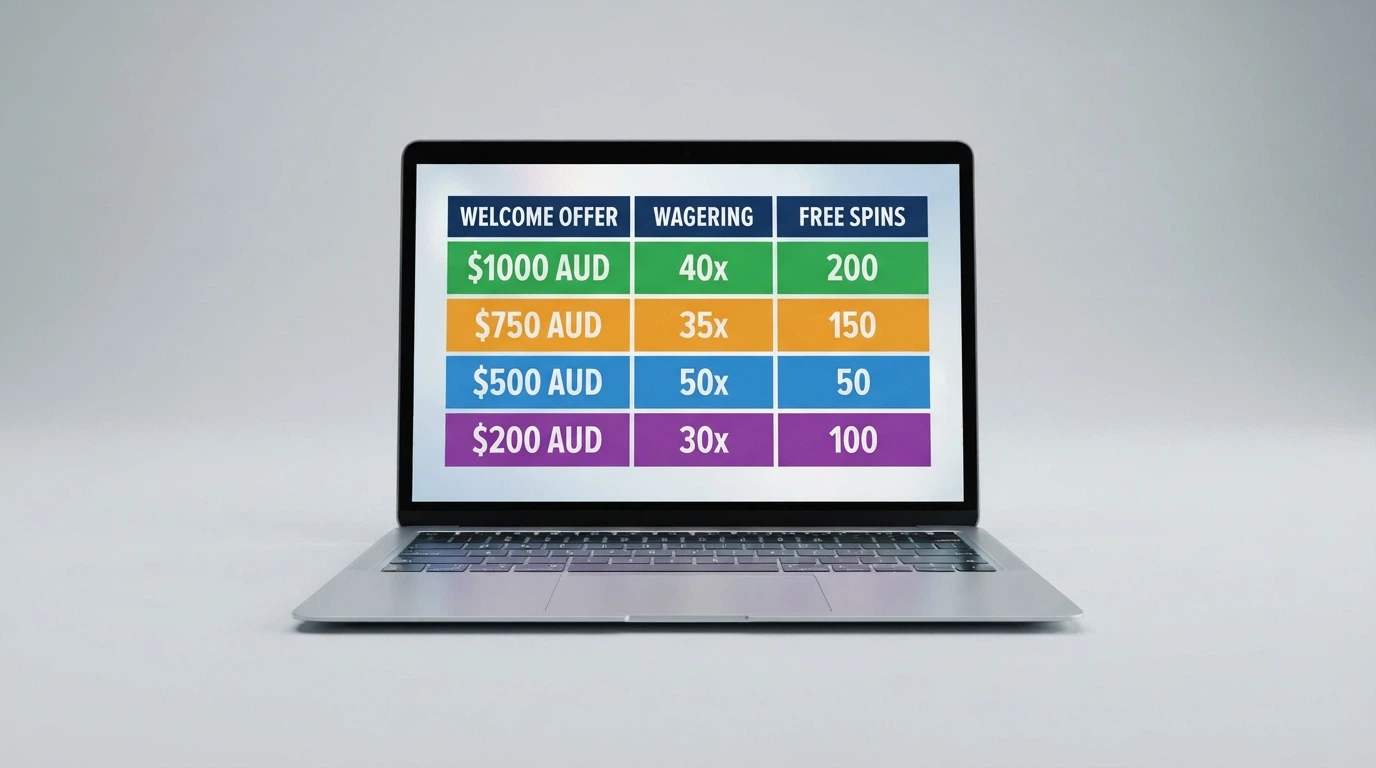
| Casino | Licence | Welcome Offer | Wagering | Free Spins |
|---|---|---|---|---|
| Rocket Play | Offshore (no AU licence) | 100% up to A$1,500 (4 tiers) | 40x | included in package |
| Spin Samurai | Curaçao eGaming (DAMA N.V.) | up to A$1,050 | 200x | 50 |
| 7Bit Casino | Curaçao Gaming (DAMA N.V.) | 100% + 100 FS on deposit | 45x | 80 no-deposit + 100 on deposit |
| Rocket Casino | Curaçao (DAMA N.V.) | up to A$1,000 (from A$30) | 200x on FS | 50 |
| FairGO | Curaçao sub-licence (Deckmedia N.V.) | 100% up to A$200 (×5) | 30x (deposit+bonus) | — |
| Royal Reels | Curaçao (Digibrite S.R.L.) | 100% up to A$500 + 50 FS | 30x | 50 |
| Skycrown | Offshore (no AU licence) | 450% up to A$8,000 (4 deposits) | 40x | 400 |
| Bizzo Casino | Curaçao (parent association) | 100% up to A$1,000 (5 deposits) | — | — |
| WinSpirit | Offshore (no AU licence) | — | — | — |
| Scream Casino | Offshore (no AU licence) | — | — | — |
The first column is the one that matters. Every name above is offshore, and that is the same offshore — Curaçao or its equivalent — under different shells. The spoke in the wheel is the deposit-minimum-to-play and the bonus-eligibility-minimum: Rocket Play’s A$5 Neosurf deposit is bonus-eligible; Skycrown’s bonus needs A$30 first; Bizzo, WinSpirit and Scream row covers for sites whose terms this survey did not confirm. Wagering numbers carry the operator’s exact figure where known; the 200x on some FS-only packages is the heaviest on the page, which is why a free-spin headline with no number under it usually reads as a contradiction.
Rocket Play
Rocket Play is the entry in the set where A$5 Neosurf deposits are tested, confirmed and bonus-eligible — the closest 2026’s low-deposit market gets to a true “A$5 deposit casino” claim. The library is broad at 3,000+ titles across BGaming, Pragmatic Play and NetEnt, the segments an Australian low-stakes player is most likely to recognise. Bitcoin withdrawal processing clears under thirty minutes, which matters for a player moving in and out of small balances on the same evening.
The welcome package is a four-tier 100% match up to A$1,500 across the first deposits, with 40x wagering and a minimum qualifying deposit of A$25 for the bonus to trigger. The A$5 Neosurf play-minimum is below the bonus-eligibility floor — a player can deposit A$5 and play without a bonus, then top up to A$25 if they want the offer attached. Two-tier behaviour of that kind is exactly what the bonus-eligibility gap looks like at the lowest entry. It is the operator that gets closest to honouring the marketing claim, and it works because the deposit method bypasses the fiat rails where the floors live.
For a player at the A$5 point, Rocket Play is the market’s most direct answer. The crypto and Neosurf entry give the deposit a real home; the bonus gap has to be designed around rather than absorbed.
Spin Samurai
Spin Samurai runs on a Curaçao eGaming licence through DAMA N.V. and accepts deposits from A$5 by Neosurf — the only fiat path in the surveyed set where A$5 lands on the bonus-eligible side at all. The library carries 116 software providers, which is the broadest in this ranking and the one that does the most work for a low-stakes player trying every title at minimum bet. Twenty-five payment methods include cards, e-wallets, bank transfers and crypto.
The headline bonus goes up to A$1,050 plus 50 free spins, but the wagering multiplier is the steepest in the table: 200x. At A$1,050 bonus, that is A$210,000 in required turnover before a cent of bonus money becomes withdrawable — and the maximum cashout cap will trim it further. The minimum to claim the welcome bonus is A$20 (or A$10 via Neosurf on the first deposit; subsequent qualifying deposits are A$15+). The low fiat entry is real; the bonus economics behind it are punishing.
Spin Samurai is the case study for what a generous headline and an honest minimum both look like at the same operator, and why the wagering multiplier matters more than either.
7Bit Casino
7Bit Casino is one of the two sites in the ranking where A$5 deposits are confirmed in the operator’s own terms. It runs on a Curaçao Gaming licence through DAMA N.V., carries about 34 payment methods and processes annual revenue reported up to twenty million dollars. The welcome package starts with 80 no-deposit free spins on Aloha King Elvis before a deposit is made — a genuine A$0 trial — followed by a 100% match plus 100 free spins on first deposit, with 45x wagering.
No-deposit free spins are the cleanest trial offer in the ranking because no money changes hands. The catch is the cashout cap and the 45x multiplier: anything won on a no-deposit package is subject to the operator’s withdrawal ceiling, and 45x is above the welcome-offer average. 7Bit is the right pick for a player who wants to test a casino before committing a cent, accepting that the value of any free-spin win will be capped at withdrawable.
For the player with a five-dollar note, 7Bit’s curve lands at: deposit A$5, play at minimum stakes, decide whether to top up to enter the matched bonus. The no-deposit package cushions the trial.
Rocket Casino
Rocket Casino is the entry where a A$5 deposit triggers something: 50 free spins on a jackpot pokie, with 200x wagering on free-spin winnings. The headline is the door at a low minimum; the wall is the multiplier. Free-spin winnings at 200x is the worst deal on the page in straightforward cash terms — a small win turns into a large play-through. The bonus match up to A$1,000 only enters at A$30 minimum deposit, so a A$5 player is buying the free-spin path, not the deposit match.
The casino runs under a Curaçao licence via DAMA N.V., the licence parent of several entries in this ranking. The library is broad; the free-spin path is the entry; the multiplier is the trap.
For the player with exactly A$5 in hand, this is the casino offering the smallest ticket into a bonus — and the highest wagering on what comes out.
FairGO
FairGO is the entry in this ranking with the heaviest RealTime Gaming catalogue, a Curaçao sub-licence through Deckmedia N.V., and the highest withdrawal friction. The welcome offer is a 100% match up to A$200, redeemable five times, with 30x wagering on deposit+bonus — clean terms on the bonus side. The minimum deposit to claim is A$20, the maximum bet while a bonus is active is A$10.
The withdrawal floor is where FairGO diverges. Minimum cashout is A$100 and a A$50 wire fee applies, which is the steepest withdrawal friction in the ranking. A player depositing the A$20 minimum is unlikely to clear A$100 in withdrawable balance on a small-deposit attempt; the fee alone is larger than the deposit. Dynamic-domain mirroring is also common at FairGO — the site’s URL shifts when ACMA blocking pressure rises — which adds friction for an Australian player trying to find the live lobby.
FairGO suits a player who is comfortable depositing at the A$20 minimum, sticking with RTG titles, and tolerating both the withdrawal cost and the domain-rotation interruption. It is the most Australian-feeling entry on offshore rails because of its RTG catalogue, and the most expensive to leave.
Royal Reels
Royal Reels is the only operator in the ranking with a true no-deposit entry: a A$10 free chip that requires no deposit, with 30x wagering and a maximum-cashout cap applied at activation. The welcome match is 100% up to A$500 plus 50 free spins at minimum qualifying deposit of A$30, with 30x wagering on the bonus amount and 35x on free-spin winnings. The casino runs on a Curaçao licence through Digibrite S.R.L.
The game-weighting rule is the structural detail worth flagging. Pokies contribute 100% toward wagering; table games and live dealer count only 3%. That is the lowest weighting on the page, which makes the bonus live or die on the player’s choice of game. The deposit of A$30 is the same Skycrown asks for to enter its bonus — the deposit minimum sits in the same band, but the rest of the terms sit further apart.
Royal Reels is the best choice for a player who wants a zero-deposit trial first, then a small deposit match at the A$30 threshold. The weighting rule is the operator’s hallmark and the cost of using the bonus on live-dealer titles.
Skycrown
Skycrown is where the headline is the loudest and the door is the highest. The welcome package is 450% total across four deposits, up to A$8,000, plus 400 free spins (125 + 75 + 50 + 150 across the four deposits, on Wolf Treasure and other named pokies). Wagering is 40x on both bonus and free-spin winnings. Crucially, crypto deposits do not qualify for any Skycrown welcome bonus — which is the one rail where a A$5 deposit would actually land.
The first deposit minimum for the bonus is A$30, rising to A$40 and A$50 across tiers. The maximum cashout is A$5,000 per welcome segment. Bonus validity is fourteen days, the shortest on the page. Maximum bet with bonus is A$7.50. Skycrown’s offer is the largest by every dollar figure, and it is also the one most visibly designed around deposit match rather than small-stakes play.
Skycrown suits a player with A$30+ to commit to a deposit match, looking for the largest possible bonus envelope, prepared to do forty turns of the wagered amount in two weeks. It is the wrong fit for any player at the A$5 entry.
Bizzo Casino
Bizzo Casino is the entry whose bonus terms were not fully confirmed. The casino operates under a Curaçao licence (parent company association noted), offers 100% up to A$1,000 across the first five deposits, and runs an offshore model with no Australian regulatory coverage. Wagering, free-spin count, minimum qualifying deposit and bonus validity all need confirmation at the live terms page before any deposit changes hands.
Bizzo’s gap is the standard gap at a low-deposit offshore casino: enough confirmed to appear in the table, not enough to verify in detail. A player who chooses Bizzo is choosing it on unconfirmed terms, and the appropriate move is to read the live bonus page before committing even the minimum deposit.
WinSpirit
WinSpirit appears in the low-deposit conversation for Australian players but is offshore with no Australian licence, and no bonus, deposit-minimum, wagering or game-library specification was confirmed this survey. That is the whole story at WinSpirit, and it is told here rather than guessed into a longer one.
A player who sees WinSpit’s name elsewhere should expect to verify the licence independently, confirm the bonus terms at the live URL, and read the withdrawal conditions before any wallet is connected.
Scream Casino
Scream Casino is in the same boat as WinSpirit on confirmed terms — offshore, no Australian licence, no confirmed figure worth carrying into prose. The ranking notes its place in the low-deposit conversation and leaves the rest to the live operator page.
For any player looking at Scream Casino as a candidate, the rule is the one that applies to any unconfirmed offshore entry in this ranking: licence check first, terms second, deposit only after.
The Pokies You Can Actually Spin With a $5 Deposit
Low-Stakes Pokies: Minimum Bets of $0.10–$0.25 at Australian-Facing Casinos
The pokies a A$5 deposit can actually spin are the ones that accept minimum bets at the bottom of the scale. Elvis Frog in Vegas (BGaming) sits at $0.10, as do Aztec Magic Deluxe (BGaming) and Book of Dead (Play’n GO). Wolf Gold (Pragmatic Play) sits at $0.25. Buffalo Power (Platipus) sits at $0.20. That is the field at minimum bet, and it is the field a A$5 player is buying into.

Mathematically, a A$5 bankroll at $0.10 buys fifty spins. A A$5 bankroll at $0.25 buys twenty. At five seconds per spin, the session runs between two and four minutes. That is the ceiling of what a small deposit produces. Bankroll survival at minimum bet is a function of how many spins the bankroll can fund, and the lowest minimum bets are the entry point — not because they change the house edge, but because they extend the time over which that edge is collected.
For a A$5 player, the title choice is a vote of confidence on the wagering contribution. At most Australian-facing casinos, pokies count 100% toward bonus wagering; at the table section of this article, the next layer down covers why that matters.
High-RTP Titles That Stretch a $5 Bankroll Further
Return-to-player is the only number on the slot screen that mathematically affects a A$5 bankroll. Below 95% RTP, the operator has skewed the maths; 96% to 97.5% is the band a “good pokie” sits in. Above 97.5%, the player is getting closer to a fair bet than any slots market routinely delivers. The expected return on a A$5 bankroll at 96% RTP is about A$4.80; at 97% it is A$4.85; at 99% it is A$4.95. The fractional differences do not flip the game, but the table below shows which titles push the player toward the higher end.
| Slot Title | RTP | Provider | Volatility |
|---|---|---|---|
| Mega Joker | 99.00% | NetEnt | Medium |
| Blood Suckers | 98.00% | NetEnt | Low |
| Immortal Romance | 96.86% | Microgaming | High |
| Aztec Magic Deluxe | 96.96% | BGaming | — |
| Big Bass Bonanza | 96.71% | Pragmatic Play | High |
| Sweet Bonanza | 96.51% | Pragmatic Play | High |
| Gates of Olympus | 96.50% | Pragmatic Play | Very High |
| Elvis Frog in Vegas | 96.00% | BGaming | — |
| Wanted Dead or a Wild | 96.38% | Nolimit City | Extreme |
| Wolf Gold | 96.01% | Pragmatic Play | — |
| Book of Dead | 96.21% | Play’n GO | Very High |
| Buffalo Power | 95.20% | Platipus | — |
For a A$5 player, the slot selection narrows toward titles with low-to-medium volatility and high RTP — the ones that run longer per bankroll. Mega Joker and Blood Suckers both sit there, and both are available at most of the major providers carried by the ranked casinos. Higher-volatility pokies give the same expected return but with bigger swings; the bankroll drains faster on the way down, even when it hits harder on the way up.
Game Weighting and Wagering Contribution: What Your $5 Turns Into
A bonus is a multiplier applied to a deposit. Pokies count 100% toward wagering requirements at most Australian-facing casinos surveyed — meaning a dollar spent on a pokie counts a full dollar against the wagering play-through. Live casino games contribute 10% to 20%. Table games contribute around 5%. Some jackpot pokies are excluded entirely or capped at 20%. That is the rule that decides whether a bonus on a A$5 deposit means anything at all.
The Royal Reels entry shows the lower limit explicitly: pokies count 100%; tables and live dealer count 3%. The gap from 100% to 3% is the difference between a bonus that finishes in a hundred spins of a pokie and a bonus that requires three thousand spins of a table game to clear. For a player playing at minimum bet, the weighting rule is what the bonus is worth. A welcomed match on a pokie is the path that turns the wagering money into withdrawable money in a reasonable session.
Live Dealer and Table Games: The Low-Stakes Reality
Live dealer tables run at higher minimums — typically A$1 per hand at the softest end, often higher on blackjack and baccarat variants, with side-bet options going further. A A$5 bankroll at A$1 per hand buys five hands, which is not the kind of session that benefits from the live-dealer product. The maths runs worse where the wagering rule runs harder: live casino contributes 10–20% to wagering. A bonus that takes a hundred pokie spins to clear takes five hundred to a thousand on a live table. The same multiplier, the same deposit, the same bonus — cleared slower than the Wagering Contribution section shows is mathematically possible.
A A$5 deposit is, in practice, a pokies product. A player looking for live-dealer experience at that budget should expect to spend the bankroll inside five hands with no realistic chance of clearing a bonus on a live-table chosen game.
Why Your $5 Deposit Rarely Unlocks a Casino Bonus in Australia
The Bonus-Eligibility Gap: Most Welcome Offers Need A$20 or More
The single sharpest detail in Australian low-deposit play is the gap between minimum deposit to play and minimum deposit for bonus. Eight of fifteen Australian-facing brands surveyed quietly enforce a higher minimum for welcome-bonus eligibility than for play.

The clearest example is Skycrown, which lists a A$5 minimum in some deposit methods but requires A$30 first-deposit minimum to enter its welcome bonus. Royal Reels sits at A$30 for the same reason. Spin Samurai is the rare exception: A$10 via Neosurf on the first deposit triggers the bonus. Rocket Play’s A$5 Neosurf deposit also tests positive as bonus-eligible — the operator idea being that a small deposit from a low-friction method counts toward the bonus, even when card or PayID would not.
The honest summary at the page level: a player reads an offer copy that says “claim a 100% match”, deposits the A$5 minimum they were quoted, and discovers the bonus eligibility needed A$30. The bonus does not retroactively attach. The play-money is in the account; the matched money is not.
Free Spins and No-Deposit Offers That Work With Pocket Change
Three offers on the ranking actually fit the A$5 buyer. Rocket Casino’s 50 free spins trigger at A$5 deposit, but at 200x wagering on free-spin winnings. Royal Reels’ A$10 no-deposit free chip needs no deposit at all, with 30x wagering and a withdrawal cap at activation. 7Bit’s 80 free spins on Aloha King Elvis are deposited before any wallet is connected.
These are small offers by design. The average no-deposit package in the Australian offshore market runs A$20–A$50 in free credits or 20–50 free spins — which is generous for no money in, restrictive in payout terms. The max-cashout cap is the part most pages skip: no-deposit and low-stake free spin wins are subject to a withdrawal ceiling, beyond which any further winnings disappear.
The wagering multiplier on no-deposit offers averages 55x. On welcome offers it averages 40x. Both numbers leave the player working through a large turnover before anything converts to cash. A A$5 deposit landing a free-spin package at 200x is the worst-case version of that rule.
$5 Deposit Mobile Casinos: Low-Stakes Play on Your Phone in 2026
Mobile Deposit Mechanics: PayID, Crypto and Instant Browser Play
A A$5 deposit on a phone is faster than the same deposit on a desktop because the rails were built for phones. PayID lives inside the banking app — open the casino on the browser, copy the PayID or BSB, paste into the bank’s payment screen, confirm. The deposit arrives in under sixty seconds. NPP Australia clears it at retail-banking speed. The casino-side floor is still A$20 even on mobile, but the round-trip from casino to bank and back is shorter than the equivalent on a credit card on a desktop. Crypto works similarly fast: open the casino, scan a QR code from the wallet app, send the USDT, see it land in under a minute. Neosurf has no native mobile app but the code-entry is a browser field, and the same A$10 minimum applies.

iOS and Android look the same on the casino side — none of these offshore operators has a native app on either store, because Australian app stores do not carry real-money casino apps. The browser experience is the entire experience. For a player who can pay by phone and play by phone, the deposit-to-spin time on a A$5-to-A$30 bankroll is under three minutes once the operator is loaded.
The browser-based norm does have a downside: Australian app-store restrictions mean there is no place to download an app and have the operator file a complaint with Apple or Google when a payout stalls. The mobile speed of the deposit is matched by the mobile friction of any dispute.
Is a $5 Deposit Online Casino Legal in Australia? The Uncomfortable Answer
The Prohibition: No Australian Online Casino Licence Exists
Online casino games, online pokies and in-play sports betting are prohibited under the Interactive Gambling Act 2001, strengthened by the 2017 amendment. ACMA is the federal regulator that enforces the prohibition — it investigates, warns, fines, refers for civil penalty proceedings and directs Australian ISPs to block illegal sites. There is no licence for online casino anywhere in the country, not federally and not in any state or territory. The licensed layer that does exist is wagering on racing and sport placed before the event, through operators holding state or territory licences (with the Northern Territory’s Racing and Wagering Commission as the de facto national licensor for online bookmakers); lotteries and keno sit alongside that and do not include casino games.
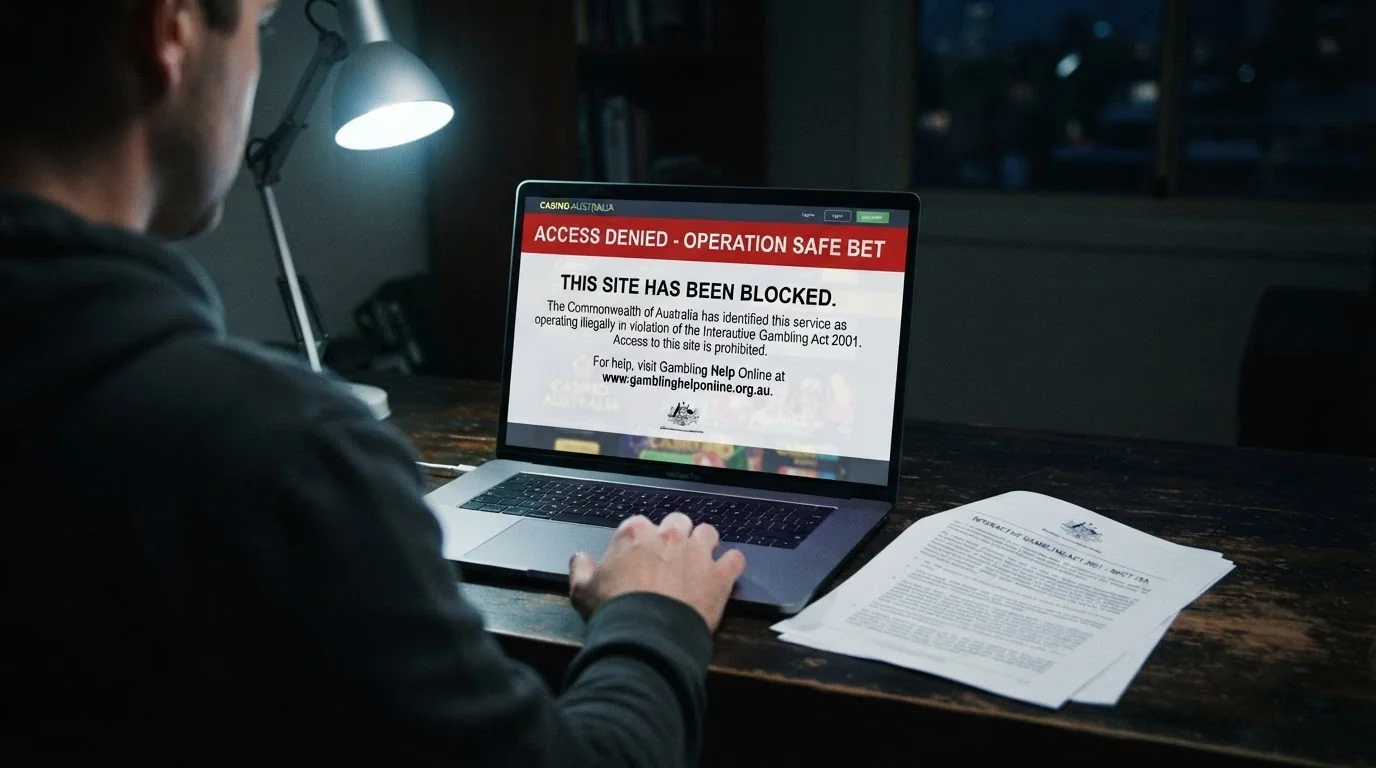
Australia’s licensed land-based venues — Crown, The Star, the state casino floors — operate under state licences for in-person play. None runs an online casino licence, because none can. Crown Melbourne and The Star Sydney do not provide online casino games; the second of the two attempted it and exited within months. The licensed face of Australian gambling ends at the online casino’s front door.
The individual player is not prosecuted under the IGA — the Act targets the provider. The player’s risk is not criminal; it is structural. No Australian consumer protection applies offshore, no BetStop coverage attaches, no AU-based dispute pathway exists. The IGA is strict about who provides the service rather than who uses it, but the player’s access to help is the casualty.
The 2026 Reform and What Changes on 1 January 2027
The Interactive Gambling Amendment (Gambling Reform) Bill 2026 passed Parliament on 19 August 2026 and its measures commence on 1 January 2027. The reform affects the licensed market — the one that does not offer online casino — but it reshapes the offshore route by making it more expensive to operate. Banks and payment providers gain express authority to block transactions to illegal gambling operators from that date, which means the deposit rail an offshore casino uses today is the rail a bank can decline tomorrow. The AdStop opt-out register, administered by ACMA and funded by a cost-recovery levy on wagering companies, launches on the same date.
The reform also tightens advertising. The current baseline — three wagering ads per hour between 6:00 am and 8:30 pm, no advertising in the fifteen minutes before a live sporting event or in the five after, no school-commute radio, no broadcast odds, no in-venue or uniform advertising, no athletes/celebrities/influencers — is the floor. The reform adds a three-year phased implementation: Phase 1 in the first year prohibits advertising during news, current affairs, and school-commute radio; Phase 2 in year 2 adds the live sporting coverage blackout and the odds commentary ban; Phase 3 in year 3 delivers comprehensive prohibition. Direct marketing of inducements is prohibited for fourteen days after sign-up, three months after BetStop deregistration, and indefinitely for customers identified as at risk of gambling-related harm.
That reform does not legalise online casino. It borders it.
What “Offshore” Really Means for Your Money and Your Rights
The offshore route comes with concrete harms spelled out above. No BetStop coverage means self-exclusion ends at the Australian border — a player who registers with BetStop has excluded themselves from every Australian-licensed online bookmaker in a single step, and has done nothing to block a single offshore casino. No Australian consumer protection means disputes go to the licence jurisdiction (typically Curaçao), with no Australian small-claims court and no legal aid. ACMA can block the site at any time, and the player with a balance still on it has no AU-based recourse to recover it. The credit-card and crypto bans, in place since June 2024, signal offshore status — any site accepting either payment method is operating outside Australian rules, and that is the operator’s voluntary tell.
A high market share at an offshore casino is evidence of traffic, nothing more. The offshore status is not unconfirmed — it is structural. There is no licence to apply for, and no application in process.
New $5 Deposit Casinos Launching for Australian Players in 2026
Recently Launched Offshore Sites With Low Deposit Floors
Genuinely new low-deposit Australian-facing casinos are scarce in 2026. Most of the offshore sites taking Australian players at low minimums are established brands that have been live for several years, and the launch pipeline looks thin. The structural ceiling applies to new entrants as much as established names: PSP floors and crypto-only constraints are unchanged by a new operator’s arrival.
For a player evaluating any new arrival, the due-diligence checklist is short and the certainty it returns is limited. Verify the licence: jurisdiction, regulator name, licence number, active status at the regulator’s lookup. Confirm payment-method coverage and the per-method deposit floor — the difference between A$5 and A$20 is the operator’s choice, not the rail’s. Read the bonus terms page before any deposit: wagering multiplier, minimum qualifying deposit, maximum cashout, game weighting, validity window. Check the withdrawal minimum and any fees. A new offshore operator with all those specifications transparent is closer to trustworthy than one whose landing page is silent about them. A new operator with unconfirmed terms is no different from WinSpirit or Scream Casino in the ranking above.
Playing Within Your Limits: Responsible Gambling at Low-Stakes Casinos
A A$5 deposit is the smallest entry point offshore play allows in 2026. That makes it both the cheapest trial and the easiest repeat. Problem-gambling prevalence in Australia is about 2.1% of adults — roughly four hundred and thirty thousand people — with the Australian Institute of Health and Welfare putting high-risk gambling at 1.8% in 2022. Those numbers sit behind every dollar in every wallet at every offshore casino.

BetStop — the National Self-Exclusion Register — has had 67,480 registrations in three years of operation (as at 31 July 2026), with 41,290 exclusions still active. 78% of registrants were under 40, and 38% chose lifetime exclusion. One registration excludes a person from every Australian-licensed online and phone wagering service in a single step. The window does not cover offshore casinos — that is the structural cost of the offshore route, and it is the most concrete single harm of the route. A player who has registered with BetStop still needs to self-exclude at each offshore casino individually, and most offshore sites carry the deposit limit and break tools the licensed market requires.
The National Gambling Helpline is 1800 858 858 — free, confidential, staffed 24 hours a day, with online chat and email counselling through Gambling Help Online. Australia’s minimum gambling age is 18.
How We Evaluate $5 Deposit Casinos for Australian Players
The ranking above is built from four sources. The ACMA blocking register provides the federal enforcement baseline — which sites have been blocked, which have withdrawn from the Australian market, and the federal position on no online casino licence. PayoutVerdict supplied the honest-facts editorial position on the A$5 figure itself, the fiat-cost ratio and the bonus-eligibility gap statistic (8 of 15 brands surveyed). AussiePokies96 contributed the wagering-multiplier survey (averages of 40x welcome, 55x no-deposit) and the game-weighting rules. VegasPokie provided the withdrawal-minimum asymmetry data and the PayID facts. Operator terms and conditions provided the per-casino specifications in the table.
Licence status was checked against the official ACMA position: no online casino licence exists in Australia, so every operator in the ranking is offshore by structure, not by inference. Where a licence jurisdiction is named, it is a Curaçao licence or sub-licence unless otherwise noted. Where data was unavailable in this survey, the no-data marker (em dash) was used; cells with unconfirmed data were not filled in. The ranking criteria — verified minimum deposit, bonus eligibility at low deposits, wagering transparency, game library depth, payment method coverage — were applied qualitatively to order the list, and the criterion that sorted first was the operator’s verified behaviour at the A$5 entry point.
The ranking is not a recommendation. No brand on this page is recommended to a reader as a place to play. The list orders casinos for the player’s review; the decision is the player’s.
What to Do With Your $5: The Verdict on Low-Deposit Casino Play in Australia
A A$5 deposit at an Australian-facing offshore casino in 2026 buys fifty spins at minimum bet, about four minutes of play, and an expected loss of roughly twenty cents at 96% RTP. The price is low; the offer is real; the protection around it is not. No online casino licence exists in Australia, which means no Australian consumer protection, no BetStop coverage, no domestic dispute pathway and the constant risk that ACMA blocks the site with a balance on it.
Three things to check before any A$5 deposit. First, the licence: jurisdiction, regulator, licence number — Australian-licensed means nothing for online casino, so a foreign licence is the baseline expectation. Second, the withdrawal minimum and fee — anything from A$25 to A$100 with optional wire fees is the offshore norm, and a small bankroll needs to know whether it can leave. Third, the bonus terms: minimum qualifying deposit, wagering multiplier, maximum cashout, game weighting, validity window. The bonus is the part of the page that costs the player the most, and the part least likely to be read.
The crypto-versus-fiat decision is the second-order choice. Fiat A$5 deposits are structurally barred at most rails. Crypto A$5 deposits work at the lowest minimums (USDT-TRC20 is the practical floor) and fail all Australian consumer-protection tests. Neosurf is the third option at A$10. Both fiat and crypto reach offshore casinos; both are offshore by route.
If consumer protection matters, Australian-licensed wagering services — online bookmakers licensed under a state or territory regime, accepting debit cards and PayID, with BetStop coverage and customer-set deposit limits — are the safer surface for whatever amount the player would have spent on a A$5 deposit. They do not offer online casino games. That is not a gap in their offer; it is the legal position in Australia. The gap is what offshore sites fill, and the offshore site charges the cost of operating outside the rules.
A A$5 deposit is a smoke test. Treat it like one: a fast round of low-stakes pokies, an honest read of the operator, an eye on the withdrawal page. Then decide whether the next deposit is worth making.
Frequently Asked Questions
Can I really deposit only A$5 at an Australian online casino?
Fiat AUD deposits of A$5 are not honest in 2026 — card processors and PayID both enforce higher floors at Australian-facing casinos. The places A$5 deposits land are cryptocurrency (USDT-TRC20 in practice) and a small number of operators with A$5 Neosurf play-minimums, including Rocket Play and 7Bit Casino. Treat the A$5 figure as a marketing floor, not a transaction fact, until a confirmed method clears.
Can I get a welcome bonus with a $5 deposit?
Rarely. Most welcome bonuses at AUD-facing offshore casinos require A$20–A$30 as a qualifying minimum, even when the play-minimum is below that. Exceptions include free-spin-only offers at Rocket Casino (50 FS at A$5), Spin Samurai’s A$10 Neosurf first-deposit bonus minimum, and no-deposit free-chip entries at Royal Reels (A$10 no-deposit chip). Wagering averages 40x on welcome offers, 55x on no-deposit.
What is the minimum I can withdraw from a $5 deposit casino?
Typical offshore withdrawal minimums are A$25–A$50, sometimes A$50–A$100 — FairGO’s A$100 minimum plus A$50 wire fee is the highest in the set. A A$5 player can fund but frequently cannot withdraw a small balance, because the cashout floor is well above the deposit floor. Verify the withdrawal minimum and fee at the live terms page before depositing.
What happens to my money if an offshore casino is blocked by the ACMA?
The ACMA has had 1,564 illegal gambling and affiliate websites blocked since November 2019, with more than 225 illegal services withdrawn from the Australian market since the 2017 strengthening. If a casino is blocked, the player’s balance is on the offshore operator’s books with no Australian-based recourse to recover it. From 1 January 2027, banks gain express authority to block transactions to illegal operators as well, adding a deposit-side risk.
Where can I get help if I have a gambling problem in Australia?
The National Gambling Helpline is 1800 858 858 — free, confidential, 24/7, nationwide. Gambling Help Online (gamblinghelponline.org.au) provides live chat and email counselling. BetStop — the National Self-Exclusion Register (betstop.gov.au) — excludes a player from every Australian-licensed online and phone wagering service in one step, but does not cover offshore casinos. About 2.1% of Australian adults — roughly four hundred and thirty thousand people — experience problem gambling in Australia.
Do $5 deposit casinos accept PayID from Australian bank accounts?
PayID is accepted at Australian-facing offshore casinos and arrives in under sixty seconds through NPP Australia — the fastest domestic rail. The deposit-side floor at casinos that accept it is A$20. Tested withdrawal turnaround is 2–4 hours. POLi, the previous generation of Australian instant-pay, was shut down at the end of September 2023; PayID/Osko replaced it.
What pokies give the best RTP for a $5 bankroll?
Mega Joker (NetEnt) returns 99% in supermeter mode. Blood Suckers (NetEnt) sits at 98%. Immortal Romance (Microgaming) at 96.86%. Book of Dead (Play’n GO) at 96.21%. A “good pokie” runs 96–97.5% RTP; below 95% means the operator is skewing the maths. At minimum bet, the high-RTP, low-to-medium volatility titles — Mega Joker and Blood Suckers — extend the A$5 bankroll the furthest per spin.