
2026’s $20 Minimum Deposit Casinos in Australia, Reviewed Side by Side
Data current as of 29 October 2026; licence claims verified against the Curaçao Gaming Control Board public register, the Anjouan Offshore Finance Authority register and the ACMA’s list of blocked and monitored operators.

A $20 minimum deposit casino is, in plain terms, an offshore online casino that lets Australian players load real money from twenty Australian dollars upward. It is the most common entry point on the market, the figure almost every new launch defaults to, and the threshold at which a player can claim a welcome bonus, spin pokies for cash, withdraw winnings and still have a small enough stake that the gamble stays small. The maths on the other side of the welcome screen is where the picture gets more interesting, and that is the picture this page draws.
Table of Contents
- What Your $20 Deposit Actually Buys at an Australian Online Casino in 2026
- Top 10 $20 Minimum Deposit Casinos for Australian Players in 2026
- Depositing A$20: Every Payment Method, Ranked From Instant to Slow
- Real-Money Pokies You Can Actually Play on a $20 Bankroll
- Mobile Play With a $20 Deposit: No App, No Problem
- New 2026 Casinos That Default to a $20 Minimum
- The Legal Reality: Every A$20 Casino You Play at Is Offshore
- Staying in Control: Deposit Limits, Self-Exclusion and Where to Get Help
- How We Evaluated and Ordered This Page’s $20 Casino Picks
- Is a $20 Deposit Worth It? What the Numbers Say
- Frequently Asked Questions
What Your $20 Deposit Actually Buys at an Australian Online Casino in 2026
A $20 deposit is the difference between browsing a casino’s lobby and playing it. At that floor, every payment method the operator supports becomes available, the cashier unlocks, the welcome bonus activates where the operator has set a $20 minimum, and the player crosses from demo mode into real money play with a real chance of a withdrawal. A ten-dollar deposit works at a few operators, but it is the exception; a fifty-dollar deposit works almost everywhere, but it is twice the entry price for a first look. Twenty dollars is where the market has settled, and almost every operator an Australian player will compare takes that figure as its floor.
The shape of the offer is the variable. A flat $20 deposit with no bonus, played through pokies at A$0.20 per spin, returns roughly 80 to 120 spins before the bankroll is gone — a genuine session, with a real chance of hitting a feature round and a real path to withdrawing anything that comes out the other side. A $20 deposit that triggers a 100% match bonus adds $20 of bonus bankroll on top, but it also adds a wagering requirement. At the market’s fairer end (35x bonus only), that 35 times $20 means $700 in qualifying wagers before any withdrawal becomes possible. At 50x on the hostile end, the same $20 bonus demands $1,000 of play. The welcome package is a bigger number on the page; whether it is worth more in the player’s pocket is a different calculation.
What a $20 Minimum Deposit Actually Unlocks
The practical mechanics start at the cashier. At the $20 floor, every Australian-facing payment rail is open: PayID, Visa and Mastercard debit, Bitcoin, Ethereum, USDT, Litecoin, Neosurf vouchers and direct bank transfer. That is not a special deal or a promotional tier — it is the standard behaviour across the offshore market, and at the $20 line the choice between rails is a choice about speed, fees and whether the same method can handle a withdrawal on the other side. A $10 deposit, where it is accepted, often locks a player out of one or two of those rails. A $50 deposit adds nothing to the choice.
Inside the lobby, $20 buys the full game library at every operator covered below. That is a real point: offshore casinos do not gate their pokies catalogue behind deposit tiers in the way some land-based loyalty programmes do. A player with twenty dollars in the account has the same access to Big Bass Bonanza, Wolf Gold, Book of Dead, the live dealer floor and the jackpot pool as a player with two thousand in the account. What changes with deposit size is not the catalogue but the bankroll’s tolerance for a bad run — and on a $20 bankroll at A$0.20 per spin, that tolerance is exactly the 80 to 120 spins research puts on a typical session.
The bonus engine is where the floor matters. Most welcome offers in the Australian-facing offshore market trigger at $20 or above; a small minority of operators (the most aggressive match-percentage ones) set the bonus trigger at $30 or $40. A player who deposits $20 and expects a 400% headline match needs to check that $20 is the trigger, not the ceiling.
Your $20 Bankroll: What 100 Spins Can Actually Deliver
A $20 bankroll at A$0.20 per spin is approximately a hundred spins, give or take a small change in the bet. A hundred spins is enough to clear a typical base-game cycle on most medium-volatility pokies, which means a feature round or two is plausible rather than unlikely. It is not enough to grind through a high-volatility title that pays in scattered, large chunks — on a $20 bankroll a single dry patch of two hundred spins will bust the session before the payout ever lands.
What the player actually takes from those hundred spins depends on the math, not the marketing. Pokies in the Australian-facing offshore market return, in aggregate, somewhere between 94% and 97% of turnover to the player over a long sample. Over a hundred spins at A$0.20, the expected return sits somewhere in the A$18.80 to A$19.40 range, with the variance meaning anything from A$0 to a feature round paying twenty or thirty times the bet. The point is not that a player will lose exactly eighty cents on a hundred spins — they will not, because variance is the point of the game — but that a $20 session is, statistically, a small expected loss with a real chance of a memorable upside.
The withdrawal story from a $20 session is straightforward when no bonus is involved. A win of any size, including the entire balance, can be withdrawn once the player has passed identity verification. The minimum withdrawal at most operators sits between A$20 and A$50, so a player who doubles their money and then plays a few more spins down to A$21 can still pull the lot out. That path closes, partially, when a bonus is involved — the wagering requirement has to be cleared before the bonus balance becomes withdrawable cash, and the math of clearing a bonus on a $20 deposit is a different conversation.
First Deposit vs Ongoing Play: Why the Welcome Offer Changes the Maths
The first deposit at any of the operators below triggers a welcome package that almost always carries a wagering requirement. A $20 deposit that picks up a 100% match bonus, for example, gives the player $40 of combined bankroll to play with, but the $20 of bonus money is locked until the wagering is cleared. At 35x bonus-only, that is $700 of qualifying wagers. At 50x bonus plus deposit, the same $20 bonus paired with a $20 deposit can require $2,000 of play before the bonus portion of the balance becomes withdrawable.
The wagering rules in the Australian-facing offshore market are mostly bonus-only (the player wagers the bonus amount, not the deposit plus the bonus), and the standard range sits between 30x and 45x. The friendliest offers add free spins on top — fifty to two hundred is typical at the $20 tier, with a standard spin value of A$0.10 per spin. The free-spin wagering rule varies by operator: some attach the same wagering to spin winnings, others ring-fence the cash and the bonus into separate balances. A player reading an offer for the first time should check which model is in play, because the same headline number can mean two different costs.
On the second deposit and onwards, the welcome package is gone and the player is on whatever reload or loyalty terms the operator runs. Those terms are almost always less generous than the welcome, both in match percentage and in any attached free-spin component. The arithmetic of ongoing play is therefore simpler: $20 in, $20 to play with, no bonus strings, and the same 80 to 120 spins at A$0.20 per spin that the first deposit would have offered if the bonus had been declined. A player who values the bonus and a player who values the simplicity are looking at the same number from two different angles.
Top 10 $20 Minimum Deposit Casinos for Australian Players in 2026
The ten operators below are ranked by the combination of bonus value at a $20 deposit, fairness of the wagering terms, and the size and quality of the game library. They are the brands Australian players actually use at the $20 floor. Every one of them operates under an offshore licence; the Australian market has no online casino licence to hold.
| Casino | Licence | Welcome Bonus at $20 Deposit | Free Spins | Wagering |
|---|---|---|---|---|
| VegasNow | Curaçao (offshore) | 100% up to A$3,000 + 200 FS on Big Bass Splash | 200 | 35x bonus only |
| LuckyOnes | Anjouan (offshore) | 200% up to A$20,000 + 500 FS | 500 | 30x bonus |
| SkyCrown | Curaçao (offshore) | 100% up to A$4,000 + 400 FS | 400 | 40x bonus |
| NeoSpin | Curaçao (offshore) | 400% up to A$80 (tier 1) | — | — |
| SpinFred | — | 100% up to AUD 500 + 100 FS on Starburst | 100 (10/day for 10 days) | 35x bonus |
| Spinago | Curaçao eGaming (offshore) | 100% up to AU$10,000 + 500 FS | 500 | 40x bonus |
| Wizzspin | — | 200% up to A$2,000 + 100 FS on Sweet Bonanza | 100 | 30x bonus |
| Hugo Casino | — | Up to $600 + 275 FS | 275 | — |
| Goldenbet | — | AU$100 ×3 cash (0x wagering) | — | 0x (real cash) |
| LuckyDreams | Curaçao (offshore) | 100% up to A$1,000 + 100 FS | 100 | 35x bonus only |
The cells showing an em dash indicate that specific offer details were not publicly available; we recommend verifying the latest terms on the operator’s official site before depositing. Where a wagering multiple is not stated, the offer cannot be compared apples-to-apples with the rest of the table — a missing figure is not a friendly figure, it is a gap a player has to close by reading the terms page before they deposit.
VegasNow: 35x Bonus-Only Wagering With 70+ Studios Behind It
VegasNow is the operator that lines up best with what an informed Australian player is actually looking for at the $20 tier. The headline is a 100% match up to A$3,000 with 200 free spins on Big Bass Splash, and the wagering sits at 35x on the bonus only — meaning the player wagers the bonus amount, not the deposit plus the bonus, and 30 days is on the clock to clear it. The spin value is the standard A$0.10 across the industry.
The part that does not show in the welcome banner is the library. VegasNow runs seventy or more game providers, including Pragmatic Play, Hacksaw Gaming, Nolimit City, Play’n GO and Push Gaming. That mix covers the high-volatility end (Nolimit City, Hacksaw) and the mass-market end (Pragmatic Play, Play’n GO), which means a $20 bankroll can move between a feature-rich pokie like Big Bass Bonanza and a longer-session low-volatility title without the player having to leave the lobby.
For a player who wants one operator that does most things competently, VegasNow is the safest pick on the list. The 35x bonus-only wagering sits in the fair half of the 30x to 45x market range, the bonus validity is the standard thirty days, and the provider roster is broad enough to keep a $20 bankroll interesting past the first hundred spins.
LuckyOnes: A 200% Match That Runs to A$20,000
LuckyOnes runs the highest percentage match on the list at 200%, paired with a 500-free-spin package and a wagering multiple of 30x on the bonus. The match ceiling is A$20,000 — a figure aimed at high-rollers depositing well above the $20 floor — but at a $20 deposit the relevant figure is the $40 of total bankroll and the wagering on the $20 bonus portion, which at 30x is $600 of qualifying wagers.
The terms that matter most at the $20 tier are the ones that were not publicly available for verification; that does not make the offer bad, but it makes a written comparison harder than the headline suggests. The 30x wagering is the friendliest on the list, and that is a real point, but a player depositing at LuckyOnes should read the bonus terms page for the validity window and the free-spin wagering rule before they claim.
For a player who cares most about the wagering multiple and is comfortable checking the rest of the terms themselves, LuckyOnes is the low-cost option. The 200% match at 30x is genuinely competitive against a 100% match at 35x if the player intends to clear the bonus and withdraw.
SkyCrown: 400 Free Spins Stacked on a 100% Match
SkyCrown pairs a 100% match up to A$4,000 with 400 free spins, all under a Curaçao licence and a 40x bonus wagering requirement. The spin count is one of the highest on the list, second only to the headline 500-spin packages at LuckyOnes and Spinago, and the match ceiling at A$4,000 is comfortable at any deposit level.
The wagering is on the higher end of the market range at 40x, which means a $20 bonus triggers $800 of qualifying wagers before it becomes withdrawable. That is a real cost in play time: at A$0.20 per spin and a 5-second spin interval, $800 of turnover is 4,000 spins, which is roughly 5.6 hours of continuous play. The free-spin winnings are typically added to the bonus balance and subject to the same wagering rule, which is standard but worth knowing.
SkyCrown is the pick for a player who wants the volume of free spins and is willing to put in the play time to clear them. A player who values a quicker exit on a $20 deposit may prefer a lower-wagering option, and the 40x on this offer should be the first number a player looks at before they claim.
NeoSpin: A 400% Tiered Offer With a Modest Cap
NeoSpin’s headline is the 400% match, which is the highest percentage on the list. The ceiling, however, is A$80 at tier 1, which means a $20 deposit triggers $80 of bonus money on top of the $20 deposit — total bankroll $100, with $80 of bonus subject to wagering. The math at the cap is interesting, but the comparison falls apart at the wagering line: research did not confirm the wagering multiple, validity, free-spin component or spin value for this offer this round.
The honest reading is that 400% sounds like the best deal on the list, but a comparison with the other nine operators requires terms that were not publicly available. A player who likes the NeoSpin package should read the bonus terms carefully before they commit the $20.
NeoSpin is a candidate for players comfortable verifying terms independently who prefer a high-multiple, small-cap bonus. Those seeking a straightforward market comparison may find the lack of publicly available terms here a significant hurdle.
SpinFred: Starburst Spins and a 100% Match With a 7-Day Clock
SpinFred runs a 100% match up to AUD 500 with 100 free spins on Starburst, delivered ten spins a day over ten days, at 35x bonus wagering and a 7-day bonus expiry. The combination of a 7-day clock and a 35x wagering is the defining feature: this offer is a sprint, not a marathon.
The 7-day expiry is the shortest on the list by a wide margin, and it is the part that should determine whether a player takes the offer. A $20 bonus at 35x is $700 of qualifying wagers, and $700 of turnover in seven days means an average of $100 a day in pokies wagering — achievable in an evening session but not the kind of requirement a casual player can clear on a weekend morning. The 10-per-day free-spin delivery also ties the player to a ten-day log-in pattern.
SpinFred also runs a separate PayID Quick Spins Pack that requires a minimum deposit of AUD 25 (not $20), awards 25 free spins on Big Bass Bonanza at 30x wagering, caps the free-spin winnings at AUD 500, and expires the spins in 48 hours. That is a different product and a different entry point, and it is worth knowing about even though it sits above the $20 floor.
SpinFred is the pick for a player who plans to play hard in the first week and clear the wagering in one push. For a player who wants the welcome bonus to sit quietly in the background while they explore, the 7-day clock is the wrong shape.
Spinago: 7,000+ Games and a 100% Match to AU$10,000
Spinago runs the largest game library on the list at 7,000-plus titles, with Evolution and Pragmatic Live confirmed on the live-dealer side. The welcome is a 100% match up to AU$10,000 with 500 free spins, a 40x bonus wagering requirement, and a maximum bet during wagering of A$7.50 per spin.
The combination of a high wagering multiple (40x), a large free-spin package, and a generous match ceiling is built for a deposit larger than $20 — the offer is competitive, but the wagering cost is real. At $20 of bonus money, 40x is $800 of qualifying wagers; on a five-dollar bet at a roulette-style game, that is a long run. The library is the offset: a player who wants a 7,000-game catalogue to explore on a $20 bankroll has the room at Spinago to do it.
Spinago is the pick for a player who values the library over the bonus size, or who plans to deposit larger amounts later and wants an operator that can absorb a bigger bankroll. At the $20 tier specifically, the wagering makes the bonus expensive; a player who values simplicity may pass on the welcome and play cash.
Wizzspin: 200% Match and Sweet Bonanza Spins at A$0.20 Each
Wizzspin pairs a 200% match up to A$2,000 with 100 free spins on Sweet Bonanza at A$0.20 per spin — double the standard spin value of A$0.10 that most operators on the list use. The wagering is 30x on the bonus, combined with the free-spin winnings, and the bonus expires after 7 days.
The A$0.20 spin value is the headline feature. At A$0.10, 100 free spins are A$10 of total spin value; at A$0.20, they are A$20, which means the free-spin package alone is worth the same as a $20 deposit. The 7-day validity is the cost: a player needs to clear the wagering inside a week, and the combined bonus-and-spin-wagering rule means the total wagering figure is higher than it looks on a banner.
Wizzspin is the pick for a player who values the free-spin value over the match percentage. The licence and the game-provider list outside Pragmatic Play were not confirmed this round, so a player who wants the full provider picture should check the lobby before depositing.
Hugo Casino: A 2026 Launch With 275 Free Spins at $20
Hugo Casino launched in 2026 and arrived at the standard market entry point of $20 minimum deposit, with a welcome package of up to $600 plus 275 free spins. The licence, the wagering multiple, the bonus validity and the spin value were not publicly available.
The newness is the defining feature and the reason for caution. A 2026 launch means a short operating history, no long track record of payouts, and terms that may still be in flux. A $20 minimum deposit is the standard market entry point, not an aggressive offer, but the welcome terms deserve the same read-through that any operator’s terms deserve.
Hugo Casino is the pick for a player who wants to be early on a new operator and is willing to read the terms carefully before committing. For a player who values a longer track record, the operators above with confirmed Curaçao licences are the safer starting point.
Goldenbet: Real Cash With Zero Wagering — the Standout Offer
Goldenbet runs the only offer on the list that does not carry a wagering requirement. The welcome is A$100 ×3 in cash, meaning the player gets a hundred Australian dollars in real cash, three times, with 0x wagering. There are no free spins attached.
The zero-wagering structure is rare in the offshore market, and it is the single most valuable feature on this list. A $20 deposit at Goldenbet, even with the offer structured as A$100 ×3 rather than a 100% match, gives the player cash they can withdraw as soon as the play is done — no turnover target, no 7-day clock, no A$5-to-A$10 max-bet cap during a clearing period. The cost is that the offer is structured differently from a match bonus, and the free-spin component is missing.
Goldenbet is the pick for a player who has read the wagering maths on the other offers and decided the trade is not worth the headline. A 100% match at 35x is not free money; a cash offer with 0x is cash. The licence and the game providers were not publicly available, so a player should verify both before depositing.
LuckyDreams: Crypto-First With Sub-15-Minute Withdrawals
LuckyDreams is the speed pick on the list. The welcome is a 100% match up to A$1,000 plus 100 free spins at 35x bonus-only wagering, under a Curaçao licence, and the operator supports Bitcoin, Ethereum, USDT on both TRC-20 and ERC-20, Litecoin, Bitcoin Cash, Dogecoin, XRP and TON for deposits and withdrawals. Crypto withdrawals at LuckyDreams process in under fifteen minutes 90% of the time.
The combination of a standard 35x bonus-only wagering and a fast crypto payout makes LuckyDreams the operator for a player who wants the bonus and wants the money out the door the same day. The minimum withdrawal on crypto is typically the lowest of any method, often lower than the A$20-to-A$50 range on cards, and the 15-minute target is a real number rather than a marketing line.
LuckyDreams is the pick for a player who already holds crypto and is happy to use it for both the deposit and the withdrawal. For a player who prefers PayID, the speed gap is smaller, but for a crypto-native player, LuckyDreams is the right fit on this list.
Depositing A$20: Every Payment Method, Ranked From Instant to Slow
| Method | Deposit Speed | Withdrawal Speed | Minimum Deposit |
|---|---|---|---|
| PayID | Instant | 5–30 minutes | A$10–A$30 |
| Visa / Mastercard debit | Instant | 2–5 business days | A$20 |
| Bitcoin, Ethereum, USDT, Litecoin | Instant | 1–6 hours | A$20 equivalent |
| Neosurf voucher | Instant (voucher redemption) | Deposit only | A$20 |
| Bank transfer | 1–3 business days | 2–4 business days | A$20 (varies) |
The deposit-speed column is the easy part: PayID, cards, crypto and Neosurf all clear in seconds once the payment is initiated. The withdrawal column is where the rails really separate, and it is also where the row for Neosurf is honest about its limitation — a Neosurf voucher can fund a deposit, but it cannot take a withdrawal back. A player who deposits with Neosurf needs a second method to cash out.
PayID: Australia’s Favourite Way to Move $20 Into a Casino
PayID is the rail that has displaced every other Australian deposit method at the offshore casino cashier. Deposits clear instantly, withdrawals at well-run operators land in five to thirty minutes, and there is no fee from the casino side. The PayID deposit range at most operators sits between A$10 and A$30 minimum and up to A$10,000 maximum per transaction, which puts $20 comfortably inside the rail’s natural home.
The technical reason PayID works is the same as the practical reason: the Australian real-time payments infrastructure (the New Payments Platform, or NPP) settles PayID transfers in seconds, and the casino’s bank receives the funds in the same settlement window. There is no card network in the middle, no chargeback risk that slows the operator, and no foreign-exchange layer that takes a percentage on the way in or out.
For a player depositing $20, PayID is the default. The only reason to consider a different rail is a player-specific reason: a player who holds crypto and values the lower minimums and the broader coin support, or a player who cannot verify a PayID against a bank account and is forced to fall back to a card or voucher.
Cards, Crypto and Vouchers: Every Other Rail That Takes $20
- Visa and Mastercard debit are universally accepted at the A$20 tier, with instant deposits and withdrawals clearing in two to five business days once the player has passed verification. The slowdown on the withdrawal side is the card network’s settlement window, not the operator’s processing time, and the fees (if any) are set by the issuing bank rather than the casino.
- Bitcoin, Ethereum, USDT and Litecoin all process $20-equivalent deposits instantly, with withdrawals clearing in one to six hours on average. Crypto payouts usually have the lowest minimums of any method, often below the A$20-to-A$50 range that cards and bank transfers require, and the network fees are a few dollars on either end rather than a percentage of the value moved.
- Neosurf remains the dominant Australian voucher option. A$20 vouchers are sold at newsagents and convenience stores across the country and can be redeemed directly at the casino cashier. The limitation is structural: a Neosurf voucher is a deposit-only instrument, and a player who deposits with Neosurf needs a second method to withdraw.
- Bank transfer works at every operator on this list, with deposit timelines of one to three business days and withdrawal timelines of two to four business days. It is the slowest rail on both ends, but it is the one method that cannot fail an address check or a card-type filter, and it is the fallback when every other rail has been ruled out.
Withdrawal Speed Compared: Which Method Gets Your Money Fastest
The withdrawal timeline is where the rails separate decisively. PayID at five to thirty minutes is the fastest, with crypto at one to six hours close behind, cards at two to five business days, and bank transfers at two to four business days. The order is consistent across operators; the variance is in the operator’s own processing time, which is typically under twenty-four hours for PayID and crypto, and up to seventy-two hours for cards and bank transfers on the slow end.
A note on verification. The withdrawal speed assumes the player has already passed the operator’s KYC (know your customer) check, which means uploading an ID document, a proof of address, and sometimes a payment-method screenshot. The first withdrawal from a new account is almost always slower than the timeline above, because the verification step is queued in front of the payment step. A player who verifies before they need to withdraw gets the published timeline; a player who verifies after they request a withdrawal can add twenty-four to seventy-two hours to the clock.
The minimum withdrawal at most operators sits between A$20 and A$50, with crypto usually at the low end and bank transfer at the high end. A player who won A$22 on a $20 deposit can withdraw the lot at a PayID or crypto-friendly operator; a player at an operator with an A$50 minimum has to spin up another A$28 before they can pull the cash out. The number is small, but it is the difference between a clean exit and a forced extra session.
Real-Money Pokies You Can Actually Play on a $20 Bankroll
A handful of pokie titles are confirmed at every $20 deposit casino covered here, and they are the titles a $20 bankroll is most likely to see in its first session. Big Bass Bonanza, Wolf Gold and Book of Dead are the staples; they are produced by Pragmatic Play and Play’n GO respectively, and they are the kind of medium-volatility pokies that hit feature rounds often enough to keep a $20 bankroll in the game. Most of the providers named in the operator write-ups above — Pragmatic Play, Hacksaw, Nolimit City, Play’n GO, Push Gaming — appear in the lobbies of every operator on the list, which means the $20 bankroll at one operator is playing a recognisable library at the next.

The wagering contribution rule is the other mechanic a bonus player needs to know. Pokies contribute 100% of every dollar wagered toward clearing a bonus, while table games typically contribute 10% to 20%. A player clearing a $700 wagering requirement by playing roulette at $5 a hand is doing $35 to $70 of effective contribution per $100 wagered; a player doing the same work on a pokie at $0.20 a spin is doing $100 of effective contribution per $100 wagered. The pokie path is the fast path, and the bonus terms almost always require it.
The Pokies You Can Actually Spin at A$0.20 Per Round
At A$0.20 per spin, a $20 bankroll is approximately a hundred spins. That is the stake level the question really turns on, because it is where the session length matches a real pokie cycle for medium-volatility titles. Big Bass Bonanza pays out its bonus feature frequently enough that a hundred spins is a reasonable chance of seeing it at least once; Wolf Gold runs on a similar rhythm with a smaller top-end payout; Book of Dead is a touch tighter, with longer base-game stretches between feature rounds.
The provider mix on the list above is the kind a $20 bankroll can use. Pragmatic Play and Play’n GO are the two mainstays, Hacksaw Gaming and Nolimit City add high-volatility options for a player who wants to chase larger single-spin wins, and Push Gaming sits in the medium-to-high band with a few standout titles. A player who runs out of the staples at one operator can move to the next operator on the list and find substantially the same library, because the offshore market aggregates from the same provider set.
High-Volatility vs Low-Volatility: What $20 Buys in Play Time
Volatility is the dial that decides how a $20 session feels. A low-volatility pokie pays out small amounts frequently; a high-volatility pokie pays out large amounts rarely. On a $20 bankroll, a low-volatility title stretches the session — a hundred spins might see a dozen small wins, and the bankroll survives long enough to see whether a feature round triggers. A high-volatility title can bust the bankroll in twenty spins if the dry patch hits, and the next eighty spins never happen.
The wagering interaction matters too. A player clearing a bonus on a $20 bankroll needs a high-contribution game (pokies, at 100%), but they also need a session that lasts long enough to put in the volume. A high-volatility pokie on a $20 bankroll with a $700 wagering target is a bad pairing: the bankroll will be gone before the wagering is half-cleared. A medium-volatility pokie is the right default; a low-volatility pokie stretches the session further but reduces the upside of any single spin.
A $20 bankroll is not a high-volatility bankroll. The arithmetic only works if the session has enough spins in it to ride out a bad run, and a $20 bankroll at a high-volatility title does not have that runway. The match-up of stake to volatility is one of the two or three decisions that determine whether a $20 session is fun, and it is worth taking seriously before the first spin.
Mobile Play With a $20 Deposit: No App, No Problem
Mobile is the dominant channel for Australian online casino play. Three of the operators covered on this page reported more than seventy percent of their traffic coming from phones, which is consistent with the broader Australian market. The mobile experience at the offshore operators serving Australian players is browser-based: no download, no app store, no install prompt, and no permissions to grant. The casino runs in the phone’s browser, the games load through HTML5, and the cashier works through the same browser session.

The technical point is that the operators that have invested in their mobile experience have invested in the browser experience, not in an app. The result, in the operators that have tuned the experience, is a game-launch time of about 2.1 seconds on a mid-range Android (the Pixel 6a benchmark used in the research), against four to six seconds at competitors who have not. The faster launches come from lighter lobby pages, pre-loaded game shells, and CDN-cached game assets; the slower launches come from a desktop-shaped lobby compressed into a phone screen.
Browser-Based Mobile Play: Faster Than Any App
A browser-based casino on a modern phone does not need an app. The HTML5 game format the operators use is the same format that runs on desktop, and the phone’s browser is, on most modern devices, fast enough to load and play these games without the optimisation tricks an app would offer. The $20 minimum deposit works the same way on a phone as on a desktop: the cashier opens in the browser, the PayID transfer fires from the phone’s banking app, and the deposit lands before the player has switched back to the casino tab.
The experience is the same for the games themselves. A pokie spin at A$0.20 on a phone is the same spin at the same RNG as a desktop spin, and the gameplay on a 6-inch screen at portrait orientation is designed for that form factor. The main difference is the screen real estate for the paytable and the settings menu, which is more cramped on a phone but not unusable. A player who is comfortable with a phone browser has the full casino in their pocket, with no app to update and no storage to manage.
New 2026 Casinos That Default to a $20 Minimum
The 2026 launch wave is consistent on one point: the $20 minimum deposit. Hugo Casino is the example confirmed in the research, but the pattern across the new-entrant market is the same. The new operators could set any minimum they want, and they keep choosing $20, because that is the number an Australian player expects to see and any deviation either excludes a meaningful slice of the market or requires a marketing effort to overcome.
The economics behind the choice are simple. The $20 minimum is a competitive price — the cost of acquiring a player who deposits $20 is roughly the same as the cost of acquiring a player who deposits $50, but the revenue per acquired player is much lower. Operators that set a $50 minimum are signalling that they want fewer, higher-value players; operators that set a $20 minimum are signalling that they want volume. The market has spoken in favour of volume, and the new launches are following.
A 2026 launch at the $20 tier is a working offer, not a special one. The competitive pressure on a new entrant is to match the established set on bonus value, wagering fairness and game library, because an Australian player with $20 in their pocket has a lot of operators to choose from. A new casino that wants the $20 segment has to clear the same bar the established set has set.
Why 2026 Launches Stick to the $20 Entry Point
The competitive pressure runs in both directions. An established operator that raised its minimum to $30 would lose a slice of casual depositors to operators that stayed at $20; a new operator that set a $10 minimum would attract a different kind of player and signal a different kind of brand. The $20 floor is the equilibrium point, and the 2026 launches are choosing it because the equilibrium is real.
The terms a new launch has to offer to compete at $20 are familiar. The wagering multiple has to sit inside the 30x to 45x band the market has standardised on; the welcome package has to offer a match that looks competitive against the 100% matches that dominate the established set; and the game library has to include the staple titles an Australian player expects to see. A new launch that misses any of those three is at a competitive disadvantage, and the market is unforgiving on all three.
A player depositing at a brand-new operator should still read the terms, the licence and the operator’s history. A 2026 launch has the freshest library and possibly the most generous welcome package, but it also has the shortest operating history. The risk-adjusted pick at the $20 tier is an operator with at least a year of operating history, and the $20 standard applies to both ends of that trade.
The Legal Reality: Every A$20 Casino You Play at Is Offshore
Online casino is prohibited in Australia under the Interactive Gambling Act 2001 (Cth), Section 15(2A). No licence for online casino operations exists in Australia; every operator covered on this page is an offshore brand accepting Australian players from Curaçao, Anjouan or another jurisdiction outside Australia. The Australian Communications and Media Authority (ACMA) enforces the prohibition against providers, with formal warnings, civil penalties, injunctions and the power to request that ISPs block illegal gambling websites.
The distinction that matters for a player is between what is prohibited and what is penalised. The IGA prohibits offering online casino to Australians; it does not criminalise Australians who use offshore casino services. There is no criminal penalty for the player, and there is no Australian regulator that will hear a dispute with an offshore operator. The brand is licensed somewhere; the player is not protected by anyone in Australia.
This is the structural shape of the $20 deposit market in Australia. The product is illegal to supply locally, the supply comes from offshore, and the consumer protection a player would have at a locally licensed operator does not exist. The National Consumer Protection Framework for Online Wagering — the ten-measure package announced on 2 April 2026 — applies to licensed wagering providers (sports, racing, lottery), not to offshore casino operators. The two markets are governed by different rulebooks.
The Interactive Gambling Act: Why No Online Casino Is Licensed in Australia
Section 15(2A) of the Interactive Gambling Act 2001 makes it illegal to provide an online casino service to customers in Australia. The product is the online casino game — pokies, table games, live dealer games — and the prohibition applies to anyone providing it to a person physically in Australia. The penalty structure runs against providers, not players: civil penalties, injunctions, formal warnings, and ISP blocking of the offending sites. The ACMA has used all of those tools since the IGA was amended in 2017, and continues to do so in 2026 with additional funding (A$3.2 million initial, A$5.2 million annually from 2026-27 to 2029-30) for gambling regulation.
The licensed alternative is sports betting, horse racing and lottery products, which are licensed at the state and territory level. A player who wants the consumer protection of a locally licensed product has access to licensed online bookmakers for sports and racing, and to the state lotteries for draws and instant tickets. The product the IGA does not license — online casino — is the product every operator on this page provides, which is why every one of them is offshore.
What Playing Offshore Actually Means for Your Money
The practical consequence of the offshore structure is the absence of Australian regulatory recourse. A player who has a payout dispute with a Curaçao-licensed operator has the regulator that issued the licence to appeal to, but not the ACMA, not the Australian Financial Complaints Authority, and not the Australian Competition and Consumer Commission. The offshore licence is what the player has, and the quality of that recourse depends on the regulator in question and the operator’s own willingness to engage with it.
The tax position is the cleanest part. Gambling winnings in Australia are not taxable for recreational players, including winnings from offshore casino play. A player who withdraws A$500 from a Curaçao-licensed operator does not report that A$500 as income to the Australian Taxation Office, and the operator does not withhold tax on the payout. The tax treatment is the same for a win at the local pub’s poker machine and a win at an offshore casino.
The structural risk — the part a $20 deposit cannot hedge — is the absence of Australian consumer protection. A player depositing at a licensed Australian bookmaker has the National Consumer Protection Framework behind them; a player depositing at an offshore casino has the operator’s terms page and the offshore licence, and that is the list. The trade is real, and a player who is uncomfortable with it has the option of not playing offshore at all.
Staying in Control: Deposit Limits, Self-Exclusion and Where to Get Help
A $20 deposit is the smallest meaningful stake on the offshore market, and a small stake is one of the better structural protections a player can give themselves. The risk is not in the size of any single deposit; it is in the pattern of deposits over time, and that is what the tools below are designed to address.
The scale of gambling harm in Australia is the backdrop. More than 3.3 million Australians — 15.1% of the adult population — are experiencing some form of gambling harm, according to Roy Morgan research, with 2,857,000 affected by their own gambling and 1,177,000 affected by another person’s gambling. The total annual gambling loss in the twelve months to March 2026 was A$36.0 billion, an increase of close to A$1.3 billion on the prior year. The harm is widespread, and the supports are free.
Deposit Limits, Session Timers and the Tools Every Player Should Set
- Deposit limits: most offshore casinos offer a daily, weekly or monthly deposit cap that the player sets themselves. A $20 player who sets a weekly cap of A$80 is locked out of a fifth deposit for the rest of the week, regardless of whether the bankroll from earlier deposits is gone.
- Loss limits: a separate cap on net losses over a period, which stops the player from chasing a bad run with new deposits. The two caps work in tandem: a deposit cap limits money in, a loss cap limits losses regardless of how the deposits were used.
- Session timers and reality checks: a pop-up or log-out prompt at a set interval (typically 30, 60 or 90 minutes) that asks the player to confirm they want to keep playing. A simple tool, and a useful one.
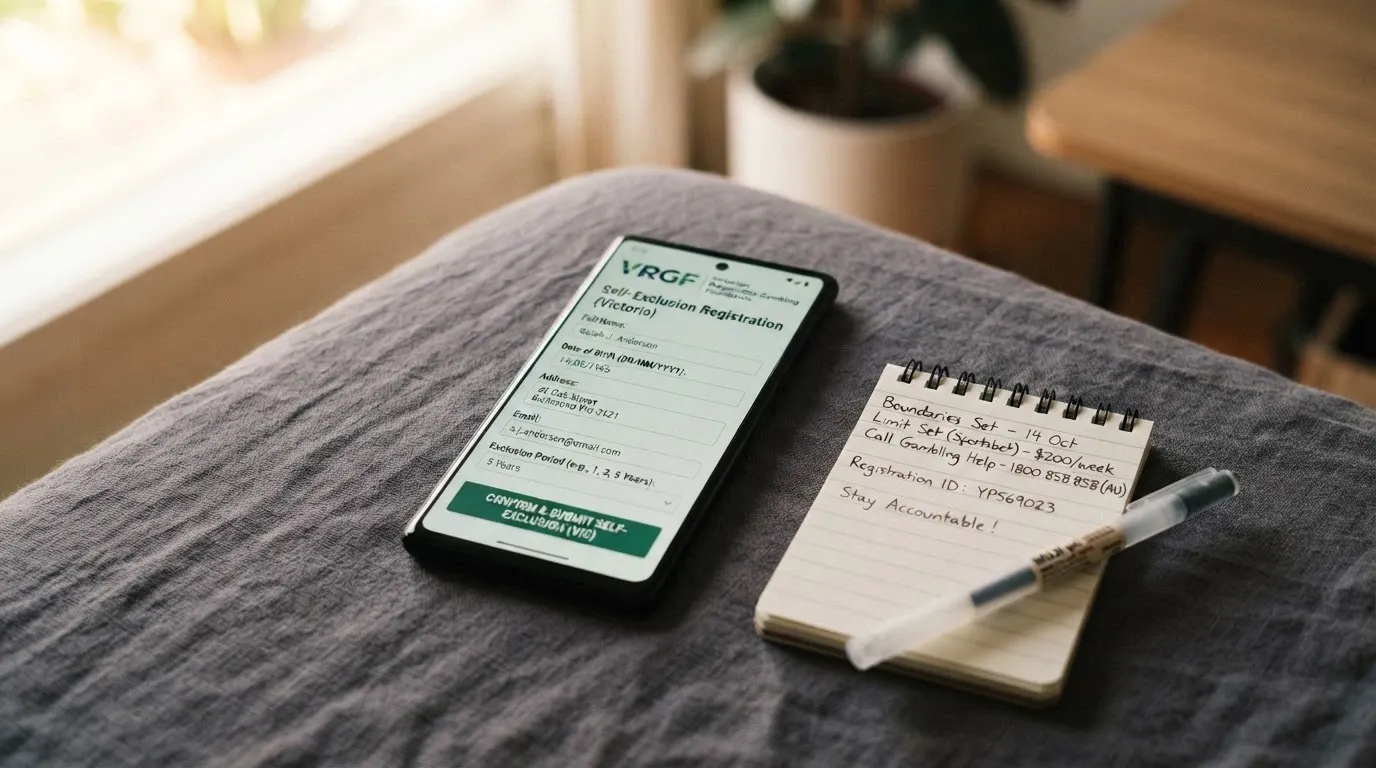
- BetStop — the National Self-Exclusion Register: launched on 21 August 2023, BetStop lets a player exclude themselves from every licensed online and phone wagering provider in Australia for a chosen period (from three months up to a permanent exclusion). As of 31 March 2026, 37,247 people held active exclusions, with 59,830 cumulative registrations to the end of Q3 FY2025-26.
The structural caveat is that BetStop applies to licensed wagering, not to offshore casino operators. A player who self-excludes through BetStop is excluded from Australian-licensed sports and racing bookmakers, but offshore casino operators do not participate in the register. The offshore operators typically offer their own self-exclusion tools, but the coverage is operator-by-operator, not national.
Where to Get Help: BetStop, the National Helpline and Free Counselling
Australian support infrastructure for gambling harm is free, 24/7 and confidential, and a player who needs any of it does not need to be in crisis to use it. The three main entry points are:
Players can access support through the National Gambling Helpline on 1800 858 858, which is free and confidential 24/7, via Gambling Help Online for free 24/7 chat and email counselling, or through BetStop for self-exclusion from licensed Australian wagering providers.
The funding behind these services is part of a broader A$112.7 million five-year package from 2025-26 for gambling harm reduction, including A$39 million over four years for financial counselling, A$28.7 million for BetStop enhancements, A$22.6 million for wagering advertising enforcement and consumer protection, and A$22.4 million for a national public awareness campaign. The services are scaled to the size of the problem they exist to address.
A $20 deposit is small enough to feel safe. The data on Australian gambling harm is unambiguous that the cost is real and the supports are there. A player who wants to keep the deposit small should also consider setting the deposit cap, the loss limit and the session timer before the first spin — most of the harm in the research is concentrated in a small share of the player base, and the tools exist to make sure a player is not in that share.
How We Evaluated and Ordered This Page’s $20 Casino Picks
The ten operators on this page were chosen because they are the brands Australian players actually use at the A$20 deposit tier. The selection draws on affiliate comparison pages, the terms and conditions of each operator, and the regulatory registers that confirm or flag licence status. The ranking combines three things: the headline value of the welcome offer at a $20 deposit, the fairness of the wagering terms (multiplier, validity window, bet cap, bonus-only versus bonus-plus-deposit), and the size and quality of the game library.
The order is not driven by a single number. A 100% match at 35x bonus-only with thirty days validity (VegasNow) ranks above a 200% match at 30x with unconfirmed validity (LuckyOnes) because the published terms on the first are more useful to a player making a decision than the headline on the second. A 0x-wagering cash offer (Goldenbet) ranks in the bottom half despite being the most player-friendly offer on the list, because the unconfirmed licence and the unconfirmed game library mean a player has more to verify before they can compare. The order is a working ranking, not a verdict; the verification of licence, terms and library is the player’s job before they deposit.
The data sources behind the ranking are the operators’ own terms pages, the ACMA’s register of blocked and monitored operators, the Curaçao and Anjouan regulatory registers for licence confirmation, and the published Australian market data on gambling losses, harm prevalence and self-exclusion registrations. This comparison also considers the structures used by other review sites, but this analysis is independent and not a derivative of any other source.
Is a $20 Deposit Worth It? What the Numbers Say
The arithmetic of a $20 deposit with a welcome bonus is a study in what the marketing page does not say. Take the standard case: a $20 deposit, a 100% match at 35x bonus-only wagering, and 200 free spins on Big Bass Splash. The bonus bankroll is $20, the wagering target is $700, and the time to clear the wagering at A$0.20 per spin on a 5-second spin interval is approximately 4,857 minutes, or 81 hours of continuous play. The expected loss on the $700 of qualifying wagers, assuming a 96% return-to-player on the pokie used to clear the bonus, is $28. The bonus itself is $20, and the deposit is still $20. The bonus costs the player more in expected loss than it delivers in bonus money.

A 50x wagering multiplier on the same $20 bonus is a $1,000 playthrough. At the same stake and interval, that is approximately 116 hours of continuous play, and the expected loss on $1,000 of turnover at 96% RTP is $40 — twice the bonus value, before the deposit is counted. A player who accepts the 50x bonus is paying $40 in expected loss for a $20 bonus and risking the deposit on top. The marketing page frames that as a free $20; the arithmetic frames it as a $40 fee.
A $20 deposit with no bonus, by contrast, is a clean $20 session at 80 to 120 spins, with a real chance of a memorable win and a clean path to withdrawal after identity verification. There is no wagering target, no bonus clock, no max-bet cap during a clearing period. The expected loss is the cost of a $20 session, not the cost of a $20 session plus a $700 clearing requirement. The marketing is quieter on this path, and the math is cleaner.
The right entry point depends on what the player values. A player who wants the longest session and the cleanest path to a withdrawal has the better deal on a no-bonus $20 deposit, with the option to claim a bonus only on terms they have read and can clear. A player who wants the largest possible bankroll and is willing to commit to a longer clearing window has a defensible case for a 100% match at 30x to 35x, provided the bonus-only structure keeps the playthrough at a level they can actually reach. A player who is drawn to the headline numbers (400% match, 500 free spins, A$20,000 ceiling) should sit down and run the math before claiming.
The verdict: $20 is the right minimum to test a casino, the right minimum to play a real-money session, and the right minimum to clear most welcome bonuses without overcommitting. The wagering terms are the part of the offer that decide whether the bonus is worth taking, and the player who reads those terms before depositing is the player who keeps the most of their $20.
Frequently Asked Questions
What payment methods can I use to deposit $20 at an Australian casino?
At the $20 floor, every Australian-facing payment rail is available: PayID, Visa and Mastercard debit, Bitcoin, Ethereum, USDT and Litecoin, Neosurf vouchers, and direct bank transfer. The choice between them is about speed, fees and whether the method can also handle a withdrawal, with PayID the default for Australian players and crypto the fastest on the withdrawal side.
What welcome bonuses can I get with a $20 deposit?
A $20 deposit triggers the welcome offer at every operator on this list, most commonly a 100% match up to a four-figure ceiling plus 50 to 500 free spins. The wagering requirements on the bonus range from 0x (Goldenbet’s cash offer) to 40x or 50x at the less favourable end, with 30x to 35x the most common in the standard market.
How many pokies spins can I get from a $20 deposit?
At A$0.20 per spin, a $20 deposit delivers approximately 80 to 120 spins before the bankroll is gone. The exact number depends on the bet size (lower bets stretch the bankroll, higher bets compress it) and on whether the player is clearing a bonus or playing cash.
What are the wagering requirements for $20 deposit bonuses?
The wagering multiple on welcome bonuses in the Australian-facing offshore market ranges from 30x to 45x, with 35x the most common single number. The wagering typically applies to the bonus amount only (not the deposit), and the time to clear it is usually 30 days, with shorter windows on the more aggressive offers.
What is the minimum withdrawal amount at $20 deposit casinos?
Minimum withdrawals at Australian-facing offshore casinos typically sit between A$20 and A$50, with crypto at the low end, PayID and cards in the middle, and bank transfer at the high end. A player who won less than the minimum can either top up the balance or wait for a larger win before requesting a withdrawal.
How fast are PayID withdrawals at Australian casinos?
At well-run operators, PayID withdrawals clear in five to thirty minutes. The first withdrawal from a new account is typically slower because the operator runs an identity verification step in front of the payment; subsequent withdrawals on a verified account run on the published timeline. The speed assumes the operator runs PayID on the NPP real-time settlement rail, which most of the established set does.