
Fast-paying casinos for Australian players: what speed really means, and what it costs you
The promise of an “instant” casino withdrawal is everywhere in the Australian search results, and almost none of the pages selling it will tell you what the operators behind it actually are. Every brand named below is an offshore casino. None holds an Australian licence. None can — because the product it would offer, online casino gambling, is prohibited outright under the Interactive Gambling Act 2001. The speed claim is real, but the protection behind it is not, and that gap is the part this page is built around.

This article ranks ten offshore casinos on payout speed where the data exists, maps every withdrawal method available to an Australian player by the time it actually takes, and sets both beside the legal reality the affiliate reviews ignore. Current as of 22 November 2026, verified against the ACMA register and the licence claims each operator publishes.
Table of Contents
- What a quick-withdrawal casino actually delivers — and why speed is the real test of a site
- How casino payouts work method by method — the Australian player’s withdrawal map
- The 10 fastest-paying casino operators for Australian players in 2026
- What no Australian casino review tells you about the law — and what it means for your money
- Staying in control when the cashout is instant — safer gambling and withdrawal discipline
- How we evaluated withdrawal speed — our methodology
- What the Australian punter should actually do about fast casino cashouts in 2026
- Frequently asked questions
What a quick-withdrawal casino actually delivers — and why speed is the real test of a site
A “quick withdrawal casino” is not a single thing — it is a tier claim that depends entirely on which payment rail a player picks, which currency the casino supports, and whether the casino has already finished verifying the player’s identity. The label gets used loosely across the market. Some operators use it to mean a crypto payout in fifteen minutes. Some use it to mean a same-day PayID transfer. A few stretch it over a bank wire that takes three working days and call that “fast” because it beats the offshore average.
What separates a genuinely fast operator from a slow one is not the welcome offer — it is the infrastructure behind the cashout button. How quickly the casino approves a withdrawal request, whether it gates the request behind a manual review, whether its payment processor supports instant settlement, and whether the player’s account is already past Know Your Customer (KYC) verification all sit on the critical path. The headline bonus figure changes every month. The cashout plumbing does not.
The trade-off is the part most reviews skip. Faster payouts usually mean smaller operators, fewer payment rails, and stricter withdrawal limits per request. A casino that pays out in twelve minutes on USDT TRC20 (a low-fee cryptocurrency transfer network) is rarely the same casino offering a high-value PayID withdrawal with no questions asked. The bigger, more heavily marketed brands tend to sit in the same-day tier — slower than crypto, but broader in method choice. A punter has to choose which of those two things matters more.
The payout-speed test: what separates a same-day casino from the rest
Three tiers cover almost every real-world cashout at an offshore casino targeting Australian players, and each has its own bottleneck.
The instant tier — under fifteen minutes — is the crypto rail, and only the crypto rail. USDT on the Tron network (USDT TRC20) clears at the blockchain in one to three minutes, with network fees under A$2 per transfer. Bitcoin and Ethereum (ETH) are slower: ETH varies with network load and typically takes six to eight hours at tested operators. Crypto is faster than PayID-only casinos by a factor of five to twenty times end-to-end.
The same-day tier — under twenty-four hours — is where PayID and the major e-wallets sit. PayID runs on Australia’s New Payments Platform (NPP) via Osko, which is open twenty-four hours a day, seven days a week, and the underlying transfer settles instantly at the bank. Casino-side processing on top of that can stretch the total to an hour, sometimes sixty, rarely longer. Skrill and Neteller withdrawals typically take one to six hours, provided the e-wallet account itself has been verified.
The multi-day tier is bank transfer. Three to five business days is the norm, and receiving-bank fees of A$25 to A$40 per wire are common. Any operator still listing POLi in its cashier in 2026 is running outdated documentation — POLi shut down on 30 September 2023.
KYC verification is the delay that sits across all three tiers. First-time identity verification adds twenty-four to seventy-two hours to a withdrawal regardless of method, which is why “verify before you play” is the single most useful rule on this page.
Why a fast cashout changes every decision you make at the pokies
The difference between a withdrawal that lands in twelve minutes and one that takes four working days is not just convenience — it changes the punter’s behaviour. The player who can move winnings out fast treats the bank balance as a real balance. The player who cannot treats winnings as casino credit, and the longer they sit there, the more likely they are to chase.
Around 2.1% of Australian adults — roughly 430,000 people — experience problem gambling, and the Australian Institute of Health and Welfare put high-risk gambling at 1.8% in 2022. Faster access to cash is not, on its own, a harm — but reducing the friction on every deposit-and-withdrawal loop also reduces the friction on a losing streak. A site that pays out in twelve minutes lets a punter reload as quickly as it lets them cash out. That symmetry is worth holding onto.
A punter who treats winnings as money they have earned and parks them outside the casino account is harder to chase than a punter who treats winnings as house money they can re-spin. The payout speed of the casino is part of that calculation, but only part. The other part is the punter’s own rule: decide what you are willing to lose before you log in, and cash out when you are ahead, not when the balance is gone.
Who needs a same-day casino — and who can afford to wait
The real-money player who withdraws regularly — weekly, sometimes more often — has a real reason to care about payout speed. They want their bank balance updated before the next session, and they want to know which rail will deliver it. PayID and crypto are the only two that genuinely serve that profile.
The casual punter who withdraws once a month, usually at the end of a session, is choosing on offer size more than on speed. The headline bonus, the game library, the loyalty perks — those matter more than whether the cashout takes an hour or three days.
The slots-first player chasing frequent, smaller cashouts needs speed and tolerates a narrower method set. Crypto is the natural fit. PayID is the fallback if they want to stay in AUD. Bank transfer is the wrong rail for this profile.
The bonus hunter prioritises offer value over speed, and is the only player profile for whom a multi-day bank transfer is a reasonable compromise — provided the bonus terms actually justify the wait.
How casino payouts work method by method — the Australian player’s withdrawal map
Payment method is the single biggest lever an Australian player pulls on payout speed. The casino’s processing time is usually fixed; the rail underneath is what changes the clock. Crypto clears fastest, PayID next, e-wallets close behind, and bank transfer is the slowest by a wide margin. An operator that advertises “instant withdrawals” almost always means one rail — not all of them.
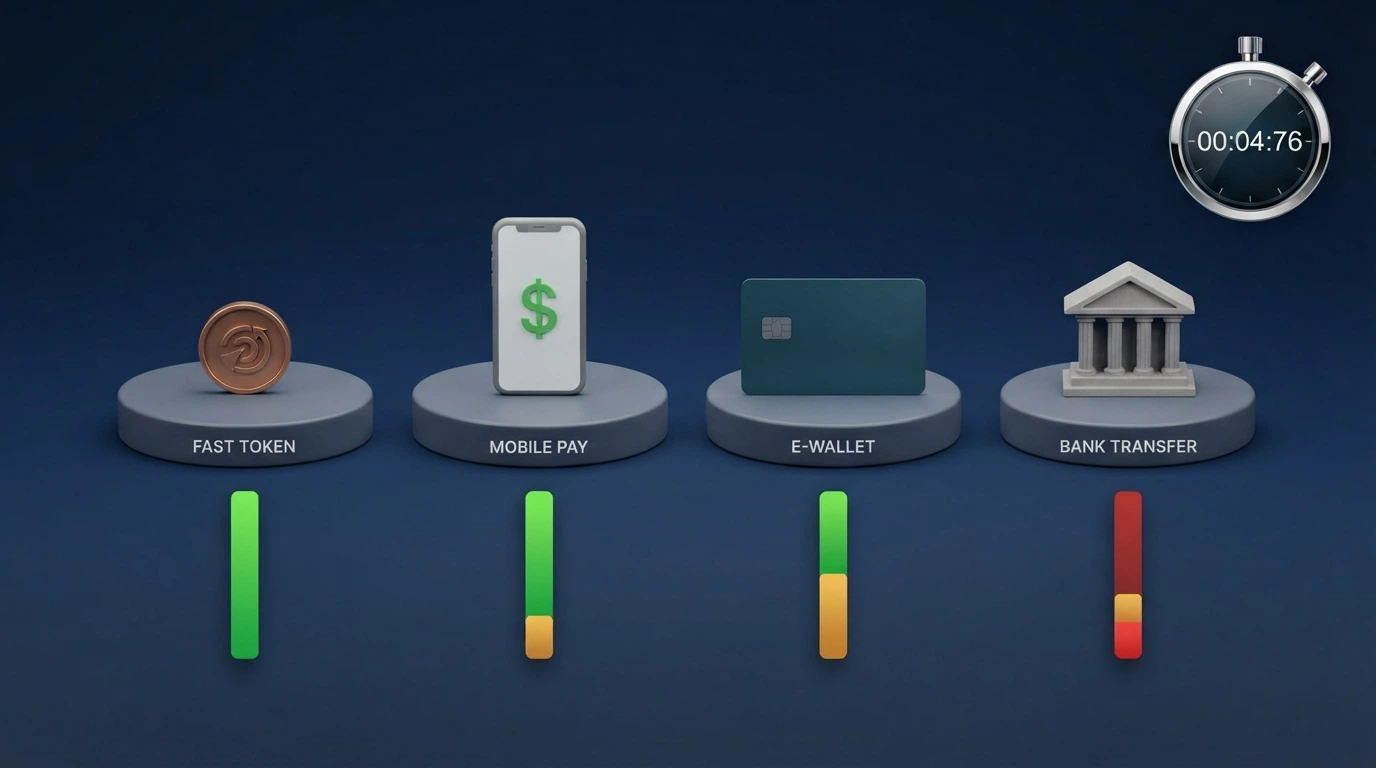
Instant, same-day or business days: the three payout tiers that matter
The instant tier is crypto, and the test for whether a casino is genuinely instant is whether it processes USDT TRC20 end-to-end in under fifteen minutes after approval. Crypto’s edge over PayID-only operators is measured at five to twenty times faster on real cashouts, and the difference is not marginal — it is the difference between waiting for lunch and waiting for the next working week.
The same-day tier is PayID and e-wallets. PayID via NPP/Osko is open twenty-four hours a day and the underlying transfer is instant once approved by the casino — total wall-clock usually one to sixty minutes, occasionally longer on first receive at a bank that has not seen an iGaming PayID before. ANZ added roughly four hours of verification on first iGaming PayID receive in late 2025 before clearing subsequent transfers at full speed. E-wallet withdrawals via Skrill or Neteller typically take one to six hours, provided the e-wallet account is itself verified.
The multi-day tier is bank transfer. Three to five business days is the published range, and receiving-bank fees of A$25 to A$40 per wire are standard at most Australian banks. The reason this rail still exists is that some players prefer the familiarity of a bank wire, and some operators do not support AUD rails at all, in which case bank transfer is the only AUD exit available.
Real-money withdrawals: what happens between “request” and “in your account”
The cashout path is the same regardless of which rail the player picks. It has four steps, and each step has its own delay range.
The pending period is the time between hitting “withdraw” and the casino’s payments team approving the request. Automated systems clear it in minutes. Manual review can stretch it to twenty-four hours on weekends and longer on public holidays.
The KYC gate is the variable that adds the most delay when it fires. First-time verification adds twenty-four to seventy-two hours regardless of casino or method, because the operator has to check the player’s identity documents against a sanctions and politically exposed persons list. Once verified, the gate does not fire again unless the player changes name, address or payment method.
The transfer time is method-dependent: instant for crypto once approved, instant for PayID once the bank has cleared it, one to six hours for e-wallets, three to five business days for bank transfer.
The receiving-bank behaviour is the step most reviews ignore. Banks do slow first receives from unfamiliar counterparties. ANZ’s four-hour lag is one documented case. Other Australian banks do similar reviews and do not always publish the timing.
The player’s only real lever is to complete KYC before requesting the first withdrawal — not at the moment the casino prompts for it, but before any cashout is in flight. Verified accounts clear the gate every time and the pending period collapses to its minimum.
Pokies payouts: why slot winnings follow the same withdrawal path
Online pokies are the game Australians most often search for, and “quick withdrawal online pokies” returns essentially the same operator set as “quick withdrawal casino.” That is not a coincidence — pokies winnings go into the same casino balance as every other game win and come out through the same withdrawal rails.
The implication is that the game the player is spinning does not change the speed of the cashout. A win on a pokies spin at an offshore casino that supports PayID will arrive via PayID. A win on a blackjack hand at the same casino will arrive via the same PayID. There is no pokies-only cashout rail.
Betsquare’s 2026 testing placed SpinBoss as the best overall fast-payout pokies site, with a tested withdrawal of one hour and eighteen minutes, and WestAce as the fastest tested cashout at fifty-eight minutes. Both results sit inside the same-day tier and below the one-hour mark — the kind of result a crypto or PayID operator can credibly deliver.
The slots-first player’s profile is high frequency and small ticket. They want a method that lets them cash out small amounts quickly without triggering the threshold at which extra review kicks in.
AU-facing operators: how Australian payment rails speed up or slow down the cashout
| Withdrawal method | Typical speed | What to watch for |
|---|---|---|
| Crypto (USDT TRC20) | 5–60 minutes after casino approval | Network fees under A$2; only rail that genuinely clears under 15 minutes |
| Crypto (ETH) | 6–8 hours typical at tested operators | Gas fees vary with network load; slower than USDT TRC20 |
| PayID via NPP/Osko | 1–60 minutes after casino approval | Open 24/7; first receive at some banks adds verification time (ANZ ~4 hours documented) |
| Skrill / Neteller | 1–6 hours | E-wallet account itself must be verified first |
| Bank transfer | 3–5 business days | Receiving-bank fees of A$25–A$40 per wire are standard |
| POLi | — | Method shut down 30 September 2023 — any operator still listing it is running outdated documentation |
PayID and Osko are the rails that make the same-day tier possible at all. NPP is Australia’s 24/7 instant settlement platform, and Osko is the service that delivers the actual payment. Without NPP, PayID would not exist as a casino withdrawal option — every same-day tier claim for AUD depends on it. Offshore casinos that have not integrated NPP-backed PayID fall back to bank transfer and sit in the multi-day tier regardless of how fast their internal approval is.
Deposit, play, withdraw — doing it all in one session
The same-session cashout — deposit, play, withdraw — is technically possible at a PayID or crypto casino, but only under a narrow set of conditions.
The account has to be KYC-verified before the deposit, not at withdrawal. The withdrawal method has to match a method the casino actually supports for cashout — not just for deposit. The amount has to sit below the threshold at which additional review triggers, which most operators set around A$2,000. The casino’s pending period has to be automated, not manual, or the request stalls until the payments team gets to it.
Any of those four conditions breaking is enough to stretch a same-session flow into a same-day or multi-day one. A KYC prompt at the moment of withdrawal is the commonest reason a punter who thought they were doing a one-hour cashout ends up waiting seventy-two hours. A weekend or public holiday landing on a manual-review queue is the second commonest.
The deposit method usually dictates the withdrawal method — most operators require cashout to the same rail used for deposit, which is part of anti-money-laundering (AML) compliance. A punter who deposits by PayID and wants to cash out by crypto will often be asked to cash out by PayID instead, or to use a method the casino explicitly approves for the destination currency.
The 10 fastest-paying casino operators for Australian players in 2026
Every operator on this list is offshore. Every one is unlicensed in Australia. None holds an Australian casino licence — because none can: online casino games and online pokies are prohibited under the Interactive Gambling Act 2001, and no licence for that product exists anywhere in Australia. Players using these operators have no Australian consumer protection, no Australian Communications and Media Authority (ACMA) complaints recourse, and no guarantee that the site will still be reachable tomorrow. ACMA has had 1,564 illegal gambling and affiliate websites blocked by Australian ISPs as of March 2026, and a blocked site can hold a player’s balance at the moment it goes dark.

The order below reflects what is verifiable about payout speed, with AU player reach as a secondary signal where speed data is absent. For most operators on this list, withdrawal speed was not confirmed by independent testing this review — players should verify current withdrawal terms on each operator’s own site before depositing.
Side-by-side: payout limits, speeds and what each operator actually delivers
| Operator | Licensed in Australia? | AU player reach (market share) | Verified payout-speed data |
|---|---|---|---|
| Rocket Play | No — offshore, unlicensed in AU | 9.4% | — |
| Skycrown | No — offshore, unlicensed in AU | 8.55% | — |
| Royal Reels | No — offshore, unlicensed in AU | 2.51% | — |
| Stake | No — offshore, unlicensed in AU | 1.28% | Crypto: 1–2 hours |
| WinSpirit | No — offshore, unlicensed in AU | 1.55% | — |
| Rainbet | No — offshore, unlicensed in AU | 1.28% | — |
| Scream Casino | No — offshore, unlicensed in AU | 0.99% | — |
| FairGO | No — offshore, unlicensed in AU | 0.8% | — |
| Bizzo Casino | No — offshore, unlicensed in AU | 0.57% | — |
| Rocket Casino | No — offshore, unlicensed in AU | 0.57% | — |
The market-share column is included because it is the only comparable signal across all ten. Speed data only exists for Stake in this list, and the reason is that the testing sources published specific numbers for it this review. That gap is the data picture most Australian players actually face when they compare operators — a handful of named brands at the top, and a long tail where the only thing to rely on is what the operator publishes on its own cashier page.
Rocket Play
Rocket Play is the highest-share AU-facing offshore casino in the featured set at 9.4% of the Australian offshore market. Its licence status is offshore — it is not licensed in Australia, and the product it offers cannot be licensed here. The operator sits at the top of the AU offshore share table alongside Skycrown, which is a useful signal about reach but not about payout speed.
No verified withdrawal-speed data exists for Rocket Play from independent testing this review. At the scale Rocket Play operates, the expected payment-method landscape covers the same three tiers the wider market covers — crypto (likely USDT TRC20 and BTC), PayID via NPP, and bank transfer — but the speed each method delivers at Rocket Play specifically is not published in a comparable form. Players should verify current withdrawal terms on the operator’s own site before depositing, and should assume the bank transfer rail is the slowest option at any operator of this scale.
For a punter prioritising reach and brand recognition, Rocket Play is the headline name in the AU offshore space. For a punter prioritising confirmed payout speed, it sits behind Stake, where the data exists.
Skycrown
Skycrown holds 8.55% of the AU offshore market — the second-largest share among the featured operators. Like Rocket Play, it is an offshore operator, and its products are prohibited by the Interactive Gambling Act. The operator runs at the same tier as Rocket Play in terms of scale and the same gap in terms of verified payout-speed data.
What a player can reasonably expect at Skycrown is the standard three-tier method landscape — crypto, PayID, e-wallet and bank transfer — without an independent speed benchmark this review. Game providers, bonus terms and withdrawal-specific conditions were not confirmed this run, which is itself a signal: at this tier of operator, only the headline marketing figures get published, and the cashout specifics live behind the cashier page.
Skycrown suits a punter who wants a large, established AU-facing brand and is comfortable verifying current terms on the operator’s own site. It sits behind both Stake (where the speed data is published) and any operator where the punter has personally tested a withdrawal, on the speed-first ranking.
Royal Reels
Royal Reels sits at 2.51% AU offshore market share — a mid-tier operator, well below the headline names but well above the long tail. It operates offshore without an Australian licence, and the IGA prohibition applies accordingly. This review could not independently verify its withdrawal speed, bonus terms, or game-provider list.
The operator’s market position is the interesting signal. Royal Reels has enough share that the brand is recognisable to an AU punter shopping for a quick-withdrawal casino, but not enough share that the brand has invested in being tested by the payout-speed sites. For a punter, the practical implication is that they will see the name on comparison pages but should not trust any cashout time they have not verified themselves.
Royal Reels suits a punter willing to dig into the cashier page and confirm the withdrawal method, speed and threshold themselves before depositing. It does not suit a punter who wants a tested, benchmarked cashout window.
Stake
Stake is the only operator on this list with a confirmed, independently tested payout-speed figure. Crypto withdrawals at Stake take one to two hours end-to-end at the tested operators in PayoutVerdict’s benchmarking — not the fastest crypto time in the wider market (BitStarz at twelve to thirty minutes is faster), but the only one in the featured set where the figure is published in a form a player can compare.
The context matters. Stake is offshore and unlicensed in Australia. It operates a crypto-first platform, which means AUD rails like PayID are not its main payment route — a punter using Stake typically deposits and withdraws in crypto, not in AUD. Crypto is banned for licensed Australian wagering deposits from 11 June 2024, so an operator accepting crypto deposits for casino play is operating outside the Australian rules by design. A punter choosing Stake has to be comfortable with crypto as the only practical cashout rail.
For a punter who already holds crypto and wants a tested speed figure, Stake is the cleanest choice on this list. The verified one-to-two-hour window sits in the same-day tier and gives a punter a real benchmark to plan around. For a punter who wants AUD rails and Australian consumer protection, Stake is the wrong operator — and indeed no operator on this list is the right one.
WinSpirit
WinSpirit holds 1.55% AU offshore market share and sits in the mid-tier of AU-facing operators. It is an unlicensed offshore entity, and the product it offers is prohibited under the IGA. Independent testing for this review did not verify its withdrawal speed, bonus terms, or game-provider list.
WinSpit’s profile matches the broader pattern of mid-tier AU offshore brands: recognisable name, real market share, but no published payout benchmark. A punter signing up at WinSpirit should treat the payout question as their own homework — check the cashier page, identify the supported methods, confirm the KYC requirements, and check whether the operator has a published processing-time figure before depositing.
WinSpirit suits a punter who wants a recognisable brand and is willing to do their own verification on the cashout specifics. It sits behind Stake on the speed-first ranking and is roughly comparable to Royal Reels on the market-share-first ranking.
Rainbet
Rainbet holds 1.28% AU offshore market share — the same figure as Stake, but with no verified payout-speed data. It is an unlicensed offshore entity, meaning the IGA prohibition covers it just like all other operators on this list. The data picture is thin in the same way the data picture is thin for most of this list: the headline marketing gets published, the cashout specifics do not.
A punter comparing Rainbet to Stake on speed grounds alone should pick Stake, where the one-to-two-hour crypto window is confirmed. A punter comparing on game library, bonus structure, or any other criterion will need to verify those specifics on the operator’s own site. Rainbet is not the wrong operator for any single reason — it is the operator with the least external data to lean on, which is itself the caution.
Scream Casino
Scream Casino sits at 0.99% AU offshore market share — under one percent, the smallest of the named brands but still recognisable. It is offshore and unlicensed in Australia. Independent testing did not confirm the withdrawal speed, bonus terms, or game-provider list for this review.
The pattern holds: at smaller AU offshore brands, the marketing layer gets investment and the cashout specifics do not. A punter choosing Scream Casino is choosing on brand familiarity or on a specific offer detail, not on a verified payout-speed figure. The due diligence list is the same as for every other operator in this tier — cashier page, supported methods, KYC requirements, threshold at which extra review kicks in.
FairGO
FairGO holds 0.8% AU offshore market share — the second-smallest share in the featured set. The brand name suggests fairness and an Australian focus, which is the marketing positioning. The legal status is the same as every other operator on this list: offshore and unlicensed in Australia, with the IGA prohibition in force.
The gap between the brand positioning and the legal reality is the thing to flag. “FairGO” reads as an Australian-facing brand with a fairness promise. It is an offshore casino, like every other name on this page, and the product it offers is prohibited under Australian law. Withdrawal speed was not confirmed from independent testing this review, and players should verify current withdrawal terms on the operator’s own site before depositing.
FairGO suits a punter who responds to the brand positioning and is comfortable verifying the rest themselves. The brand name is not a substitute for confirmed speed data.
Bizzo Casino
Bizzo Casino holds 0.57% AU offshore market share — at the bottom of the featured set. It is offshore and unlicensed in Australia. The withdrawal speed, bonus terms, and game-provider list remain unconfirmed by independent testing for this review.
At this share level, the signal is that the operator exists and serves Australian players, but the comparison data does not. The payout-speed question is the punter’s to answer — check the cashier, confirm the methods, and verify the threshold at which extra review kicks in before depositing. The smaller the operator, the more this homework matters, because the marketing layer is the only layer being maintained.
Bizzo Casino suits a punter who has a specific reason to be at this brand — a game they want, an offer they have seen — and is willing to do their own verification on the cashout.
Rocket Casino
Rocket Casino holds 0.57% AU offshore market share — tied with Bizzo Casino at the bottom of the featured set. It is offshore and unlicensed in Australia. Testing for this review did not confirm the withdrawal speed, bonus terms, or game-provider list.
The same caveat applies as for every other operator on this list: the punter is choosing on marketing and reach, not on verified speed. The due diligence is the same: cashier page, supported methods, KYC requirements, threshold. Rocket Casino is the operator with the thinnest data and the smallest share, and a punter should treat it as the most unvetted name in the featured set.
What no Australian casino review tells you about the law — and what it means for your money
Online casino is prohibited in Australia under the Interactive Gambling Act 2001. There is no licence for online casino anywhere in the country. The Australian market is structurally the French case — the product is banned outright — not the British one where the product is licensed and regulated. Every operator on the rest of this page is offshore, unlicensed in Australia, and offering a product that is prohibited here.

The 2026 reform passed Parliament on 19 August 2026, with the new measures commencing on 1 January 2027. From that date, banks and payment providers gain express authority to block transactions to illegal gambling operators — a direct change to how fast withdrawals at offshore casinos may flow in the future. The reform does not legalise online casino. It strengthens the prohibition and adds the tools to enforce it.
No Australian casino licence exists — what the Interactive Gambling Act actually prohibits
The Interactive Gambling Act 2001 (IGA), strengthened by the Interactive Gambling Amendment Act 2017, prohibits the provision of online casino games, online pokies and in-play betting to a person in Australia. The prohibition is on the provider, not the player — the individual punter is not prosecuted — but no Australian-licensed operator can offer online casino. That licence does not exist.
What Australia does license is wagering on races and sport placed before the event begins, plus lotteries and keno, through operators licensed by a state or territory. The Northern Territory Racing and Wagering Commission (NTRWC), administered through Licensing NT, is the de facto national licensor for large online bookmakers, with licence terms running up to twenty years. The licensed wagering operators — SportsBet, Tab, Bet365, Ladbrokes, TABtouch — hold NT or state wagering licences and do not offer casino games. That distinction is the cleanest test for whether an operator is legally accessible from Australia.
A player who wants legal recourse to an Australian complaints body, BetStop coverage and consumer protection under Australian law is looking at licensed wagering, not casino. Casino games and pokies are not part of that product category.
The “no-verify” casino route: what skipping KYC really costs
A casino that lets a punter skip identity verification looks like a faster path to a withdrawal — until the first cashout over the threshold triggers the KYC check anyway. The “no ID check under US$2,000” model that some operators publish is a ceiling, not a waiver. Above the ceiling, the same verification fires.
The cost of skipping KYC is not speed. It is recourse. A player who never verified with the casino has no documented identity relationship with the operator. If the operator refuses a withdrawal, voids a win or closes the account, the player has no paper trail and no Australian complaints body to take it to. The ACMA cannot recover anyone’s money — the agency enforces the prohibition on providers, not individual disputes. The speed the operator gains by skipping the check is borrowed from the protection the player loses by skipping it.
KYC verification, properly completed, is the single biggest speed lever a player controls. First-time verification adds twenty-four to seventy-two hours, but it is a one-time cost. Verified accounts clear the gate on every subsequent withdrawal.
Outside the licensed market: the protections you give up the moment you sign up
Five things an Australian player forfeits at an offshore casino. None of them are recoverable once the player has deposited.
No BetStop coverage. BetStop — the National Self-Exclusion Register — went live in August 2023 and binds approximately 150 licensed Australian wagering services. As at 31 July 2026, 67,480 registrations had been recorded, of which 41,290 exclusions were still active; 78% of registrants were under 40, and 38% chose lifetime exclusion. The register does not reach offshore casinos. A self-excluded person who signs up at an offshore casino will be accepted, deposited with, and allowed to play.
No ACMA complaints recourse. The ACMA enforces the prohibition on providers. It cannot investigate a complaint about a delayed withdrawal, a voided win or a closed account, and it cannot recover a player’s balance. The most the agency can do is direct ISPs to block the site — which it has done for 1,564 illegal gambling and affiliate websites as of March 2026, with more than 225 illegal services withdrawn from the Australian market since 2017. A blocked site may hold a player’s balance at the moment it goes dark.
No Australian Consumer Law protection. Australian Consumer Law guarantees do not apply to services provided from outside Australia by an unlicensed operator. A punter dealing with a licensed wagering operator has the Australian Competition and Consumer Commission (ACCC) and state consumer affairs tribunals. A punter dealing with an offshore casino has the casino’s own dispute process and whatever regulator issued the casino’s actual licence — Curaçao, Anjouan, the Malta Gaming Authority — none of which have an Australian complaints pathway.
No guaranteed access. The site can be blocked by ISPs at any time, at the ACMA’s direction, and a blocked site can still hold a player’s balance. The block is DNS-level — it is presented as a barrier to Australian access, not as an unbeatable one — but it can strand a withdrawal request in the moment it fires.
No tax clarity for operators. Gambling winnings are not assessable income under section 6-5 of the ITAA 1997 for an ordinary punter, and losses are not deductible under section 8-1 — unless the person is carrying on a business of betting. That is the player’s side. The operator’s side is different: the Northern Territory levies a 5% wagering tax on wagers minus payouts plus a 0.05% racing levy, and each state sets its own point-of-consumption tax, typically 10–15% of net wagering revenue. None of that tax architecture protects the punter. It governs the operator’s relationship with the regulator, not the player’s relationship with the operator.
What changes on 1 January 2027 — the reform that rewrites the offshore withdrawal picture
The Interactive Gambling Amendment (Gambling Reform) Bill 2026 passed Parliament on 19 August 2026 and its measures commence on 1 January 2027. None of the changes legalise online casino. All of them strengthen the prohibition and add the tools to enforce it.
From that date, banks and payment providers gain express authority to block transactions to illegal gambling operators. A PayID or card payment to an offshore casino can be refused at the bank, not just declined at the casino. That is a direct change to how fast withdrawals at offshore casinos may flow in the future — a blocked inbound payment is also a blocked outbound payment.
The reform also adds a federal advertising hourly cap — no more than three wagering ads per hour between 6:00 am and 8:30 pm — and a live-sport blackout from fifteen minutes before to five minutes after a live event. Broadcasting sporting odds is banned outright, and online wagering ads are restricted to logged-in, age-confirmed users. Athletes, celebrities and influencers are barred from promoting wagering products.
Direct marketing of inducements is prohibited for fourteen days after a customer signs up, for three months after a person deregisters from BetStop, and indefinitely for customers identified as at risk. The inducement ban does not change the underlying prohibition. It changes how licensed wagering operators can market to Australian customers. Offshore casinos are already operating outside the Australian rules, so the inducement ban does not reach them — but the bank-blocking authority does.
Staying in control when the cashout is instant — safer gambling and withdrawal discipline
Faster access to winnings is not, on its own, a harm reduction — but it does change the friction on every deposit-and-withdrawal cycle. A punter who can cash out in twelve minutes can also reload in twelve minutes. The symmetry of speed is worth thinking about before chasing the marketing pitch.

Around 2.1% of Australian adults — roughly 430,000 people — experience problem gambling, and the Australian Institute of Health and Welfare put high-risk gambling at 1.8% in 2022. The Government has drawn a direct analogy with the existing prohibition on online casino games, pointing to rapid-play mechanics and spending thresholds that in some configurations allow consumers to wager up to A$1,000 every three hours. The speed of the cashout is part of that calculation.
The help that exists: BetStop, the Helpline and the tools you can use today
Three services cover most of what an Australian punter needs, and the limits of each are worth knowing before relying on them.
The National Gambling Helpline is 1800 858 858 — free, confidential, open twenty-four hours a day, seven days a week. Gambling Help Online at gamblinghelponline.org.au provides online chat counselling and phone counselling twenty-four hours a day. Both are run by the Department of Social Services and reach anyone in Australia, regardless of which operator they use or whether that operator is licensed.
BetStop — the National Self-Exclusion Register — covers approximately 150 licensed Australian wagering services. Self-exclusion ranges from a minimum of three months up to a lifetime; a person cannot apply to be removed in the first three months. Excluded people cannot access sites such as TAB, Sportsbet, Neds, Ladbrokes, Unibet and Bet365. BetStop does not reach offshore casinos. A self-excluded person who signs up at an offshore casino will be accepted and allowed to play, and the register will not block them.
The activity-statement and deposit-limit tools are available at licensed operators and show a player exactly what they have spent over a chosen window. Those tools do not exist at offshore casinos in any enforceable form.
Withdrawal speed and bankroll discipline: why faster is not always safer
The single most useful rule for a punter is to set withdrawal rules before logging in, not during. Decide the amount you are willing to lose. Decide the amount above which you will cash out. Stick to both. The speed of the cashout does not change those rules — it just changes how quickly the bank balance reflects them.
The self-assessment question every punter should ask is whether the cashout speed is the reason they chose this operator. If the answer is yes, the speed-first framing is a marketing pitch, and the protection gap behind it is the part that does not get marketed. A punter whose primary concern is the speed of the cashout is a punter the offshore market was built to attract, and the protection architecture behind that speed is thinner than the affiliate pages make it look.
If the gambling has stopped being fun, the Helpline is 1800 858 858 and Gambling Help Online is at gamblinghelponline.org.au. Both are free, confidential and open twenty-four hours a day.
How we evaluated withdrawal speed — our methodology
This page ranks the ten offshore operators by payout speed where the data exists, with AU player reach as a secondary signal where speed data is absent. The data sources consulted were the ACMA official register (for licence status and enforcement actions), the PayoutVerdict testing archive (for method speed benchmarks), the Instant-Withdrawal-Casinos-AU.com testing archive (for PayID and e-wallet data), the Stage and Cinema testing editorial (for fast-payout rankings and editorial criteria), the Betsquare testing archive (for pokies-site benchmarks), and the NewCasino.ai archive (for operator-specific speed data). The Parliament of Australia and ACMA publications were used for the legal framework.

The criteria that ordered the ranking were verified withdrawal speed where available, AU player reach as a secondary signal, and licence status disclosure. Operators are listed by their order in the operators skill, with verified speed data overriding market share where the two diverge.
What was not verifiable this review: bonus terms, game-provider lists and per-operator withdrawal speeds beyond the few confirmed data points (Stake at one to two hours crypto). The data picture is thin because the live-data sweep could not be executed and the archive contains partial coverage. Players should verify current withdrawal terms on each operator’s own site before depositing.
What the Australian punter should actually do about fast casino cashouts in 2026
The decision framework is the same regardless of which operator the punter is comparing: is the speed worth the protection gap? The gap is real. No operator on this page holds an Australian licence. No operator on this page connects to BetStop. No operator on this page answers to the ACMA for a delayed withdrawal. The faster cashout is real, and so is the absence behind it.

The practical checklist before depositing at any offshore casino is four points and takes five minutes. Verify the licence the operator publishes — Curaçao, Anjouan, Malta, none of which are Australian. Confirm the withdrawal method the operator supports for AUD and the speed it publishes for that method. Complete KYC before playing, not at the moment of withdrawal, so the first cashout does not stall for twenty-four to seventy-two hours. Check the threshold at which extra review triggers — most operators set this around A$2,000 — and plan the cashout size accordingly.
The method-first approach is the cleanest way to make this decision. Pick the payout rail before the operator. Crypto delivers the fastest cashout but ties the punter to a crypto-first platform like Stake. PayID delivers same-day AUD withdrawals but requires the casino to support NPP, which not all operators do. Bank transfer delivers AUD but takes three to five business days and charges A$25 to A$40 in receiving-bank fees. Once the rail is picked, the operator choice follows.
The reminder that closes this page: the safest fast cashout in Australia is from a licensed wagering operator, and licensed wagering operators do not offer casino games. Casino games and pokies are prohibited under the IGA 2001, and no Australian licence for that product exists. The fastest legal cashout from an Australian-licensed operator is a wagering win paid out via PayID — not a casino win, because there is no Australian-licensed casino to win it from.
Frequently asked questions
How long until a PayID payout lands in my Australian bank account?
PayID withdrawals at offshore casinos typically clear one to sixty minutes after casino approval, because PayID runs on Australia’s New Payments Platform (NPP) via Osko, which is open twenty-four hours a day. First-time PayID receives at some banks add verification time — ANZ added roughly four hours on first iGaming receive in late 2025 before clearing subsequent transfers at full speed.
What is the difference between instant and same-day casino cashouts?
“Instant” means under fifteen minutes and almost always refers to crypto — USDT TRC20 typically clears in one to three minutes at the blockchain. “Same-day” means under twenty-four hours and usually refers to PayID or e-wallets like Skrill and Neteller. A bank transfer taking three to five business days is not in either tier, even when an operator calls it “fast.”
Do I need to verify my identity before a casino withdrawal is approved?
Yes, for any first withdrawal above the operator’s no-verify threshold. First-time KYC adds twenty-four to seventy-two hours regardless of method, which is why the speed-first rule on this page is to verify before you play, not at the moment of withdrawal. Some operators publish a “no ID check under US$2,000” model, but above that ceiling the check still fires.
What happens to my money if an offshore casino is blocked by the ACMA?
The block is DNS-level — it stops Australian ISPs resolving the site, but it does not unwind withdrawals in flight. The ACMA has had 1,564 illegal gambling and affiliate websites blocked as of March 2026, and a blocked site can hold a player’s balance at the moment it goes dark. There is no Australian complaints body that can recover the funds. This is the protection gap an offshore casino carries by design.
Can Australian players deposit with crypto at an online casino?
Crypto is banned as payment for licensed Australian wagering deposits from 11 June 2024, with penalties of up to A$247,500 for non-compliant operators. Offshore casinos accepting crypto are operating outside the Australian rules by design. A punter choosing crypto at an offshore casino is choosing speed and accepting the legal and protection gap that comes with it.
How does BetStop work and does it cover offshore casino sites?
BetStop is the National Self-Exclusion Register, live since August 2023, covering approximately 150 licensed Australian wagering services. Self-exclusion ranges from a minimum of three months up to a lifetime. BetStop does not reach offshore casinos — a self-excluded person who signs up at an offshore casino will be accepted and allowed to play, because offshore casinos are not connected to the register.