
What a $10 Deposit Really Buys You at Australian Online Pokies
Current as of 29 October 2026 · Licence and offer claims verified against each operator’s terms and ACMA guidance.

Table of Contents
- Why a $10 Deposit Goes Further Than You Think at Online Pokies
- Where Your $10 Deposit Actually Triggers a Bonus — and Where It Doesn’t
- The High-RTP Pokies That Turn $10 Into 200+ Spins
- Online Pokies Aren’t Licensed in Australia — Here’s What That Means for Your $10
- The $10 Bonus Trap: Why Most Sites Take Your Deposit But Lock the Welcome Offer
- Getting Money In and Out: Payment Methods for $10 Pokies Deposits
- $10 Pokies on Your Phone: What Mobile Play Actually Delivers
- How to Pick a $10 Deposit Pokies Site You Won’t Regret
- How We Evaluated These $10 Deposit Pokies Sites
- Your $10, Your Call: What the Numbers Actually Say
- Frequently Asked Questions
Why a $10 Deposit Goes Further Than You Think at Online Pokies
A ten-dollar note has been the structural floor for Australian online pokies deposits for years, and it remains the floor in 2026. Not the marketing floor a casino would prefer to advertise, but the one that payment-method economics actually allow. Neosurf vouchers are denominated in tens. Card processors refuse to authorise micro-transactions below the anti-fraud threshold. PayID’s own rails reject anything that would not cover its own fraud-screening overhead. The result is that the lowest workable fiat deposit an Australian punter can make at an offshore pokies site sits at A$10 — and the A$5 fiat casino simply does not exist.
That fact does the page’s work before any bonus table does. Once the floor is established, every other number on this site is a question of how far that A$10 stretches — and how much of it a player gets to keep.
What Counts as a Minimum Deposit — and Why $10 Is the Real Floor
Casino minimum-deposit numbers look like marketing decisions. They are not. They are set by the rails that move the money, and three rails dominate the offshore pokies market in Australia.

Neosurf, the prepaid voucher system widely used at offshore casinos, ships in fixed denominations — A$10, A$20, A$50, A$100 and so on. There is no A$5 Neosurf voucher, because the network does not issue one. If a casino’s deposit page says “minimum A$5”, and the only voucher denominations on the payment screen are A$10 and up, the real deposit minimum is A$10, not A$5.
PayID, the near-instant bank-transfer rail operated by Australia’s New Payments Platform, has its own floor. Banks operating on the rail apply anti-fraud thresholds that block payments too small to be economically processed — and a sub-A$10 transfer is one of those. The practical minimum that survives the fraud filter is A$10, and the casinos have built their deposit pages around that.
Card processors form the third rail. Visa and Mastercard’s processing economics for international merchant transactions have a cost-to-revenue ratio that makes sub-A$10 deposits uneconomic for the operator. A casino that tries to take A$5 by card ends up paying more in processing fees than it receives in cleared funds. The operators who do take card deposits set A$10 as the floor for the same reason Neosurf does: it is the smallest amount that survives the plumbing.
The result is a market where every offshore pokies site reachable from an Australian IP accepts A$10 as the floor, and none accepts A$5. The headline “A$5 minimum deposit casino” that occasionally turns up in search results refers to a product that, in fiat terms, does not exist for Australian players in 2026.
What a $10 Bankroll Actually Gets You: Spins, Stakes and Playing Time
A$10 is a fixed sum. What it buys depends on the pokie the player sits down at. The arithmetic is simple, and it is worth doing before a deposit.
At a A$0.05 minimum bet — the floor on Blood Suckers (NetEnt) — the same ten dollars buys 200 spins. At A$0.10 — the entry stake on Book of 99 (Relax Gaming) and Big Bass Splash (Pragmatic Play) — it buys 100 spins. At A$0.20, the minimum on Sweet Bonanza 1000 (Pragmatic Play), the bankroll funds 50 spins.
RTP shapes what happens during those spins. A 98% RTP pokie returns, on average, A$0.049 of every A$0.05 wagered. A 99% RTP pokie returns A$0.0495 of the same wager. The difference looks tiny on a single spin — half a cent — but across 200 spins it adds up to about A$1 of expected return, which is the difference between an A$8 expected session and an A$9 expected session on a A$10 bankroll.
Volatility is just as live a question. A low-volatility pokie pays out small wins frequently. A high-volatility pokie holds the bankroll for long dead stretches and pays out larger wins rarely. For a $10 player with no second deposit planned, low volatility is the rational choice. It keeps the session alive long enough for the RTP to do its work, and it avoids the trap of a dead-stretch bankroll wipeout that a high-volatility title can deliver in twenty flat spins.
Demo Mode vs Real-Money Play at the $10 Level
Every offshore pokies site in the featured set offers free-play demo mode on its titles. The demo is functionally identical to real-money play at the same pokie — same reels, same paytable, same bonus triggers — except no money changes hands. A punter can sit on a pokie for an hour in demo mode and lose nothing.
That hour is useful. The volatility question above, the bonus-trigger structure inside a pokie, the speed of the autoplay, the visual quality of the game on the player’s screen — none of these is answerable from a screenshot. They are answerable from twenty minutes at the reels in demo mode.
The Australian legal position makes demo mode practical. Online pokies are expressly classified as prohibited interactive gambling services under the Interactive Gambling Act 2001, but the prohibition sits at the provider level — offering real-money wagering on a prohibited product to a person in Australia. Demo mode involves no wagering and no money changing hands, so it sits outside the prohibition as a strictly defined matter. Players can use demo mode to evaluate a pokie, an operator, or a session plan before putting their A$10 on the line.
The transition from demo to real-money play is a single button on every offshore site. What changes is the speed at which a player goes from “this is interesting” to “I have deposited A$10 and lost A$4”. Demo mode does not solve that problem. It does solve the problem of finding out whether a pokie is the right one before committing real money to it.
Where Your $10 Deposit Actually Triggers a Bonus — and Where It Doesn’t
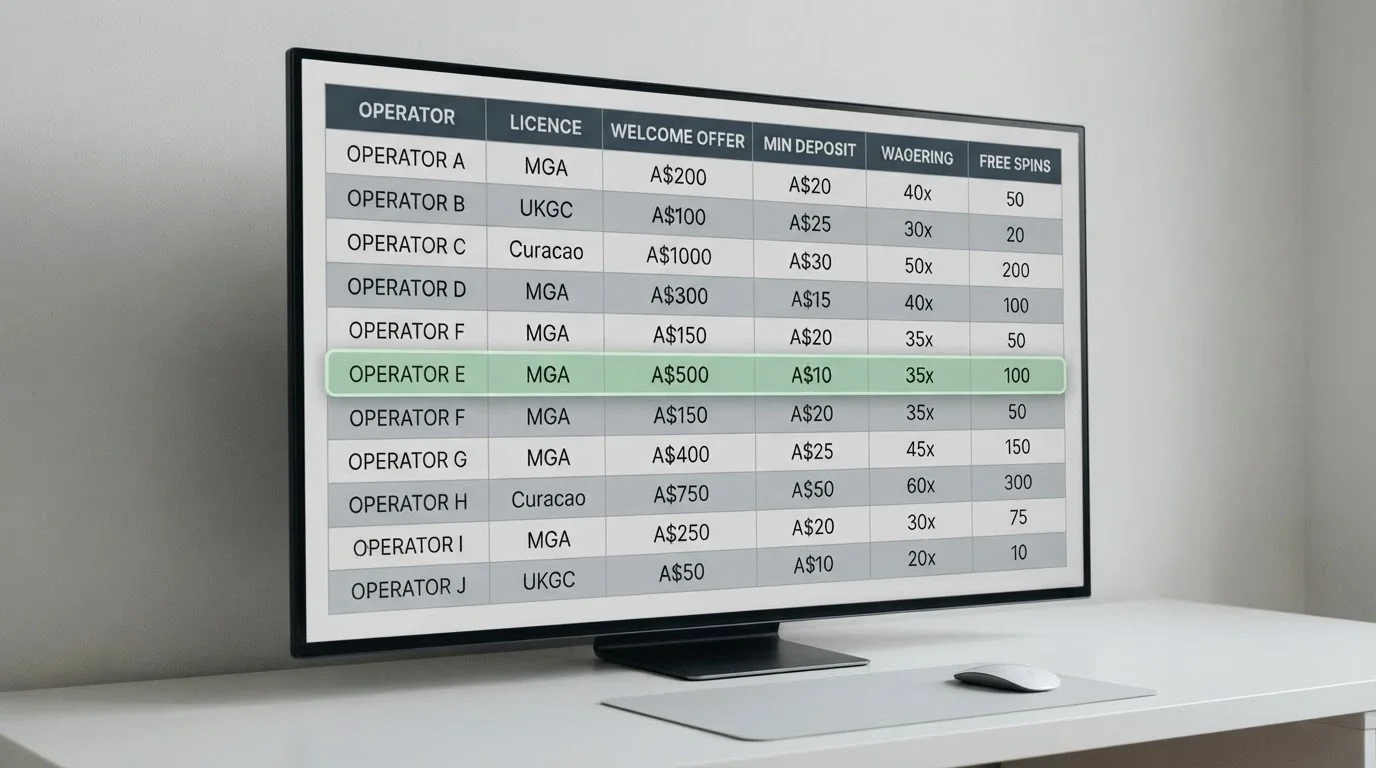
The table below compares the ten featured operators on the terms that matter to a A$10 player. The single most important column is the fifth: the minimum deposit at which the welcome bonus actually activates. Most of these operators will happily accept a A$10 deposit. Almost none of them will hand the player the welcome offer in exchange.
| Operator | Licence (Offshore) | Welcome Offer | Min. Deposit for Bonus | Wagering | Free Spins |
|---|---|---|---|---|---|
| SkyCrown | Curaçao | 450% up to A$8,000 + 400 FS | A$30 | 40x bonus + FS winnings | 400 |
| Royal Reels | Offshore | 100% up to A$500 + 50 FS | A$30 | 30x bonus + FS winnings | 50 |
| Fair Go | Curaçao sub-licence (ACMA-blocked) | 100% up to A$200 × 5 | A$20 | 30x deposit + bonus | — |
| Stake | Curaçao | No welcome match; rakeback/races | No deposit floor (crypto) | N/A | — |
| Rainbet | Anjouan | 250% up to $1,750 + 60 FS | A$30 | 40x or no-wager release | 60 |
| NeoSpin | Curaçao | 400% up to A$10,000 | A$10 | — | 0 |
| LuckyOnes | Anjouan | 200% up to A$2,000 + 100 FS | A$20 | — | 100 |
| VegasNow | Curaçao | 100% up to A$3,000 + 200 FS | A$20 | — | 200 |
| Bizzo | Curaçao (TechSolutions) | Up to €400 + 150 FS | A$20 | 40x bonus only | 150 |
| RocketPlay | Curaçao | 100% up to €1,000 + 100 FS | A$20 | 40x deposit + bonus | 100 |
The table tells one story. Of the ten operators reviewed, one — NeoSpin — activates a welcome match at A$10. A second, Fair Go, starts at A$20. Two more, LuckyOnes and VegasNow, sit at A$20 after a recent threshold drop. The remaining three require A$30 before the welcome offer opens. The “A$10 deposit casino” promise that this offer implies is, on the welcome-bonus side, more often a payment-minimum claim than a bonus-claim one.
SkyCrown: 9,000+ Games and a $30 Hurdle to Unlock the Bonus
SkyCrown is the closest thing to a casino buffet in the featured set: more than 9,000 titles spanning IGTech, Booongo, Pragmatic Play, NetEnt and Evolution. The library includes Ugga Bugga (Playtech), the highest-RTP pokie currently distributed live at 99.07%. That alone is a draw for the small-bankroll player who knows what to look for.
The welcome package is built for a player depositing in size. SkyCrown runs four deposit tiers totalling 450% match up to A$8,000 plus 400 free spins, with the first deposit landing 120% up to A$1,200 plus 125 free spins. The minimum to unlock that first tier is A$30 — not A$10. A punter who deposits A$10 will get the games, will get PayID processing, will get access to the lobby — and will not get the bonus.
Wagering on the bonus plus free-spin winnings sits at 40x. The bonus has a 14-day validity window and an A$5,000 max cashout per bonus part. The library is the argument, but the trigger sits one tier above the A$10 deposit.
Verdict: a real casino with a real library, but the A$10 player is buying access, not the welcome offer.
Royal Reels: The $10 No-Deposit Chip With a Catch
Royal Reels is the only featured operator with a genuine zero-deposit offer at the A$10 deposit level. The casino runs a A$10 no-deposit chip — A$10 in real-money funds credited to a new account on signup, no deposit required — at 40x wagering and a A$200 maximum cashout cap.
The chip is a marketing artefact. A$10 × 40x = A$400 in required turnover before withdrawal; on a 96% RTP pokie, that turnover costs about A$16 in expected loss against the A$200 cashout ceiling. The expected value of the chip, after the house edge has done its work, is in the A$180 range — and the player must clear A$400 in wagering inside whatever validity window the casino applies.
The deposit welcome offer at Royal Reels — 100% match up to A$500 plus 50 free spins, at 30x on the bonus plus free-spin winnings — only activates at A$30.
Verdict: the A$10 chip is real money on the table, but the math is the marketing and the cap is the cage.
Fair Go: ACMA-Blocked, Still Operating, and Still Taking Australian Players
Fair Go is the most regulator-attended casino in the featured set. It was, in fact, the first illegal offshore gambling site ACMA ever ordered blocked, on 19 November 2019, and Australian ISPs have been required to refuse Australian traffic to the site ever since. The casino is, in 2026, still reachable from Australia — via mirror domains, alternative URLs, and the offshore routing that ACMA’s blocking order does not always cover.
The welcome package is built for players depositing small sums over time. Fair Go runs a five-tier welcome of 100% up to A$200 on each of the first five deposits (A$1,000 total), with 30x wagering on deposit plus bonus. The minimum to unlock the bonus is A$20. The library is RTG-only (RealTime Gaming), which gives a smaller catalogue than the multi-provider operators.
The withdrawal ceiling is the binding constraint. Fair Go’s weekly withdrawal limit is A$2,500. A A$10 player will not hit that cap, but a player who wins something larger at the casino will sit on the cashout queue longer than at a competitor with no weekly ceiling.
Verdict: a workable A$20 deposit site for the patient RTG fan, but the ACMA history is the headline and the A$2,500 weekly cap is the constraint.
Stake: No Bonus, No Wagering, No Minimum — Crypto-First Play on Its Own Terms
Stake is the structural outlier in the featured set. The Curaçao-licensed operator, established in 2017, does not run a traditional welcome match. There is no bonus to trigger, no wagering to clear, and no free-spin welcome bundle. Instead, Stake runs a continuous VIP rakeback engine and a stream of timed races, with rewards paid on activity rather than on first deposit.
The deposit floor is the other structural difference. Stake accepts crypto — bitcoin, ethereum, litecoin and the like — and the minimum deposit for crypto is a function of network fees rather than a casino-set number. A punter who buys A$10 worth of bitcoin on a local exchange and sends it to a Stake deposit address has deposited A$10. KYC requirements are minimal for crypto play, though verification is required before withdrawal.
Stake’s library of 3,000+ titles includes its own “Stake originals” — provably fair games built in-house — alongside Pragmatic Play, Evolution and other mainstream providers.
Verdict: not a casino for the player hunting a welcome match, but the only one in the set where A$10 buys real access with no threshold penalty.
Rainbet: Rakeback and $1.7M in Monthly Races Instead of a Welcome Bonus
Rainbet’s headline number is not its welcome bonus. The Anjouan-licensed operator runs a welcome match of 250% up to $1,750 plus 60 free spins across three deposit stages — but the bonus activates at A$30 per stage, and the casino’s identity is built around its activity-based rewards instead.
The activity numbers are large. Rainbet runs approximately $1.7M in monthly race prize pools and a $20,000 weekly raffle. Players earn rakeback on every wager, with the option to lock that rakeback into a 40x wagering requirement or release it gradually with no wagering. Wagering on the welcome bonus sits at 40x, with a 7-day validity window and a $700 max cashout per deposit stage.
Rainbet’s library is 4,000+ titles including 14 provably fair originals.
Verdict: the welcome is a footnote at this site; the rakeback and race structure is the offer, and it rewards volume rather than a single A$10 deposit.
NeoSpin: The Only Featured Site Where $10 Genuinely Triggers a 400% Match
NeoSpin is the standout operator for a A$10 deposit. The Curaçao-licensed casino runs a 400% match up to A$10,000 on the first deposit — pure cash match, no free-spin padding — and the bonus activates at A$10 via PayID. A punter who deposits A$10 receives a A$40 bankroll (the A$10 deposit plus a A$30 bonus credit) and access to the full welcome structure.
The wagering terms on the NeoSpin welcome are not specified in the operator’s public terms as of this writing. Players should check the site’s current T&Cs before depositing, because the wagering multiple, the validity window and the max cashout all sit inside those terms, and any of them can change without notice.
The library runs multiple providers — Playtech, NetEnt, Relax among them — and includes Ugga Bugga, Book of 99 and the high-RTP pokies a small-bankroll player wants.
Verdict: the genuine A$10 bonus trigger exists, and only here among the featured set. Read the wagering terms before depositing.
LuckyOnes: 200% Match and 100 Free Spins From a $20 Entry Point
LuckyOnes runs a clean two-part welcome: 200% match up to A$2,000 plus 100 free spins. The structure is straightforward — match percentage and free-spin count both above the market median — and the library spans multiple providers. The trigger sits at A$20, twice the A$10 deposit’s floor, but well below the A$30 tier that most competitors require.
The wagering terms on the LuckyOnes welcome are not specified in current public sources. Players should check the site’s terms before committing, because the bonus’s real value depends on the multiplier, the validity window, and any game-exclusion list applied to the free-spin winnings.
Verdict: the threshold is twice the A$10 minimum but the bonus is competitive; worth the extra A$10 if the wagering is reasonable.
VegasNow: 200 Free Spins From $20 and a Lowered Entry Bar
VegasNow sits in the same A$20 trigger tier as LuckyOnes but with a different shape. The Curaçao-licensed casino runs 100% match up to A$3,000 plus 200 free spins — the highest free-spin count among featured operators at the A$20 deposit tier. The trigger was lowered to A$20 in 2026 from an earlier higher floor.
The library spans multiple providers. The wagering terms are not specified in current public sources, and the same T&C check applies as for LuckyOnes.
Verdict: 200 free spins is the headline, the A$20 trigger is the floor, and the wagering math decides whether the offer is worth the deposit.
Bizzo Casino: 40x on the Bonus Only, 150 Free Spins Across Two Deposits
Bizzo’s structural advantage is the wagering base. The Curaçao-licensed casino (TechSolutions group) runs a two-deposit welcome of up to €400 plus 150 free spins, with 40x wagering on the bonus amount only — not on the deposit plus bonus. That distinction matters: a A$100 deposit with a A$100 bonus at 40x on bonus-only requires A$4,000 of turnover, while the same offer at 40x on deposit plus bonus requires A$8,000.
The free-spin wagering has a 7-day validity window. The max cashout on deposit-bonus winnings is €10,000; the max cashout on free-spin winnings is €50. That €50 cap on FS winnings is the real ceiling on the free-spin side of the offer, and any large spin-win above it is forfeited.
Verdict: bonus-only wagering is the structural win, the €50 FS cap is the ceiling, and the bonus-only math gives this site the cleanest clearing path among featured competitors.
RocketPlay: 100 Free Spins, a Straightforward Match and a Tight 7-Day Window
RocketPlay rounds out the featured set with a 100% match up to €1,000 plus 100 free spins, at 40x on deposit plus bonus, with a 7-day validity window and a €50 cap on free-spin winnings. The Curaçao-licensed casino runs Playtech, NetEnt and Pragmatic Play among its providers.
The trigger sits around A$20, above the A$20 cluster and the A$10 minimum. The wagering is on the deposit plus bonus, the heavier of the two clearing structures. The 7-day window is tight for a low-stakes player working through the requirement at A$0.05 a spin.
Verdict: competitive on free spins, ordinary on wagering, and the A$20 trigger pushes it slightly above the A$10 player it would otherwise suit.
The High-RTP Pokies That Turn $10 Into 200+ Spins
A pokie’s RTP — return to player — is the percentage of every dollar wagered that the game returns, on average, across millions of spins. It is the closest thing to a structural advantage a player can find on a pokies site, and at the A$10 deposit level, the choice of game is the largest lever a punter has.
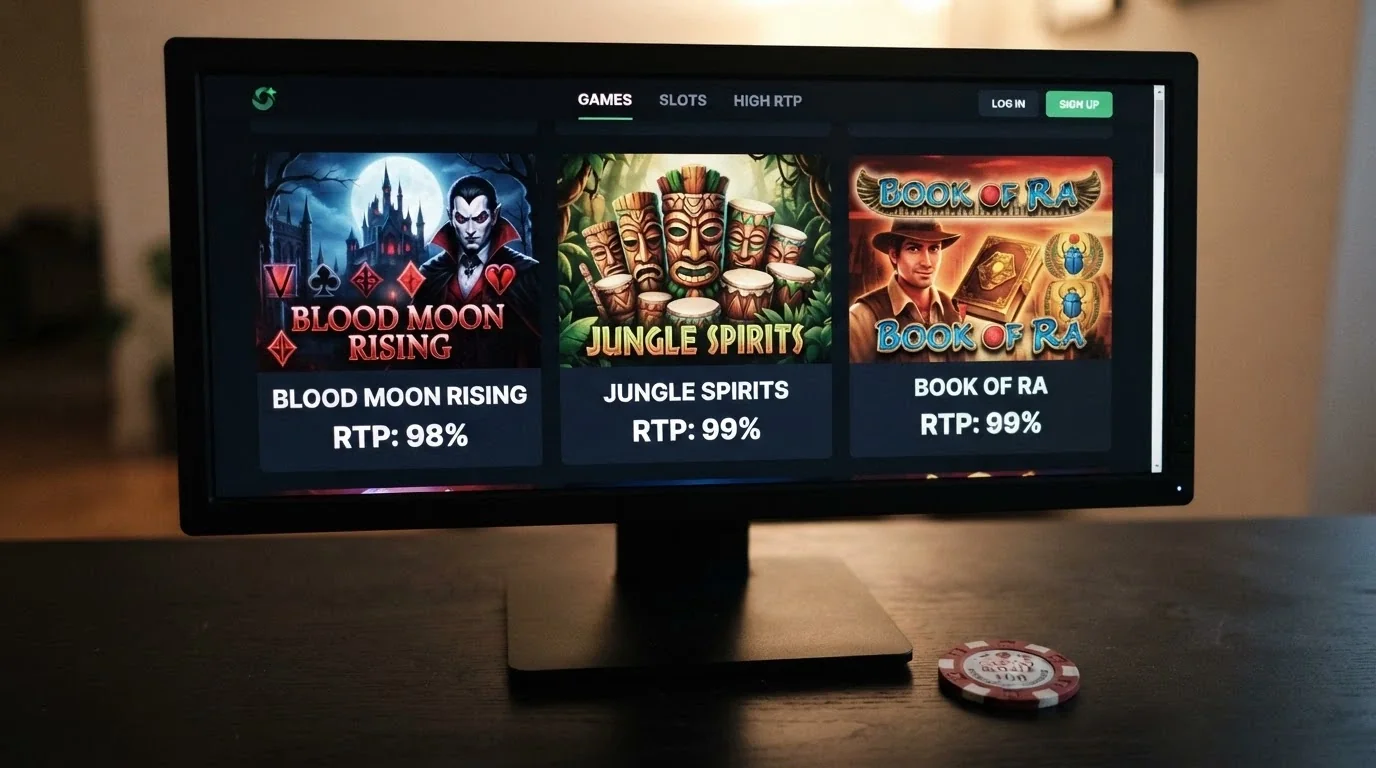
The three pokies below are the highest-RTP titles currently distributed at the offshore casinos in this guide. Each carries an RTP of 98% or higher; each has a different volatility profile and a different minimum bet, which means each suits a different kind of small-bankroll session.
| Pokie | RTP | Provider | Volatility | Min. Bet |
|---|---|---|---|---|
| Ugga Bugga | 99.07% | Playtech | — | — |
| Blood Suckers | 98.00% | NetEnt | Low | A$0.05 |
| Book of 99 | 99.00% | Relax Gaming | Medium-high | A$0.10 |
Ugga Bugga sits at the top of the RTP table — 99.07%, the highest published figure on any live-distributed pokie. Playtech’s game is available at SkyCrown. The minimum bet is not specified in current public sources.
Blood Suckers is the low-volatility choice at 98% RTP. NetEnt’s title has a A$0.05 minimum bet — the lowest stake on the table — which means a A$10 bankroll funds 200 spins. The low-volatility profile keeps the session alive long enough for the RTP to do its work.
Book of 99 is the medium-high volatility counterpart at 99% RTP. Relax Gaming’s title takes a A$0.10 minimum bet, halving the spin count to 100 on a A$10 bankroll, but the higher volatility means the session can produce larger line hits when they come.
RTP and Volatility: Why They Matter More at a $10 Stake
At A$0.05 a spin, a 98% RTP pokie returns A$0.049 of every wager. The player loses A$0.001 per spin on average — A$0.20 across 200 spins, A$1 across 1,000 spins. Those are small numbers in absolute terms, but they are the entire cost structure of a $10 session. The 2% house edge, applied across the spin count, is what the casino earns from the player. There is no other source of profit on a $10 bankroll.
Volatility shapes how that 2% is paid. A low-volatility pokie distributes the loss in tiny amounts across many spins — the bankroll bleeds slowly, with frequent small wins keeping the balance above zero for longer. A high-volatility pokie concentrates the loss into long dry stretches punctuated by larger wins — the bankroll can go to zero in a hurry, but a single hit can multiply a $10 deposit several times over.
For a player who has decided to deposit exactly $10 and not chase losses with a second deposit, low volatility is the rational choice. The session lasts longer. The expected loss is identical in percentage terms but smaller in absolute dollar terms because the player runs through fewer spins before the bankroll depletes. The “house edge” sounds like a single number until it is multiplied by the actual spin count a $10 bankroll buys.
The 2.1% Australian adult problem-gambling prevalence figure is worth keeping in mind here. About 430,000 Australians experience problem gambling, which is a reminder that for a small minority of players, a $10 deposit is the entry point to something the maths does not describe. The arithmetic of a Blood Suckers session is benign for almost everyone; for a small number of players, the arithmetic is the wrong frame for what is actually happening.
Minimum Bets and the Real Cost of a Session
The arithmetic behind a $10 session is straightforward. A A$10 bankroll at A$0.05 a spin is 200 spins; at A$0.10 it is 100 spins; at A$0.20 it is 50 spins. At a 98% RTP, the expected loss on 200 spins is 200 × A$0.05 × 0.02 = A$0.20. At a 99% RTP on 100 spins at A$0.10, the expected loss is 100 × A$0.10 × 0.01 = A$0.10. The dollar cost is small in either case, and the difference between the two is the value of choosing the higher-RTP, lower-volatility title.
The practical calculation: a Blood Suckers session at 200 spins of A$0.05 produces an expected loss of approximately A$0.20. That figure assumes only the deposit amount is wagered — the bankroll is played through once, with no second deposit. It is a statistical average across millions of spins, not a guaranteed outcome for any single session; a player can win or lose substantially more than the expected figure on any given 200-spin run.
Session length matters too. At a 5-second interval between spins, 200 spins takes roughly 17 minutes of uninterrupted play. A Book of 99 session at 100 spins takes about 8 minutes; a Sweet Bonanza 1000 session at 50 spins takes about 4 minutes. The A$0.05 minimum bet does not just minimise the dollar cost — it maximises the time the player gets for that cost, which is the actual entertainment value of the deposit.
The same 200-spin figure, framed differently, is the answer to a question most players never ask: what does a dollar of house edge actually cost? At Blood Suckers, the answer is half a cent per spin, A$0.20 per session. That is the casino’s profit from a player who deposits once and plays through once. It is also the player’s entertainment cost.
Online Pokies Aren’t Licensed in Australia — Here’s What That Means for Your $10
The Interactive Gambling Act 2001 prohibits online casinos and online pokies outright at the provider level. It is an offence for an operator — anywhere in the world — to offer real-money online casino games to a person in Australia. The product the A$10 deposit buys is, by Australian federal law, a product no one is allowed to sell to the person buying it.
That contradiction shapes every dollar in this guide. None of the ten operators in the featured set holds an Australian licence for online pokies. None can. No such licence exists. Every one of them operates offshore — Curaçao, Anjouan — and serves Australian players from outside the Australian regulatory perimeter.
The IGA targets providers, not players. The individual player is not prosecuted. The Act’s enforcement teeth — civil penalties, criminal prosecution, ISP-level blocking — all run against the operator side of the transaction. Australian players accessing an offshore pokies site are not committing an offence under the IGA as it currently stands. The enforcement architecture is provider-facing.
What changed in 2026 is the shape of the next reform. The Interactive Gambling Amendment (Gambling Reform) Bill 2026 passed Parliament on 19 August 2026 and commences on 1 January 2027. It bans online keno “pocket pokies” and foreign-matched lotteries; it caps advertising (3 per hour during live sport, with a blackout window); and it prohibits direct marketing of inducements to a customer for 14 days after signup. None of these new provisions changes the player-facing side of the existing prohibition — the player-targeting architecture stays as it was. They tighten the operator-facing architecture and extend it to adjacent products.
The enforcement side has been active for years. ACMA has had 1,564 illegal gambling and affiliate websites blocked by Australian ISPs since November 2019. Fair Go Casino was the first, ordered blocked on 19 November 2019. The block list has grown steadily since, and the blocking is at the ISP level — Australian customers using Australian internet services cannot reach blocked sites without technical workarounds like VPNs.
Licensed vs Unlicensed: What the Distinction Actually Means for Your Money
The Australian-licensed wagering market — TAB, Sportsbet, Ladbrokes, the major online bookmakers — operates under a completely different legal framework from the offshore pokies casinos in this guide. The two should not be confused.
An Australian wagering licence covers betting on races and pre-event sport, lotteries and keno. It does not cover online pokies, online casino games, or in-play sports betting — those products are prohibited at the provider level. The licensed operators are regulated by state and territory bodies (the Northern Territory Racing and Wagering Commission for the larger online bookmakers, with state-based oversight in each jurisdiction) and by ACMA for the online-specific provisions of the IGA.
The licensed wagering market has deposit and loss ceilings that the offshore market does not have — not because the offshore market is more permissive, but because there is no offshore market to apply them to. There is no national deposit or loss ceiling for online gambling in Australia because the product those ceilings would govern is banned outright. A punter at an Australian-licensed sports bookie faces account-level deposit limits and mandatory identity checks; a punter at an offshore pokies site faces the operator’s own account controls, which may or may not exist.
The credit-card ban applies to licensed wagering only. From 11 June 2024, credit cards, credit-related products and digital currency are banned as payment for online wagering with Australian-licensed operators. The same ban does not reach the offshore pokies market. An offshore casino is free to accept credit cards from Australian players, and several of the featured operators do.
The offshore site a player uses is not connected to BetStop. BetStop — Australia’s National Self-Exclusion Register — binds Australian-licensed wagering services only. Offshore casinos are not connected to the register. A person who has self-excluded through BetStop can still register, deposit and play at an offshore pokies site.
Player Protection and Responsible Gambling: Help That Actually Exists
The protection architecture that does exist in Australia sits on the responsible-gambling side, not the licensing side. It is worth knowing where it is, because every player — at every stake level, on every product — has access to it.
BetStop, the National Self-Exclusion Register, had 67,480 registrations as of 31 July 2026, with 41,290 active exclusions. The register is the structural answer to problem gambling for players using Australian-licensed services. A person who self-excludes through BetStop is barred from every Australian-licensed wagering account for the exclusion period (minimum three months, permanent available).
The same protection does not extend offshore. A person who has self-excluded through BetStop will not be stopped at an offshore pokies site. The offshore operator has no obligation to check the register, no integration with the register’s database, and no reason to refuse bets from a self-excluded Australian. Self-exclusion is a useful tool for licensed-product play; it is not a complete answer for someone who also plays offshore.
The National Gambling Helpline is 1800 858 858. It is free, confidential, and staffed 24 hours a day, every day of the year. Counselling is available by phone, by SMS, and online. Gambling Help Online provides live chat and email counselling in addition to self-help resources. Both services are free, both are confidential, and neither is connected to a casino’s marketing list.
The 2.1% problem-gambling prevalence figure — about 430,000 Australian adults — is the population context. Most Australian adults who gamble do so without harm. The 2.1% figure is the estimate of those who experience problems serious enough to warrant clinical attention. For a player who notices their own play drifting outside what they planned, the 1800 number is the one to call.
The $10 Bonus Trap: Why Most Sites Take Your Deposit But Lock the Welcome Offer
Depositing $10 and claiming a welcome bonus are two different transactions at almost every offshore casino. The casino takes the A$10 deposit, credits it to the player’s account, lets the player wager with it, and declines to attach the welcome offer to it. The player has spent A$10 on real-money pokies and has not received the bonus they came for.
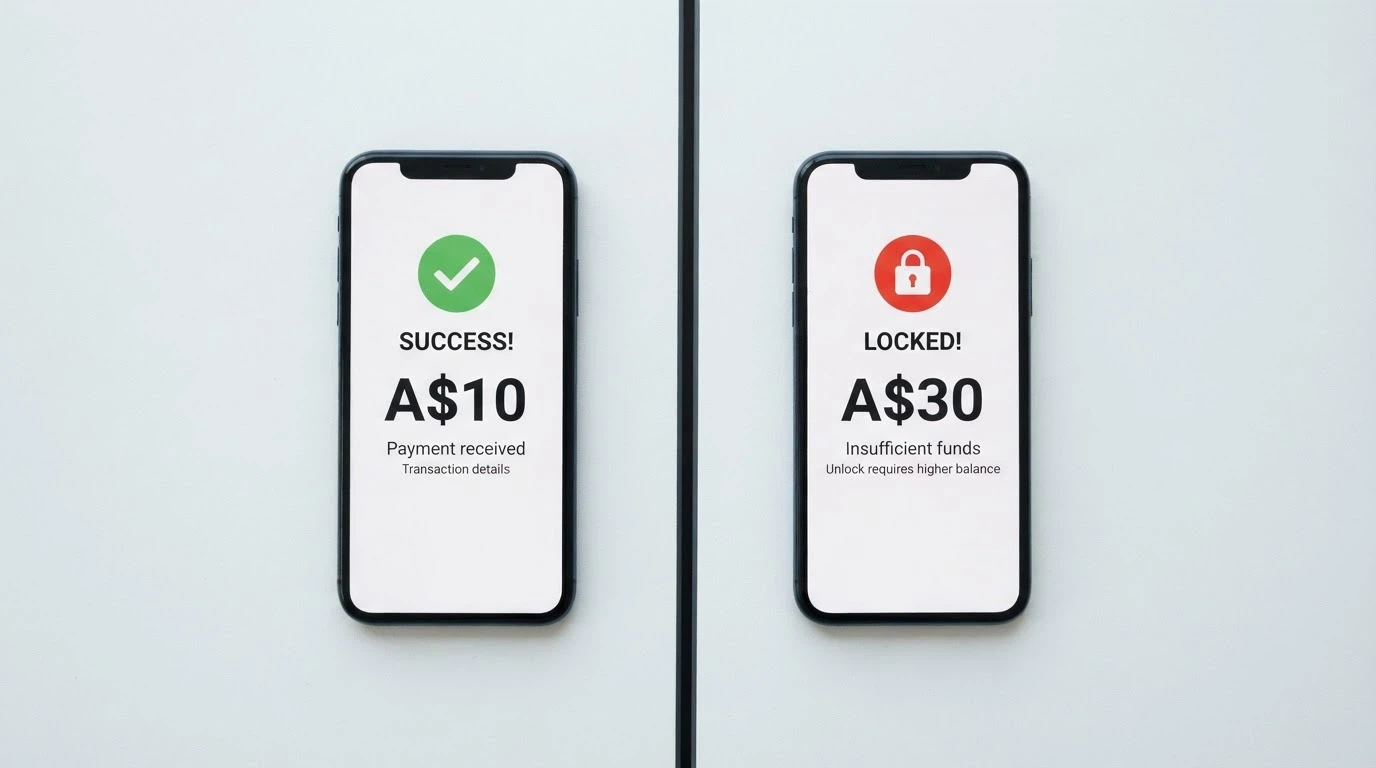
The gap between the deposit minimum and the bonus trigger is the most important number on this page. Most A$10 deposit casinos require A$20 or A$30 to activate the welcome bonus. NeoSpin is the single featured operator where A$10 genuinely triggers the welcome match.
First-Deposit Match Offers: What a $10 Player Can Actually Claim
The bonus-trigger gap runs across every featured operator except NeoSpin. SkyCrown, Royal Reels, Rainbet and RocketPlay all sit at A$30; LuckyOnes and VegasNow dropped to A$20 in 2026; Fair Go is at A$20; Bizzo’s regional trigger sits around A$20.
For a player with a hard A$10 budget, the only featured operator that returns the welcome offer at the A$10 trigger is NeoSpin. For a player able to stretch to A$20, two more operators enter the bonus picture; at A$30, almost the entire featured set is accessible.
The wagering math on those bonuses is the second constraint. Fair Go’s 30x on deposit plus bonus is heavier than Bizzo’s 40x on bonus only, even though the multiplier looks lower — because the clearing base is wider. A A$100 deposit with a A$100 bonus at 30x on deposit plus bonus requires A$6,000 in turnover; the same offer at 40x on bonus only requires A$4,000. The clearing path is genuinely easier under the bonus-only structure, even at a higher multiple.
No-Deposit Bonuses and Free Chips at the $10 Level
Royal Reels offers a A$10 no-deposit chip — A$10 in real-money funds credited to a new account on signup, no deposit required. The terms: 40x wagering on the chip, A$200 maximum cashout. The wagering requirement is A$400 of turnover before withdrawal opens, and the cashout ceiling caps any win at A$200.
The chip’s expected value depends on the RTP of the pokie it is played on. At 96% RTP (a market average), A$400 in wagering produces an expected return of A$384 — meaning the expected value of the chip, before the cashout cap, is approximately A$384 minus the A$10 chip cost, or A$374. The A$200 cashout cap clips that figure: a player who generates A$200+ in withdrawable balance after wagering is paid out at A$200, and the excess is forfeited.
Common no-deposit wagering in the Australian offshore market sits between 30x and 60x. Royal Reels’ 40x is mid-market. The A$200 cap is on the lower end for offshore no-deposit offers; some sites set no cap, but the wagering multiple at those sites is often higher.
Wagering Requirements Explained: What 30x or 40x Actually Costs
A wagering requirement is a multiplier applied to a bonus balance that determines how much the player must wager before withdrawal opens. A 40x wagering requirement on a A$10 bonus means A$400 in required turnover. The requirement is calculated on the bonus only at some sites, on deposit plus bonus at others — the same headline number means very different amounts of play.
The expected-loss math behind the wagering requirement is what determines the bonus’s real cost. A 40x on A$10 bonus = A$400 turnover at 96% RTP = A$16 expected loss, against a A$10 bonus value. The bonus is negative expected value for the player before any other constraints are applied — and almost every wagering requirement in the offshore market is on the negative-EV side by design.
The game-contribution rate shapes the clearing path. Pokies contribute 100% to wagering requirements at the offshore sites in this guide. Table games contribute as little as 10%, and some are excluded entirely. For a A$10 player, the clearing path runs through pokies — there is no other game type that meets the contribution requirement quickly enough to clear a bonus at low stakes.
The validity window is the last constraint. Most wagering requirements expire in 7 to 14 days. At A$0.05 a spin, a player working through A$400 of turnover needs 8,000 spins — approximately 11 hours of uninterrupted play. A 7-day window is enough on paper; a 14-day window is comfortable. A player with a A$10 budget should check the validity window before claiming, because missing the window forfeits both the bonus and any winnings tied to it.
Getting Money In and Out: Payment Methods for $10 Pokies Deposits
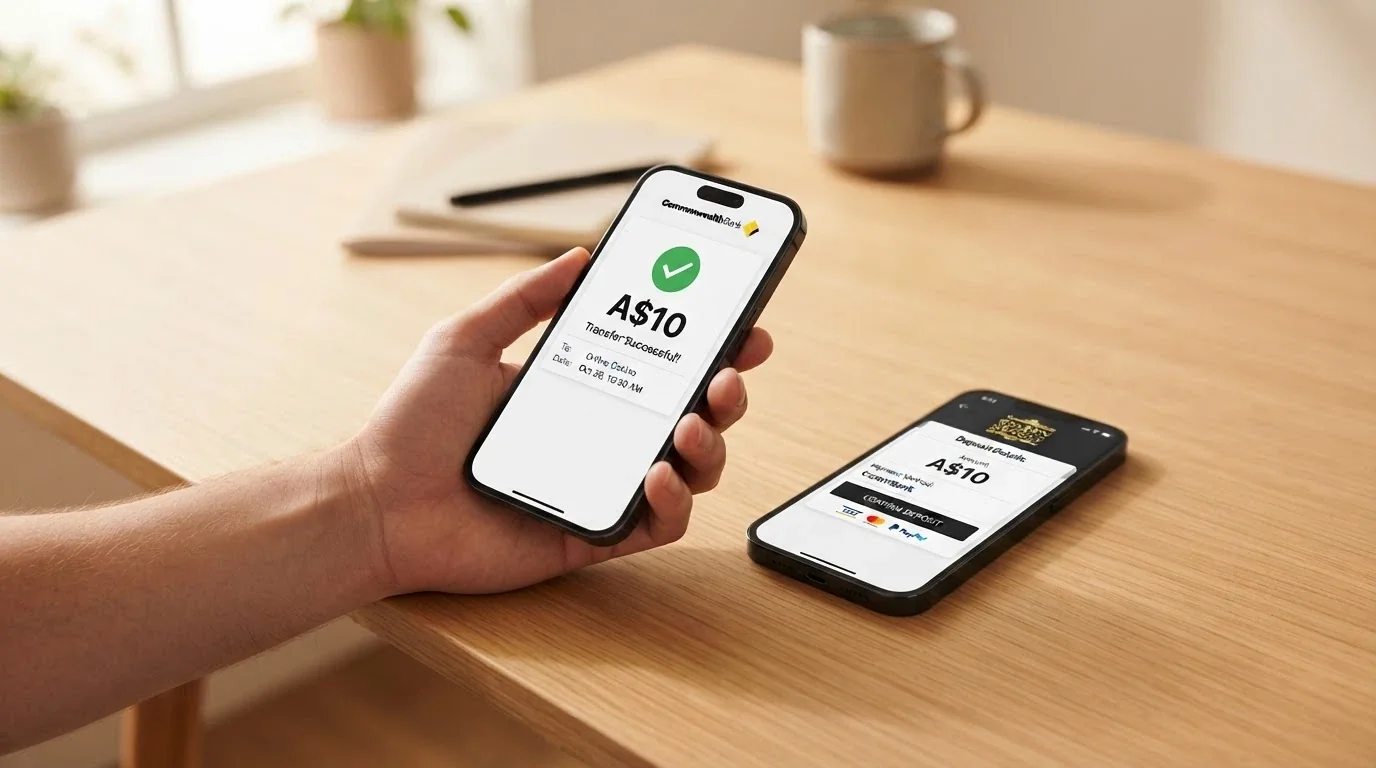
PayID is the deposit rail that defines the Australian offshore pokies experience in 2026. It is instant, fee-free, and operates at the A$10 minimum that matches the A$10 deposit exactly. Almost every featured operator accepts PayID at A$10. The withdrawal side of the same rail is a different story.
PayID: The Fastest Way to Fund a $10 Pokies Account
PayID deposits at offshore casinos are typically instant, with zero fees charged by the casino and zero fees charged by the PayID/Osko rail itself. The player’s bank sends the A$10 from a linked account using the player’s mobile number, email address or ABN as the PayID identifier; the funds arrive in the casino’s account within seconds; the casino credits the player’s balance.
The minimum deposit for PayID at the featured operators is A$10. That floor aligns with the payment-rail economics that the rest of the market sets — PayID’s anti-fraud thresholds block sub-A$10 transfers, and the casinos have built their deposit pages around that floor.
PayID withdrawals are not instant. The same rail that deposits in seconds takes 1-3 business days to deliver a withdrawal, and the delay is on the operator’s processing side rather than the payment rail. A casino that takes a day to action a withdrawal request before sending the funds through PayID will get the funds to the player’s bank in 1-3 business days from the request. The rail itself is fast; the operator’s internal process is the bottleneck.
Credit Cards, Neosurf and Other Deposit Options
Neosurf is the prepaid voucher alternative for players who prefer not to link a bank account to an offshore casino. Vouchers are available in fixed denominations — A$10, A$20, A$50, A$100 — at Australian retail outlets. The voucher code is redeemed at the casino’s deposit page, and the funds are credited instantly.
Debit cards work at offshore casinos without the credit-card ban that applies to Australian-licensed wagering from 11 June 2024. The ban covers credit cards, credit-related products and digital currency for licensed wagering only; it does not reach offshore pokies operators. Visa Debit and Mastercard Debit are widely accepted at the featured sites.
Method-specific fees are uncommon but exist. Some offshore casinos charge a small percentage on credit-card deposits to cover processing costs; PayID and Neosurf are typically fee-free. Players should check the deposit-page fee disclosure before committing to a method.
The Withdrawal Trap: Why Cashing Out Is Harder Than Depositing
The minimum withdrawal at offshore casinos usually sits much higher than the minimum deposit — A$25 to A$100 versus A$10. A site that takes A$5 in often won’t let a player take a small balance out until they hit a A$25-A$50+ minimum, and hidden caps can throttle a real win for weeks.
The trap is structural for the A$10 player. A punter who deposits A$10, plays through it, and ends the session with a balance of A$15 has doubled their money but cannot withdraw — the A$25 minimum has not been reached. To reach the withdrawal floor, the player must either win enough to clear A$25 (a 2.5x return on a A$10 deposit), deposit again to fund the wagering that pushes the balance above the floor, or simply abandon the balance.
The Fair Go withdrawal cap is the larger constraint. Fair Go’s A$2,500 weekly withdrawal limit applies to all withdrawals, regardless of size. A player who wins A$10,000 at Fair Go will not get all of it in one transaction — the casino pays out A$2,500 per week until the balance is cleared. The cap is not relevant to a A$10 deposit session, but it is the structural ceiling on a large win at that operator.
Operator processing adds another 1-3 business days on top of any payment-rail time. A PayID withdrawal request submitted on Friday evening will not arrive in the player’s bank account until Tuesday or Wednesday at the earliest, after the operator’s weekend processing delay.
Crypto Deposits at the $10 Level: Bitcoin and Beyond
Crypto deposits at Stake and Rainbet operate without the A$10 floor that fiat methods impose. A punter who buys A$10 worth of bitcoin on a local exchange and sends it to a casino deposit address has effectively deposited A$10, regardless of any operator-set minimum — the network fees and the on-ramp costs are the only constraints.
The AUD-to-crypto conversion is the friction. A player needs to acquire crypto through an Australian exchange before sending it to the casino. Each exchange carries its own KYC requirements, its own fees, and its own deposit methods — the conversion is not instantaneous, and the fees eat into the A$10 deposit at the small-stakes end.
The credit-card and crypto ban for Australian-licensed wagering (effective 11 June 2024) does not reach offshore casinos. Stake and Rainbet accept crypto from Australian players without restriction; the ban applies only to operators holding an Australian wagering licence. Stake’s minimal-KYC crypto play is the cleanest expression of that gap.
The offshore reality matters here too. Crypto deposits at offshore casinos have no chargeback path. A credit-card deposit at an offshore casino can in some cases be reversed through the card issuer; a crypto deposit cannot. The player accepts the operator’s terms, including the withdrawal terms, at the point of deposit, and the crypto transaction is the player’s binding commitment to those terms.
$10 Pokies on Your Phone: What Mobile Play Actually Delivers
Every featured offshore casino runs a mobile-responsive site. None of the ten offers a native iOS or Android app in Australia — Apple’s App Store and Google’s Play Store do not carry real-money casino apps in the Australian market, and the offshore operators do not build native apps for distribution outside those stores.
The browser experience on a modern smartphone is mature. The HTML5 pokies that dominate the offshore catalogues — NetEnt, Playtech, Pragmatic Play, Relax Gaming — are built mobile-first. The touch interface replaces the click interface cleanly: spin, autoplay, bet adjustment, paytable access all sit within thumb reach. PayID deposits from a mobile browser work identically to a desktop session.
Session length on mobile is shorter. A player on a phone is more likely to be playing in short bursts — 10 minutes on the bus, 20 minutes on the couch — than a player at a desktop. That pattern suits the A$0.05 minimum bet on Blood Suckers, where 200 spins takes 17 minutes; it does not suit the high-RTP high-volatility pokies that reward longer sessions.
The data cost is minor. A pokies session at A$0.05 a spin transfers roughly 1-2 MB of game data per minute. A 30-minute session on a 4G connection uses about 50 MB of data — a small fraction of any modern mobile plan. The data cost is not a meaningful constraint for Australian players on standard mobile plans.
How to Pick a $10 Deposit Pokies Site You Won’t Regret
Five verification checks that take under two minutes. A player who runs all five before depositing will separate a usable site from one that stalls a withdrawal for weeks.

- Bonus trigger. Does the welcome offer activate at A$10, or only at A$20-A$30? If the welcome is the reason for choosing the site, the trigger must match the deposit.
- Withdrawal minimum. What is the floor, and how many times must a A$10 deposit multiply to reach it? A site with a A$100 withdrawal minimum on a A$10 deposit requires a 10x return to cash out.
- Licence jurisdiction. Curaçao and Anjouan are the two common offshore licences. Both are operator-tier rather than player-tier — neither offers Australian consumer recourse — but the licence’s existence at all is a baseline check.
- Payment method. Is PayID supported? Are there deposit or withdrawal fees? What is the stated withdrawal processing time?
- Wagering structure. Bonus-only or deposit plus bonus? Contribution rate for pokies? Validity window length? Max cashout on free-spin winnings?
A site that fails any of these checks is not necessarily unplayable, but it requires more due diligence than the alternatives.
Threshold Flexibility: When a $20 Deposit Site Is Worth the Extra $10
Some operators with a A$20-A$30 bonus trigger offer enough extra value — more free spins, lower wagering, a higher cashout cap — that stretching the deposit is rational. A player who was going to deposit $10 twice in any case is functionally depositing $20 once; the welcome offer unlocks on the higher trigger and the player pays the same total.
The comparison runs across the featured set. Bizzo’s 40x on bonus only is structurally easier to clear than Royal Reels’ 30x on deposit plus bonus, even at a higher multiplier — because the clearing base is the bonus amount, not the deposit plus bonus. VegasNow’s 200 free spins is the largest free-spin count at the A$20 trigger; the value of those spins depends on the assigned pokie, the RTP of that pokie, and the max cashout on FS winnings.
A player whose budget is genuinely A$10 cannot stretch to A$20. For that player, NeoSpin is the only featured site that returns the welcome match at the A$10 trigger. For a player whose budget is A$20-A$30, the comparison across LuckyOnes, VegasNow, Fair Go and the rest of the A$20-A$30 tier determines the best choice.
Red Flags: What a Risky $10 Deposit Pokies Site Looks Like
Five danger signs signal an offshore casino that a A$10 player should avoid.
No visible licence disclosure. A casino that does not name its licence jurisdiction on the footer of every page is operating without the basic transparency the offshore market requires. Curaçao and Anjouan are the common jurisdictions; a site that does not name one is hiding something.
Withdrawal minimum above A$50, or max cashout below A$100 on deposit bonuses. Both are signs that the operator’s withdrawal economics are stacked against small-stakes players. The withdrawal-floor trap at the A$10 level is bad enough at A$25; above A$50, a player must clear 5x their deposit to cash out.
Wagering terms at 50x or higher on deposit plus bonus. A A$10 deposit with a A$10 bonus at 50x deposit plus bonus requires A$1,000 in turnover — 20,000 spins at A$0.05, or about 28 hours of uninterrupted play. The clearing path is functionally impossible for a casual player.
No PayID or AUD-denominated deposit option. An offshore casino that takes only crypto, only EUR, or only obscure e-wallets is a casino that has decided Australian players are not its target market. The conversion friction and the lack of AUD support add cost and complexity to every transaction.
ACMA blocking history as a warning indicator. ACMA has blocked 1,564 illegal gambling and affiliate websites since November 2019. A site on that list is still reachable from Australia via technical workarounds, but the block itself is a regulator’s public assessment that the site operates illegally in the Australian market. Fair Go is the highest-profile example; the block did not stop the casino from operating, but it is the public record of regulator attention.
How We Evaluated These $10 Deposit Pokies Sites
The ten featured operators were assessed against a fixed set of publicly verifiable criteria — no paid placements, no affiliate-driven ordering. The ranking reflects what a A$10 depositor in Australia actually faces at each operator, not the commercial value of any partnership.
The evaluation criteria, in order of weight for the A$10 player:
Bonus-trigger alignment. The minimum deposit at which the welcome offer activates, compared to the A$10 deposit offer. NeoSpin’s A$10 trigger sits at the top; SkyCrown, Royal Reels, Rainbet and RocketPlay’s A$30 trigger sits at the bottom.
Wagering structure. Bonus-only wagering (Bizzo) ranks above deposit-plus-bonus wagering (Fair Go, RocketPlay) at the same multiplier, because the clearing base is narrower. The validity window and max cashout on free-spin winnings are secondary factors within the wagering criterion.
Withdrawal-minimum transparency. A site that publishes its minimum withdrawal amount clearly, in AUD, with no buried clause, scores higher than one that lists it in clause 14 of the terms. The withdrawal minimum range in this market is A$25-A$100.
Licence-jurisdiction disclosure. Both Curaçao and Anjouan are operator-tier licences with no Australian consumer protection. A site that names its jurisdiction and provides a licence number for verification scores higher than one that does not.
PayID and AUD support. A site that accepts PayID at A$10 and denominates its account balances in AUD scores higher than one that requires currency conversion. The PayID support criterion aligns directly with the A$10 deposit’s payment-method economics.
Game-library breadth and RTP data availability. The presence of high-RTP pokies (Ugga Bugga, Blood Suckers, Book of 99) in the library, with RTP figures published in the game’s help screen, scores higher than a library that does not surface RTP data.
The ten operators were selected from the broader offshore market because they reach Australian players at the A$10 threshold and meet the basic transparency criteria above. They are not the only A$10-deposit offshore casinos available to Australian players; they are the set the evaluation surfaced against the criteria.
Your $10, Your Call: What the Numbers Actually Say
The arithmetic of a $10 deposit at a high-RTP pokie is surprisingly favourable on paper. Blood Suckers at A$0.05 a spin produces an expected loss of approximately A$0.20 across 200 spins — a 2% house edge applied to A$10 in wagering. Book of 99 at A$0.10 a spin produces an expected loss of A$0.10 across 100 spins. The dollar cost of the entertainment is small.
The structural barriers around that arithmetic are where the practical experience gets rougher. The withdrawal floor at A$25-A$100 means a player must more than double their deposit to cash out — and most A$10 sessions end below that floor. The bonus trigger at A$20-A$30 means the welcome offer most players came for is locked at the deposit they cannot afford. The offshore reality means there is no Australian consumer protection if a withdrawal is refused or a win is voided.
The rational framing is to treat a A$10 deposit as a fixed-cost entertainment purchase. The entertainment value of 200 spins at A$0.05 is approximately 17 minutes of pokie play, at an expected cost of A$0.20 in expected loss. The actual session will not match the expected loss — variance is real, and the player will either lose the deposit faster or slower than 2% — but the framing of the deposit as a paid entertainment purchase, with any cashout as a bonus rather than the goal, is the one that survives contact with the maths.
A player who deposits $10 at NeoSpin and uses the welcome match gets a A$40 bankroll. A player who deposits $10 at Stake and opts out of any bonus gets pure crypto play with minimal KYC. A player who deposits $20 at LuckyOnes or VegasNow gets a full welcome match and a free-spin bundle. None of these is a route to a guaranteed cashout; all of them are routes to a structured entertainment session with a real-money stake. The house edge, applied across the spins the bankroll funds, is what the player pays for the entertainment. The cashout, if it comes, is the bonus.
The 2.1% of Australian adults who experience problem gambling — about 430,000 people — are the reminder that for a small minority of players, a A$10 deposit is not entertainment. For those players, the maths is the wrong frame, and the National Gambling Helpline at 1800 858 858 is the number to call before the next deposit.
Frequently Asked Questions
Is it legal to play at $10 minimum deposit online pokies in Australia?
The Interactive Gambling Act 2001 prohibits online casinos and online pokies at the provider level — it is an offence for an operator to offer them to a person in Australia. The Act does not target individual players; no Australian player has been prosecuted for gambling online. Every site in this guide is offshore and unlicensed in Australia. ACMA has blocked 1,564 illegal gambling and affiliate websites since November 2019.
Can I get a welcome bonus if I only deposit $10 at an Australian online casino?
Most A$10 deposit casinos in Australia require A$20 or A$30 to activate the welcome bonus — the deposit is accepted at A$10, but the bonus does not trigger until the higher amount. NeoSpin is the featured operator where A$10 genuinely triggers a 400% match welcome. Royal Reels offers a A$10 no-deposit chip, which does not require any deposit at all but carries 40x wagering and a A$200 max cashout.
Which payment methods work for $10 deposits at Australian pokies sites?
PayID is the default deposit method for Australian players in 2026 — instant, fee-free, and operating at a A$10 minimum that matches the market floor. Neosurf vouchers (A$10, A$20, A$50, A$100 denominations) are the prepaid alternative. Debit cards are widely accepted at offshore casinos; credit cards are banned for Australian-licensed wagering from 11 June 2024 but not for offshore sites. Bitcoin and other cryptocurrencies work at Stake and Rainbet with no operator-set deposit floor.
Are $10 deposit casino winnings tax-free for Australian players?
Under Australian tax law, gambling winnings are generally not assessable income for recreational players. A casual player who deposits A$10, plays through it, and ends the session ahead does not owe income tax on the win. The position changes if gambling is conducted as a business — for a professional player, winnings are assessable income and losses are deductible. The ATO’s website is the authoritative source for the current position; specific situations should be reviewed with a tax professional.
What is the difference between an Australian-licensed wagering site and an offshore pokies site?
An Australian-licensed wagering service holds a state or territory licence to offer racing and pre-event sport betting, lotteries and keno. Online pokies, online casino games and in-play sports betting are prohibited under the Interactive Gambling Act 2001 — no Australian licence exists for those products. Offshore pokies sites operate from Curaçao, Anjouan and similar jurisdictions, with no Australian licence and no Australian consumer protection. Players at offshore sites have no local recourse if a withdrawal is refused or a win is voided; players at Australian-licensed sites have the protections of the licensing regime, but cannot play online pokies there.