
Best online keno casino Australia 2026: licensed draws versus the offshore field
 Available in AU
Online keno in Australia sits on a legal fault line that almost no review page names out loud. Keno is one of only a handful of online gambling products Australia actually licenses — alongside wagering and lotteries — and two Australian keno products operate legally today, KenoGO and The Lott’s keno. Reach beyond them and you are playing at an offshore casino offering a product the Interactive Gambling Act 2001 prohibits any Australian-licensed operator from supplying. From 1 January 2027 the line shifts again: the Interactive Gambling Amendment (Gambling Reform) Bill 2026 bans online keno outright, so the very product this page covers is on its way to becoming prohibited. A shortlist of ten operators reaches Australian keno players in 2026 — one licensed, nine offshore — and the choice between them is not which bonus has the bigger headline number, but which side of the regulatory line you are willing to stand on.
Data current as of 18 October 2026, verified against the ACMA register, KenoGO and The Lott gameplay pages, and the licence databases of the offshore operators named below.
Table of Contents
- Online keno in Australia sits on a legal fault line — here is what that means for your game
- The 2026 Australian keno casino shortlist — and how their bonuses actually stack up
- Every keno variant worth your attention — single-line, live, multi-card and more
- Free keno: try every variant before you spend a single dollar
- Why crypto keno deposits keep reaching Australian players
- The laws that decide whether your keno game is legal or not
- When keno stops being fun: the limits and support that actually exist
- How we selected and ranked these keno casinos
- The keno decision every Australian player faces in 2026
- Frequently asked questions about online keno in Australia
Online keno in Australia sits on a legal fault line — here is what that means for your game
What online keno actually is — and why it has drawn a dedicated Australian audience
Keno is a lottery-style number game that translates unusually well to a screen. Twenty numbers are drawn from a pool of 80, players pick a set of “spots” before the draw, and the paytable rewards how many of their chosen numbers land in the 20. The mechanic is the same one retail keno runners have offered in Australian pubs and clubs for decades, but online the pace accelerates, the spot range widens, and the bet sizes multiply. KenoGO Classic runs draws where players select up to 10 numbers from 80 for an A$1 entry, with the top prize at A$1,000,000. The Lott runs a similar 20-from-80 draw every few minutes, also from A$1, with one to ten spots per game. Both sit in the legally licensable Australian market.
The dedicated audience exists because keno delivers something pokies cannot: a single game with a clean mathematical shape, where the player’s decision (how many spots, which numbers, when to walk away) is the whole story. There is no bonus round, no payline structure, no scatter symbol. The draw is the event and the paytable is the contract. Online keno inherits that clarity and adds pace — every few minutes at The Lott, on demand at any offshore casino lobby.
Single-card versus multi-line keno: how online play widens your options
A retail keno ticket carries one set of numbers; online, that constraint disappears. Multi-line keno stacks several paytables in a single round, multi-card keno runs two to four tickets simultaneously against the same draw, and autoplay drives the whole thing forward at the cadence you choose. The practical ceiling, based on session testing reported across the keno lobby guides, sits at two to four simultaneous tickets — enough action to keep a session moving, not so many that the bankroll disappears before the player notices.
Online speed demands a discipline the retail game hides. Twenty keno games an hour at A$5 a ticket is A$100 of turnover, and at the standard Australian keno RTP of approximately 75 percent, the expected loss on that hour sits near A$25. The arithmetic is the same in any venue; what changes online is how easily a player runs the numbers without anyone noticing.
Real-money keno: what changes when you play for cash
Free keno and real-money keno run on identical RNG. The paytable, the spot mechanics, the draw cadence, all match. What changes is what the numbers cost. A$0.40 minimum to A$400 maximum bet per ticket at Galaxsys-powered keno titles defines the offshore range. KenoGO and The Lott start at A$1 per entry. Side games on the licensed products — keno racing, heads-or-tails — push their effective RTP toward 80 percent, a step up from the underlying 75 percent of standard draws.
Turnover velocity is where real money keno stops resembling lottery play. Online RNG keno runs as fast as a player clicks. Twenty games an hour is conservative; an autoplay session can clear twice that without effort. At the upper end of the offshore range, an hour’s session at A$5 per draw burns through the bankroll the same way a high-volatility pokie does, just with a different shape on the screen.
The apps and software that deliver online keno to your screen
The provider name on a keno lobby matters more than the casino brand. Galaxsys sets the upper offshore RTP envelope — its keno titles run between 87.5 and 99.6 percent RTP depending on spot count, at high volatility, with a maximum win of 10,000× at Keno 10. Bally’s Keno Neo sits at 93.81 percent RTP with high volatility and a 200,000× ceiling. Spribe’s keno lands near 97 percent at medium volatility. Realistic Games’ keno is the lower-volatility entry at 96.20 percent. IGT’s Cleopatra Keno delivers 95.25 percent RTP with a 10,000× maximum win. These are the maths behind the same game.
Multi-provider keno lobbies mix several of these into one screen — Neospin’s 14 keno formats are the broadest in the Australian-facing offshore market, with Book of Keno, Keno 10 (one-minute draws), and Mascot Gaming’s Across the Universe Keno all carried under one roof. SkyCrown lists 7,000-plus total games. Wild Tokyo clears 8,000. The breadth is real; the underlying maths on any given keno title still comes from the provider name printed at the bottom of the game window.
Keno casino bonuses explained — and why the fine print matters more than the headline number
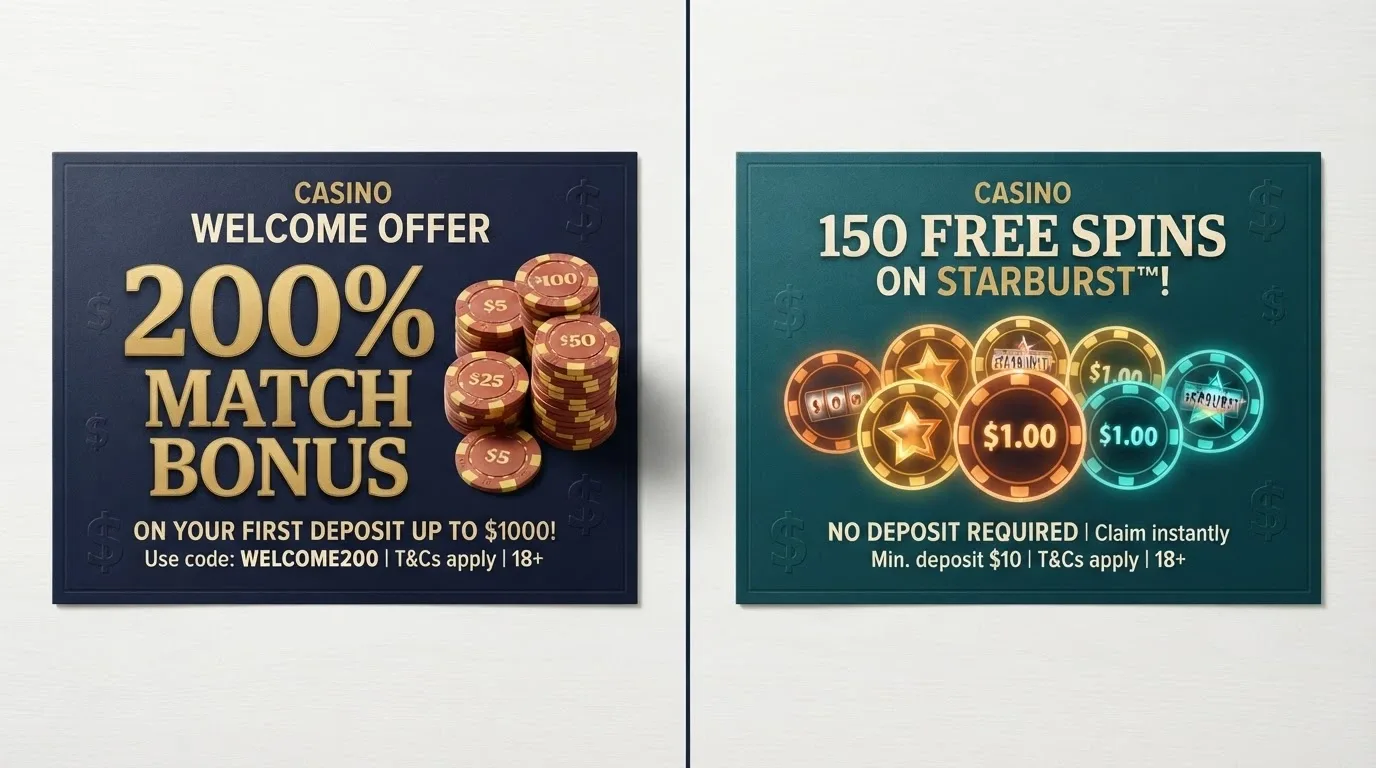
A keno bonus looks like a marketing department’s gift and behaves like a loan with interest. Neospin’s welcome offer — a 300 percent match up to A$11,000 plus 300 free spins — is the largest headline on this list. The fine print: 40× wagering on the deposit plus the bonus, a maximum bet of A$10 while the wagering is open, and free spin winnings capped between A$150 and A$225 depending on the source. A player depositing A$100 to claim the headline is asked to turn over A$8,000 — the A$100 deposit plus the A$100 bonus, multiplied by 40 — before a cent of the bonus cash becomes withdrawable. That is a week’s worth of casual keno play compressed into a wagering requirement.
Game weighting is the line that decides whether a bonus is actually usable at the keno table. At Neospin, pokies contribute 100 percent toward wagering; live dealer games contribute 5 percent. Keno’s contribution is not stated explicitly in the operator’s terms as captured by research, and that gap is itself information — a player chasing keno wagering is, at best, working from an unclear contract. Wild Tokyo’s 50× wagering on cash and free spin winnings within a five-day limit is the strictest on the list: a player who does not clear it in five days loses both the bonus and any winnings tied to it. The headline number is never the cost. The wagering multiple, the game weighting, the validity window and the max-bet cap together are the cost.
The 2026 Australian keno casino shortlist — and how their bonuses actually stack up
Ten operators carry keno for Australian players in 2026. One — KenoGO — is Australian-licensed and connected to the national self-exclusion register. Nine operate offshore under a Curaçao licence and offer keno to Australian players without holding any Australian licence, because no Australian casino licence exists to hold. The table ranks them on the columns the comparison actually depends on: licence status, welcome bonus, free spins, the wagering multiple and the keno offering itself.
| Casino | AU Licence Status | Welcome Bonus | Free Spins | Wagering Multiplier | Keno Offering |
|---|---|---|---|---|---|
| KenoGO | AU-licensed (state/territory) | — | — | — | 4 products (Classic, Bonus, Jackpot, Heads or Tails) |
| Neospin | Not AU-licensed (Curaçao) | 300% up to A$11,000 | 300 | 40× (deposit + bonus) | 14 formats |
| Golden Crown | Not AU-licensed (Curaçao) | Up to A$10,000 across 4 deposits | 100 (first deposit) | 40× | 9 types |
| SkyCrown | Not AU-licensed (Curaçao eGaming) | 450% up to A$8,000 across 4 deposits | 400 | ~40× | Yes (count not confirmed) |
| Wild Tokyo | Not AU-licensed (Curaçao) | Up to A$3,300 across 3 deposits | 450 | 50× (cash + FS winnings) | Yes |
| RocketPlay | Not AU-licensed (Curaçao) | 100% up to A$1,000 | 100 (20/day for 5 days) | 40× (FS separate) | Yes (count not confirmed) |
| Royal Reels | Not AU-licensed (Curaçao) | Up to A$4,500 across 3 deposits | 250 | 40× (bonus + deposit) | Yes (count not confirmed) |
| Stake | Not AU-licensed (Curaçao) | — | — | — | Customisable RTP variants |
| FairGO | Not AU-licensed (Curaçao) | — | No-deposit FS | 30× (no-deposit FS winnings) | RTG keno |
| Bizzo Casino | Not AU-licensed (Curaçao) | — | No-deposit FS | 40× | Yes (count not confirmed) |
The spread in the wagering column is the part that does the most damage. A 30× no-deposit free spin wagering at FairGO looks generous next to Wild Tokyo’s 50× across cash and free spin winnings inside a five-day window — but the underlying comparison is not between 30 and 50, it is between no-deposit and deposit-gated. No-deposit free spins cost the operator real money up front and arrive with stricter cashout caps. Deposit-gated bonuses are bigger on the page and tougher on the player in practice.
For a player weighing the licensed option against the offshore field, the arithmetic of one specific offer illustrates the gap. Take Neospin’s headline bonus as the worked example: a player depositing the minimum A$30 receives a A$90 bonus at the 300 percent match rate, for a total playable balance of A$120. The 40× wagering on deposit plus bonus requires A$4,800 of turnover before the bonus converts to withdrawable cash. Playing 20 keno games an hour at A$1 per ticket — a deliberate slow pace, well below the A$10 max-bet cap — that A$4,800 turnover is 4,800 individual draws. Working from a Galaxsys-style keno RTP toward the middle of the published 87.5 to 99.6 percent range, around 94 percent, the expected loss across clearing the bonus sits near A$290 — a multiple of the deposit itself. The same hour, with the same spot count at KenoGO’s licensed product at roughly 75 percent RTP, would cost the player close to A$1,200 in expected loss on identical turnover, but the deposit is A$1 per draw, the wagering requirement is absent, and every dollar of winnings is withdrawable from the moment the draw settles. Two contracts for the same game; the player picks which cost is preferable.
KenoGO — Australia’s only licensed online keno provider
KenoGO is the only operator on this page that holds an Australian licence for keno. It operates under state and territory licensing, is connected to BetStop, and offers four products from a A$1 entry price. KenoGO Classic lets players select up to 10 numbers from 80 for a chance at up to A$1,000,000. KenoGO Bonus carries a 10× multiplier and lifts the headline prize to A$10,000,000 on a A$2 ticket. KenoGO Jackpot starts at A$2 per ticket with a Major prize ceiling of A$40,000,000. Heads or Tails is the side game that pushes the effective RTP closer to 80 percent.
The trade-off is the maths. Standard keno RTP at KenoGO sits near 75 percent — significantly below the offshore range of 87.5 to 99.6 percent. A player who values the consumer-protection infrastructure (state-regulated payouts, BetStop coverage, complaint mechanisms through state gaming regulators) over the RTP gap is the player KenoGO is built for. A player who values return per dollar wagered and does not need Australian recourse finds more in the offshore lobbies. Both are real positions; the licensed path simply costs more per spin.
Neospin — 14 keno formats and the biggest headline welcome bonus on this list
Neospin carries the broadest keno lobby in the Australian-facing offshore market: 14 formats including Book of Keno, Keno 10 with one-minute draws, and Across the Universe Keno from Mascot Gaming. The total game count sits above 5,800. The welcome package is a 300 percent deposit match up to A$11,000 plus 300 free spins, governed by 40× wagering on deposit and bonus combined, with a minimum deposit of A$30 to A$45 and a maximum wager of A$10 during the wagering window. Free spin winnings are capped at A$150 to A$225, with pokies contributing 100 percent toward wagering and live dealer games contributing 5 percent.
Neospin operates under a Curaçao Gaming Authority licence and is not connected to BetStop. A self-excluded Australian player can still deposit, wager and withdraw from Neospin — the operator has no obligation to check Australian self-exclusion registers and no penalty for ignoring them. The breadth of the keno lobby is the genuine asset; the bonus terms are the genuine cost. With A$4,800 of wagering required on a A$120 combined balance, successful bonus conversion is less a standard outcome and more a statistical long shot for the average player.
Golden Crown — 9 keno types and a four-deposit welcome package
Golden Crown spreads its welcome across four deposits for a total of up to A$10,000: 100 percent up to A$2,000 plus 100 free spins on the first deposit, with subsequent deposits at 50 percent to 100 percent match rates. Wagering sits at 40×. The keno lobby carries nine types including Magic Keno, Amaterasu Keno and the proprietary Keno Goldencrown. The Curaçao Gaming Authority is the licence.
The four-deposit structure is a different shape from the single-shot welcome. A player who plans to deposit across multiple sessions gets more total bonus value; a player who deposits once and moves on leaves the rest of the package unused. The 40× wagering multiplies the same way it does at Neospin, and the offshore non-coverage from BetStop is identical. Golden Crown’s keno count is below Neospin’s but above most of the remaining field.
SkyCrown — 7,000-plus games and a 450 percent welcome spread
SkyCrown’s welcome package is a 450 percent match up to A$8,000 across four deposits with 400 free spins, the highest aggregate match rate on this page. Wagering runs near 40× on both bonus and free spin winnings, the minimum deposit is A$20 to A$30, and the maximum bet during wagering sits at A$5 to A$8 — tighter than Neospin’s A$10 cap. The licence is Curaçao eGaming. Game count clears 7,000.
The lower max-bet cap matters in practice. A player working through SkyCrown’s wagering at A$5 to A$8 per draw cannot accelerate the clearing by raising stakes; the cap is the throttle. The 450 percent headline is genuinely larger than Neospin’s 300 percent on a percentage basis, though the absolute cap is lower, so the comparison depends on deposit size more than headline number.
Wild Tokyo — 450 free spins, a tight five-day wagering window
Wild Tokyo offers the largest free-spin count on this list at 450, plus up to A$3,300 in deposit match across three deposits. The wagering sits at 50× on both cash and free spin winnings, and the operator gives players five days to clear it. Game count clears 8,000. Curaçao is the licence.
Five days is the operative constraint. A player depositing A$100 on day one with 50× wagering owes A$5,000 of turnover; at 20 keno games an hour, that is a 250-hour session compressed into five days, or roughly fifty hours per day — physically impossible. The free spins and the bonus convert only if the player either plays continuously at a high tempo or concentrates play on games that contribute 100 percent to wagering. Keno’s contribution percentage is not stated in Wild Tokyo’s terms as captured here; a player relying on keno to clear Wild Tokyo’s bonus is working from unclear contract terms.
RocketPlay — daily free spins and a lower deposit threshold
RocketPlay’s welcome is a 100 percent match up to A$1,000, plus 100 free spins delivered 20 per day for five days on Aztec Magic by BGaming. Free spin winnings carry a separate 40× wagering requirement with a A$300 maximum cashout. The deposit bonus wagering is 40× on bonus plus deposit, completable within 7 to 14 days. Curaçao is the licence.
The split between free spin wagering and deposit bonus wagering is the operative detail. A player who clears the free spin requirement does not automatically clear the deposit bonus, and vice versa. The 24-hour batch validity on each day’s free spins means a player who misses a day loses that batch entirely. RocketPlay’s A$1,000 cap is the lowest absolute welcome on the deposit-match side of this list, but the structured free spin delivery is a more disciplined product than a single 300-spin drop.
Royal Reels — three-deposit structure with 30-day bonus validity
Royal Reels structures its welcome across three deposits for up to A$4,500 and 250 free spins: 200 percent up to A$2,000 plus 100 free spins on the first deposit, 150 percent up to A$1,500 plus 75 on the second, 100 percent up to A$1,000 plus 75 on the third. Wagering is 40× on bonus plus deposit. The bonus validity is 30 days per tier — the longest on this list. Curaçao is the licence.
The 30-day window changes what the wagering requirement means in practice. A player working through A$4,000 of bonus plus A$2,000 of deposit at 40× owes A$240,000 of turnover, spread across 90 days for a player who touches all three deposits. Twenty keno games an hour at A$5 per draw is still A$100 per hour of turnover, and 2,400 hours is not a 90-day proposition at any tempo. The longer validity buys room to breathe; it does not buy a path to clearing the requirement on keno alone.
Stake — no traditional welcome bonus, customisable keno RTP instead
Stake does not run a deposit-match welcome. The product is built around rakeback, cashback and a proprietary keno engine with customisable risk levels and a tested RTP near 97 percent, with a stated in-game RTP of 98 percent on BC.Game’s keno (a closely related product family). Max win sits at 1,000×. Curaçao is the licence.
For a player who values return per wager over bonus headline, Stake’s model is the cleanest on the list. The customisable risk lets a player move between low-variance and high-variance draws within the same lobby. There is no bonus to clear and no wagering requirement to thread; the absence of a welcome offer is a feature, not a bug, for those prioritizing simple math over marketing.
FairGO — RTG-powered keno with no-deposit free spins
FairGO runs on the RealTime Gaming platform and offers no-deposit free spins with 30× wagering on winnings, a 7-day activation window from the moment the free spins land, and a A$100 maximum cashout. Curaçao is the licence. RTG’s keno library is the underlying game selection; the RTG catalogue carries a recognisable visual style and a small but stable set of keno variants.
The no-deposit free spin is the cleanest low-risk entry on this list. A$100 maximum cashout is the ceiling on what the free spin can ever be worth; the 30× wagering on winnings is below the 40× to 50× the deposit-gated bonuses demand. Deposit bonus terms at FairGO are not stated in the operator’s public materials as captured by research, and a player planning to deposit beyond the free spin offer is working from incomplete terms.
Bizzo Casino — no-deposit free spins available through 2026
Bizzo offers no-deposit free spins with 40× wagering on winnings, valid through 31 December 2026. Curaçao is the licence. The expiry date on the no-deposit offer is rare among offshore operators; most no-deposit free spins run on rolling terms. The keno lobby is present but the specific count was not confirmed in this round of research, so the depth of the offering is best treated as qualitative.
A player considering Bizzo past the no-deposit expiry should know that the headline offer changes shape. The welcome bonus structure at Bizzo beyond the no-deposit free spins is not stated in the operator’s public materials as captured here. Treat any deposit-gated bonus terms as needing direct verification with the operator.
Every keno variant worth your attention — single-line, live, multi-card and more
The variant a player picks is the single biggest lever they control. The same casino lobby can carry five keno games with RTPs ranging from 94 percent to 99.6 percent, and the difference is entirely in the variant, the spot count, and the provider’s paytable structure. Choosing a variant is choosing a return profile.
Keno slot machines: the RNG cousin of the classic draw
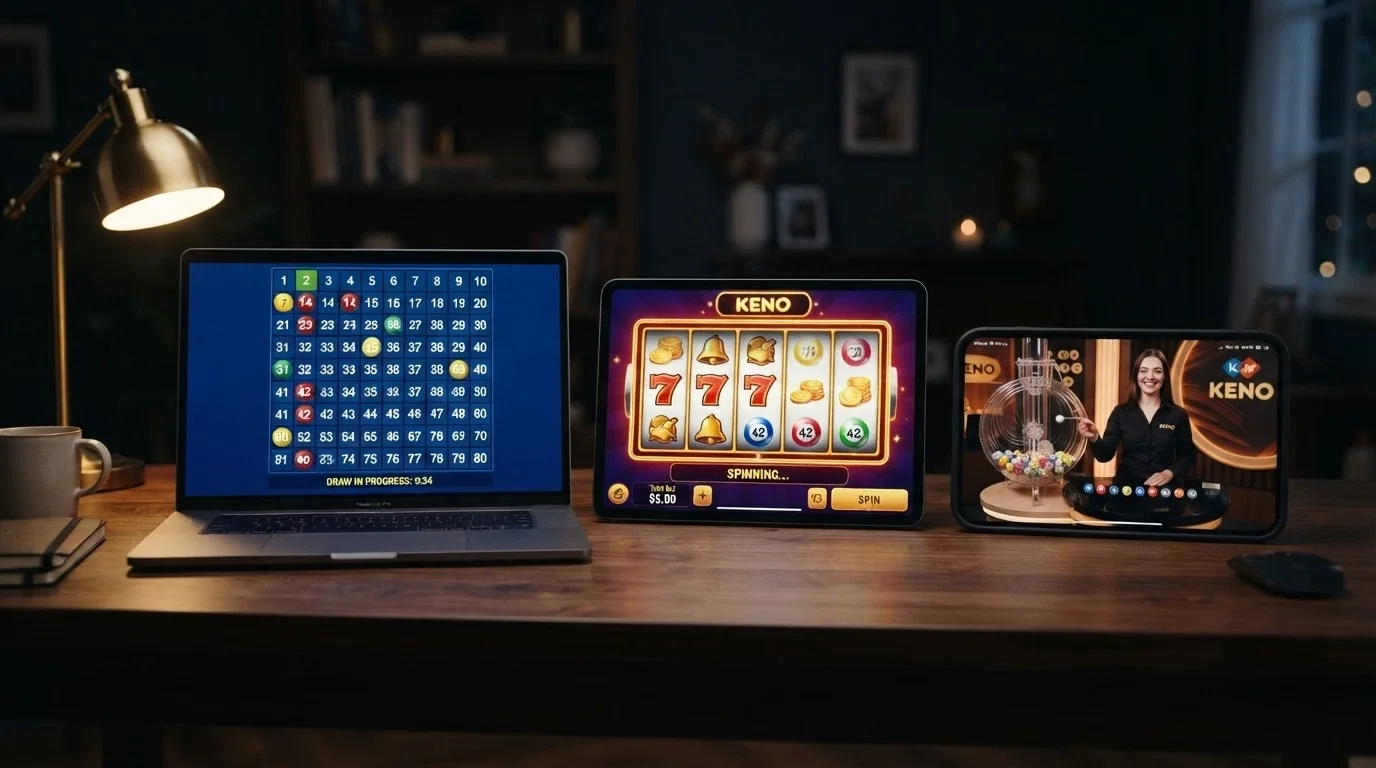
A keno slot machine wraps the 80-number draw in a five-reel frame. The reels spin, the numbers “land,” and the paytable is structured as a slot machine pays — multiple ways to win on a single spin, bonus features, multipliers. Dragon Power Keno from Atomic Slot Lab runs at 95.50 percent RTP with medium volatility and a maximum win of 2,500×. Enchanted Keno from Gromada Games sits at 94.96 percent RTP, medium volatility, with a maximum win of 10,000×. The maths is the same keno; the interface is a slot, and the pacing follows the slot cadence rather than the keno draw cadence.
A player who finds the classic keno grid too slow will find the slot-style variant faster-paced without losing the underlying game. Those prioritizing a traditional number-selection mechanic, however, may find the visual density of slot-based keno distracting rather than engaging.
Live keno: a real caller, a real draw, real-time stakes
Live keno replaces the RNG with a studio, a human caller, and a physical ball draw. The pace slows to the draw cadence rather than the click cadence; players watch numbered balls leave a blower and the paytable resolves in real time. Which operators on this list carry live keno specifically was not systematically confirmed in this round of research, so the depth of the live-keno offering is best treated qualitatively: most offshore lobbies with a keno tab carry at least one live-dealer keno table, but the count varies.
The pacing difference is the operative contrast. RNG keno runs as fast as the player’s finger; live keno runs as fast as the draw. For a player who wants the social texture of a real draw and is willing to trade pace for it, live keno delivers. For a player who wants turnover velocity, RNG keno is the tool.
Multi-card and four-card keno: playing several tickets at once
Multi-card keno runs two to four tickets against the same draw, with each ticket carrying its own spot selection and paytable. Autoplay drives the multi-ticket session forward at a chosen cadence, and the history panel tracks each ticket’s performance independently. Two to four simultaneous tickets is the practical ceiling — beyond that, the player’s attention fragments and the bankroll depletes faster than the decision-making can track it.
The bankroll implication is straightforward. Four tickets per draw at A$1 each is A$4 per draw, four times the single-ticket turnover. Twenty draws an hour is A$80 of turnover; the expected loss on the offshore RTP range sits well below the licensed 75 percent, but the absolute cost per hour climbs in proportion to the ticket count. Treating multi-card as a way to “cover more numbers” is a persistent misconception; every ticket still faces the same underlying 20-from-80 draw probability.
The rules every keno variant shares — and where they diverge
Every variant on this list rests on the same draw mechanic: 80 numbers, a player-selected set of spots, 20 numbers drawn, payout scaled to how many of the player’s spots land in the 20. The paytable structure, the bonus features, the spot range and the side games are where variants diverge.
Classic keno is the baseline. Bonus Number keno adds one extra drawn number that functions as a multiplier on hits. Power keno applies a multiplier to the entire payout when a high hit count lands. Multi-race and autoplay keno run the same draw repeatedly under preset parameters. The Lott’s licensed keno offers one to ten spots per game; KenoGO’s Classic caps at 10 spots. Some offshore variants cap at 15. Spot count is the most powerful single variable the player controls.
How spot count, paytables and RTP actually shape your return
Five to seven spots is the cited compromise between hit frequency and payout size. Fewer spots means more frequent hits but smaller payouts; more spots means rarer hits but larger payouts. The exact break-even depends on the paytable, but the 5-to-7-spot range is where most online keno paytables balance the two. Outside that range, a player is choosing between a high-frequency, low-payout profile (one to four spots) and a low-frequency, high-payout profile (eight to ten or more).
Standard licensed keno RTP sits near 75 percent; offshore RNG keno runs between 87.5 and 99.6 percent depending on spot count. The gap is the cost of the regulatory framework. KenoGO and The Lott are structured as lottery products with state oversight and consumer protections; the lower RTP is the trade-off for BetStop coverage, complaint mechanisms and state-guaranteed payouts. Offshore RNG keno delivers the higher RTP with no consumer protection infrastructure in Australia.
The software houses behind Australia’s most-played keno titles
| Game Title | Provider | RTP | Volatility | Max Win |
|---|---|---|---|---|
| Keno (Galaxsys) | Galaxsys | 87.5%–99.6% | High | 10,000× |
| Keno Neo | Bally | 93.81% | High | 200,000× |
| Keno | Spribe | ~97% | Medium | — |
| Keno | Realistic | 96.20% | Low | — |
| Keno | Lightning Box | 94% | Medium | 2,500× |
| Cleopatra Keno | IGT | 95.25% | — | 10,000× |
| Across the Universe Keno | Mascot Gaming | 95.15% | High | 130,000× |
| Dragon Power Keno | Atomic Slot Lab | 95.50% | Medium | 2,500× |
| Enchanted Keno | Gromada Games | 94.96% | Medium | 10,000× |
| Keno Betting | Elbet | 97.44% | Medium | 25,000× |
| Keno Fast | AGT Software | 95.5% | — | 1,500× |
| Bonus Keno 2 | Virtual Gold Studios | 96.51% | — | 10,620× |
| Jungle Keno | Caleta Gaming | 94.87% | High | 60,000× |
| KENO X | Tank Gaming | 94% | High | 10,000× |
The provider column is more informative than the casino brand. A Galaxsys keno game at any of the nine offshore operators on this list runs at the same RNG and the same paytable; the casino is the wrapper, the provider is the maths.
Free keno: try every variant before you spend a single dollar
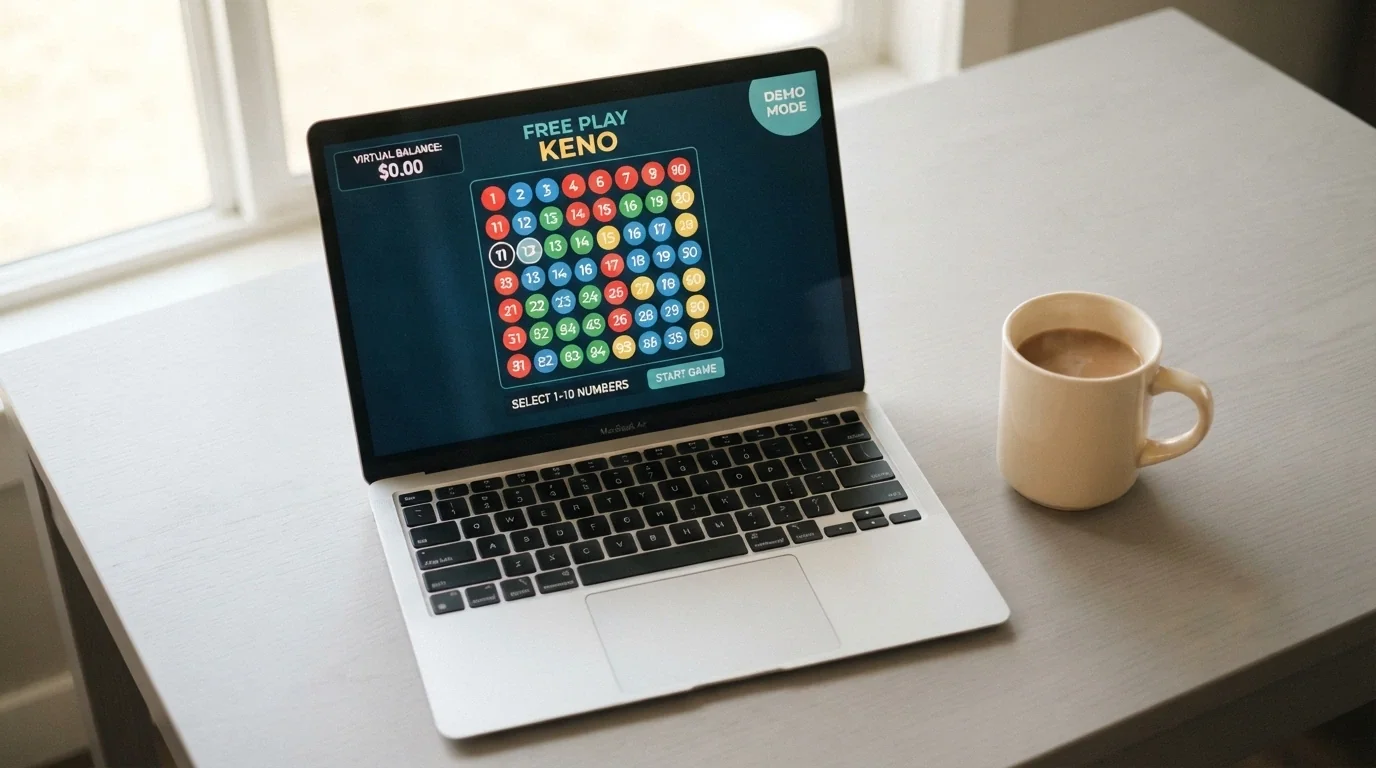
Free-play and demo-mode keno give a player the full game — identical paytable, identical draw mechanic, identical RNG — with a virtual balance that cannot be lost. Demo mode is the standard onboarding tool at every offshore casino on this list, and most do not require an account to launch a keno game in demo mode.
Free keno slots and where to find them
Every operator on this page except KenoGO runs an offshore casino lobby where keno titles are available in demo mode without a deposit. The keno slot machines from Atomic Slot Lab, Gromada Games and Mascot Gaming, the RNG keno from Galaxsys, Spribe and the rest of the provider table, all run on the same RNG in demo as in real-money mode. Most offshore operators grant immediate access to these demo environments without requiring a registered account.
Demo-mode keno: identical gameplay, zero financial risk
Demo mode runs on the same RNG as the real-money game. The paytable is unchanged. The draw frequency is unchanged. What demo mode omits is the psychological pressure of real-money stakes — and that omission is the point. A player learning a new variant wants to see how the draw cadence feels, how the paytable responds to different spot counts, how the autoplay function behaves across a hundred draws. None of that requires real money, and demo mode provides it cleanly.
The one thing demo mode cannot simulate is the player’s own emotional response to a losing streak. A virtual balance that cannot be lost produces no tilt. The real-money equivalent of a fifty-draw losing streak in demo mode is information; in real-money mode it is a cost.
What free play teaches you that a paytable cannot
A paytable shows the numbers. Free play shows the rhythm. How fast the draws come, how the autoplay feels, how a bankroll depletes across two hundred draws — that is the lesson demo mode teaches better than any published paytable. Watching a virtual balance drop from A$1,000 to A$750 across an hour’s worth of keno draws at A$1 per ticket is information that no paytable delivers. The turnover velocity lesson is the most underrated part of free play; twenty games an hour at A$5 a ticket is A$100 of turnover with an expected loss near A$25, and watching the virtual balance track that trajectory teaches bankroll discipline better than any table.
Why crypto keno deposits keep reaching Australian players
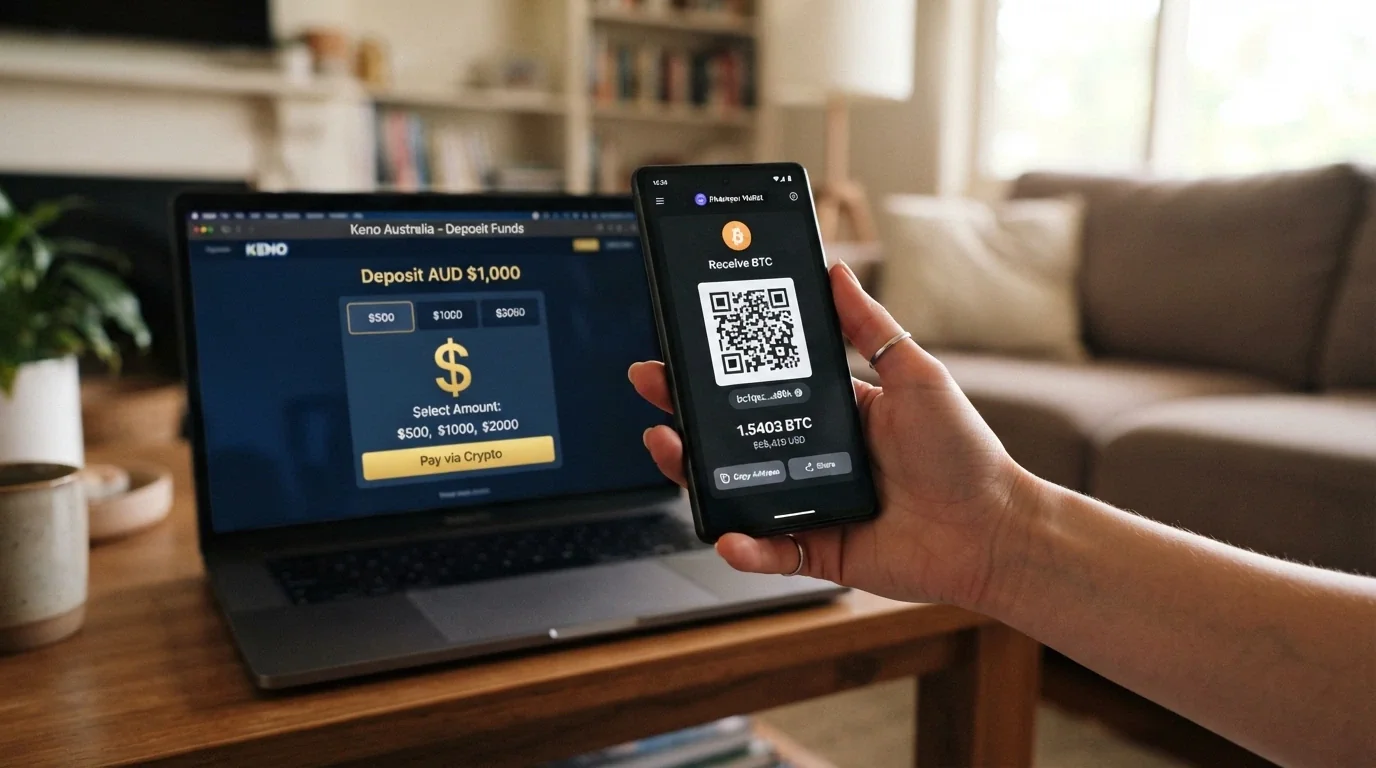
The credit-card and crypto ban that took effect on 11 June 2024 covers licensed online wagering. It does not reach offshore casinos. The exemption is the gap. Every offshore operator on this list accepts cryptocurrency deposits, and crypto is the dominant payment rail for Australian players using these sites because the Australian banking system will not process the transaction.
Bitcoin keno casinos that accept Australian players
Bitcoin, Ethereum, and in some cases Litecoin or USDT, are accepted at the offshore casinos on this page. Crypto deposit availability at offshore casinos is widespread and well established. Per-operator crypto acceptance was not systematically confirmed in this round of research, so the depth of each operator’s crypto offering is best treated qualitatively.
The conversion and volatility risk is the operative cost. An offshore casino operating in USD converts crypto deposits at the point of deposit through its own processor, typically 2 percent to 5 percent above the mid-market rate. A Bitcoin deposit worth A$1,000 at the time of transfer lands in the player’s casino balance at A$960 or so after the conversion spread. The volatility risk runs in the opposite direction between deposit and withdrawal — if Bitcoin drops 10 percent during the session, the player is withdrawing into a weaker currency than they deposited.
How crypto payments work around Australia’s banking barrier
Crypto deposits use a wallet address rather than a card number. The bank never sees a gambling transaction code; no gambling merchant category is applied; no AUSTRAC flag is raised at the point of transfer. From 1 January 2027, the 2026 reform gives banks and payment providers express authority to block transactions to illegal gambling operators, and the ACMA’s disruption tools in collaboration with AUSTRAC under the Fintel Alliance are already targeting the payment rail. Crypto sits one layer removed from that infrastructure, which is why offshore keno casinos lean into it.
The practical risk for the player is the absence of recourse. A chargeback through a card issuer is not available on a crypto deposit. An Australian consumer protection claim is not available against an offshore operator. If the operator refuses a withdrawal or voids a win, the player has no Australian regulator to appeal to. Crypto buys access to the offshore product; it does not buy any of the protections the licensed path provides.
The laws that decide whether your keno game is legal or not
Online keno is currently legal from AU-licensed operators. Every offshore casino offering it to Australians is doing so unlawfully — there is no Australian casino licence for any of them to hold, because no Australian casino licence exists.
The Interactive Gambling Act and where online keno sits under it
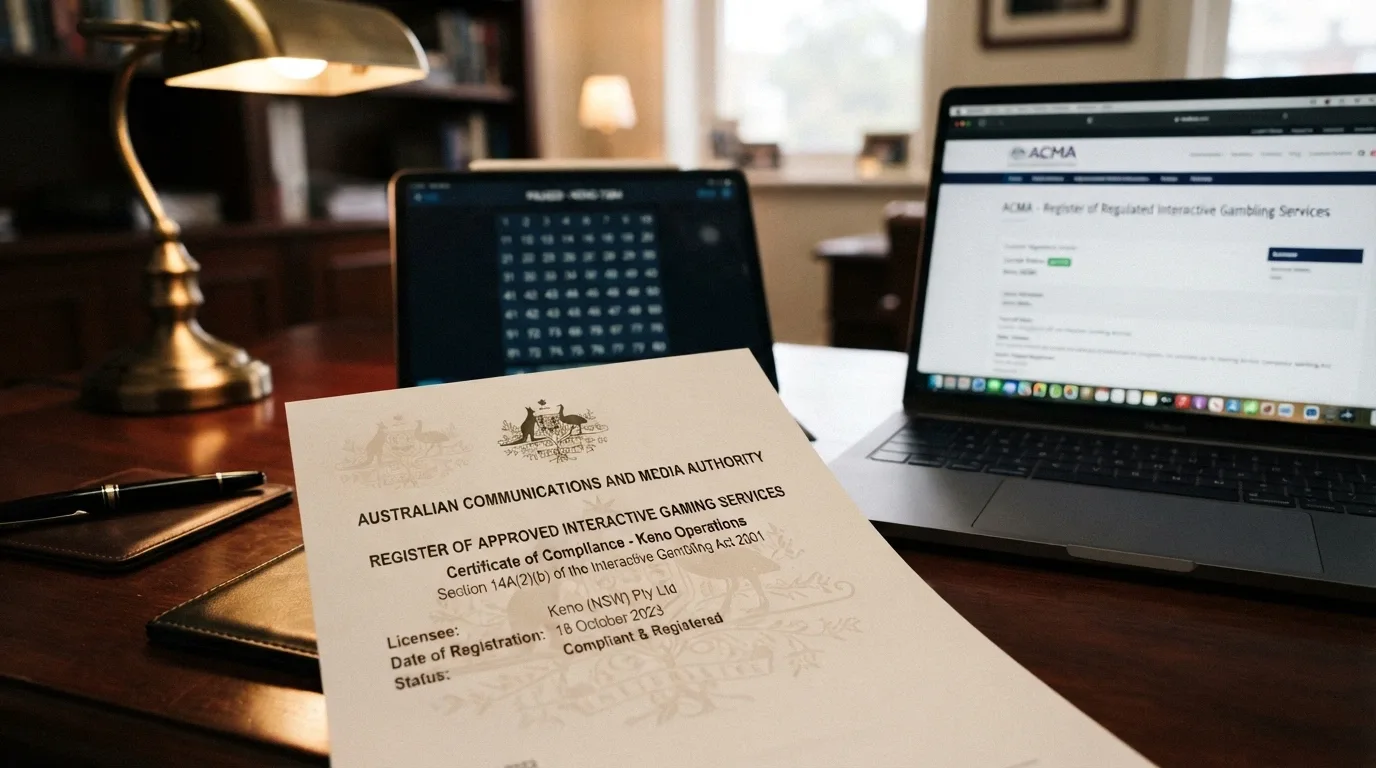
The Interactive Gambling Act 2001, strengthened by the Interactive Gambling Amendment Act 2017, prohibits online casino games, online pokies and in-play sports betting to persons in Australia. Keno, lotteries and pre-event wagering are the legally licensable online products — provided by operators licensed by a state or territory. The Northern Territory Racing and Wagering Commission, administered through Licensing NT, is the de facto national licensor for online wagering; keno licensing sits at the state and territory level.
The Act targets the provider, not the individual player. An Australian who deposits at an offshore casino is not prosecuted. The offshore casino is the party operating unlawfully by offering an unlicensed product to Australians. The practical effect on the player is the absence of consumer protection, not the presence of legal risk on the player side.
Licensed Australian keno: KenoGO, The Lott and state-regulated play
KenoGO operates under state and territory licensing, offers four keno products from A$1 entry, and is connected to BetStop. KenoGO Classic pays up to A$1,000,000 on a A$1 ticket. KenoGO Bonus applies a 10× multiplier and lifts the headline prize to A$10,000,000 on a A$2 ticket. KenoGO Jackpot runs from A$2 with a Major prize ceiling at A$40,000,000. Heads or Tails is the side game. The Lott’s keno draws 20 from 80, with entries from A$1, played every few minutes, and one to ten spots per game.
The underlying RTP at the licensed products sits near 75 percent for standard keno, with side games pushing toward 80 percent. The offshore RNG range of 87.5 to 99.6 percent is significantly higher. The licensed trade-off is the consumer-protection infrastructure: state-regulated payouts, BetStop coverage, complaint mechanisms through state gaming regulators. The offshore trade-off is the RTP gap and the absence of that infrastructure.
The 2026 reform: why online keno’s legal window is closing on 1 January 2027
The Interactive Gambling Amendment (Gambling Reform) Bill 2026 was introduced to the House of Representatives on 2 July 2026, referred to the Senate Environment and Communications Legislation Committee for inquiry, and passed Parliament on 19 August 2026. The bill bans online keno and foreign-matched lotteries, strengthens BetStop protections, adds wagering advertising restrictions, and increases powers to combat illegal gambling services. The measures commence on 1 January 2027.
The advertising changes are sweeping. From 1 January 2027, a federal cap of no more than three wagering ads per hour between 6:00 am and 8:30 pm applies, with a live-sport blackout from 15 minutes before a live sporting event until 5 minutes after it ends. Athletes, celebrities and influencers are barred from promoting wagering products, no wagering advertising is allowed inside sports venues or on player and official uniforms, and direct marketing of inducements is prohibited for 14 days after a customer signs up, for three months after a person deregisters from BetStop, and indefinitely for customers identified as at risk of gambling-related harm. AdStop, a national wagering advertising opt-out register, will be administered by the ACMA.
For an Australian reading this page after 1 January 2027, the product it covers is prohibited to provide. The licensed keno products at KenoGO and The Lott remain available — keno’s prohibition applies to online keno supplied by offshore operators, not to state-licensed draws. The offshore lobbies are the ones the reform targets.
What the ACMA does — and what it cannot do about offshore casino sites
The ACMA blocks websites, investigates complaints, issues formal warnings and pursues civil penalty proceedings against illegal operators. Since November 2019, the ACMA has had 1,564 illegal gambling and affiliate websites blocked by Australian ISPs, with more than 225 illegal services withdrawing from the Australian market since 2017. The enforcement scale is real; the enforcement reach is not unlimited.
The ACMA cannot shut down a Curaçao-based operator. It cannot seize a foreign domain. It cannot recover a player’s lost deposit at an offshore site. The disruption tools launched in 2025 in collaboration with AUSTRAC under the Fintel Alliance target the payment rail — the bank transfer, the card transaction, the PayID — rather than the operator itself. A player who deposits at an offshore casino today and finds the site blocked by their ISP tomorrow has no recourse through the ACMA for the balance left inside. That is the consumer-protection gap the licensed path closes.
When keno stops being fun: the limits and support that actually exist
Responsible-gambling infrastructure at offshore keno casinos ranges from operator-by-operator self-imposed limits to nothing at all. BetStop, Australia’s strongest player-protection tool, covers exactly one operator on this list.
Deposit, loss and session-limit tools: what the platforms offer
KenoGO and The Lott, as state-licensed operators, offer deposit limits, session limits and take-a-break tools that align with the National Consumer Protection Framework for Licensed Wagering Services. Offshore casinos may offer similar tools on a voluntary basis — deposit caps, cooling-off periods, self-exclusion buttons — but no Australian regulator enforces them, and the operator can change or remove the tools at any time without notice.
The gap is structural, not operational. A licensed Australian operator’s responsible-gambling tools are audited; an offshore operator’s are marketing copy. A player who sets a deposit limit at a licensed operator and finds the limit ignored has a regulator to complain to. The same player at an offshore operator has an email to write and no guarantee of a response.
BetStop and self-exclusion: which keno sites the register actually covers
BetStop — the National Self-Exclusion Register — went live in August 2023 and recorded 67,480 registrations by 31 July 2026, of which 41,290 exclusions were still active. Seventy-eight percent of registrants were under 40; thirty-eight percent chose lifetime exclusion. The register binds Australian-licensed wagering services only. An offshore casino is not connected to BetStop and has no obligation to check it.
For a self-excluded Australian, the practical effect is severe. The exclusion closes every licensed wagering account, every licensed keno entry, every licensed lottery ticket. It does not close a Neospin account, a Wild Tokyo account, a RocketPlay account, or any of the other nine offshore brands on this list. Once an Australian has chosen lifetime exclusion at BetStop, engaging with an offshore casino essentially undermines the very protection the register was designed to provide.
The National Gambling Helpline and where to get free, confidential support
The National Gambling Helpline is 1800 858 858. It runs 24 hours a day, seven days a week, is free, and is confidential. Gambling Help Online provides free 24/7 chat and email counselling through gamblinghelponline.org.au. Both are staffed by trained counsellors, not a call-centre script.
The harm prevalence sits at approximately 2.1 percent of Australian adults — roughly 430,000 people — with high-risk gambling at 1.8 percent per the Australian Institute of Health and Welfare in 2022. For the player reading this page, the number is not a statistic; it is a recognition that keno’s pace and RTP profile can sit comfortably inside a problem-gambling pattern without the player noticing. The Helpline is the first number every Australian keno player should know, regardless of which operator they choose.
How we selected and ranked these keno casinos
The ten operators on this page were measured against the same criteria: licence status, keno game variety, bonus fairness and payment access for Australian players. The data behind those criteria came from the ACMA register, the operators’ own terms pages, and the gameplay specifications published by the underlying keno providers.
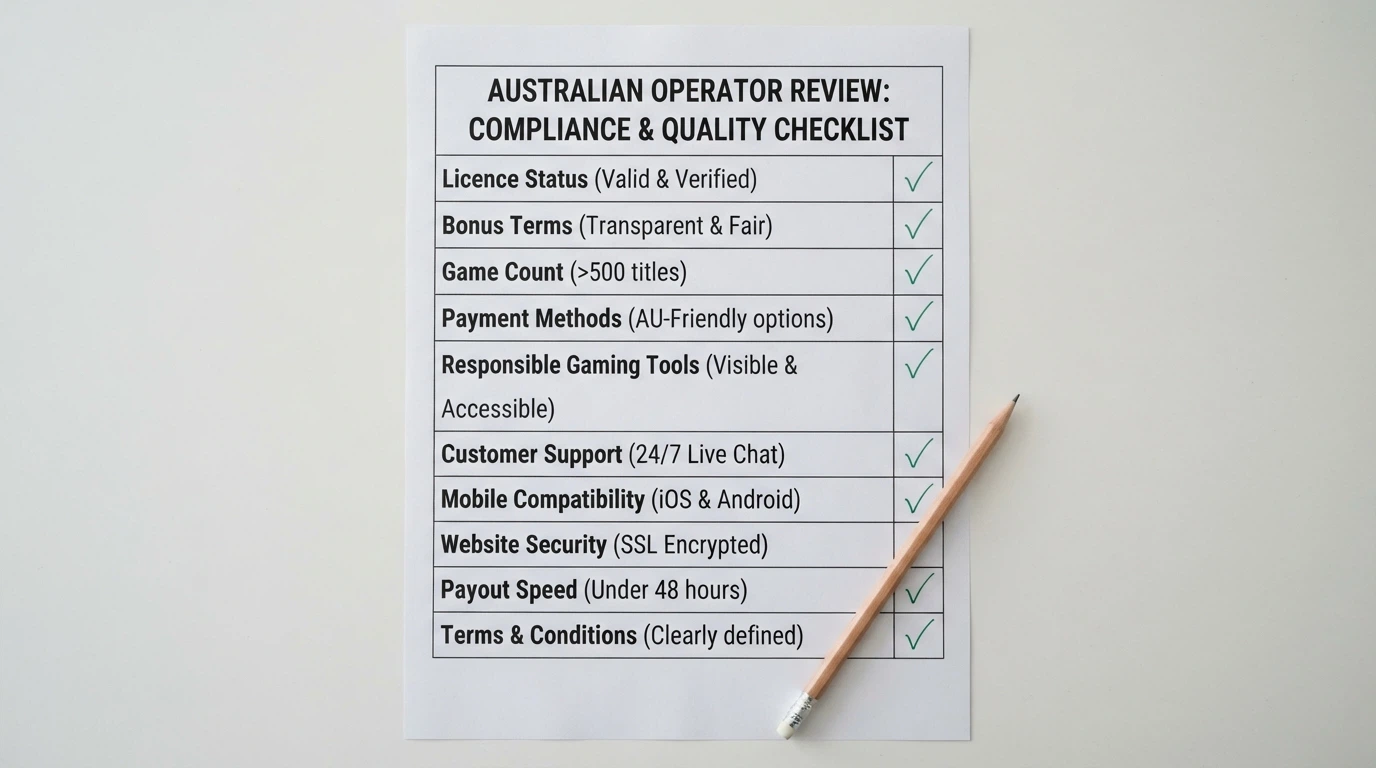
AU licence status was checked against the ACMA register and the state and territory gaming regulators. No offshore casino on this list holds an Australian casino licence, because no Australian casino licence exists to hold. Keno game variety was sourced from the operators’ published lobby counts and from direct testing reported by independent Australian-facing casino review sites. Bonus terms were read from the operators’ own terms and conditions pages as published in 2026. Payment access was sourced from the operators’ banking pages and from the published payment-rail restrictions under the 11 June 2024 credit and crypto ban.
Operators not on this list were excluded for one of three reasons: they did not carry keno as a distinct game category, their terms explicitly excluded Australian players, or their licence status and complaint infrastructure fell below the minimum threshold the comparison implies. The ranking reflects the table’s columns, not a scoring system.
The keno decision every Australian player faces in 2026
Two paths run through Australian keno in 2026, and they cost different things. The licensed path — KenoGO, The Lott — sits at roughly 75 percent RTP on standard keno, delivers state-regulated payouts, BetStop coverage, and complaint mechanisms through the state gaming regulators. The cost is the RTP gap. The offshore path — Neospin, Golden Crown, SkyCrown, Wild Tokyo, RocketPlay, Royal Reels, Stake, FairGO, Bizzo — delivers RTPs from 87.5 to 99.6 percent, broader keno lobbies, and bigger welcome bonuses. The cost is every consumer protection the licensed path provides.
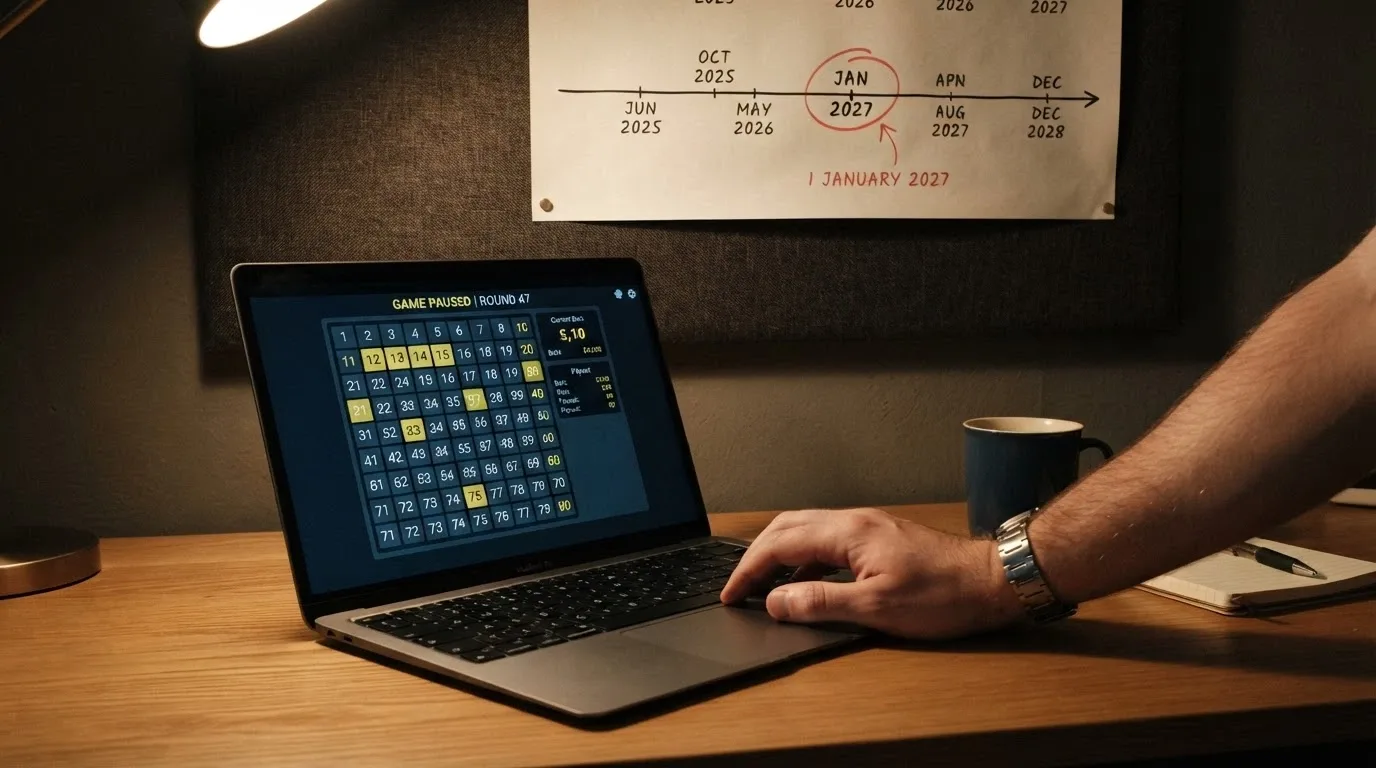
From 1 January 2027 the offshore path becomes the prohibited path. The Interactive Gambling Amendment (Gambling Reform) Bill 2026 bans online keno outright. The licensed keno products at KenoGO and The Lott remain available, because they are state-licensed lottery products, not online casino keno. The offshore lobbies offering keno to Australians are the target of the reform. A player reading this page after that date is reading about a product that the Australian Parliament has decided to prohibit — and the offshore operators carrying it have, in the legislature’s view, been carrying an unlawful product all along.
The call is not which bonus has the bigger headline number. It is which side of the legal line you are willing to stand on, what you give up on each side, and whether the RTP gap is worth the absence of Australian consumer protection. The page has laid out both paths with their costs. The decision is yours.
Frequently asked questions about online keno in Australia
Is online keno legal in Australia?
Online keno is legal when provided by an Australian-licensed operator such as KenoGO or The Lott. Every offshore casino offering keno to Australians does so without an Australian licence, because no Australian casino licence exists to hold. From 1 January 2027, the Interactive Gambling Amendment (Gambling Reform) Bill 2026 bans online keno outright.
What is the typical RTP of online keno games?
Standard licensed Australian keno sits near 75 percent RTP, with side games like heads-or-tails closer to 80 percent. Offshore RNG keno ranges from 87.5 percent to 99.6 percent depending on the provider and spot count. The gap reflects different regulatory models: licensed keno is a lottery product with consumer protections; offshore keno offers higher return with no Australian recourse.
Can I play keno for free online before betting real money?
Yes. Most offshore casinos on this list launch keno titles in demo mode without requiring an account or deposit. Demo mode runs on the same RNG and paytable as real-money play. KenoGO and The Lott do not offer demo mode in the same sense — entries start at A$1 on the licensed products.
How does BetStop protect Australian keno players?
BetStop is the National Self-Exclusion Register, recording 67,480 registrations by 31 July 2026. A registered player is excluded from every Australian-licensed wagering service. The protection extends to KenoGO and The Lott. It does not extend to any of the nine offshore casinos on this list, which are not connected to the register.
What are the best keno variants available at Australian-facing online casinos?
Keno variants at Australian-facing offshore casinos include classic 80-number draws, Bonus Number keno with an extra multiplier draw, Power keno with payout multipliers on high hit counts, multi-card keno running two to four tickets per draw, live keno with a human caller, and slot-style keno hybrids like Dragon Power Keno and Enchanted Keno. RTP varies by variant: Galaxsys keno runs up to 99.6 percent, Spribe keno near 97 percent, Bally Keno Neo at 93.81 percent.
What payment methods can I use to deposit at a keno casino in Australia?
At licensed Australian operators, deposit methods are debit card, bank transfer, PayID and BPAY. Credit cards and crypto are banned for online wagering since 11 June 2024, with a current exemption for lotteries and keno. Offshore casinos accept crypto as the dominant rail, alongside cards and e-wallets, with no Australian consumer protection on deposits or withdrawals.
Written by the editors at Instant Withdrawal Casinos AU.