
What “Anonymous” Means at an Australian Crypto Casino, and What It Costs
 Available in AU
Every online casino that accepts Bitcoin from an Australian is operating outside Australian law. The Interactive Gambling Act 2001 prohibits the provision of online casino games, online pokies and in-play betting to anyone in Australia. No licence exists, federally or in any state or territory, because the product itself is banned. A site that takes crypto deposits from an Australian customer is, by definition, an offshore operator running on its own house rules — and the anonymity it markets is a real but partial feature, not a guarantee. The rest of this page measures what that anonymity actually delivers, where it ends, what the player gives up to get it, and which of the ten operators currently accessible from Australia hold up when the marketing is set aside.

Current as of 18 October 2026 — operator licence claims verified against Curaçao eGaming and the Anjouan Gaming Authority public registers.
Table of Contents
- What “Anonymous Crypto Casino” Actually Means for Australian Players
- How Crypto Keeps a Casino Registration Anonymous
- The Legal Reality: Offshore Casinos and Australian Law
- The Ten Offshore Brands Accepting Australian Deposits in 2026
- Why Your 2026 Crypto Casino Bonus Is Smaller Than It Looks
- Responsible Gambling When Nobody Knows Who You Are
- How We Selected and Ranked These Casinos
- Playing Offshore With Your Eyes Open
- Frequently Asked Questions
What “Anonymous Crypto Casino” Actually Means for Australian Players
An anonymous crypto casino, in the sense the term has acquired across offshore marketing, is an online casino built around two promises: no identity verification at registration, and cryptocurrency-only deposits. The pitch is that a player can open an account with nothing more than an email address, send Bitcoin or USDT from a self-custody wallet, and play real-money games without ever handing over a driver’s licence, a passport or a proof-of-address document. For an Australian player in 2026, the product sits in a specific legal vacuum — there is no licensed Australian online casino to compare it against, so “anonymous” is not a differentiator among Australian competitors. It is the defining feature of every option on the table, and every option on the table is offshore.
The promise has two halves. The first half — email-only sign-up — is genuinely frictionless at most of the operators covered below. The second half — permanent anonymity through to withdrawal — is where the marketing starts to outrun the mechanism. Curaçao- and Anjouan-licensed casinos typically operate under anti-money-laundering policies that set a KYC review trigger somewhere between EUR 2,000 and EUR 10,000 in cumulative withdrawals or deposits, though some operators apply a risk-based approach with no fixed dollar threshold. Below the threshold, the player rarely sees a document request. Above it, the casino asks for photo ID, proof of address and sometimes a source-of-funds declaration. “No KYC” in this market therefore means KYC-deferred, not KYC-absent — and the difference matters when a player wins enough to cash out.
The cluster of operators accessible to Australian players in 2026 — Stake, BitStarz, mBit, Cloudbet, Jack, Moonbet, Vave and others covered below — share three structural traits: they hold offshore licences (Curaçao or Anjouan, never an Australian one), they accept crypto as their primary or exclusive deposit rail, and they are not connected to BetStop, the Australian national self-exclusion register. The Australian player approaching this market in 2026 is choosing between variants of the same offshore model, not a licensed alternative.
The No-KYC Promise — and When It Ends
“No KYC” at a crypto casino almost always means email-only registration, with identity verification triggered at a withdrawal threshold rather than at sign-up. The thresholds vary sharply. Cloudbet publishes a concrete figure — A$2,200 per day for withdrawals — and asks for photo ID and proof of address above it. mBit operates on a similar deferred model, with KYC triggered on withdrawals of roughly US$5,000 or more. Moonbet sets the threshold at A$2,000 cumulative withdrawals, below which no KYC is requested. Other operators in the set run on a risk-based approach with no fixed dollar amount at all — the casino may request verification on any withdrawal at its discretion, based on factors the player never sees.

The practical consequence is that small, frequent withdrawals stay anonymous, while a single large withdrawal — a jackpot, an accumulated bankroll, a sportsbook win — often triggers the full verification process. When that happens, the documents requested are the same as at any regulated casino: government photo ID, a recent utility bill or bank statement, and occasionally a selfie or a source-of-funds declaration. The casino is not being unreasonable; it is complying with its own AML obligations, and the threshold at which those obligations bite is one of the things the player should understand before depositing.
A fixed threshold gives the player a number to plan around. A risk-based approach gives the player nothing to plan around — KYC may be requested on the first withdrawal or never, depending on deposit pattern, withdrawal size and the operator’s internal scoring. Across the featured set, Cloudbet’s A$2,200/day figure is the most transparent, and the risk-based operators are the least.
Crypto as the Enabler: Why Digital Currency Casinos Target Australian Players
Since 11 June 2024, credit cards, credit-linked products and digital currencies have been banned as payment methods for licensed online wagering in Australia. Operators breaching the ban face civil penalties of up to A$247,500. The legal deposit routes for a licensed Australian wagering account are debit cards, bank transfers, PayID/Osko and BPAY — and all of them require identity verification before the account is opened. Crypto acceptance and Australian-licensed wagering have become mutually exclusive. The regulated Australian betting market is now effectively crypto-free, while crypto use continues only on unlicensed offshore platforms that could never legally serve Australians in the first place.
The technical reason this matters is that a licensed wagering operator can see its customer’s transactions through the Australian banking system. An offshore operator taking Bitcoin cannot. The crypto rail is what makes the offshore model commercially viable for both sides: the player gets to bypass Australian identity requirements, and the operator gets to bypass the Australian prohibition on providing casino games. The transaction settles on a public blockchain, but the wallet addresses on either side are pseudonymous strings — there is no name attached to either end unless the wallet provider has run KYC at the on-ramp or off-ramp. Australian banks cannot see the transaction. ACMA cannot block it at the payment layer. The crypto rail is the offshore operator’s structural advantage, and it is also the structural reason no Australian regulator can intervene if the operator disappears with the player’s balance.
Pokies, Real Money and Mobile: How Australia’s Anonymous Play Landscape Looks in 2026
The product the Australian player actually finds at these casinos is overwhelmingly pokies — slots — alongside table games, live dealer titles and sportsbooks at the operators that carry one. Real-money play is the default; there is no demo mode that meaningfully substitutes for the paid experience at the bulk of these sites. Every platform is mobile-browser-accessible, and none requires an app-store download. A VPN is an optional layer a privacy-conscious player may add, but it is not a requirement to reach or play at any of the operators covered below — the sites are accessible directly from an Australian IP address, which is part of why ACMA’s enforcement runs at the DNS level rather than the network level.
The game libraries are large. Jack carries 7,000+ titles across casino and sportsbook. BitStarz publishes 6,000+ games. Moonbet lists 10,000+ games from 50+ studios, including Evolution and Pragmatic Play. mBit sits at 5,000+. Cloudbet at 3,000+. The studios behind these catalogues — Pragmatic Play, Evolution, Hacksaw Gaming, BGaming, NetEnt and dozens of others — are the same providers that supply licensed operators in other jurisdictions, and the games themselves are the same titles. What changes between a licensed European casino and an offshore Australian-facing one is the regulatory frame around the games, not the games.
How Crypto Keeps a Casino Registration Anonymous
The technical chain behind an anonymous crypto casino deposit runs wallet-to-wallet, with no bank or card intermediary in the loop. The player holds crypto in a self-custody wallet or on an exchange, sends it to a deposit address the casino displays, and the funds arrive after blockchain confirmation. There is no point at which an Australian bank sees the transaction. There is no card processor collecting the player’s name and address. The casino’s record of the player is whatever the player entered at registration — typically an email address and a password — plus the wallet addresses that have deposited.
Settlement speed varies sharply by coin. Solana is the fastest at the casinos that accept it, with most withdrawals landing in under five minutes. Litecoin and USDT on the TRC-20 network typically settle under ten minutes. Bitcoin, despite being the brand-name crypto of the industry, is the slowest of the common options — block confirmation times push Bitcoin withdrawals into a 30-to-60-minute window. The coin the player chooses for withdrawal is, in practice, the single biggest speed lever the player controls.
The anonymity that lives in this chain is real but bounded. The blockchain is a public ledger. Every transaction is visible, including the deposit that funded a casino account and the withdrawal that paid it out. What the blockchain does not carry is identity — the wallet address is a string of characters, not a name. The link between a wallet and a real person lives off-chain, in the records of the exchange or wallet provider where the player bought the crypto, and in any KYC the casino eventually runs. A player who bought Bitcoin on a KYC-verified Australian exchange and then sent it to an offshore casino has not achieved anonymity — they have achieved a paper trail that runs through the exchange and the blockchain, with the casino at one end. A player who bought Bitcoin peer-to-peer or through a non-KYC route has achieved something closer to the marketing promise. The casino cannot tell the two apart until it asks for documents at the withdrawal threshold.
Bitcoin, Altcoins and the Multi-Token Reality
Bitcoin is the headline, but the working currency of anonymous crypto casinos in 2026 is the full altcoin stack. USDT — the dollar-pegged stablecoin — is the dominant choice for players who want to avoid volatility while the funds sit in a casino balance. Solana and Litecoin are the speed plays. Ethereum sits between them. And then the deposit surfaces balloon out: Anon Casino accepts 300+ different cryptocurrencies for deposit, though only six are eligible for withdrawal (Bitcoin, Ethereum, Litecoin, Solana, USDT and XRP). Cloudbet supports 35+ cryptocurrencies for both directions. Jack takes 15+. Moonbet lists 50+.

The gap between deposit-eligible and withdrawal-eligible coins is the sharpest practical detail in this market. A casino may accept a long tail of tokens for deposit — because accepting is cheap and signals breadth — while restricting withdrawals to a handful because liquidity and confirmation reliability vary. The player who deposits in a niche token may find they have to convert before withdrawing, and the conversion cost eats into the win. Reading the withdrawal-eligible list before depositing is the single most useful piece of due diligence at this stage of the process, and it is one most players skip.
Instant Withdrawals as the Other Half of the Anonymity Promise
Speed is part of the anonymity sell. A casino that pays in under five minutes feels frictionless in a way a 24-hour withdrawal window does not, and the marketing leans into that feeling. The reality, measured against the featured set, is more uneven. Jack’s tested crypto payouts land in under five minutes. Moonbet’s tested payouts take about four minutes. mBit sits in a 10-minute-to-3-hour band. Cloudbet is the slowest of the operators with confirmed figures, at roughly 24 hours. The fastest of the bunch overlap with the fastest blockchain options — Solana and Litecoin — but the operator’s own processing layer adds its own delay on top of blockchain confirmation, which is why two operators accepting the same coin can sit at opposite ends of the speed range.
The gap between “instant” in the marketing and the actual time-from-request-to-arrival matters at the moment a player is testing whether the casino pays. A casino that takes 24 hours is not dishonest, but it is slower than the headline. A casino that takes four minutes is delivering on what the rest of the market is selling. Speed-focused players should prioritise coin selection over banner marketing: picking a faster network like Solana or Litecoin bypasses the common Bitcoin bottleneck and aligns the deposit experience with the four-minute instant-pay promise.
“Truly Anonymous” Claims vs the KYC Trigger Reality
The marketing language in this market runs to “100% anonymous” and “no verification ever.” The mechanism behind those claims runs to a threshold and a clause. Every operator in the featured set reserves the right to request identity documents at some point in the withdrawal process. The threshold may be published (Cloudbet’s A$2,200/day, Moonbet’s A$2,000 cumulative) or undisclosed and risk-based (Stake, BitStarz, Jack at the operator’s discretion). What no operator in this market promises is permanent anonymity through to any withdrawal amount — because no Curaçao- or Anjouan-licensed casino can operate that way under its own AML obligations, and the licensing authority can revoke the licence for non-compliance.
The player who reads “100% anonymous” as a contractual guarantee is reading past the terms. The player who reads it as “no documents for small withdrawals” is reading what the operator actually delivers. The difference between the two readings is the difference between a confident cashout and a refusal at the moment of payout, with no Australian regulator to escalate to. An offshore casino that refuses a withdrawal — for any reason, including a bonus-term interpretation — leaves the player with no Australian consumer protection, no Australian complaints body, no BetStop coverage, and no recourse if the operator voids a win or closes the account. The site can also be DNS-blocked by the ACMA at any time, with the player’s balance still on it.
The Legal Reality: Offshore Casinos and Australian Law
Online casino, online pokies and in-play betting are prohibited services under the Interactive Gambling Act 2001. The Act makes it an offence to provide these services to a person in Australia, and it targets the provider, not the player. No Australian authority issues online casino licences — not the federal government, not any state or territory — because the product is prohibited. Every offshore crypto casino accessible from Australia in 2026 is operating outside Australian rules, and the ACMA enforces that line through ISP-level DNS blocking, formal warnings and civil penalty proceedings.
The enforcement record is substantial. Since its first blocking request in November 2019, the ACMA has had 1,788 illegal gambling and affiliate websites blocked by Australian ISPs, with over 230 illegal services withdrawing from the Australian market since enforcement was strengthened in 2017. The October-to-December 2025 quarter alone added 133 websites to the blocked list — 38 for providing a prohibited interactive gambling service, 26 for providing an unlicensed regulated interactive gambling service, and 5 for advertising prohibited or unlicensed services. By June 2026 the cumulative total had reached 1,751 blocked sites, with formal warnings issued to operators and to individuals promoting illegal services — a July 2025 warning went to prediction-market platform Polymarket, and a separate warning to MMA fighter Jamie Mullarkey for promoting an illegal gambling operator on Instagram.
The grey/offshore market accounts for roughly 15% of Australia’s total gambling market — a meaningful slice of an industry that also includes the heaviest per-person gambling losses on earth, at around A$32 billion a year on legal gambling alone. The IGA does not cap deposits, losses or stakes at the federal level, because the product those caps would govern is banned outright. The Australian equivalent is the payment-method restriction — and from 1 January 2027, banks and payment providers gain express authority to block transactions to illegal gambling operators, which closes another avenue the offshore model has relied on. Player winnings are not assessable income under section 6-5 of the ITAA 1997, and losses are not deductible under section 8-1, unless the person is carrying on a business of betting.
The Interactive Gambling Act 2001 and What It Actually Prohibits
The IGA draws a clean line through Australian gambling. Online casino games, online pokies and in-play betting on a sporting event once it has started are prohibited — it is an offence to provide them to a person in Australia. Pre-match wagering on races and sport is permitted and licensable, through state- and territory-licensed operators, with the Northern Territory Racing and Wagering Commission functioning as the de facto national licensor. Lotteries and keno are permitted. The minimum age for all commercial gambling in Australia is 18.
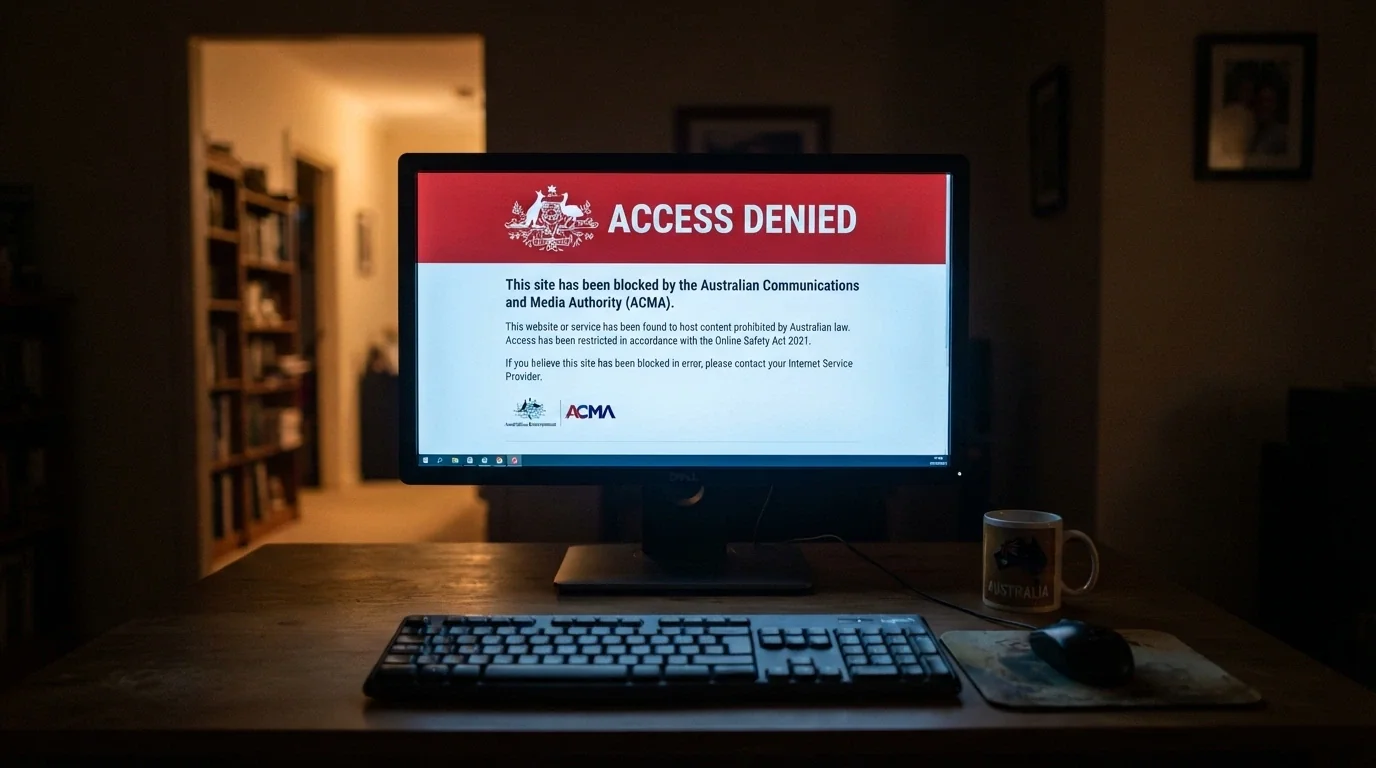
The 2017 amendment to the IGA closed the offshore loopholes that had allowed international operators to serve Australian customers without consequence, and gave the ACMA its blocking and civil-penalty powers. The enforcement tools that flow from that amendment — DNS-level blocking of illegal sites, formal warnings to operators and promoters, civil penalty proceedings — are the practical reason an Australian player reaches a blocked-site notice when typing an offshore casino URL into a browser. The notice is not a suggestion. It is the result of a court-issued blocking order served to the ISP.
The Crypto Payment Ban and What It Tells You About Any Casino That Asks for Bitcoin
The Interactive Gambling Amendment (Credit and Other Measures) Act 2024 banned credit cards, credit-related products and digital currencies as payment for online wagering, commencing 11 June 2024. Operators breaching the ban face penalties of up to A$247,500. The effect on the licensed Australian market was immediate and total: regulated wagering operators pulled crypto acceptance, and the regulated market became effectively crypto-free. The effect on the offshore market was the opposite — every operator that had been on the fence about crypto support became more aggressive in promoting it, because crypto is now the defining payment rail of the unlicensed segment.
The compliance signal is one-directional. A gambling site accepting Bitcoin, Ethereum or USDT from an Australian customer is not operating under Australian rules, because Australian rules do not allow it. Legal deposit routes for licensed Australian wagering are debit card, bank transfer, PayID/Osko and BPAY — all of them requiring identity verification before the account is opened. Crypto acceptance is a one-question test, and the answer determines which regulatory frame applies.
What a Player Gives Up Outside the Licensed Market
The offshore route strips every Australian consumer protection in one motion. There is no BetStop coverage — the National Self-Exclusion Register binds Australian-licensed wagering services, and an offshore casino is not a licensed wagering service. There is no Australian complaints body — ACMA cannot recover money for a player, only enforce against the provider. There is no recourse on a refused withdrawal, a voided win or an account closure. The site can be DNS-blocked at any time, with the player’s balance still on it.
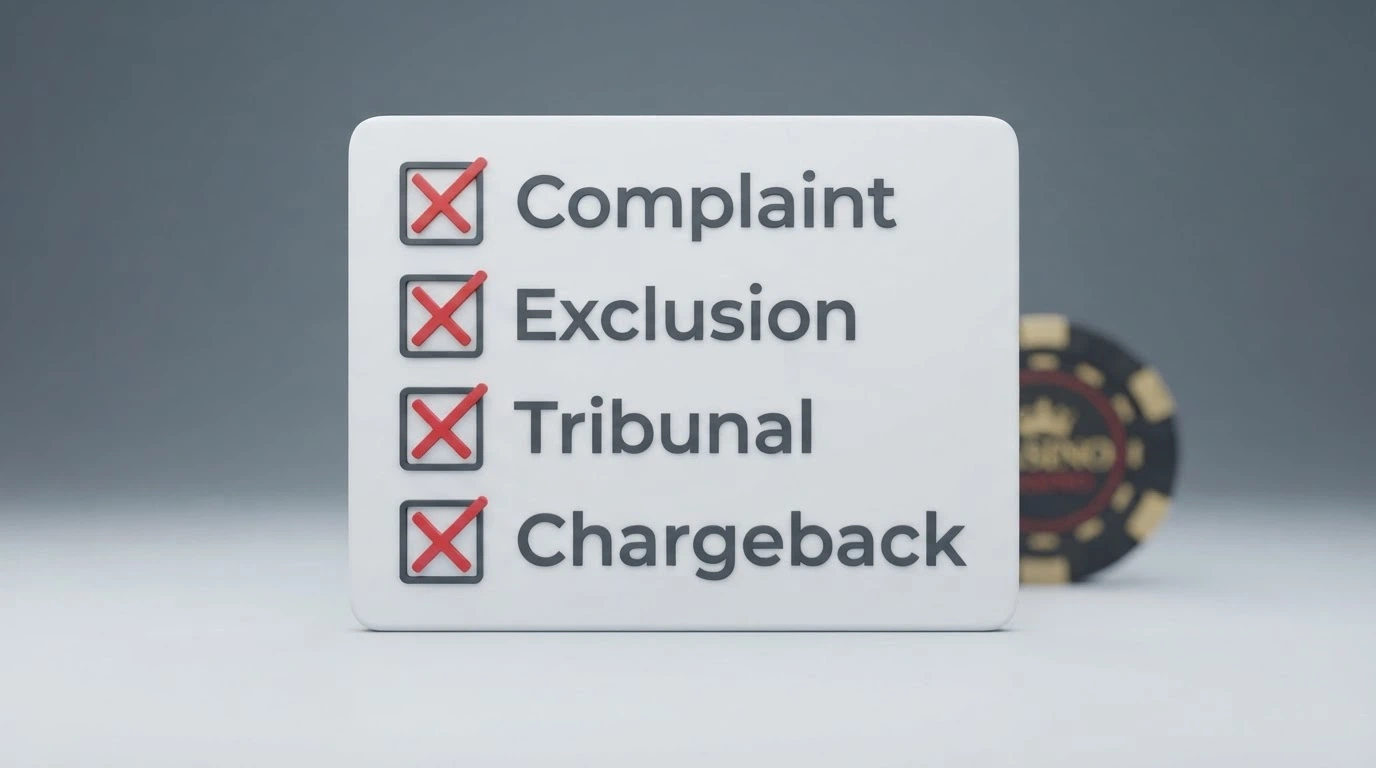
BetStop itself is the clearest marker of what the licensed frame provides. Since going live in August 2023, it has registered 67,480 Australians, with 41,290 exclusions active as of 31 July 2026. Seventy-eight per cent of registrants were under 40, and 38% chose lifetime exclusion. One registration excludes the player from every Australian-licensed online and phone wagering service. None of that reaches an offshore crypto casino. The self-excluded player who then opens an email-only account at an offshore site and deposits Bitcoin will not be flagged, will not be blocked and will not be contacted. The casino has no identity to match against the register.
The 2026 Reform Bill and What Changes on 1 January 2027
The Interactive Gambling Amendment (Gambling Reform) Bill 2026 was introduced to the House of Representatives on 2 July 2026 and passed Parliament on 19 August 2026. Its measures commence on 1 January 2027. None of the bill’s provisions reach offshore casinos directly — the prohibition that bans them predates the bill by 25 years — but the bill tightens the domestic frame around them and gives Australian authorities new tools to act.
| Measure | What It Does | Effective Date |
|---|---|---|
| Ad caps | Three wagering ads per hour max between 6:00 am and 8:30 pm; live-sport blackout from 15 min before to 5 min after live events | 1 January 2027 |
| Odds broadcast ban | Ban on broadcasting sporting odds on television and radio | 1 January 2027 |
| Endorsement ban | Athletes, celebrities and influencers barred from promoting wagering | 1 January 2027 |
| AdStop register | National wagering advertising opt-out register administered by the ACMA, funded by cost-recovery levy on operators | 1 January 2027 |
| Inducement marketing | Direct marketing of inducements prohibited 14 days post-sign-up, 3 months post-BetStop deregistration, indefinitely for at-risk customers | 1 January 2027 |
| Bank blocking authority | Banks and payment providers gain express authority to block transactions to illegal gambling operators | 1 January 2027 |
The bank-blocking authority is the provision most relevant to the offshore model. From 1 January 2027, the legal infrastructure exists for Australian banks to refuse to process payments to identified illegal operators — which closes another avenue the offshore model has relied on for the on-ramp and off-ramp. The offshore operators most resilient to this change will be the ones that never touch the Australian banking system at all: crypto-native, wallet-to-wallet, with no fiat on-ramp requiring a bank partner.
The Ten Offshore Brands Accepting Australian Deposits in 2026
The table below ranks the ten featured operators against the criteria that matter for an Australian player in 2026: licence jurisdiction, welcome bonus shape, KYC trigger and accepted cryptocurrencies. Every operator on this list holds an offshore licence — none holds an Australian one, because no Australian online casino licence exists. The honest gaps where research carries no confirmed figure are marked as such, and the operator write-ups that follow cover the operators with public data in full and the operators without it qualitatively.
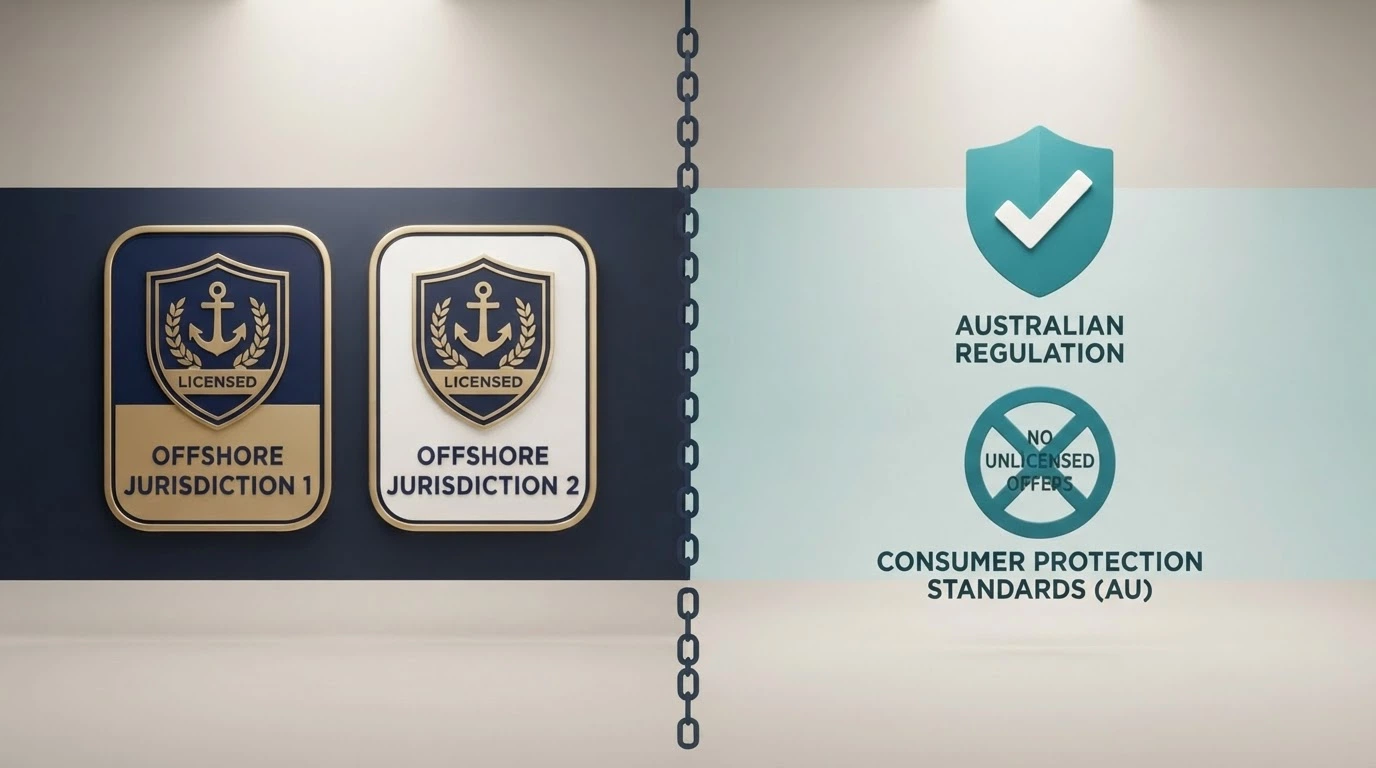
| Casino | Licence Jurisdiction | Welcome Bonus | KYC Trigger | Crypto Accepted |
|---|---|---|---|---|
| Stake | Curaçao | — (risk-based, no fixed public amount) | Risk-based, at operator discretion | BTC, ETH, LTC, USDT, DOGE, XRP + others |
| BitStarz | Curaçao | Up to A$10,000 + 180 FS (40× wagering), 30 no-deposit FS | Risk-based | BTC, ETH, LTC, USDT, DOGE + others |
| mBit | Curaçao (8048/JAZ) | Up to 4 BTC + 325 FS | ~US$5,000+ cumulative withdrawals | BTC, ETH, DOGE, LTC |
| Cloudbet | Curaçao (8048/JAZ) | — (not confirmed) | A$2,200/day withdrawals | BTC, ETH, LTC + 35+ others |
| Jack | Curaçao | 100 FS on A$50 (1× playthrough, A$100 max win); 5–30% wager-free rakeback | Risk-based | BTC, ETH, LTC, USDT, XRP + 15+ |
| Moonbet | Anjouan | 20–40% Moonrake rakeback + 4–8% Moonback cashback | Under A$2,000 cumulative withdrawals | 50+ cryptocurrencies |
| Vave | Curaçao | Up to 4 BTC across 4 deposits (150% up to 1.5 BTC + 100 FS first), 40 no-deposit FS | — (not confirmed) | BTC, ETH + others |
| Rocket Play | Offshore (jurisdiction not confirmed) | — | — | — |
| Skycrown | Offshore (jurisdiction not confirmed) | — | — | — |
| Royal Reels | Offshore (jurisdiction not confirmed) | — | — | — |
Across the set, only Moonbet publishes a no-KYC ceiling that is both concrete and accessible (A$2,000). Cloudbet publishes a concrete threshold but at a higher figure (A$2,200/day). The rest operate on either a risk-based approach with no published threshold, or on terms that were not refreshed this research round. The cryptocurrency breadth ranges from a handful of major coins to 50+ at Moonbet and 35+ at Cloudbet. The bonus shape ranges from a wager-free rakeback model at Jack and Moonbet to a four-deposit headline-figure package at BitStarz and Vave, and the wagering attached to those packages is where the real cost lives — covered in the bonus section below.
Stake — The Household Name With a Risk-Based KYC Stance
Stake’s position in this market is unusual because the brand sits on both sides of the regulatory line. Stake.com.au operates as a Northern Territory-licensed sports bookmaker for Australian customers — that product is wagering, not casino, and it falls inside the licensed frame. The .com casino is a separate Curaçao-licensed entity offering the products Australia prohibits: online casino games and online pokies. The two share a brand, and the brand’s recognition flows from the licensed sports-betting product, but the casino itself is offshore and unlicensed in Australia.
The casino runs a risk-based KYC approach with no fixed dollar threshold. Verification may be triggered on any withdrawal at the operator’s discretion — which means a player cannot plan around a published figure the way they can at Cloudbet or Moonbet. The game library includes titles from Pragmatic Play, Evolution, Hacksaw Gaming and BGaming, among others, and the crypto support covers BTC, ETH, LTC, USDT, DOGE and XRP, with additional tokens at the operator’s discretion. A fixed public welcome bonus amount was not confirmed this research round; the operator runs promotional offers that vary by market and timing rather than a standing welcome figure. For an Australian player specifically, the casino is a higher-friction KYC experience than Moonbet or Cloudbet, and a lower-friction one than licensed verification at a domestic bookmaker — which is the trade-off the offshore model delivers.
BitStarz — The Biggest Welcome Package, With the Longest Wagering Tail
BitStarz puts a A$10,000 figure on the welcome package — plus 180 free spins distributed 20 per day over nine consecutive days, and 30 no-deposit free spins on registration. The package is split across four deposits, with the first deposit a 100% match up to A$2,000 plus 180 free spins. The number is among the largest in the featured set. The wagering requirement attached to it is 40× — and at 40×, the A$10,000 package implies a turnover obligation of A$400,000 across the deposit sequence, with the per-deposit wagering scaled accordingly.
The wagering tail is where the headline stops being the deal. A 40× multiple on a A$2,000 first deposit means A$80,000 of turnover before a dollar of bonus-derived winnings becomes withdrawable, and the time-to-clear that turnover is the cost the player actually pays for the package — covered in detail in the bonus section below. The 30 no-deposit free spins are a separate, lower-commitment entry point: the player claims them without funding an account, plays through the spin value, and the winnings (if any) carry their own wagering requirement. The casino holds a Curaçao licence, runs a risk-based KYC approach, and lists 6,000+ games from Pragmatic Play, Evolution, NetEnt and BGaming, among others. The headline figure earns attention. The 40× multiple earns scepticism.
mBit — Email-Only Entry With a 5,000-Game Library
mBit is the closest the featured set comes to the marketing image of an anonymous crypto casino: an email address at registration, no document request until the threshold, and a catalogue large enough to feel like a full casino rather than a curated lobby. The welcome package is up to 4 BTC plus 325 free spins across deposits, and the casino holds a Curaçao licence (8048/JAZ).
The KYC trigger sits at approximately US$5,000 or more on cumulative withdrawals — high enough that a player running small and frequent cashouts stays below it, low enough that a single big win will trigger it. Withdrawal speed runs from 10 minutes to 3 hours depending on the coin, which is faster than Cloudbet and slower than Jack and Moonbet. The crypto support covers BTC, ETH, DOGE and LTC, with the catalogue at 5,000+ games. For a player prioritising the email-only entry point and a large game library over the fastest payouts, mBit is the structural fit. The bonus wagering terms were not confirmed this research round, which is the operator’s biggest information gap.
Cloudbet — Explicit KYC Thresholds and 35+ Cryptocurrencies
Cloudbet is one of the few operators in the featured set that publishes a concrete KYC threshold rather than running on operator discretion: A$2,200 per day for withdrawals, with photo ID and proof of address required above that figure. The threshold is high enough to allow regular play without triggering verification, and low enough to be predictable. It is the most transparent KYC policy in the set.
The trade-off is withdrawal speed. Cloudbet’s crypto payouts sit at roughly 24 hours — the slowest of the operators with confirmed figures, well behind Jack’s under-five-minute testing and Moonbet’s four-minute testing. The crypto support is the widest in the set alongside Moonbet, at 35+ cryptocurrencies, and the game library runs to 3,000+ titles across slots, live casino and sportsbook. A specific welcome bonus amount was not confirmed this research round. Cloudbet stands alone among this group for its operational transparency, making it the superior choice if predictable KYC triggers matter more to your planning than sub-five-minute withdrawal times.
Jack — Wager-Free Rakeback and Sub-Five-Minute Payouts
Jack (formerly Jackbit) flips the bonus model that the rest of the set runs on. Where BitStarz and Vave stack deposit-match packages with multi-digit wagering multiples, Jack runs a 5–30% rakeback with zero wagering — the rakeback is paid on losses and is withdrawable as cash, with no turnover obligation attached. The 100 welcome free spins come with a 1× playthrough on winnings and a A$100 maximum win cap, attached to a A$50 minimum deposit. The bonus terms are simpler than the multi-deposit package terms, and the wagering obligation attached to them is, in practical terms, almost nothing.
The payouts are the fastest of the featured set at under five minutes on tested crypto withdrawals, and the crypto support covers BTC, ETH, LTC, USDT, XRP and 15+ other tokens. The game library runs to 7,000+ titles plus a sportsbook spanning 140+ sport categories, 75,000+ pre-match events and 82,000+ live events, with 11 VIP ranks from Rookie to Legend and a A$40,000 weekly casino tournament. The casino holds a Curaçao licence. Jack’s wager-free approach effectively bypasses the turnover math that plagues its competitors, offering a transparent rebate model rather than the complex, high-turnover packages found elsewhere.
Moonbet — Anjouan-Licensed With a 10,000-Game Catalogue
Moonbet stands out from the Curaçao crowd by holding an Anjouan Gaming Authority licence rather than a Curaçao eGaming licence — a different regulator, with a different operating frame, though no more recognised by Australian authorities than Curaçao. The operator carries a 4.1/5 Trustpilot score, the only public reputation metric among the featured set, and lists 10,000+ games from 50+ studios including Evolution and Pragmatic Play. The game library is the largest in the set.
The KYC threshold is concrete at A$2,000 cumulative withdrawals — below that, no documents requested. The payouts run at approximately four minutes on tested crypto withdrawals, the fastest alongside Jack. The bonus model runs on Moonrake rakeback (20–40%) plus Moonback cashback (4–8%), both at 0× wagering — the wager-free structure Jack runs, with different percentages. Zero platform fees on transactions, no published withdrawal limits, 50+ cryptocurrencies accepted. Moonbet effectively combines the market’s largest game library with industry-leading payout speeds and a clear, low-barrier verification threshold.
Vave — No-Deposit Spins and a Four-Deposit Crypto Package
Vave opens with 40 no-deposit free spins — higher than BitStarz’s 30 — and scales to a welcome package of up to 4 BTC across four deposits, with the first deposit a 150% match up to 1.5 BTC plus 100 free spins. The minimum deposit to trigger the package is 20 USDT or equivalent. The casino holds a Curaçao licence, and the wagering terms vary by bonus and are viewable in the “Info” tab on each bonus card.
The KYC threshold was not confirmed this research round, and the game provider list was not detailed. The structural profile is similar to BitStarz — a multi-deposit headline package, no-deposit free spins on registration, Curaçao licence, crypto-first deposit rails — but with a larger no-deposit spin offering and a slightly different deposit-match curve. The comparison with BitStarz ultimately hinges on your bonus preference: Vave offers a more aggressive no-deposit free spin package, while the match-deposit structure provides the necessary scale for high-volume play.
Rocket Play — A Top-10 Australian Pick With Limited Public Detail
Rocket Play is an offshore, unlicensed casino with an established Australian audience, ranking among the top Australian-facing brands by market share. The bonus structure, the KYC threshold and the game-provider details were not refreshed this research round — the operator’s public-facing specifications are not in the figures the inputs carry, and a write-up that invented them would publish figures no later phase could verify.
What is verifiable is the offshore status, the absence of an Australian licence (because no Australian online casino licence exists), and the brand’s Australian market position. For a player who already knows Rocket Play from search results and is comparing it to the rest of this list, the comparison is straightforward: the operator runs on the same offshore model as every other entry here, with no Australian consumer protection, no BetStop coverage and no Australian complaints body. The bonus terms and KYC threshold would need to be confirmed directly with the operator before depositing.
Skycrown — Strong AU Market Share, Thin Public Bonus Detail
Skycrown carries an established Australian audience by market share, and runs on the same offshore, unlicensed model as every operator on this list. The bonus structure, KYC threshold and game-provider details were not refreshed this research round. The write-up that omits them is the honest one; the write-up that invents them is the unreliable one.
For an Australian player, Skycrown’s profile matches the rest of the set: offshore licence, no Australian licence, no Australian consumer protection, no BetStop coverage. The comparison to the rest of the list is structural rather than numerical, because the numbers were not refreshed. The operator is included in the ranking because it is accessed by Australian players; the ranking position reflects the absence of confirmed specifications rather than any judgement about the operator’s product.
Royal Reels — An Australian Brand Name on an Offshore Product
Royal Reels carries an Australian-facing brand name and is an offshore, unlicensed casino, like every other operator on this list. The brand name is a marketing signal, not a regulatory signal — no Australian online casino licence exists to confer. The bonus structure, KYC threshold and game-provider details were not refreshed this research round.
The structural profile matches the rest of the set: offshore jurisdiction, no Australian licence, no Australian consumer protection, no BetStop coverage. For a player weighing Royal Reels against the rest of this list, the comparison is the same as for Skycrown and Rocket Play: the offshore model is shared, and the specifications that would differentiate the operator from its peers were not confirmed. The ranking position is based on inclusion in the Australian-accessible operator set, not on any judgement about the operator’s product specifics.
Why Your 2026 Crypto Casino Bonus Is Smaller Than It Looks
Welcome bonuses at anonymous crypto casinos advertise big numbers — up to A$10,000 at BitStarz, up to 4 BTC at mBit and Vave — but the wagering requirement attached to the bonus is the real cost driver, and the headline figure is the marketing layer above it. A 40× wagering requirement on a A$2,000 first-deposit match means turning over forty times the deposit before a dollar of bonus-derived winnings becomes withdrawable. The bonus is not free money. It is a turnover obligation priced at the deposit amount, and the time it takes to clear that obligation is what the player is actually paying for the package.
Across the featured set, three bonus shapes dominate. The no-deposit free spin is the lowest-commitment entry — BitStarz offers 30, Vave offers 40, both with no funding required up front, and the winnings carry their own wagering terms. The deposit-match welcome package is the volume play — BitStarz, mBit and Vave all run multi-deposit structures with headline figures in the A$10,000 or 4 BTC range and wagering multiples between 35× and 40×. The rakeback and cashback model is the ongoing structure — Jack’s 5–30% rakeback and Moonbet’s 20–40% rakeback both carry 0× wagering, which makes them the only bonus structures in the set that pay withdrawable cash with no turnover attached.
The wager-free offers are the lowest-risk bonus type at any anonymous crypto casino. A rakeback paid at 0× wagering is a cash rebate on losses, withdrawable on receipt. A free spin with 1× playthrough and a hard maximum win cap (Jack’s A$100) is a small, bounded upside with a bounded cost. A 40× wagering deposit match is a large upside with a cost that scales linearly with the deposit, and the cost is measured in hours of play at a stated stake per spin. The player who picks the bonus on headline size alone is paying for the package in hours; the player who picks it on the wagering multiple is paying for it on terms closer to the marketing.
No-Deposit Spins, Match Bonuses and Rakeback: The Three Bonus Shapes at Crypto Casinos
- No-deposit free spins — BitStarz’s 30 and Vave’s 40 are the headline figures. The player claims the spins without funding the account, plays them at a fixed coin value, and any winnings carry their own wagering terms (BitStarz at 40×, Vave’s not confirmed this round). The risk to the player is zero in dollar terms; the upside is bounded by the spin count and the wagering attached to whatever is won.
- Deposit-match welcome packages — BitStarz up to A$10,000 across four deposits with 40× wagering, mBit up to 4 BTC + 325 free spins, Vave up to 4 BTC across four deposits with 150% on the first. The first deposit at BitStarz is a 100% match up to A$2,000; at Vave it is a 150% match up to 1.5 BTC. The risk to the player is the deposit itself plus the turnover obligation; the upside is the bonus amount, scaled by the wagering multiple.
- Rakeback and cashback — Jack’s 5–30% rakeback at 0× wagering, Moonbet’s 20–40% Moonrake rakeback plus 4–8% Moonback cashback, also at 0×. The structure pays a percentage of losses back to the player as withdrawable cash, with no turnover attached. The risk to the player is the loss itself; the upside is the rebate.
Each shape has a different minimum deposit to trigger it. BitStarz’s package is funded across four deposits at varying thresholds; Vave’s package is triggered at 20 USDT or equivalent; Jack’s free spins require a A$50 minimum deposit. The rakeback and cashback at Jack and Moonbet are ongoing rather than welcome-gated, which is the structural reason they appear alongside one-off welcome packages in the same ranking.
How Wagering Requirements Eat the Offer
A 40× wagering requirement on a A$2,000 first-deposit bonus means A$80,000 of turnover before any bonus-derived winnings become withdrawable. The number is the contract, and it is the gap between the headline and the deal. At a A$1 stake per spin and a 5-second interval between spins, A$80,000 of turnover is 80,000 spins, which is 400,000 seconds of play, which is roughly 111 hours. That is the time cost of clearing the first-deposit bonus at BitStarz alone — and the welcome package is four deposits, not one, so the cumulative time across the package is several times that figure, scaled by the wagering attached to each deposit.
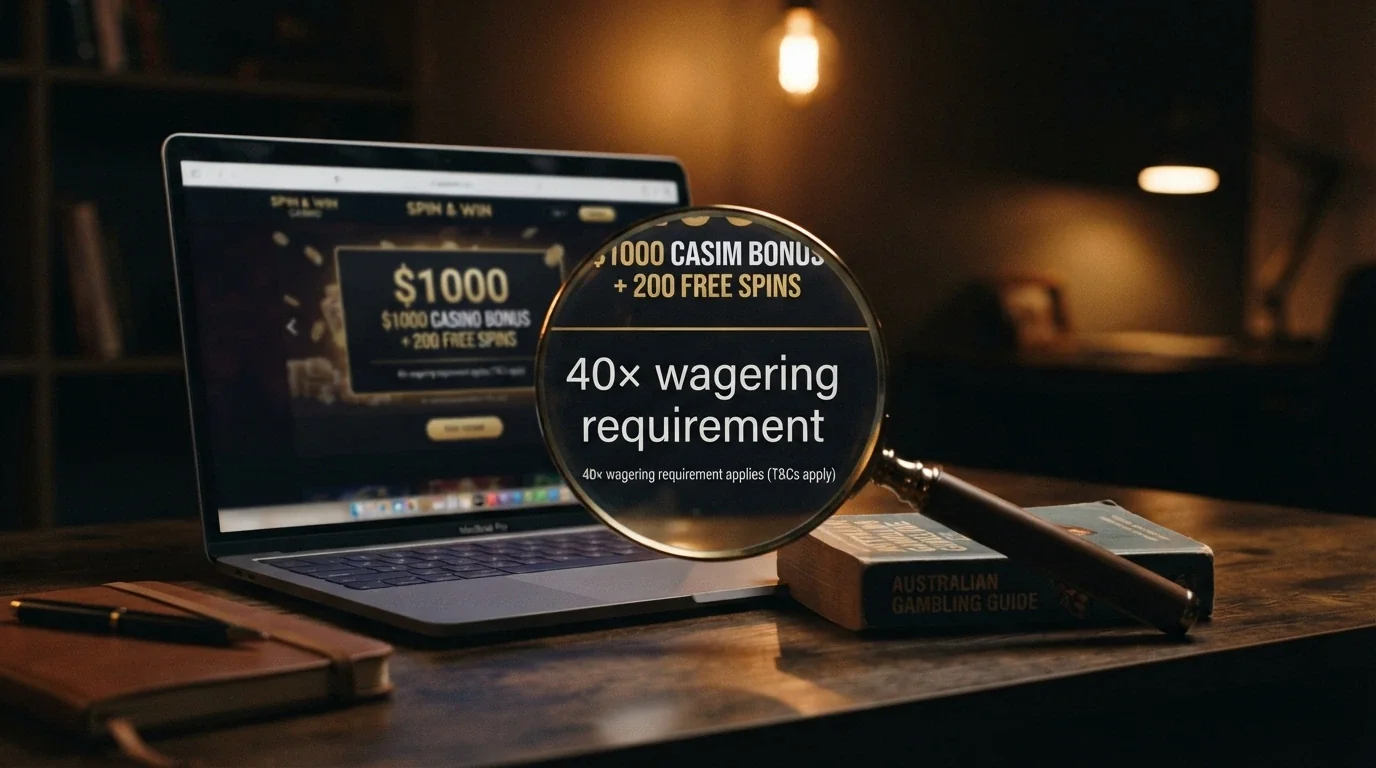
The arithmetic is mechanical. It is also why the wagering multiple is the most important number on a bonus page, ahead of the headline. A bonus of A$2,000 at 40× carries a turnover obligation 40 times the bonus amount. A bonus of A$100 at 0× carries no turnover obligation at all. The two are not comparable on the headline figure; they are comparable on the total cost of clearing, and the cost is hours of play measured against the player’s own stake and the operator’s spin interval. The casino makes its margin on the difference between the bonus amount and the expected loss during the clearing play, and the wagering multiple is the dial that sets that margin.
What Anonymity Costs You at the Bonus Stage
A bonus dispute at a licensed Australian bookmaker can be escalated to a state tribunal, to the bookmaker’s internal complaints body, or to the ACMA in serious cases. A bonus dispute at an offshore crypto casino cannot be escalated to any Australian body, because no Australian body has jurisdiction over an offshore operator and no Australian consumer protection framework covers an unlicensed product. The operator’s terms are the contract, and the operator’s interpretation of the terms is final. A casino that refuses to pay a bonus win, voids a bonus for a term breach the player did not see, or closes the account over a bonus dispute leaves the player with no Australian recourse, no complaints body and no recovery mechanism.
The wager-free offers narrow this gap without closing it. Jack’s rakeback at 0× wagering and Moonbet’s rakeback and cashback at 0× both pay cash that is withdrawable on receipt — there is no bonus-derived win sitting in a turnover-pending state for the operator to dispute later. A A$100 maximum win cap on Jack’s free spins is a hard ceiling the player agrees to up front, which means there is no ambiguity to dispute at cashout. The bonus terms at the high-wagering end of the set — BitStarz, Vave — leave more room for the operator’s discretion to bite at cashout, and that is the structural cost of the headline figure.
Responsible Gambling When Nobody Knows Who You Are
Australia has one of the most developed harm-minimisation infrastructures in gambling — and none of it reaches an offshore crypto casino, because the operator never verified the player’s identity in the first place. The National Gambling Helpline (1800 858 858) is free, confidential and staffed 24 hours a day, with online chat and counselling through Gambling Help Online. BetStop — the National Self-Exclusion Register — excludes a player from every Australian-licensed wagering service with one registration. The Australian Institute of Health and Welfare tracks problem gambling prevalence at 2.1% of adults, roughly 430,000 people, with high-risk gambling at 1.8%.
None of that infrastructure operates at an anonymous offshore casino. The casino has no name to match against the BetStop register. The casino has no identity to flag against at-risk-player indicators. The casino has no obligation to offer deposit limits, activity statements or self-exclusion tools, and most do not. The anonymity that the marketing sells as a feature for the player is, from a harm-minimisation standpoint, a hole where every identity-based protection would otherwise sit. A self-excluded Australian who opens an email-only account at an offshore crypto casino and deposits Bitcoin will not be detected, will not be contacted, and will not be blocked by any system Australia has built.
Australia’s Help Infrastructure and the BetStop Blind Spot
The National Gambling Helpline (1800 858 858) is the front line of Australia’s help infrastructure for problem gambling — free, confidential, 24/7, with online counselling at Gambling Help Online. The counsellors who staff it are trained for the licensed-operator context: they can advise on self-exclusion, on state-based complaints processes, on deposit limits offered by licensed bookmakers, and on the practical mechanics of stopping.

BetStop is the structural tool the counsellors point self-excluding players toward. Since going live in August 2023, it has registered 67,480 Australians, with 41,290 exclusions active as of 31 July 2026. Seventy-eight per cent of registrants are under 40, and 38% chose lifetime exclusion — a signal that the people using the register are the people most exposed to the harms the register was built to address. One registration excludes the player from every Australian-licensed online and phone wagering service. The mechanism is identification at the operator level: a licensed bookmaker checks every login and every deposit against the register and refuses service if there is a match.
The blind spot is the offshore casino. The operator is not licensed in Australia, is not connected to the register, and will continue accepting a self-excluded person’s deposits without flagging or refusing. The helpline counsellor can register the player on BetStop, but the registration only reaches the licensed frame. A player who wants the offshore casino to stop accepting their deposits has no Australian mechanism to make that happen — the casino would need to be asked directly, and it has no obligation to comply.
The Prevalence Problem: Why Anonymity Shields At-Risk Players
Australians lose around A$32 billion on legal gambling every year — the heaviest per-person losses of any country on earth, by some margin. The Australian Institute of Health and Welfare puts problem gambling prevalence at 2.1% of adults, roughly 430,000 people, with high-risk gambling at a further 1.8%. These are the licensed-market figures, captured through surveys and operator reporting in a regulatory frame that records identity. The offshore market is not measured with the same rigour, and the prevalence of harm within it is not visible to any Australian authority.
The structural problem for harm minimisation at an anonymous crypto casino is that every identity-based tool fails. There is no deposit limit by default, because there is no account to attach a limit to. There is no activity statement, because there is no player identity to issue one to. There is no at-risk-player intervention, because there is no player history to monitor. The casino has no way to identify the player who needs help, and no obligation to try. The anonymity that the marketing sells as a player benefit is, for the player who needs protection most, the absence of every protection available.
How We Selected and Ranked These Casinos
The ten operators in this ranking were drawn from a shortlist of brands active in the Australian market, cross-referenced against search results for crypto-friendly, no-KYC platforms accessed by Australian players. The criteria that ordered the ranking were the KYC threshold clarity (a published threshold ranks above an unpublished risk-based approach), the bonus weight (where research carries the figures), the breadth of cryptocurrency support and the confirmed withdrawal speed. Every operator on the list is offshore and unlicensed in Australia, because no Australian online casino licence exists — the ranking order does not change that fact, it ranks operators within it.
The honest gaps are marked as such. Operators 8 to 10 — Rocket Play, Skycrown, Royal Reels — are included because they have an established Australian audience, but their bonus structure, KYC threshold and game-provider details were not refreshed in the research round that informed this page. Those entries cover what is verifiable — the offshore status, the absence of an Australian licence, the structural profile — and stop where the verifiable figures stop. No weightings or numerical scores are claimed. The ranking is qualitative, and the gaps are part of what the ranking shows.
Playing Offshore With Your Eyes Open
This page has measured what an anonymous crypto casino delivers to an Australian player in 2026: the no-KYC promise and where it ends, the bonus structure and what the wagering requirement costs, the offshore status and the regulatory frame around it, the consumer protections the player gives up and the help infrastructure that does not reach the offshore operator. The decision framework is the same for every player approaching this market: know the prohibition, know the KYC trigger, know the bonus cost, know the recourse gap.
The IGA does not prosecute the player — the Act targets the provider, not the person using the service. That is the one protection the player keeps. What the player gives up is every other protection: no BetStop coverage, no Australian complaints body, no recourse on a refused withdrawal, no activity statement, no deposit limit, no ACMA recovery, no assurance that the site will be reachable tomorrow if it is blocked today. The licensed alternative for wagering — Australian-licensed bookmakers under state and territory conditions — is the only route that delivers BetStop coverage and Australian consumer protection, and it is the only route that does not require crypto at all.
The concrete steps a player who proceeds anyway can take to limit harm are: set a personal deposit limit before the first deposit, and stick to it; choose the wager-free bonus structures (Jack’s rakeback, Moonbet’s rakeback and cashback) over the high-wagering headline packages; read the KYC trigger before the first deposit, not at the moment of a large withdrawal; keep the bankroll to an amount the loss of which would not affect the player’s life; and contact the National Gambling Helpline (1800 858 858) or Gambling Help Online if the play stops feeling like a choice. Anonymity at an offshore crypto casino is a trade-off the page has measured. The reader decides whether to make it.
Frequently Asked Questions
Are anonymous crypto casinos legal in Australia?
No. Online casino, online pokies and in-play betting are prohibited services under the Interactive Gambling Act 2001, and no Australian online casino licence exists. Every operator accessible from Australia in 2026 is offshore and unlicensed locally. The IGA targets the provider, not the player — individual users are not prosecuted — but the product itself is illegal to provide to anyone in Australia, and ACMA enforces through ISP-level DNS blocking.
What does “no KYC” actually mean at a crypto casino, and when will I be asked for ID?
“No KYC” at an anonymous crypto casino means email-only registration, with identity verification deferred to a withdrawal threshold. The thresholds vary by operator. Cloudbet publishes A$2,200 per day for withdrawals. mBit triggers verification on cumulative withdrawals of roughly US$5,000 or more. Moonbet sets the ceiling at A$2,000 cumulative. Other operators run on a risk-based approach with no fixed threshold at all. Above the threshold — published or operator-defined — the casino asks for photo ID, proof of address and occasionally source-of-funds documentation.
What happens if an offshore crypto casino refuses my withdrawal or closes my account?
There is no Australian recourse. The ACMA cannot recover money for individual players. There is no Australian complaints body with jurisdiction over an offshore operator. The site’s terms are the contract, and the operator’s interpretation is final. The site can also be DNS-blocked at any time, with any balance still on it becoming inaccessible. This is the structural risk of the offshore model: the anonymity that lets the player in also keeps the regulator out.
Does BetStop cover anonymous crypto casinos?
No. BetStop binds only Australian-licensed wagering services. An offshore crypto casino is not licensed in Australia, is not connected to the register, and will continue accepting a self-excluded person’s deposits without flagging or refusal. The self-exclusion that protects a player from every Australian-licensed bookmaker does not reach the offshore operator, and the only mechanism that does is asking the operator directly, which the operator has no obligation to honour.
What is the fastest cryptocurrency for casino deposits and withdrawals?
Solana is the fastest in 2026, with most withdrawals landing in under five minutes. Litecoin and USDT on the TRC-20 network typically settle under ten minutes. Bitcoin takes 30 to 60 minutes due to block confirmation times. The coin the player chooses for withdrawal is the single biggest speed lever the player controls, and Bitcoin — the brand-name crypto on every banner — is the slowest common option.
Can the Australian government block me from accessing an offshore crypto casino?
The ACMA can direct Australian ISPs to block illegal gambling websites at the DNS level, and has done so for 1,788 sites since November 2019, with 133 added in the October-to-December 2025 quarter alone. The blocking is effective for most Australian internet connections but is not presented as unbeatable. The site can also be blocked with a balance still on it, which is a risk for any player holding funds at the time of a blocking order.
Written by the editors at Instant Withdrawal Casinos AU.