
Free spins on Australian online pokies — the real cost behind the offer
The free-spin pitch is built to skip the arithmetic. Fifty spins on the house. Sign up and the reels are already turning. Every Australian punter who has spent any time in the market knows the shape of the offer, and most have at least once claimed one. What the headline glides past — the wagering multiple, the cashout cap, the expiry window, the single pokie the spins are locked to — is what the rest of this page is about. The maths is unflattering. The legal position is unforgiving. The honest summary, after working through both, is that no-deposit free spins are entertainment with a small chance of a fifty-to-two-hundred-dollar payout after conditions, not a route to reliable income.
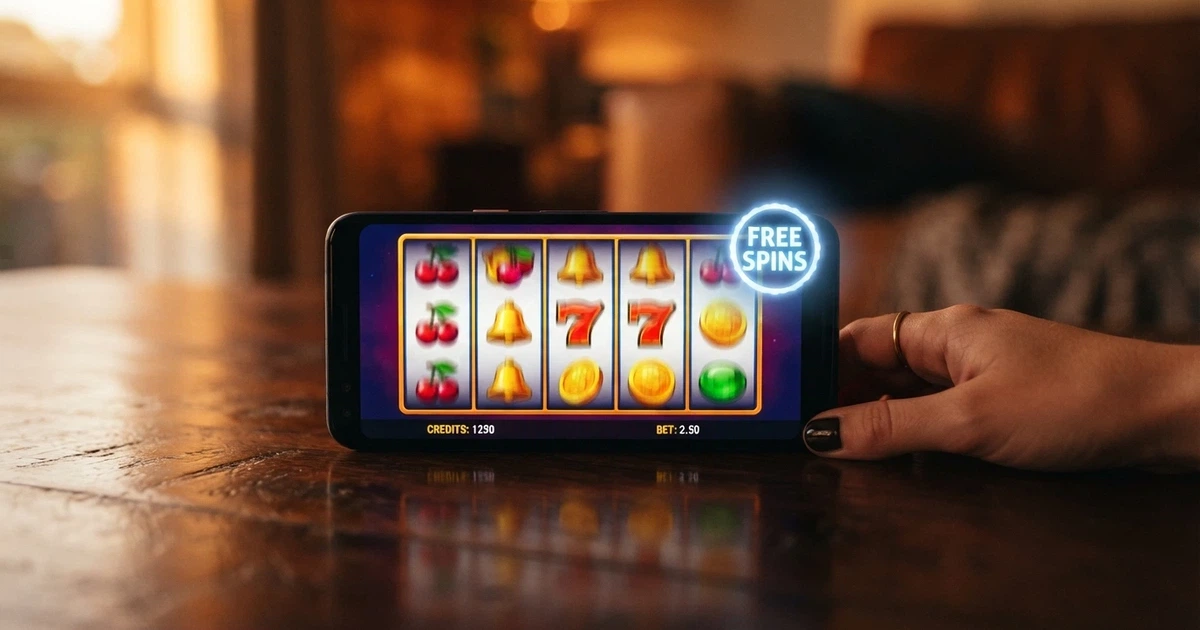
Verified as of 16 October 2026 against the ACMA register and current operator terms pages.
Table of Contents
- What free spins on online pokies actually mean for Aussie players
- No-deposit free spins on pokies — what you actually get without spending a cent
- The online pokies sites Australians actually use for free spins — ranked
- Free-play pokies — demo mode with free spins, no account needed
- Where free-spins pokies sit under Australian law — the offshore reality
- Free-spin bonuses beyond no deposit — how the numbers stack up
- Responsible gambling — the safety net every free-spins player needs
- How we chose and ranked these pokies sites
- No-deposit free spins in Australia — are they worth your time?
- Frequently asked questions
What free spins on online pokies actually mean for Aussie players
A free spin is a single turn of a pokie’s reels that the casino pays for instead of the player. In practice the punter opens an account, the casino credits a fixed number of spins — usually ten, twenty or fifty — at a fixed per-spin value (typically AU$0.10 to AU$0.50), and any win from those spins lands in a bonus balance that is subject to the offer’s terms. Nothing comes off the player’s debit card. Nothing is risked. That is the pitch. It is also where the arithmetic starts. A fifty-spin offer at AU$0.20 a spin carries a starting value of AU$10, but that AU$10 is not the player’s money and it is rarely withdrawable on its own. It is a stake, dressed up as a gift, on which the casino has placed terms that almost always mean more turnover than the win can survive.
Australian players chase these offers for the obvious reason. The headline is “free”, and a free attempt at a real-money pokie — one that could, in theory, pay out a few hundred dollars — sits in a different category from a fifty-dollar deposit that you might also lose. There is a version of the offer for almost every type of punter: a no-deposit bonus that costs nothing to claim, a deposit-match package that doubles the first bankroll, and a sign-up bundle that ties spins to the act of registering rather than paying. Each type has its own arithmetic, its own ceiling, and its own disappointment built into the small print. What unifies them is that the casino sets the terms, and the player reads them only if something has already gone wrong.
Why your “free” pokies spins come with a price tag
The word “free” survives because no cash leaves the player’s wallet at the point of claiming. It does not survive the terms page. Three terms do almost all of the work in turning a free-spin win into something the casino keeps. The first is wagering, a multiplier applied to the winnings that sets how much must be turned over before any withdrawal is allowed. The second is the maximum cashout, a hard ceiling on how much of the bonus balance can ever be withdrawn. The third is the expiry, which is short enough that the player either plays through the wagering fast or loses the balance entirely. Across AU-facing no-deposit free-spin offers in 2026, wagering requirements run from 30× to 60× on winnings — anything below 40× is regarded as generous, 40× to 50× is the standard band, and anything above 60× is the kind of multiple that takes the offer out of the “entertainment” category and into something closer to a fee for using the casino’s software. Maximum cashout caps sit between AU$50 and AU$200. Expiry runs from as little as 24 hours to use the spins themselves, with a separate 7-to-14-day window to clear the wagering. The gap between what the headline says you have won and what the player can actually withdraw is, in most cases, the offer.
No-deposit, deposit-match and sign-up spins — three different animals
The phrase “free spins” covers three distinct products, and an Australian punter comparing offers needs to know which is which. A no-deposit free spin costs nothing to claim — the spins are credited on registration, before any deposit, and the only commitment is opening an account. A deposit-match free spin is unlocked by funding the account first; the spins are part of a welcome package that ties bonus credits to a real-money deposit. A sign-up free spin is the ambiguous one: the term gets used for both no-deposit offers and for first-deposit bundles, and an operator’s “free spins on sign up” can mean either, depending on the small print. The distinction matters because the arithmetic differs. Across AU-facing casinos in 2026, free-spin offers range from 10 to 250 spins, with average wagering around 35× to 40×, a common deposit trigger of AU$10 to AU$30, and a common cashout cap of AU$50 to AU$200. Popular providers running the underlying pokies include Pragmatic Play, NetEnt and BGaming.
No-deposit spins are almost always tied to a single nominated pokie — the player does not pick the game, the casino does, and that restriction sits quietly in the terms. Deposit-match spins usually name a pokie as well, but the rest of the welcome package (the match bonus, the additional spins on the second or third deposit) lets the player move around the lobby once the wagering begins. Sign-up spins are functionally a no-deposit offer if the spins are credited on registration, and a deposit-match offer if the spins unlock only after the first deposit clears. Reading the terms page resolves the question in about thirty seconds. Skipping the terms page is how players find themselves surprised by a “free” win that has already evaporated.
Free spins on sign up — what that actually means for your first session
The sign-up free-spins mechanic is built around the moment of registration. The player fills in a form, verifies an email or phone number, and the spins are credited — either automatically or via a button in the cashier — ready to be played on the nominated pokie. The terms that govern what happens next are unusually tight because the casino is giving away something for nothing and wants the play to happen fast. Spins often come with a 24-hour window to use; the wagering, when applied to whatever the spins win, typically runs for a separate 7-to-14 days. The first session is therefore the one that matters. A punter who registers, walks away, and comes back two days later may find the spins gone and only a stale bonus balance remaining. A punter who registers at 11pm on a work night and runs out of evening may find the same thing.
Cross-device staleness is a real and underappreciated hazard. A sign-up offer that was activated on a desktop browser does not always survive a switch to a mobile session — the bonus balance may not appear in the app, the spins may need to be re-triggered, and the clock on the expiry keeps ticking either way. The cleanest workflow is to register on the device the player intends to play on, use the spins the same evening, and only then begin the wagering on the bonus balance. BitStarz’s 50 free spins no deposit on registration is a representative example: 40× wagering, 7-day validity, AU$100 max cashout. Bizzo’s 20 free spins no deposit on Lady Wolf Moon MEGAWAYS is the same shape in miniature — fewer spins, the same kind of tight window. The pattern across both is that the sign-up bonus is a same-day product. The casino is not in the business of holding the bonus open while the player gets around to it.
PayID, cards and crypto — how you actually move money on a pokies site
For an Australian punter funding an account at an offshore casino, the legal deposit routes have shrunk in 2026. PayID and Osko are the fastest — instant transfers from an Australian bank account using a phone number or ABN as the identifier, with the funds clearing in seconds and no fee on either side. Debit cards still work for most operators. POLi, the once-popular Australian direct-debit service, was decommissioned on 30 September 2023, and the deposit-page options that used to list it now point elsewhere. That is the legal side of the picture. The illegal side is what was banned on 11 June 2024: credit cards, credit-related products and digital currency (crypto) are all prohibited as payment for online wagering in Australia. An AU player using a credit card at an offshore pokies site is not just breaching the casino’s terms — they are using a payment method the law has closed off.
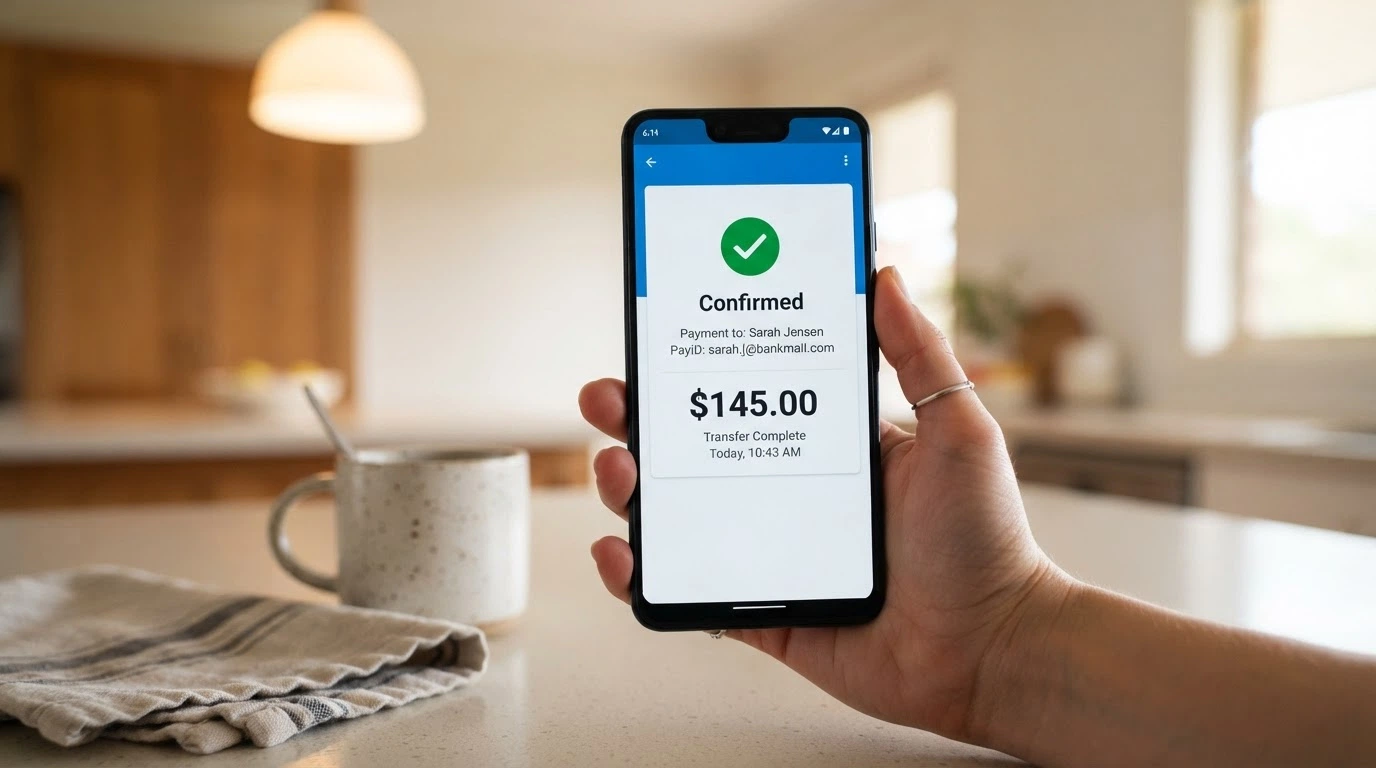
The next change is also a tightening. From 1 January 2027, banks and payment providers in Australia gain express authority to block transactions to illegal gambling operators. The transaction may simply not go through; the player’s bank may decline it without explanation. For a punter using an offshore casino in 2026, the practical effect is that the payment routes that still work may not work for much longer — PayID through a major bank, a debit card from a lender with conservative gambling-block policies, a transfer from a building society that has not yet implemented transaction screening. Crypto is banned and has been for nearly two years. The deposit page at the offshore casino may offer it; the Australian law does not. The page lists what the casino accepts. The law decides what the player can actually use.
No-deposit free spins on pokies — what you actually get without spending a cent
A no-deposit free-spin offer is the cleanest product in this market — there is no first deposit, no matched-funding, no upsell. The casino credits the spins on registration, the punter plays them, and any win lands in a bonus balance subject to terms. Across the AU-facing market in 2026, these offers typically run from 10 to 250 free spins, with average wagering around 35× to 40×, common maximum cashout caps of AU$50 to AU$200, and the underlying pokies almost always coming from a short list of providers — Pragmatic Play, NetEnt and BGaming are the names that recur.
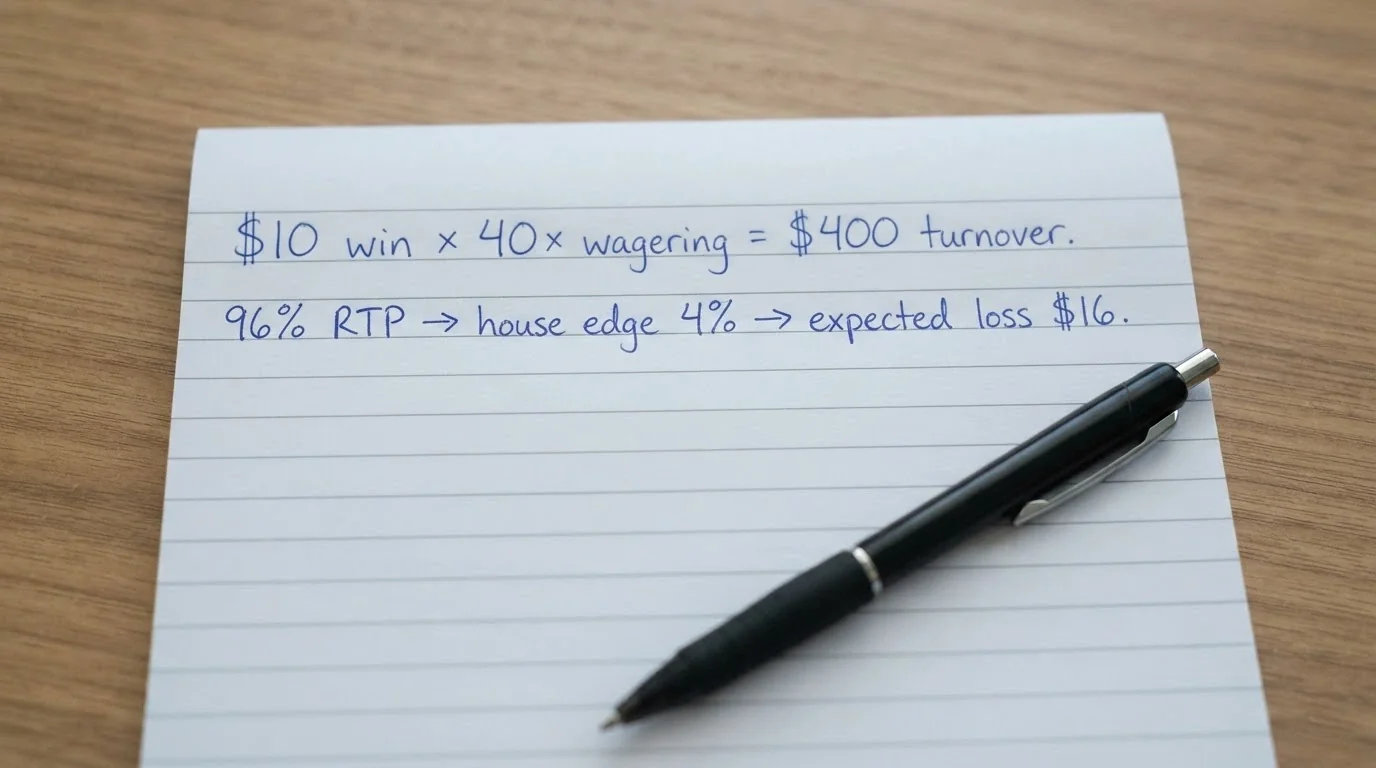
The arithmetic is where the offer stops being generous. Take a representative case: a 50-spin no-deposit offer at AU$0.20 per spin. The starting value sits at AU$10. The wagering requirement, at the standard 40× on winnings, means that AU$10 must be turned over forty times — producing AU$400 in required turnover before any withdrawal is allowed. At a 96% return-to-player — the long-run rate a typical modern pokie pays back — the house keeps 4% of turnover. Four percent of AU$400 is AU$16. That AU$16 is the expected loss during the wagering itself, and it is more than the AU$10 the spins ever produced. The “free” win is, statistically, already gone before the player sees a withdrawal screen — and that is at a friendly 40× multiple with a friendly 96% RTP. A 60× multiple on a 94% pokie lifts the expected loss to AU$14 on AU$400 turnover and shortens the cashout ceiling further.
The honest reading of a no-deposit offer, after the maths, is that it is a sample of the casino’s software paid for in expected loss. The player trades the chance of a small payout for the experience of a few hundred real-money spins. Some players will clear the wagering and walk away with AU$50 or AU$100. Most will not. The casino knows which group is which, and the offer is priced accordingly.
The no-deposit bonus wrapper vs stand-alone free spins — what you are actually claiming
Not every “no-deposit” offer is free spins. The same mechanic is sometimes wrapped around a small cash credit instead, and the two pay out differently. A pure free-spins NDB credits the spins on a nominated pokie, the win lands in a bonus balance, and the player wagers through that balance at the offer’s multiple. A cash-chip NDB credits a small amount — AU$10 is typical — directly to the bonus balance, and the player chooses which eligible pokie to play. A bonus-code-gated NDB is the same offer, but requires a code at the cashier or registration step to unlock. Royal Reels’ AUD 10 no-deposit bonus for new sign-ups is the cash-chip version: 30× to 40× wagering, 7-to-14-day validity, AU$200 max cashout. The cash-chip pays out the same way the free-spins win does — through the wagering and the cashout cap — but the player picks the pokie, which means the RTP and the volatility are a player choice rather than a casino instruction.
The structural difference matters because it changes what the player can control. With a free-spins NDB the volatility is whatever the nominated pokie is — Gates of Olympus on a 50-spin offer is a high-volatility ride whether the player wants one or not. With a cash-chip NDB the player can pick a low-volatility pokie and grind through the wagering, or pick a high-volatility one and chase. Either way the wagering and the cashout cap are the same. The game is just the surface.
25 free spins or 100 — why the spin count is only half the story
Spin count is what the marketing leads with. It is also the half of the offer that matters least. A fifty-spin offer at AU$0.20 per spin carries an AU$10 starting value. A twenty-five-spin offer at AU$0.50 per spin carries AU$12.50. A hundred-spin offer at AU$0.10 per spin carries AU$10. Three different pitches, three different headline counts, and a starting-value spread of only twenty-five percent. The player who chooses between them on count alone is choosing between offers that are essentially the same size, with the only difference being which pokie each one is locked to and which wagering multiplier applies.
The variance in spin value across AU-facing offers is wide enough that the count tier is a poor proxy for the offer’s worth. Per-spin values of AU$0.10, AU$0.20, AU$0.50 and AU$1.00 all appear in the market, sometimes within the same operator’s rotating promotions. The same fifty spins could be worth AU$5 or AU$50 depending on the value the casino has chosen to apply. The punter reading the headline “50 free spins” without looking at the value is, at best, reading half the offer.
Wagering requirements on no-deposit spins — the 30× to 60× hurdle that decides what you keep
Wagering is the multiplier that decides what leaves the casino and what stays. The mechanic is straightforward: the bonus balance (the winnings from the free spins, or the cash chip, depending on the offer) must be turned over a fixed number of times before any withdrawal is permitted. A 40× multiple on an AU$10 win means AU$400 in turnover. The player bets, the reels resolve, the balance goes up or down, and after AU$400 of bets the wagering clears and the remaining balance becomes withdrawable — subject to the cashout cap. The standard AU-facing band in 2026 runs from 30× to 60× on winnings, with anything below 40× considered excellent, 40× to 50× the norm, and above 60× the kind of multiple that prices most players out of the offer before they begin.
Casinos set the multiple where they do because the math works in their favour. At 96% RTP, the expected loss on AU$400 of turnover is AU$16 — a figure that already exceeds the AU$10 starting value of a typical fifty-spin offer. The casino does not need the player to fail; it needs the player to keep playing long enough for the house edge to compound. A 30× multiple on AU$10 is AU$300 in turnover, with an expected loss of AU$12. A 60× multiple is AU$600, with an expected loss of AU$24. The arithmetic is the same on both sides — it is the volume that changes. A lower multiple gives the player a shorter path to withdrawal; a higher one gives the casino more turnover from the same starting value. The industry has settled on 40× because that is where the balance between “the player feels they had a chance” and “the casino makes its expected return” lines up.
Cashout caps — why your $200 win on free spins might really be $50
The maximum cashout is the ceiling on what the player can ever withdraw from a no-deposit offer, regardless of how much the wagering produces. The cap is applied at withdrawal, not during play: the bonus balance can climb above the cap during wagering, but only the capped amount becomes withdrawable. Anything above the cap is forfeited at the cash-out screen. The standard AU-facing band in 2026 runs from AU$50 to AU$200, with most offers sitting at AU$100. Fair Go’s 77 free spins on Plentiful Treasure, for instance, carries an AU$180 cap. BitStarz’s 50 free spins carries an AU$100 cap. Royal Reels’ AUD 10 no-deposit cash bonus carries an AU$200 cap.
The cap interacts with the volatility of the nominated pokie in ways that change the offer’s real shape. A high-volatility pokie on a small spin count can produce a single large win or nothing; the cashout cap matters enormously in the first case and is irrelevant in the second. A low-volatility pokie on a larger spin count tends to produce a long string of small wins, each one eroding the bonus balance as the wagering grinds through. The cap in either case is the casino’s way of saying “this is as much as we will ever pay you from this offer”. The punter who reads only the spin count and the wagering is missing the third leg of the offer’s terms.
Expiry, max bet and the single-game lock — the terms that void your spins before you cash out
Three smaller terms finish the job the wagering and the cashout cap start. Expiry windows run from 24 hours to use the spins themselves, with a separate 7-to-14-day window to clear the wagering on whatever those spins produced. A punter who lets either clock run out loses the balance — including anything that was sitting above the cashout cap, which becomes a particularly bitter loss once the cap is gone too. The cleanest workflow is to use the spins the day they are credited and to budget time over the next week for the wagering itself, with the understanding that the offer does not wait for the punter to be ready.
The max-bet rule sits on top of the wagering. During the wagering phase, nearly every no-deposit offer caps the size of a single spin at AU$5 to AU$10. Bizzo, for instance, applies a €5 max bet per spin during wagering. The cap is there to prevent the punter from blowing through the wagering requirement in three or four bets at high stakes — a strategy that would, in expectation, leave the casino with a smaller slice of the turnover. Exceeding the max bet once is, on most offers, enough to void the winnings. The casino’s terms pages state this plainly; the punter who ignores it learns the rule from the support ticket that declines their withdrawal.
The single-game lock is the third term, and the one that surprises most first-time players. No-deposit free spins are almost always tied to a single nominated pokie — the player cannot switch games, even after the wagering has begun, and even if the bonus balance allows it. The lock exists because the casino wants the play to happen on the pokie it has chosen, where the RTP and the volatility are known quantities. The punter who wanted to use their free spins on a different title is, by the time they discover the lock, already past the moment of choice.
Finally, KYC sits on top of everything. Identity verification is required before any withdrawal from a no-deposit offer, and some casinos now tie the NDB to a pending KYC check — meaning the player cannot even begin the wagering until the documents are in. For a punter who registered with the wrong name on their account, or with an address that does not match their ID, the path from “free spins credited” to “cash in the bank” runs straight through the support inbox.
The online pokies sites Australians actually use for free spins — ranked
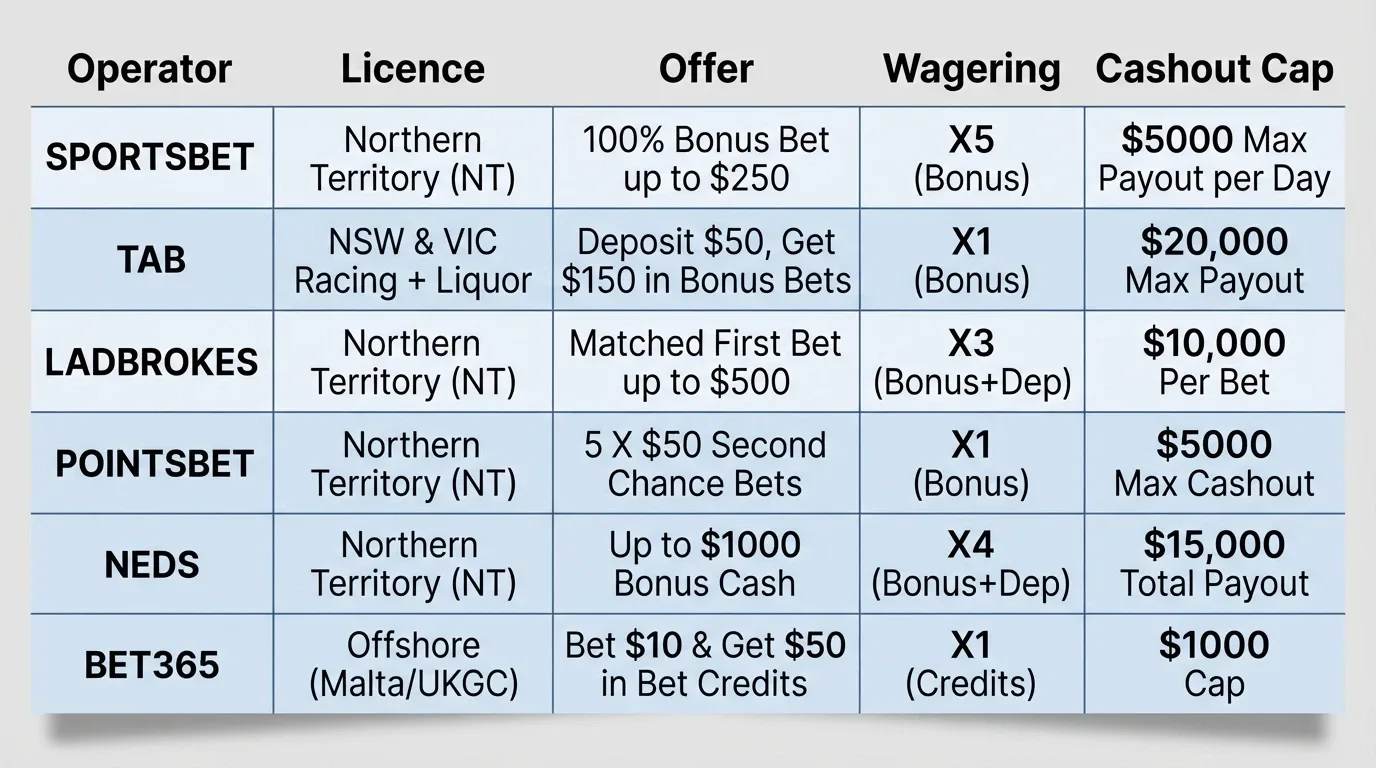
The table below compares the ten operators that turn up most often in AU-facing pokies coverage in 2026. Every operator is offshore — no Australian licence exists for online casino or online pokies under the Interactive Gambling Act 2001, so the licence column shows the offshore framework under which the operator is regulated (or, where research does not carry a specific number, the framework alone). Wagering multiples and cashout caps are quoted as the operator publishes them; where research does not carry the figure, the cell is left as an em dash.
| Operator | Licence | No-Deposit Offer | Free Spins | Wagering | Max Cashout | Game Providers |
|---|---|---|---|---|---|---|
| Skycrown | Curaçao (OGL/2023/176/0095) | — | 400 FS welcome | 40× | A$5,000/welcome bonus | Pragmatic Play, NetEnt, BGaming |
| RocketPlay | Curaçao framework | — | 50 FS welcome | 30× | — | Pragmatic Play, NetEnt |
| Royal Reels | Offshore — licence not confirmed | AUD 10 NDB | — | 30–40× | AU$200 | Multiple |
| Fair Go Casino | Offshore — RTG-powered | 77 FS (Plentiful Treasure) | — | 60× | AU$180 | RealTime Gaming |
| WinSpirit | Offshore — licence not confirmed | — | 100 FS welcome | — | — | Multiple |
| Bizzo Casino | Offshore — licence not confirmed | 20 FS (Lady Wolf Moon MEGAWAYS) | 175 FS across 4 deposits | 40× | — | Multiple |
| BitStarz | Offshore — cryptocurrency casino | 50 FS on registration | — | 40× | AU$100 | 5,000+ games |
| Rainbet | Offshore — AU restricted for bonuses | — | 60 FS (Sweet Bonanza) | 40× | ~AU$50 for codes | Pragmatic Play, Originals |
| Stake | Offshore — cryptocurrency-focused | Not confirmed for AU | — | — | — | Multiple providers, Originals |
| Uptown Pokies | Offshore — RTG-powered | AU$50 no-deposit chip | — | — | — | RealTime Gaming |
The headline reads from this table: every operator holds an offshore licence or none that research could verify, none is AU-licensed (because no such licence can exist), and the genuine no-deposit offers are concentrated at Fair Go, BitStarz, Royal Reels, Bizzo and Uptown Pokies. The deposit-required welcome packages carry larger spin counts — Skycrown’s 400, RocketPlay’s 50, WinSpirit’s 100, Bizzo’s 175 — but they require a deposit first. Wagering multiples cluster around 40×, with RocketPlay’s 30× the friendliest in the set and Fair Go’s 60× the steepest. Max cashout caps on the NDB offers sit between AU$100 and AU$200. Beyond the bonus, the providers cluster around Pragmatic Play, NetEnt and RealTime Gaming — the three studios whose pokies dominate the AU-facing offshore market in 2026.
Skycrown
Skycrown runs one of the larger welcome packages in the AU-facing set — up to A$8,000 across the first deposits, with 400 free spins added on top. The package is deposit-required; there is no standing no-deposit offer. Wagering is 40× on the match bonus and on the free-spin winnings, with a 14-day bonus validity for the standard tiers and a tighter 5-day window for the high-roller variant. The max bet on bonus funds is A$7.50, and the max cashout from the welcome bonus is A$5,000. Skycrown holds a Curaçao iGaming licence under Hollycorn N.V., certificate number OGL/2023/176/0095, and runs thousands of pokies from Pragmatic Play, NetEnt, BGaming and others.
The verdict on Skycrown is that it is a deposit-driven offer, not a no-deposit one. The 400-spin headline is large, but the wagering on both the bonus and the spins is the standard 40×, and the cashout ceiling is well above what a free-spins punter would ever reach. For a player with a budget to deploy across the first four deposits, the headline value is real; for a player hunting for a no-deposit free-spin entry, the offer does not apply.
RocketPlay
RocketPlay sits at the other end of the wagering spectrum from Fair Go. The welcome package is 100% match up to AU$200 plus 50 free spins, with 30× wagering on the bonus amount — the lowest in the ranked set, and the reason the operator turns up in any “low-wagering” search. The library runs to 3,000+ games, with Pragmatic Play and NetEnt prominent among the providers. RocketPlay holds a Curaçao licence under the framework but, like several operators in the set, the specific licence number is not in the snippets research could verify.
The verdict on RocketPlay is that it is the friendliest welcome offer in the set for a player who is going to deposit anyway. The 30× multiple materially shortens the path to a withdrawable balance; the 50 free spins on top are an add-on rather than the headline. For a no-deposit-first punter, the offer does not apply.
Royal Reels
Royal Reels is one of the few operators in the ranked set that runs a genuine no-deposit offer alongside the welcome match. The welcome bonus is 100% up to AUD 500 with a minimum deposit of AUD 30, and the no-deposit offer is a separate AUD 10 credited on sign-up, with 30× to 40× wagering, 7-to-14-day validity, and an AU$200 max cashout. The library runs through multiple providers, and slots contribute fully to wagering. Royal Reels is offshore; the specific licence framework is not confirmed in the snippets research carried.
The verdict on Royal Reels is that it is the cleanest small-cash NDB in the set — AUD 10 is a real starting balance, the wagering is in the standard band rather than above it, and the player picks the pokie. The 100% match on top makes the welcome package work for depositing players, but the AUD 10 NDB is the part worth highlighting for the player who wants to test the lobby first.
Fair Go Casino
Fair Go runs one of the standout no-deposit offers in the AU-facing market in 2026 — 77 free spins on Plentiful Treasure, no deposit required, with a 60× wagering requirement on winnings and a maximum cashout of AU$180. The library is RealTime Gaming throughout, which means the nominated pokie for the spins is an RTG title and the rest of the lobby is RTG-only. The 60× multiple is the steepest in the ranked set, and the reason Fair Go sits at the bottom of the friendliness ladder despite having one of the more accessible entry offers.
The verdict on Fair Go is that it is the best genuine NDB in the set for a player who likes the math. A 77-spin offer on a single RTG pokie, with 60× wagering and an AU$180 cap, is a clear product: the player knows exactly what they are getting and exactly what the terms cost. The wagering is unfriendly. The cap is competitive. Grind the 60× turnover and the offer pays out at the AU$180 ceiling; look for a quick path to a withdrawal and it will not.
WinSpirit
WinSpirit’s welcome package is 100% up to AU$2,000 on the first deposit, with a minimum deposit of AU$20. The bonus title references 100 free spins, but the underlying wagering, validity, max cashout and per-spin bonus pokie are not confirmed in research — the operator’s full terms page was not in the snippets carried this round. The library runs through multiple providers, and the operator is offshore. WinSpirit is one of the cases where research gaps force the page to describe the offer in the operator’s own shape without inventing figures research did not carry.
The verdict on WinSpirit is that the headline offer is large and the player should treat it as a deposit-driven package whose exact terms need to be read at the cashier. The 100-spin reference in the bonus title is unverified for this run; the player should not assume the headline matches the small print.
Bizzo Casino
Bizzo runs both ends of the offer spectrum: a 20 free spins no-deposit offer on Lady Wolf Moon MEGAWAYS (via an exclusive code) on top of a deposit-driven welcome package of up to €3,550 plus 175 free spins across four deposits. Wagering on the bonus is 40× to be completed in 14 days, with a €5 max bet per spin during wagering. The library runs through multiple providers. Bizzo is EUR-denominated in its bonus terms, which matters for an AU player: the AU$ value of the wagering requirement fluctuates with the exchange rate, and the max bet in euros converts to roughly AU$8 at typical rates.
The verdict on Bizzo is that the no-deposit offer is small but real — 20 spins on a Megaways title is a credible taste of the lobby without spending a cent. The deposit package is large and spread across four deposits, which rewards a player who plans to stick around rather than one who is testing the waters. Twenty spins are the whole of the free entry here; the headline 175-spin welcome is the deposit ladder wearing a bigger number.
BitStarz
BitStarz runs the largest no-deposit spin count in the ranked set — 50 free spins on registration, no deposit required, with a 40× wagering requirement on the bonus cash received and a 7-day validity. The max cashout from the NDB is AU$100, and the underlying library runs to 5,000+ games, which makes BitStarz one of the larger lobbies in the offshore market. BitStarz is also one of the more established cryptocurrency casinos in the AU-facing space, though it accepts fiat deposits as well.
The verdict on BitStarz is that the 50-spin NDB is the cleanest large-count no-deposit offer in the ranked set. The wagering is the standard 40×, the validity is tight at seven days, and the cashout ceiling is at the lower end of the AU band. For a player who wants the largest possible no-deposit spin count without funding the account, BitStarz is the operator the others are measured against.
Rainbet
Rainbet’s welcome package is a three-tier match — 100% / 50% / 100% up to $700 per tier, $1,750 total — plus 60 free spins on Sweet Bonanza, with 40× wagering. The library runs Pragmatic Play and the operator’s own Originals, and the site carries a no-wager first-deposit offer as well. The catch is in the eligibility list: Australia is on Rainbet’s restricted list for bonus offers. The headline numbers apply; the Australian player is excluded from claiming them.
The verdict on Rainbet is that the offer exists and the player is locked out. For an AU punter, Rainbet is one to read about, not to register at — the operator’s terms specifically exclude Australian players from the bonus package that the headline otherwise describes.
Stake
Stake runs a cryptocurrency-focused lobby with multiple providers plus the operator’s own Originals, and the platform’s reputation in the AU-facing market is built on its live-game and sports product rather than its pokies welcome. Research this round did not confirm a standing no-deposit free-spins offer for AU players at Stake, and the operator’s promotional structure does not centre on the same kind of welcome package the rest of the set runs. The honest read of the offer is that it does not exist in the form the player might assume from a search result — Stake is a deposit-and-play operator, and the typical entry is a funded account, not a free-spin credit.
The verdict on Stake is that it is the largest library in the set with the thinnest no-deposit offering. A player hunting for a free-spin credit will not find one; a player who already knows Stake and wants to fund an account will find a deeper lobby than most of the other operators in the ranking.
Uptown Pokies
Uptown Pokies runs an AU$50 no-deposit chip — the largest no-deposit value in the ranked set, but in cash form rather than free spins. The library is RealTime Gaming throughout. The wagering, the validity, the max cashout and the max bet on the chip are not confirmed in research this round, and the operator’s terms page should be read at the cashier before any claim. Uptown Pokies is offshore and RTG-powered.
The verdict on Uptown Pokies is that the headline figure is the largest in the set, but the player is claiming a chip, not spins. The chip pays out through wagering the way free-spin winnings do; the player picks the pokie; the cashout cap and the multiple determine what survives. For a player who wants the largest possible no-deposit starting balance and is happy to grind through the turnover, the chip is competitive; for a player who specifically wants spins, the offer is the wrong product.
Free-play pokies — demo mode with free spins, no account needed
There is a different kind of “free spins” that does not appear in any bonus offer, and that is the demo mode built into almost every modern pokie. The demo version of a pokie runs in the browser, with no download, no registration, no deposit and no withdrawal — the player gets a demo balance of fictional credits, the reels spin, the free-spins feature triggers as it would in the real game, and any win stays on the screen. The free-spins round inside the demo behaves exactly the way it does on the real-money version, which is why demo mode is useful: it lets the player experience a pokie’s bonus round before committing any cash. The wins are not withdrawable. They never have been. The player who confuses a demo free-spin round for a no-deposit offer has missed the one distinction that matters.

For an Australian punter deciding whether a pokie is worth real money, demo mode is the cheapest way to find out. Most providers run their pokies in instant-play HTML5, which means the game opens in any modern browser on desktop or mobile without an app, a plugin or a download step. The demo balance is replenished by reloading the page if it runs out, and the free-spins feature triggers at the same frequency as in the real-money version. The player can see whether the bonus round pays out the way the marketing claims, whether the volatility matches what the provider states, and whether the game holds their attention for the kind of session they would actually play. None of that information costs a cent, and none of it leads to a withdrawal.
Play free pokies with free spins — no download, no registration
Browser-based instant play is the default for almost every modern pokie. The game opens in the browser tab, the demo balance is loaded by the provider, and the player spins without entering an email address, choosing a username, or accepting any terms. There is no account to delete afterwards because there is no account to begin with. The only commitment is the time spent playing, which is exactly the kind of commitment a punter testing a new pokie wants to make. Free-spins features activate in demo mode at the same frequency as in real-money play, which is the whole point: a player who wants to see Gates of Olympus’s tumble mechanic in action, or Sweet Bonanza’s pay-anywhere multiplier, can do so without paying for the privilege.
Demo spins vs real-money free spins — what you can actually cash out
The two routes share the word “free” and almost nothing else. Demo spins produce demo wins, which sit on the screen and disappear when the player closes the tab. No-deposit free spins on a real-money offer produce real-money wins, which land in a bonus balance, run through wagering at the offer’s multiple, and become withdrawable up to the cashout cap if the player clears the conditions. The arithmetic that governs the real-money route — AU$10 starting value, AU$400 turnover at 40×, AU$16 expected loss at 96% RTP, an AU$50 to AU$200 cashout ceiling — does not apply to the demo route at all. The demo route has no wagering, no cashout cap, no expiry, and no balance. The real-money route has all four.
A player who searches for “free online pokies with free spins” and lands on a demo page is not looking at a no-deposit offer. A player who searches for “no deposit free spins Australia” and lands on a casino bonus page is. The distinction is the difference between entertainment that costs nothing and entertainment that costs something in expected value. Both are legitimate products. Conflating them is the mistake the marketing pages invite, and the one the terms pages quietly resolve.
Where free-spins pokies sit under Australian law — the offshore reality
The Australian position on online casino and online pokies is not a grey area. The Interactive Gambling Act 2001 makes it illegal for gambling providers to offer online casino games, online pokies and in-play sports betting to people in Australia. There is no licence for online casino anywhere in the country — not federally, not in any state or territory. Every operator in the ranked set above is offshore. The licensed AU wagering operators Australians use every day — Sportsbet, bet365, Ladbrokes and the rest — hold state and territory wagering licences that cover racing and sport only. Online pokies are not on that licence. They are not on any licence. They are not legal to provide to an Australian customer, and the Australian Communications and Media Authority (ACMA) has been enforcing that position since the IGA was strengthened in 2017.
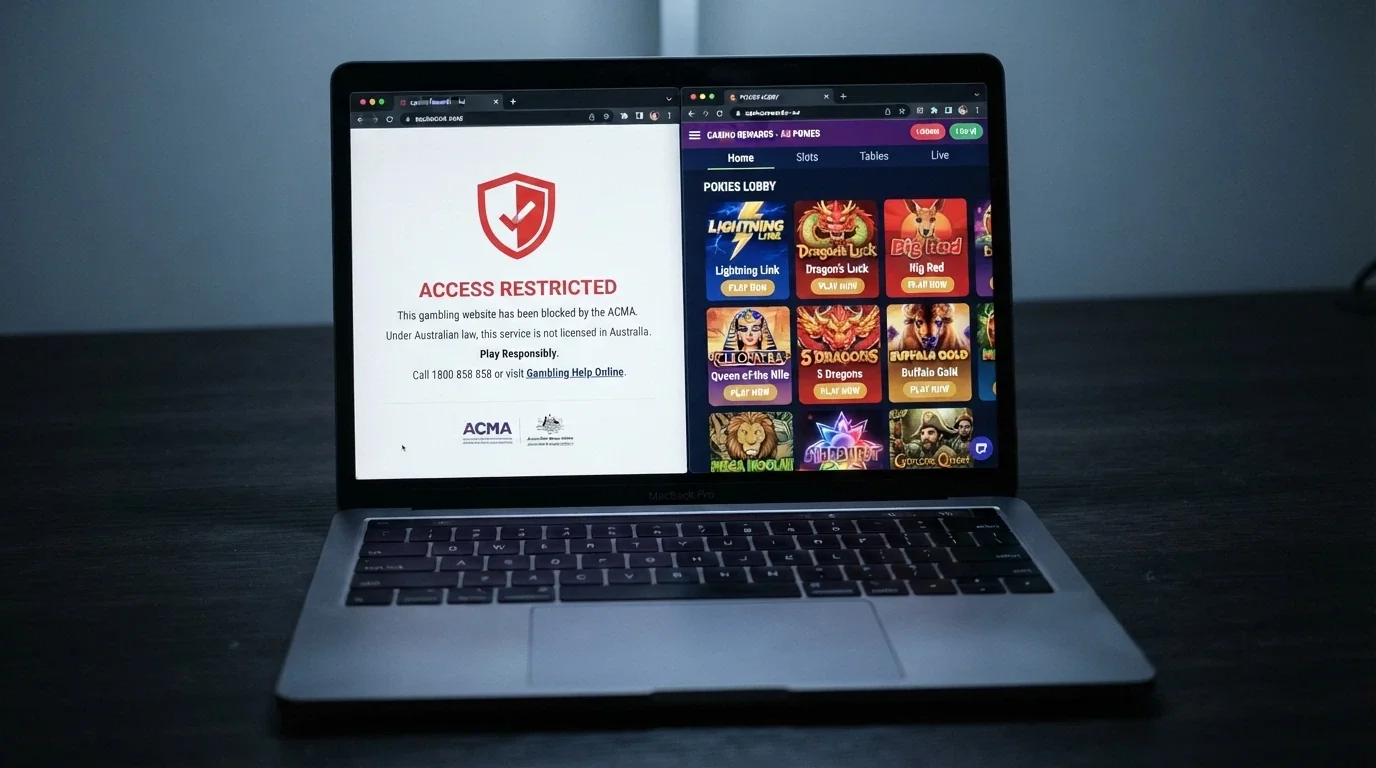
The enforcement is real. Since the ACMA’s first blocking request in November 2019, 1,564 illegal gambling and affiliate websites have been blocked by Australian ISPs. More than 225 illegal services have withdrawn from the Australian market since 2017 — some under ACMA pressure, some after seeing the writing on the wall. The IGA targets the provider, not the player, which is why no individual punter has been prosecuted for using an offshore casino. That does not make the site legal. It makes the punter’s risk a different kind of risk: not criminal, but commercial, in a market where the consumer protection is exactly what the operator chooses to provide.
What an Australian player gives up at an offshore casino
The protections Australians take for granted at a licensed bookmaker do not extend to an offshore casino. BetStop, the National Self-Exclusion Register, binds Australian-licensed wagering services only — an offshore casino is not connected to the register. A punter who has self-excluded through BetStop and then opens an account at an offshore pokies site is not covered by that exclusion; the offshore operator never saw the registration, has no obligation to honour it, and treats the new account as a fresh customer. The same gap applies to the National Gambling Helpline’s coverage: the helpline itself is available to anyone in Australia, regardless of where they play, but the operator-side protections — account closure, deposit-limit enforcement, marketing suppression after a self-exclusion — are Australian-licence products, and offshore casinos are not Australian-licensed.
The more concrete loss is recourse. A punter who has a withdrawal dispute with an offshore casino has no Australian complaints body to escalate to. The ACMA enforces the IGA against providers, not against player complaints. State and territory gambling regulators do not have jurisdiction over an unlicensed operator in another jurisdiction. A punter whose withdrawal is delayed, voided or refused at an offshore casino is left with the operator’s own support channels and whatever dispute resolution the operator’s licensing framework (Curaçao, Anjouan, Kahnawake) provides — which is, in practice, slow and partial. The third concrete loss is operational. An offshore site can be DNS-blocked by Australian ISPs at any time, with player balances still on it. The 1,564 blocks since November 2019 are not a single event; they are a stream, and any of the operators in the ranked set above is a candidate for the next request.
The 2026 gambling reform — what changes on 1 January 2027
The Interactive Gambling Amendment (Gambling Reform) Bill 2026 passed Parliament on 19 August 2026, and its measures commence on 1 January 2027. The package is the most significant change to the Australian online wagering framework since 2017, and three provisions directly affect how free-spin offers will reach Australian players in the year ahead. The first is the bank-blocking authority: from 1 January 2027, banks and payment providers gain express power to block transactions to illegal gambling operators, which means a deposit at an offshore pokies site may simply not go through. The second is the advertising cap: no more than three wagering advertisements per hour between 6:00 am and 8:30 pm, with a live-sport blackout from fifteen minutes before to five minutes after a live event. The third is the inducement-marketing restriction: direct marketing of inducements — bonuses, free bets, free spins — is prohibited for fourteen days after a customer signs up, for three months after a person deregisters from BetStop, and indefinitely for customers identified as at-risk.
The combined effect for the offshore casino market is that the routes to an Australian customer are narrowing. Banks may decline the deposit. Advertising platforms may decline the affiliate traffic. The free-spin pitch that has reached Australian punters through affiliate sites and bonus aggregators is, by the time the reform package is fully in force, facing restrictions on three of the four channels it currently uses. The offshore operator that wants to reach an Australian player in 2027 will need a deposit route, an advertising route and an inducement route that all survive the new rules. Some will not.
Licensed AU wagering vs offshore pokies — two different worlds
A punter who has only used licensed Australian bookmakers and then encounters an offshore pokies site will notice the difference quickly. The licensed AU wagering product covers racing and sport — pre-event betting on horse racing, harness, greyhound, AFL, NRL, cricket, soccer, tennis and the rest of the sporting calendar. The offshore pokies product covers the things the licensed AU product is not allowed to offer: online casino games, online pokies, live dealer tables, in-play sports betting. The two are not interchangeable. A punter who wants to bet on the Melbourne Cup is using the licensed product. A punter who wants to spin Gates of Olympus is using the offshore product. Both are real, both are marketed, and both reach the Australian customer — but only one of them has an Australian licence.
The reason this matters for a free-spin page is that the offshore pokies product is the one being sold. The licensed product cannot offer it. The player reading an offer for “50 free spins on registration” is reading an offer from an operator that the ACMA would block if asked, and that has been withdrawn from the Australian market by 225+ other operators who decided the enforcement was no longer worth the customers. A page about “licensed online casinos in Australia” is describing something that does not exist, and the honest framing of the ranked set above is that every operator in it is offshore, every bonus is offered from outside Australia, and every term applies in a jurisdiction the player cannot escalate to.
Geo-eligibility — NSW, state rules and what “Australia” actually covers for free spins
The Interactive Gambling Act is federal, which means the prohibition applies across every state and territory. State and territory regulators add their own layers — New South Wales, Victoria, Queensland, Western Australia, South Australia, Tasmania, the Northern Territory and the ACT each run their own gambling frameworks with their own restrictions, inducement rules and consumer-protection regimes — but the federal prohibition is the floor, not the ceiling. For an offshore casino offering free spins to “Australian players”, the operator’s terms page typically treats the country as a single block: either Australia is eligible or it is not. Some operators apply state-by-state restrictions (NSW residents excluded from certain bonus types is one pattern that recurs in the AU-facing market); others run blanket prohibitions on the entire country.
The practical effect for a player is that an offer listed as available “in Australia” may not be available in their state, and an offer listed as “Australia restricted” may still be claimable from a state the operator has not separately excluded. The check is always the same: the operator’s terms page, the cashier’s eligibility drop-down, and the support team if either is ambiguous. The federal prohibition does not vary by postcode; the operator’s eligibility list does.
Free-spin bonuses beyond no deposit — how the numbers stack up
The no-deposit offer is the headline product on this page, but the broader free-spin landscape includes deposit-match packages, reload bonuses and loyalty free-spins drops. Across AU-facing casinos in 2026, free-spin offers run from 10 to 250 spins, with average wagering of 35× to 40× and common max cashout caps of AU$50 to AU$200. The deposit trigger — the minimum deposit needed to unlock the spins — sits between AU$10 and AU$30 at most operators. The popular providers running the underlying pokies remain Pragmatic Play, NetEnt and BGaming. Deposit-match free spins pay out the same way no-deposit spins do (through the wagering and the cashout cap), but they sit on top of a matched bonus that increases the starting balance and therefore the total turnover required.
Reload and loyalty free spins are a separate category. These are spins credited to existing players — typically after a deposit, a milestone, or a tier promotion — and they tend to carry friendlier terms than the welcome package: lower wagering, longer validity, sometimes a higher cashout cap. The economics are different from a welcome offer: the casino is rewarding retention rather than acquiring a customer, and the bonus is sized accordingly. For a player who plans to stay at one operator for more than a single deposit cycle, the reload and loyalty drops are usually worth more per spin than the welcome package, even though the headline numbers are smaller.
25, 50, 100 free spins — what each count tier actually buys you after wagering
The table below compares three common spin-count tiers by the figures that actually determine what the player keeps. Starting value is the headline count times a representative per-spin value of AU$0.20 (a mid-range figure across the AU-facing market); turnover is starting value multiplied by 40× wagering; expected loss is turnover times 4% (the house edge implied by a 96% RTP); the estimate after conditions is starting value minus expected loss, which is the average outcome before the cashout cap and the expiry are applied.
| Spin Count | Typical Spin Value | Starting Value | Turnover at 40× Wagering | Expected Loss at 96% RTP | Estimate After Conditions |
|---|---|---|---|---|---|
| 25 FS | AU$0.20 | AU$5 | AU$200 | AU$8 | -AU$3 |
| 50 FS | AU$0.20 | AU$10 | AU$400 | AU$16 | -AU$6 |
| 100 FS | AU$0.20 | AU$20 | AU$800 | AU$32 | -AU$12 |
The arithmetic is unforgiving. At a 40× multiple and a 96% RTP, every common count tier produces a negative expected outcome once the wagering is applied. The 25-spin tier produces an AU$3 expected loss against an AU$5 starting value. The 100-spin tier produces an AU$12 expected loss against an AU$20 starting value. The reason the offers exist at all is that the player distribution is bimodal: most players will lose their balance during the wagering, but a small minority will hit a feature round, clear the turnover and walk away with the cashout cap. The casino prices the offer for the average; the player who lands in the minority collects the cap. Everyone else pays for the privilege of finding out which group they are in.
Game contribution — why your free spins do not work on every pokie
Wagering requirements apply to the games that contribute to clearing them. Standard video pokies contribute 100% — every AU$1 bet on a nominated video pokie counts as AU$1 toward the turnover requirement. Progressive jackpot pokies contribute far less: 0% to 10% is typical, on the basis that a jackpot pokie’s volatility makes its contribution to the casino’s expected revenue too unpredictable to count in full. Table games — blackjack, roulette, baccarat — contribute 10% or are excluded entirely. Live dealer games are almost always excluded. The contribution table is the operator’s way of directing the wagering toward the games the casino wants played, and the player who tries to grind through the turnover on a live blackjack table will find their AU$1 bets counting as AU$0.10 toward the requirement — or not counting at all.
The practical effect for a free-spin player is small, because the spins themselves are locked to a single nominated pokie and the player does not choose the game. The effect becomes larger once the wagering phase begins, when the player can move to other games. A punter who wants to clear the turnover on blackjack will discover that the contribution rate makes the wagering effectively ten times longer than the headline number suggests. A punter who sticks to video pokies will clear the wagering at the published rate. The terms page states the contribution table plainly; the player who reads only the wagering multiple is missing the rate that determines how long the clearing actually takes.
High-RTP pokies worth your free spins — the best titles by the numbers
The pokie the spins are locked to matters as much as the offer’s terms. A free-spin credit on a 99% pokie has a 1% house edge; the same credit on an 84% pokie has a 16% house edge. Over the AU$400 turnover required by a 40× wagering requirement on an AU$10 win, the difference in expected loss is AU$60 — more than the entire starting value of the offer. The table below lists eight pokies with verified RTP from research; volatility and max-win figures are quoted where research carries them, and the em dash marks the cells research does not fill.

| Pokie Title | RTP | Provider | Volatility | Max Win |
|---|---|---|---|---|
| Mega Joker | 99.00% | NetEnt | Low | 2,000× |
| Blood Suckers | 98.00% | NetEnt | Low | 900× |
| 1429 Uncharted Seas | 98.60% | Thunderkick | Low | 2,200× |
| Big Bass Bonanza | 96.71% | Pragmatic Play / Reel Kingdom | Medium-High | 2,100× |
| Sweet Bonanza 1000 | 96.53% | Pragmatic Play | High | 25,000× |
| Gates of Olympus | 96.50% | Pragmatic Play | High | 5,000× |
| Book of Dead | 96.21% | Play’n GO | — | — |
| Gonzo’s Quest | 95.97% | NetEnt | Medium-High | 37,500× |
The spread at the top is the headline. Mega Joker’s 99% RTP in Supermeter mode is the highest in the set; Blood Suckers at 98% and 1429 Uncharted Seas at 98.6% sit close behind. The Pragmatic Play titles — Big Bass Bonanza, Sweet Bonanza 1000, Gates of Olympus — run lower RTPs in the 96% range but offer larger max wins, which is the trade-off the volatility column captures. Book of Dead’s RTP figure deserves a footnote: 96.21% is the standard version, and lower-RTP variants at 95%, 92%, 91.2%, 87.2% and 84.2% exist in the market. A player who sees a “Book of Dead” bonus should check which RTP configuration the operator is running before assuming the 96.21% headline.
The offer-side implication is that a free-spin credit on Mega Joker is, in expectation, the cheapest free spin in the table — the house edge is 1%, and the expected loss on AU$400 turnover is AU$4, against AU$16 for a 96% pokie and AU$64 for an 84% pokie. Most no-deposit offers lock the spins to a single nominated title, which means the player does not choose between Mega Joker and Book of Dead. The choice the player does have is between offers whose nominated pokie sits at the high end of the RTP range and offers whose nominated pokie sits at the low end. The table above is the data that turns that choice from a guess into a comparison.
Responsible gambling — the safety net every free-spins player needs
The same offshore casino market that delivers no-deposit free spins is the same market that does not connect to BetStop, does not provide an Australian complaints body, and does not enforce an Australian self-exclusion. The responsible-gambling infrastructure exists, and an Australian player can use it whether they play at a licensed bookmaker or at an offshore casino — but the operator side of the protections is weaker offshore than it is onshore.
BetStop, the National Self-Exclusion Register, had 67,480 registrations as at 31 July 2026, with 41,290 exclusions still active. 78% of registrants are under 40, and 38% have chosen a lifetime exclusion. The register binds every Australian-licensed wagering service — online and phone bookmakers, sportsbooks, the lot — to honour the exclusion. An offshore casino is not connected. A player who has self-excluded through BetStop and then opens an account at an offshore casino is not covered by that registration; the offshore operator has no record of it, has no obligation to honour it, and treats the new account as a fresh customer. The most concrete harm of the offshore route is that the self-exclusion a player thought they had does not extend to the offshore lobby.
The National Gambling Helpline is 1800 858 858 — free, confidential and staffed 24 hours a day, 7 days a week. Gambling Help Online, at gamblinghelponline.org.au, provides online chat and counselling. Both are available to anyone in Australia, regardless of where they play, and both are the right first call for a player who feels their gambling has moved beyond entertainment. About 2.1% of Australian adults — roughly 430,000 people — experience problem gambling; the Australian Institute of Health and Welfare put high-risk gambling at 1.8% in 2022. The numbers are real, the help is real, and the gap between the help and the offshore casino is real too.
How free spins fit a responsible bankroll — limits and reality checks
The practical tools — deposit limits, take-a-break, activity statements, session tracking, self-exclusion — work best at Australian-licensed operators, where the regulator’s consumer-protection rules require them to be available and effective. At an offshore casino, the same tools may exist in name, but the enforcement is whatever the operator chooses to provide. A deposit limit set at an offshore casino can be raised by the player at any time, with no cooling-off period. A take-a-break request can be reversed by support. The activity statement may not exist at all. None of this is a reason not to use the tools — they are useful where they work — but a player using an offshore casino should not assume the same protections apply as at a licensed Australian bookmaker.
The other practical reality is that free-spin offers are entertainment, not investment. A punter who treats a 50-spin no-deposit offer as a route to a regular payout is, on the maths above, paying for the privilege of finding out which small minority of players hit a feature round. A punter who treats the offer as a few hundred spins on a pokie they were curious about — with the chance of a small payout if the reels land well — is reading the offer the way the casino priced it. Both approaches are legitimate; the first one is the one that gets people in trouble.
Winnings from gambling are not assessable income under section 6-5 of the ITAA 1997, and losses are not deductible under section 8-1, unless the person is carrying on a business of betting. There is no tax trap on a free-spin payout, but there is also no tax shield on the losses — the money that does not return from the wagering is gone without offset. The cleanest framing for a free-spin budget is the same as for any other entertainment spend: decide what the session is worth before it starts, and stop when the budget runs out.
How we chose and ranked these pokies sites
The ten operators above were drawn from the AU-facing pokies sites with verifiable free-spin offers in 2026. The first check was the licence: every operator was checked against the ACMA register and against official offshore licence databases. No Australian casino licence exists for online pokies under the Interactive Gambling Act 2001 — the IGA prohibits the product entirely — which means the licence check, by definition, returns “not AU-licensed” for every operator in the ranked set. The offshore framework under which each operator is regulated is listed in the comparison table; the absence of an Australian licence is the starting position for every entry, not a finding against any one of them.
The ranking criteria are qualitative. No-deposit free-spin availability is the first filter — an operator with no standing NDB was placed lower in the ranking than one with a clean NDB, with the AU eligibility restrictions (Rainbet’s restricted-country status) taken into account. Wagering fairness was the second filter: the standard 40× band is the median, RocketPlay’s 30× is the friendliest, Fair Go’s 60× is the steepest. Cashout cap reasonableness was the third filter: the AU$50 to AU$200 band is the median, with the figure listed where research carries it and an em dash where it does not. Game range and provider quality — Pragmatic Play, NetEnt, RealTime Gaming, BGaming, the operator’s own Originals — was the fourth filter, with larger libraries weighted over smaller ones. Operator track record was the fifth filter: established operators with stable terms and consistent withdrawal processing were placed above operators whose research footprint was thinner.
Two limitations apply. First, the ranking is not a “best casino” verdict — it is a comparison of free-spin offers at operators that AU players actually use, and the operators themselves are offshore and unlicensed in Australia. Second, the figures in the table are the figures research could verify; cells research could not fill are marked with an em dash rather than an estimate, and the operator profiles note where the underlying terms were not confirmed in this round. A punter who finds an offer at one of these operators should still read the terms page at the cashier before claiming — the offer terms above are the operator’s published terms at the time of writing, and operators revise them.
No-deposit free spins in Australia — are they worth your time?
The honest summary is that no-deposit free spins are entertainment with a small chance of a $50 to $200 payout after conditions. They are not a route to reliable income, and the maths above is the reason. A typical 50-spin offer at AU$0.20 per spin carries an AU$10 starting value. The 40× wagering on winnings turns that AU$10 into AU$400 of required turnover, and at 96% RTP the expected loss during that turnover is AU$16 — already more than the AU$10 the spins ever produced. The cashout cap of AU$50 to AU$200 then sits on top of whatever survives the wagering, and the offshore route adds the BetStop gap, the ACMA blocking risk and the absence of Australian consumer protection.
The practical reader is the punter who wants to try a pokie or a casino without committing a deposit, and who reads the terms before claiming. For that reader, the ranked set above gives a starting point: BitStarz’s 50-spin NDB with 40× wagering and an AU$100 cap; Fair Go’s 77 spins on Plentiful Treasure with 60× wagering and an AU$180 cap; Royal Reels’ AUD 10 cash chip with 30× to 40× wagering and an AU$200 cap; Bizzo’s 20 spins on Lady Wolf Moon MEGAWAYS with 40× wagering; Uptown Pokies’ AU$50 chip on the RTG library. Each one delivers what it says, with terms that govern what the player actually keeps. The reader who treats the offer as a free taste of a real-money pokie, with a small chance of walking away with the cap, is reading the offer the way the casino priced it. The reader who treats the offer as a path to a payout will, on the maths, pay for the privilege of finding out which small minority of players clear the wagering.
The offshore reality does not change with the offer. The ACMA has blocked 1,564 illegal gambling sites since November 2019; 225+ illegal services have withdrawn from the Australian market since 2017. Every operator in the ranked set above is one DNS request away from being unreachable, and player balances still on the site when the block lands are difficult to recover. A punter who keeps a balance at an offshore casino longer than the wagering requires is carrying risk the casino has not priced. The withdrawal, when it happens, is the safer moment to keep the operator at arm’s length.
Frequently asked questions
Are no-deposit free spins available to Australian players at online casinos in 2026?
Yes, across a handful of offshore operators. BitStarz runs 50 free spins on registration with 40× wagering and an AU$100 cap; Fair Go runs 77 spins on Plentiful Treasure with 60× wagering and an AU$180 cap; Royal Reels runs an AUD 10 cash chip with 30× to 40× wagering; Bizzo runs 20 spins on Lady Wolf Moon MEGAWAYS with 40× wagering. None of these operators is Australian-licensed — no such licence exists for online pokies.
Is it legal to play online pokies with free spins in Australia?
The Interactive Gambling Act 2001 prohibits providers from offering online casino games and online pokies to people in Australia; the individual player is not prosecuted. Every offshore casino offering free spins to Australians is operating illegally under the IGA. Players using them forfeit Australian consumer protection, BetStop coverage, and any recourse through the ACMA, and the site can be DNS-blocked at any time with player balances still on it.
How long do no-deposit free spins last before they expire?
Across AU-facing offers in 2026, expiry windows run from 24 hours to use the spins themselves, with a separate 7-to-14-day window to clear the wagering. Some offers apply both clocks; others give the full 14 days for both phases. The cleanest workflow is to use the spins on the day they are credited and to budget time over the next week or two for the wagering, with the understanding that the offer does not wait for the punter to be ready.
Which pokies can I use my free spins on — can I choose any game?
No. No-deposit free spins are almost always tied to a single nominated pokie — the casino chooses the game, and the player does not. Once the wagering phase begins, the player can usually move around the lobby (subject to game-contribution rates), but the spins themselves are locked to the one title the offer names. The nominated pokie is published in the offer’s terms; it is the one figure the player should check before claiming.
Do I need to verify my identity before withdrawing no-deposit free spins winnings?
Yes. KYC identity verification is required before any withdrawal from a no-deposit free-spin offer. Some casinos now tie the NDB spins to a pending KYC check, meaning the wagering cannot begin until the documents are in. The verification typically requires a government-issued ID, proof of address, and sometimes a copy of the payment method used to fund any prior deposits — even on no-deposit offers where no payment was made.
Can I use PayID to deposit or withdraw at offshore pokies sites that accept Australians?
PayID and Osko work for deposits at many AU-facing offshore casinos — the transfer clears instantly through an Australian bank account, with no fee on either side. Withdrawals are a different story: most offshore operators pay back through bank transfer, cryptocurrency, or e-wallet rather than PayID. The deposit-side convenience of PayID does not extend to the withdrawal side. From 1 January 2027, banks also gain express authority to block transactions to illegal gambling operators, which may affect whether the PayID deposit goes through at all.
Wager-free spins — do they exist for Australian players?
Wager-free spins are the cleanest product the market could offer: the spins pay out as withdrawable cash, with no turnover requirement between the win and the withdrawal. They exist in some markets and at some operators, but in the AU-facing space in 2026, research did not confirm a standing wager-free no-deposit offer for Australian players. What does exist is a category of low-wagering offers — typically 1× to 10× on winnings — that sit closer to the wager-free end of the spectrum without being there. The operator’s motivation for offering true wager-free spins is straightforward: the player walks away with whatever the spins produced, the casino has already paid for the spin, and the marketing value of “no wagering” is worth more than the cost of the few players who hit a feature round.
The honest read for an AU player in 2026 is that a wager-free NDB is unlikely to appear in the inbox. What is more likely is a deposit-gated free-spin bundle with low wagering — 10× to 20× on winnings, often with a cashout cap higher than the AU$50 to AU$200 standard. The shape of the offer is closer to a real-money free-spin credit than to a no-deposit teaser, and it is the kind of offer an AU punter might find at one of the larger deposit-driven operators in the ranked set above. For a player whose priority is “withdrawable cash from free spins”, a low-wagering deposit offer is the closest practical answer in the AU-facing market as it stands.