
Best Real Money Casino Apps for Android in Australia in 2026
 Available in AU
Every Android casino app Australians actually use is offshore, unlicensed in this country, and one blocking request away from disappearing behind an ISP wall. There is no licensed online casino in Australia — the Interactive Gambling Act 2001 makes that product unlawful to provide, and no Australian licence for it exists, at federal level or in any state or territory. This page ranks the ten offshore operators that Australian Android players actually search for, names what each one delivers, and lays out exactly what the wagering multipliers and bonus headlines cost the person depositing.
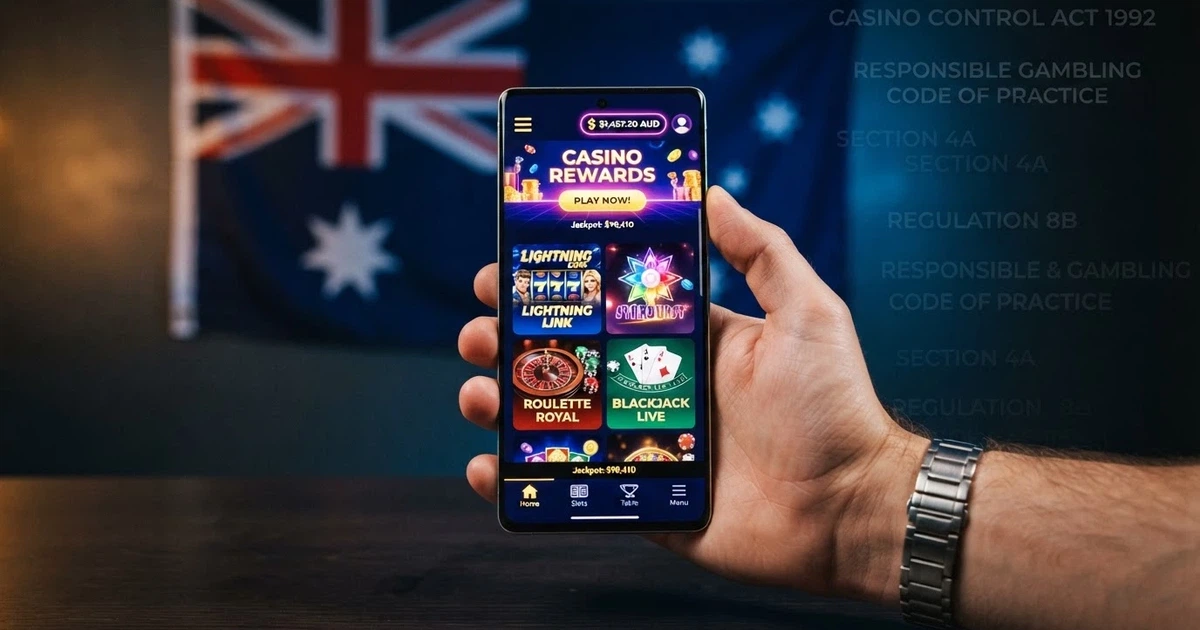
Data current as of 18 October 2026 — verified against the ACMA’s published investigations register and the operators’ published terms pages.
Table of Contents
- Australia’s Android Casino Reality: What the Law Actually Says in 2026
- Best Android Casino Apps: Our 2026 Top 10 Compared
- RocketPlay
- Royal Reels
- Skycrown
- Stake
- FairGO
- WinSpirit
- Rainbet
- Bizzo Casino
- Scream Casino
- Rocket Casino
- Why Your Favourite Pokies Play Differently on Android in 2026
- Getting Money In and Out: Payments, Crypto and the Real Cost
- Android Casino Bonuses: Why the Biggest Number Isn’t the Best Deal in 2026
- Free Pokies on Android: The Smart Way to Test Before You Deposit
- Live Casino on Android: Can Your Phone Handle a Real Dealer in 2026?
- How We Ranked These Android Casino Apps
- Staying Safe: Responsible Gambling on Your Phone in 2026
- Your Next Move: Picking an Android Casino App That Works for You
- Frequently Asked Questions
Australia’s Android Casino Reality: What the Law Actually Says in 2026
Australian players searching for a casino app rarely see the legal reality up front, because offshore affiliate sites do not print it. Online casino is a prohibited interactive gambling service in this country. No operator holds an Australian licence for it because no such licence exists, at federal level or in any state or territory. The Interactive Gambling Act 2001, tightened by amendments in 2017, makes it an offence to provide an online casino game, online pokies or in-play sports betting to a person physically in Australia. What you actually use — the apps on this page — are offshore operators running outside that framework, and that is the baseline you measure everything else against.
The Interactive Gambling Act: No Online Casino Licence Exists in Australia
The Interactive Gambling Act 2001 is the federal statute that makes providing online casino games, online pokies or in-play sports betting to a person in Australia an offence. The Act was strengthened in 2017 by the Interactive Gambling Amendment Act, which closed the offshore loopholes the original text had left open and gave the Australian Communications and Media Authority the enforcement and blocking powers it now uses. There is no licence to apply for, because the activity itself is prohibited. Not federally, not in any state, not in the Northern Territory, where licensed wagering on sports and racing is administered by Licensing NT but online casino is not a licensable product at all.
The distinction matters when a competing page tells you a brand is “licensed”. It is licensed somewhere — usually Curacao — but not in Australia, because no Australian casino licence exists to hold. The Northern Territory Racing and Wagering Commission licences wagering operators on pre-event sports and racing, and that regime levies a 5% wagering tax on wagers minus payouts, plus a 0.05% racing levy. State point-of-consumption taxes typically run 10–15% of net wagering revenue. None of these figures apply to casino, because no casino operator sits inside the regime. What is left is an unlicensed offshore product served to Australian phones by companies that hold a licence in another jurisdiction and very little local accountability.
The Act targets the provider, not the player. An Australian who opens an offshore casino app and deposits is not prosecuted. The operator is. That is the practical shield most offshore marketing copy relies on, and it is real — but the absence of criminal liability for the player is not the same as the presence of consumer protection. There is no Australian regulator to complain to, no Australian dispute scheme to escalate to, and no Australian court order that compels a payout. The player’s recourse is the licence holder in the operator’s own jurisdiction, with the leverage that gives.
Offshore Casino Apps: What They Are and Why Australians Use Them
An offshore casino app is one operated by a company incorporated and licensed outside Australia, serving Australian players without local regulatory permission. Every operator named on this page fits that description. None holds an Australian casino licence, because none can. Some hold Curacao eGaming licences; others carry licences that research did not pin down for this review. None of them are connected to BetStop, the National Self-Exclusion Register, so a person who has excluded themselves from licensed wagering can still deposit and play at every one of them.
What consumer protections are lost when the operator is offshore? The list is long and worth running through. There is no Australian deposit, loss or stake cap, because Australia caps the payment method rather than the deposit amount. There is no activity statement requirement, no mandated cooling-off period, no enforced reality check, no compulsory exclusion at loss thresholds, and no binding complaint mechanism. The site can also be ISP-blocked at any time at the regulator’s request, which means the URL on your home screen can stop loading while a balance sits on it. Several operators on this list — RocketPlay, Royal Reels, WinSpirit, Bizzo Casino — have already been formally listed on the ACMA’s blocking register for contravention of section 15(2A) of the IGA.
Australians still use these apps because the legal product they would prefer does not exist. There is no Australian-licensed online casino to switch to. The licensed wagering operators — Sportsbet, bet365, Ladbrokes, TAB, PointsBet, Neds — take bets on sports and racing, and the federal prohibition stops them from taking bets on a roulette spin or a blackjack hand. The player who wants to play pokies on a Tuesday night has the choice between an offshore app and not playing at all. That is the actual market the offshore operators sit in, and it is why the ACMA’s blocking list, after 1,564 sites, still leaves the same demand standing.
App vs Browser: How Android Casino Apps Actually Reach Your Phone
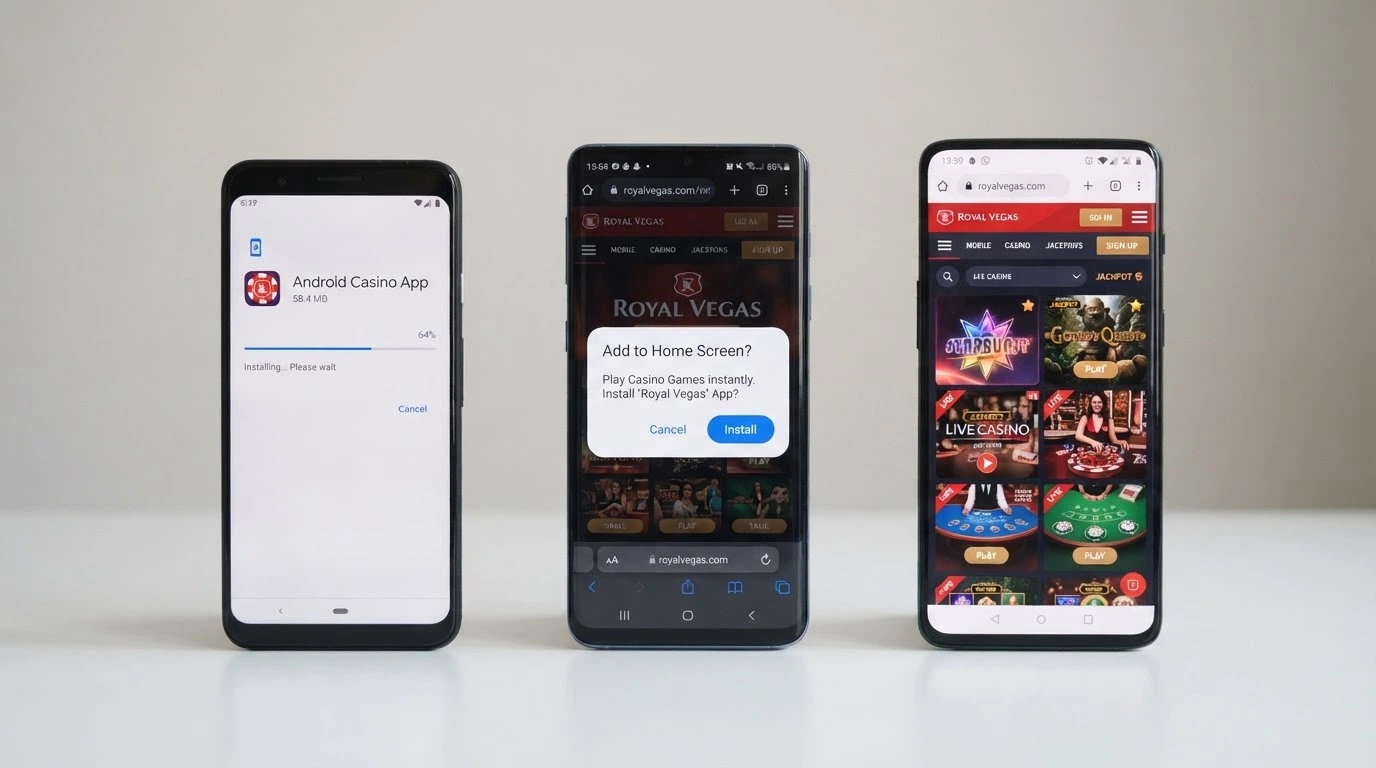
Google Play does not carry real-money casino apps in Australia. Apple’s App Store is the same. Both stores restrict real-money gambling apps for Australian distribution, and the operators have built around that restriction with three delivery models. The first is the APK direct-download — an Android installation file hosted on the operator’s own website, installed after the user enables “Install unknown apps” for the relevant browser. The second is the Progressive Web App, or PWA — a mobile site designed to behave like a native app once the player adds it to the home screen through the browser’s install prompt. The third is the mobile-responsive browser site with no shortcut at all, used as the fallback when neither an APK nor a PWA is offered.
The APK is the closest experience to a native app. DeeSpin’s Android client, which is among the lighter examples, runs on Android 8.0 (Oreo) and later, works on Samsung, Google Pixel, Oppo and Xiaomi devices, and weighs under 50MB. The PWA is a softer compromise — it loads like a website, but once installed it opens in its own window without the browser chrome and can hold a session in the background. WinSpirit uses this model: the install is an Add to Home Screen action, and the resulting icon behaves like an app icon for everything except full offline play. Royal Reels is portrait-first mobile browser only, with the same Add to Home Screen shortcut, but with no standalone window once launched.
For the player, the practical differences are load speed, install friction and the ability to receive push notifications. APKs win on push and on look-and-feel; PWAs win on friction — there is no “unknown apps” toggle to enable. Browser-only sites require no install at all, which means no icon on the home screen and no shortcut to a balance. Across the ten operators on this page, the split is roughly four APK or PWA models and six browser-only sites. The legality is the same in every case.
ACMA Enforcement: 1,564 Sites Blocked and Counting
The ACMA’s blocking regime is the most concrete expression of Australian gambling law. Since its first blocking request in November 2019, the regulator has had 1,564 illegal gambling and affiliate websites blocked at the Australian ISP level. More than 225 illegal services have withdrawn from the Australian market entirely since enforcement was strengthened in 2017, a figure that includes services that exited voluntarily after ACMA contact rather than waiting for a formal block. The investigations page on the ACMA’s site is the public ledger — every contravention finding sits there with the operator name, the section of the Act breached and the date.
The current ledger names RocketPlay, National Casino, Bizzo Casino, Ignition Casino, WinSpirit 1, Spinanga and Slot Mafia as having been found in contravention of subsection 15(2A) of the Interactive Gambling Act 2001, providing a prohibited interactive gambling service with an Australian customer link. The blocking list also includes Reef Reels, Royal Reels, Wildblaster and Slots Gallery among services found to be providing prohibited interactive gambling services to Australians. Four of the operators on this page sit on one or the other of those two ACMA lists.
What blocking means for a player who already has a balance is the uncomfortable question. The site stops resolving through Australian ISPs, but the player’s account, balance and bonus state still exist on the operator’s server. The operator is not obliged to refund the balance; the player is not guaranteed a withdrawal route. Some blocked operators maintain mirror domains or alternative links that work for some ISPs; others simply stop serving the account. The lesson is mechanical: balances on offshore apps are real money subject to an enforcement regime the operator has already disregarded once.
Best Android Casino Apps: Our 2026 Top 10 Compared
The table below ranks the ten offshore casino apps Australian Android players actually search for, by mobile access method and ACMA enforcement status. Every row is an operator you can find, install or load on an Australian phone this week. The ACMA Status column is binary at the operator level: either the operator is on ACMA’s blocked-providers list, or it is not individually confirmed as blocked. That distinction is the one that determines whether the operator can keep serving Australians without an ISP-level workaround.
| Operator | Mobile Access | ACMA Status |
|---|---|---|
| RocketPlay | APK (direct download) | Blocked (s 15(2A) IGA) |
| Royal Reels | Browser (Add to Home Screen) | Blocked |
| Skycrown | Browser | Not individually confirmed |
| Stake | Browser | Not individually confirmed |
| FairGO | Browser | Not individually confirmed |
| WinSpirit | PWA (Add to Home Screen) | Blocked (s 15(2A) IGA) |
| Rainbet | Browser | Not individually confirmed |
| Bizzo Casino | Browser | Blocked (s 15(2A) IGA) |
| Scream Casino | Browser | Not individually confirmed |
| Rocket Casino | Browser | Not individually confirmed |
The full reviews follow the table. Each write-up covers the operator’s mobile experience, its game library where research confirms it, its welcome offer where the terms are published, and the one verdict a player needs before signing up.
How the Comparison Works
The four columns a player actually uses to choose between offshore casino apps are mobile access quality, game provider breadth, published bonus terms and ACMA enforcement status. Mobile access quality covers whether the operator ships an APK, a PWA or a browser-only site, and how each behaves on a 4G or 5G connection. Game provider breadth matters because it determines which pokies, live dealer tables and crash games are available — RocketPlay’s mix of Pragmatic Play, BGaming, NetEnt and Evolution is a different experience from FairGO’s RealTime Gaming-focused catalogue. Bonus terms matter because the headline figure is the most misleading number on any casino review. ACMA enforcement status matters because a blocked operator is one ISP request away from vanishing.
Licence type is not a differentiator on this page. Every operator is offshore. Every operator holds a licence somewhere — most commonly Curacao — but no operator holds an Australian casino licence, because no Australian casino licence exists. Treating one Curacao licence as meaningfully different from another is the kind of detail that makes a competing page look authoritative while saying nothing useful. The differentiator that does matter is whether the operator is on ACMA’s blocked-providers list. An operator that is blocked is one that the regulator has already adjudicated to be providing a prohibited interactive gambling service to Australians. An operator that is not individually confirmed is simply one ACMA has not named on the page — that is absence of a finding, not absence of risk.
“Not individually confirmed” on the ACMA column does not mean safe. It means the operator’s name does not appear on the public investigations page research checked. ACMA’s list grows, and an operator absent today can be listed next month. The page updates with the register, and the register is the source of truth. The remaining columns reflect what research confirmed at the point of writing. Where a figure is missing, the operator write-up says so, because the gap is the information.
RocketPlay
RocketPlay runs a welcome package worth up to A$2,000 plus 100 free spins across the first two deposits. The first deposit is a 100% match up to A$1,000 plus 100 free spins on Aztec Magic Deluxe, with the spins credited 20 per day over five days rather than dropped into the account all at once. The second deposit is a 200% boost. Minimum deposits are A$20 and A$75 respectively. The wagering multiplier is 40× on the bonus amount — meaning a player who claims the full A$1,000 first-deposit match has to turn A$40,000 over before any withdrawal is possible. The operator’s site works as an APK direct-download on Android and as a mobile-responsive browser fallback.
RocketPlay’s PayID withdrawal is the standout detail. Withdrawals through PayID are processed in under an hour for most Australian banks, with a daily limit of A$5,000 unless higher-tier verification is completed. That puts RocketPlay at the fast end of the AU-facing offshore market for payouts, and explains why the brand shows up repeatedly in Australian affiliate copy. The game mix is the other selling point: Pragmatic Play, BGaming, NetEnt and Evolution are all confirmed on the platform, which covers most of the pokies and live dealer titles an Australian Android player searches for.
The number that has to sit beside that welcome package is the wagering one. A A$1,000 first-deposit match at 40× wagering is A$40,000 of turnover before the bonus is unlocked. At a A$1 stake per spin, that is roughly 40,000 spins, which at a typical 5-second interval works out to around 56 hours of play — and that is the time figure the headline bonus buys you, assuming only the bonus amount is wagered at the minimum stake. The other number to keep in mind is that RocketPlay is on the ACMA’s blocked-providers list for contravention of s 15(2A) of the IGA, which means the URL can stop resolving for Australian ISPs at any time without notice.
Royal Reels
Royal Reels runs two welcome structures side by side, and either one can be the entry point depending on which affiliate link the player lands through. The single-deposit welcome is a 100% match up to A$500 with wagering set at 30× on the bonus only — meaning a player who claims the full A$500 match has to turn A$15,000 over to clear it. The minimum deposit is A$20. On top of that sits a A$10 no-deposit bonus, with its own wagering multiplier of 40×, which means A$400 of total wagering is required before the no-deposit bonus converts to withdrawable cash. The alternative 3-deposit structure adds up to A$2,500 plus 50 free spins, with the second-deposit match at 75% up to A$750 and the third at 100% up to A$1,250. Wagering on that structure is 35× on the bonus only, with a A$5 per-spin cap during the clear-down period.
Royal Reels holds a Curacao Gambling Licence and was established in 2023. It does not ship a native Android app. The mobile experience is a portrait-first browser site tested on iOS 18, iOS 19, Pixel 8 Android and Samsung S24 Android, with an Add to Home Screen web-app shortcut as the closest thing to an installed icon. There is no APK to download. For a player used to a proper app, the experience reads as a website first, even after the shortcut is set up. The Curacao licence is the licence every offshore operator on this page shares or aspires to — it is a real registration, not a sham, but it offers an Australian player none of the protections an Australian-issued licence would.
Royal Reels is on the ACMA blocking list, which is the more material fact than the licence. A site that the regulator has already adjudicated to be providing a prohibited interactive gambling service to Australians is one enforcement cycle away from being ISP-blocked. Compared with RocketPlay’s under-an-hour PayID withdrawal, Royal Reels does not publish a comparable payout-speed figure, and that gap is itself information. The no-deposit bonus is the genuine draw — it is one of the few A$10 no-deposit offers still active at an ACMA-listed operator — but the 40× multiplier on a A$10 bonus is the kind of marketing line that costs the player A$400 in turnover before any of it can be touched.
Skycrown
Skycrown reaches Australian Android players through a mobile browser site rather than an APK or PWA. That places it in the same delivery bucket as most of the operators on this list — no Play Store listing, no install prompt, just a URL that opens in Chrome or Samsung Internet and renders the lobby in a touch-friendly format. The site’s design follows the offshore-template that has become standard across Curacao-licensed brands: vertical game tiles, a collapsible cashier menu, a hamburger nav at the top, and game categories for pokies, live casino, table games and crash games along the left rail.
The published detail research did not confirm for Skycrown covers most of what a comparison page usually lists. Specific welcome bonus terms, exact wagering multipliers, the licence number under which the brand operates and the named game providers were all unavailable at the point of this review. That is a meaningful gap for a reader comparing operators — bonus terms are the one figure that determines whether an offer is worth claiming, and a missing wagering multiplier means the headline bonus cannot be evaluated. The brand’s presence in Australian affiliate copy suggests a real player base, but the absence of published terms means there is no way to verify what the brand is offering from outside the site.
Skycrown is a fair browser-based entry to the offshore market. It is not the operator to choose if payout speed is the deciding factor, because published withdrawal data was not confirmed, and it is not the operator to choose if bonus transparency matters, because no published terms were located for this review. For a player who has already decided to play offshore and wants a familiar lobby layout without committing to an APK, the mobile browser route is workable. Beyond that, the gap in published detail is the information.
Stake
Stake sits at the rakeback end of the offshore market rather than the welcome-bonus end. The brand does not run a conventional deposit-match welcome bonus the way RocketPlay and Royal Reels do — instead, the model is a rakeback system that returns a percentage of the house edge to active players, layered on top of a VIP programme that scales with wagering volume. For an Australian Android player, the practical effect is that the first deposit is matched by ongoing cashback rather than by a one-off bonus that must be wagered through to convert. The licence is Curacao. The mobile access is browser-based.
The game mix is one of the deeper ones on this page. Stake carries Pragmatic Play, Evolution and Hacksaw Gaming, which means the same pokies catalogue a RocketPlay player sees (Big Bass Bonanza, Gates of Olympus and the rest of Pragmatic’s high-volatility hits), the live dealer suite Evolution is known for, and Hacksaw’s scratchcard and crash-game library. The provider mix is the brand’s real draw for a player who cares about catalogue breadth — it is closer to a full-service platform than a pokies-only site.
Stake’s offer is built for the player who plans to keep playing rather than the player chasing a headline bonus. The flat statement that fits the brand is this: there is no wagering multiplier because there is no bonus to clear — the value is in the rakeback percentage and the VIP tier, both of which compound over volume rather than paying out on the first deposit.
FairGO
FairGO runs on RealTime Gaming — RTG — as its primary pokies provider, which sets it apart from the Pragmatic Play-dominant operators above. RTG’s catalogue is the one Australian players of a certain vintage will recognise from the early-to-mid 2010s offshore scene, with a stable of branded and unbranded pokies that has aged better than its reputation suggests. The mobile access is browser-based, with no APK or PWA documented for Australian distribution.
The detail research confirmed is the payout speed. FairGO’s PayID withdrawals settle within four hours after full KYC verification, and crypto, bank transfers and e-wallet withdrawals clear within 48 hours. Compared with RocketPlay’s under-an-hour PayID withdrawal, FairGO sits in the slower-but-still-fast band of the market. The 48-hour bank-transfer ceiling is the fallback for players who do not want to send KYC documents on day one, and it is faster than the multi-day windows some competing offshore operators publish.
FairGO’s wagering terms were not confirmed for this review, so the welcome bonus cannot be quoted. What can be quoted is the payout experience: PayID in under four hours after KYC is competitive, and the RTG catalogue is a genuine alternative to the Pragmatic Play default that dominates the rest of this list. Compared with Stake’s rakeback model, FairGO looks more like a traditional welcome-bonus operator with a faster payout on the AU-specific rail.
WinSpirit
WinSpirit ships a Progressive Web App — no Play Store listing, no APK to download, but a mobile site that installs to the home screen as a standalone window once the player taps Add to Home Screen in the browser. The PWA model is the middle ground between APK friction and browser-only impermanence: the icon behaves like an app icon, the launch is fullscreen, but the underlying rendering is still the website. PayID is front-and-centre for Australian players at the cashier, which signals an AU-aware product rather than a globally-reskinned offshore template.
The game providers confirmed on the platform are Pragmatic Play and BGaming, with the implication that the rest of the major studios are present but unverified for this review. Pragmatic Play on its own covers the high-traffic Australian pokies titles, and BGaming adds the Aztec Magic Deluxe variant that RocketPlay’s free spins are tied to. The combination is a workable pokies library without the NetEnt or Evolution breadth of the deeper-stacked operators.
The number that has to follow WinSpirit around is its ACMA listing. The operator appears on the regulator’s blocked-providers page as WinSpirit 1, named for contravention of section 15(2A) of the IGA — the same provision that names RocketPlay and Bizzo Casino. The PWA experience is a clean technical delivery; the regulatory status is the disqualifier for a player who weighs the ACMA’s view of the operator. Welcome bonus terms were not confirmed for this review, which is the other gap a comparison shopper has to live with.
Rainbet
Rainbet is one of the lighter entries on this list. The mobile access is browser-based, with no APK, PWA or branded shortcut documented. The brand’s visibility in Australian affiliate copy is lower than RocketPlay, Royal Reels or Stake, and that lower visibility matches a thinner published footprint overall. Welcome bonus terms, licence number, named game providers and withdrawal time data were not confirmed for this review.
That thinness is itself the information. A player comparing operators has to weigh Rainbet against a brand like Royal Reels, where the licence is at least confirmed and the bonus terms are at least published. Rainbet has neither confirmation to point to. The brand appears to be a real offshore operator serving Australian traffic, but the absence of published specifics is what a comparison shopper is buying into when the choice lands on Rainbet over a more documented alternative.
For a player who already has an account and knows the brand, the comparison page does not need to add much. For a player choosing between ten operators for the first time, Rainbet is the option that requires the most independent verification before a deposit goes in. Browser access works; the rest of the picture is missing.
Bizzo Casino
Bizzo Casino is on the ACMA’s blocked-providers list for contravention of section 15(2A) of the IGA, which is the most material fact about the brand. The licence is Curacao, the mobile access is browser-based, and the brand has been visible enough in Australian search traffic to draw a formal regulator finding. That visibility is what earned the ACMA listing — Bizzo’s name surfaces often enough that the regulator took the trouble to investigate and adjudicate.
The detail research did not confirm for Bizzo covers the welcome bonus, the wagering multiplier and the named game providers. What can be confirmed is the regulatory status and the licence type, both of which place Bizzo in the same offshore bucket as RocketPlay, Royal Reels and WinSpirit — Curacao-licensed, browser-based, ACMA-listed. The brand’s market position is built on visibility rather than on a documented differentiated offer, and the ACMA listing is the regulator’s response to that visibility.
For a player who arrived at Bizzo through affiliate copy, the comparison is straightforward. The brand offers the same offshore product as the rest of the list, under the same regulatory cloud, with no confirmed payout speed or bonus term to distinguish it from the alternatives. Bizzo is the operator whose name recognition is doing the heaviest lifting, and the ACMA finding is the price of that recognition.
Scream Casino
Scream Casino runs on a browser-based mobile site, with no APK or PWA documented for Australian distribution. The brand’s footprint in Australian affiliate copy is moderate, and the published detail is light. Welcome bonus terms, the licence number, named game providers and payout speed data were not confirmed for this review. That is the same thinness profile as Rainbet and Rocket Casino, and it places Scream Casino in the group of operators a comparison shopper has to evaluate with more independent research.
What can be said is the negative: the brand is not on the ACMA’s blocked-providers list, which means it has not been formally adjudicated to be providing a prohibited interactive gambling service. That is not the same as the brand being licensed or safe — it is the absence of a finding, not a positive clearance — but it does distinguish Scream Casino from the four operators on this page that are explicitly listed.
The market position is best described as a middle-tier offshore brand with browser-based access and limited published detail. For a player who has used the brand before and is comfortable with the offer, the comparison page is not where the decision lands. For a first-time visitor, Scream Casino is one of the operators where the gap in published terms is the deciding factor.
Rocket Casino
Rocket Casino is distinct from RocketPlay despite the similar name. RocketPlay is the Curacao-licensed, ACMA-listed, APK-distributed operator reviewed above. Rocket Casino is a separate brand with browser-based mobile access, no documented APK or PWA, and a thinner published footprint. The two should not be confused — they are not the same operator, not the same licence, and not the same ACMA status. A player searching for either name will land on both, and only one of them is the headline-grabbing welcome-bonus brand.
What research did not confirm for Rocket Casino covers welcome bonus terms, the licence number, named game providers and payout speed data. The brand appears in Australian affiliate copy at moderate volume but does not surface in the same headline-bonus coverage as RocketPlay. The flat statement that fits the brand is this: a browser-based offshore operator that should not be confused with the ACMA-listed RocketPlay, with limited published detail to distinguish it from other operators in the same delivery bucket.
For a comparison shopper, the question is whether Rocket Casino offers anything RocketPlay does not, and the published footprint does not support an affirmative answer. The brand is workable; the differentiation is not visible.
Why Your Favourite Pokies Play Differently on Android in 2026
The pokie on your phone is the same game engine that runs on a desktop browser or at another casino, but the player experience changes more than the screen size suggests. RTP can shift between operators on the same title, because providers ship multiple RTP variants and the casino picks which one to host. Volatility is fixed by the maths model and does not change between casinos, but a high-volatility pokie at a reduced-RTP variant is a meaningfully different bet from the same pokie at the standard rate. The pokies Australians search for most — Big Bass Bonanza, Gates of Olympus, Starburst and Book of Dead — are all available in multiple RTP configurations across the offshore market.

The Pokies Australians Search For Most
Big Bass Bonanza is Pragmatic Play’s 2020 release that defined the high-volatility fishing genre. Five reels, three rows, ten paylines, released on 15 December 2020, with a hit frequency of 25.8%. Gates of Olympus is Pragmatic Play’s cluster-pays title on a 6×5 grid, where eight or more matching symbols trigger a win and Zeus drops multipliers from ×2 to ×500 across the tumble sequence. Both titles appear across nearly every offshore casino in this market. Starburst is NetEnt’s low-volatility evergreen, the title that introduces players to slots in most regulated markets and still pulls AU traffic on the offshore side. Book of Dead is Play’n GO’s high-volatility explorer, the pokie that broke through in 2016 and has held its place in the top-fifty ever since.
The pattern across these four is the dominance of Pragmatic Play in the AU-facing offshore market. Three of the four highest-traffic pokies for Australian Android players are Pragmatic Play or Play’n GO titles; one is NetEnt. The provider mix on the featured operators mirrors this: Pragmatic Play is confirmed on RocketPlay, Stake and WinSpirit, with Evolution (live dealer) and Hacksaw adding the secondary catalogue. NetEnt is confirmed on RocketPlay. RTG is the outlier — FairGO’s primary provider — which keeps that brand’s catalogue distinct from the Pragmatic-dominant bulk of the offshore market.
Slot RTP and Volatility: The Numbers Behind the Spins
| Slot Title | Provider | RTP | Volatility | Max Win |
|---|---|---|---|---|
| Starburst | NetEnt | 96.09% | Low | ~500× |
| Big Bass Bonanza | Pragmatic Play | 96.71% | High | 2,100× |
| Gates of Olympus | Pragmatic Play | 96.50% | High | 5,000× |
| Book of Dead | Play’n GO | 96.21% | High | ~5,000× |
RTP, or return to player, is the percentage of total wagered money a pokie pays back over millions of spins. A 96.71% RTP means the game keeps 3.29% of every dollar wagered across its full lifecycle — and that figure is averaged, not promised to any individual session. Big Bass Bonanza’s 96.71% is the standard rate, but the title ships in reduced variants at some offshore casinos, and the figure a player sees in a game’s info panel may not match the standard rate if the casino is hosting a lower-paying configuration. Gates of Olympus is the more cautionary case: standard 96.50%, but reduced variants at 94.99%, 92% or lower have been documented at some offshore operators.
Volatility is what your session actually feels like. A low-volatility pokie like Starburst pays out often in small amounts, draining a bankroll slowly. A high-volatility pokie like Big Bass Bonanza or Gates of Olympus can run long dry stretches punctuated by larger hits, with the headline max win (2,100× for Big Bass, 5,000× for Gates of Olympus) sitting as a ceiling that most sessions never reach. For bankroll management, volatility is the number that decides stake size — high-volatility pokies want smaller stakes per spin and longer sessions to ride out the variance. RTP decides the long-run cost; volatility decides what the path to that long run looks like.
Which Android Casino Apps Deliver the Best Pokies Experience
The app matters as much as the title. A pokie that loads in under three seconds on 4G and almost instantly on 5G is a fundamentally different experience from one that stutters on every spin, and the offshore operators have moved their platforms to the point where the gap is small but real. DeeSpin’s APK, for instance, weighs under 50MB and runs on Android 8.0 or later across the major device families. Most featured operators render the lobby in portrait mode with horizontal game tiles that rotate to landscape once a pokie launches, and that rotation is where the load-time gap shows up most clearly.
The provider mix shapes what a player actually sees on the lobby. RocketPlay carries Pragmatic Play, BGaming, NetEnt and Evolution — a mix that covers the Australian top-traffic pokies, the live dealer suite and a long tail of BGaming titles. Stake’s Pragmatic Play, Evolution and Hacksaw Gaming mix is similarly broad, with Hacksaw adding the scratchcard and crash catalogue. WinSpirit carries Pragmatic Play and BGaming, which covers the high-traffic pokies without the Evolution live dealer layer. FairGO runs on RTG, which keeps it on a different catalogue than the Pragmatic-dominant bulk. For a pokies-focused player, the RocketPlay or Stake provider mix is the broader experience; for a player who prefers RTG’s library, FairGO is the route.
Getting Money In and Out: Payments, Crypto and the Real Cost
The deposit is the easy part. Every AU-facing offshore casino on this page takes a PayID or bank-transfer deposit in Australian dollars, clears it near-instantly, and lets the player into the lobby within seconds. The withdrawal is where the friction lives, and the friction is not random — it is the same friction every offshore operator imposes, because every offshore operator faces the same problem. The player has to be verified before the operator will release funds, and the verification process is the bottleneck that turns “instant deposits, 24-hour withdrawals” marketing copy into three-day waits.
Deposit Methods That Work for Australian Players
PayID is the dominant AU deposit method at offshore casinos. Deposits clear near-instantly, work 24/7 including weekends and public holidays (most Australian banks allow PayID transfers around the clock), and require no card. Typical minimum deposits are A$10 to A$30, which puts the entry threshold below what most Australian bank cards would bother with. Neosurf is the lower-end option at A$10 minimum — a prepaid voucher available at Australian retail outlets, useful for players who do not want a casino transaction on their bank statement.
Bank transfer is the fallback for deposits above the PayID daily limit, and e-wallets cover the rest of the AU-facing market. What is missing is PayPal — most offshore operators do not list PayPal as a deposit option, because PayPal restricts gambling transactions in Australia. The deposit screen at a typical featured operator offers PayID, bank transfer, Neosurf, and one or two e-wallets. Credit cards, credit-related products and crypto are banned as payment for online wagering since 11 June 2024, with penalties for non-compliance up to A$247,500 — so any operator offering a credit card deposit or a Bitcoin deposit is, by definition, operating outside Australian rules.
PayID on Casino Apps: Why It Is Everywhere for Deposits but Scarcer for Withdrawals
PayID’s strength on the deposit side is its speed and ubiquity. The instant-clearing, 24/7 model is built into the Australian payments rail, and offshore operators have integrated it because it removes the friction that a bank-transfer deposit would impose. A player who tops up at 11pm on a Sunday gets the funds in their casino balance within seconds. That is the experience that has made PayID the default AU deposit method at every offshore operator that bothers to support it.
The withdrawal side is less uniform. PayID withdrawals are not always supported, because the offshore operator’s payment processor has to be set up to receive funds back through the same rail — and many platforms process withdrawals through bank transfer, crypto or e-wallets instead. Where PayID withdrawal is supported, the speed depends on the operator. RocketPlay processes PayID withdrawals in under an hour for most Australian banks, with a A$5,000 daily limit unless higher-tier verification is completed. FairGO’s PayID withdrawals settle within four hours after full KYC. The gap between RocketPlay’s sub-hour figure and FairGO’s four-hour figure is the kind of detail that separates one operator from another on a comparable offer.
For a player optimising for payout speed, the calculus is: choose an operator with confirmed PayID withdrawal support, complete KYC before the first withdrawal request, and check the daily limit against the amount you want to cash out. An operator with no confirmed PayID withdrawal is one where the bank-transfer fallback applies, and the bank-transfer fallback is typically 48 hours at best.
Crypto and the Credit Card Ban: What It Means for Your Casino Deposits
The Interactive Gambling Amendment (Credit and Other Measures) Act 2023 commenced on 11 June 2024. From that date, credit cards, credit-related products and digital currency (crypto) are banned as payment for online wagering in Australia. Penalties for non-compliance reach A$247,500. The law applies to operators licensed under the Australian regime — Northern Territory wagering operators, state-licensed sportsbooks — but the practical signal is broader: any Australian-facing gambling site that accepts a credit card or a Bitcoin deposit is, by definition, operating outside Australian rules.
That signal is worth its weight in interpretation. The site is offshore. The licence is not Australian. The regulator that issued the licence is not the ACMA. None of this is news for an offshore casino, but the credit card and crypto acceptance is the smoking gun: a licensed Australian operator cannot offer either, so the operator offering either is not licensed. From 1 January 2027, banks and payment providers gain express authority to block transactions to illegal gambling operators — which means a Bitcoin deposit that works today may be declined at the bank level next year.
For a player who prefers crypto for the privacy and the speed, the offshore market is the only option. The trade-off is that crypto deposits and crypto withdrawals place the entire transaction outside any Australian consumer protection framework. A crypto withdrawal to the wrong address is unrecoverable. A crypto deposit to a blocked operator is stuck in a balance that the operator may never release. Crypto is fast; it is not safer than PayID for an Australian player who can use PayID instead.
Withdrawal Times: What the Fine Print Doesn’t Tell You
Operator marketing pages quote “24–48 hours” for withdrawals as if the figure were a binding commitment. It is not. The 24–48 hour window assumes that KYC has been completed before the withdrawal request, that the request is made on a weekday during business hours, that the payment processor is operating normally, and that no additional verification flag has been triggered by the withdrawal amount or the payment method. Every one of those assumptions is a place where the timeline can stretch.
KYC is the bottleneck on a first withdrawal. A player who deposited A$20, played for thirty minutes and requested A$35 back is, at most offshore operators, going to be asked for a photo ID, a proof of address and possibly a selfie with the ID before the withdrawal is approved. That verification can take 24–72 hours, and it happens once. Subsequent withdrawals, with KYC on file, clear in whatever window the operator’s payment processor sets — which is the 24–48 hour figure the marketing pages quote, provided the request lands on a weekday and the operator does not pause for manual review.
Weekends stretch the timeline. A PayID withdrawal requested at 6pm Friday may not arrive until Monday morning, because bank processing at some Australian institutions does not run on weekends for non-instant rails. A bank-transfer withdrawal through an offshore operator’s payment processor is at the mercy of that processor’s own schedule, which is usually Monday-to-Friday in business hours. Crypto withdrawals are the exception — they clear 24/7 — but the credit-card ban means an Australian player cannot use a credit card to buy the crypto in the first place, and the offshore route for buying crypto carries its own friction.
The published maximum withdrawal time is rarely binding. Most operators reserve the right to extend processing for “additional verification”, and that extension is discretionary. The practical advice is to complete KYC before the first withdrawal request, to keep the first withdrawal modest, and to expect the first withdrawal to take longer than the marketing-page figure.
Android Casino Bonuses: Why the Biggest Number Isn’t the Best Deal in 2026
The headline bonus number is the least informative figure on any casino review. A welcome package worth A$2,000 plus 100 free spins looks, at first glance, like A$2,000 in cash and 100 chances to win for free. The wagering requirement is what the figure actually costs, and the wagering requirement is the number that decides whether the offer is worth claiming. A 40× wagering multiplier on a A$1,000 bonus means A$40,000 of turnover before any withdrawal is possible. The headline bonus does not mention this. The marketing page certainly does not lead with it.

Welcome Bonuses: The Headline vs the Reality
RocketPlay’s first-deposit welcome is a 100% match up to A$1,000 plus 100 free spins on Aztec Magic Deluxe, with the spins credited 20 per day over five days. The minimum deposit is A$20 to trigger the bonus, A$75 to claim the full match. Wagering is 40× on the bonus amount only — not on the deposit plus bonus — which is the better of the two possible structures. Royal Reels runs a competing 100% match up to A$500 with 30× wagering on the bonus only, plus a A$10 no-deposit bonus at 40× wagering on its own. The 3-deposit Royal Reels structure adds up to A$2,500 plus 50 spins across three deposits with 35× wagering on the bonus only and a A$5 per-spin cap during clear-down.
The match percentage interacts with the wagering multiplier in ways the headline figure does not show. A 100% match up to A$1,000 at 40× is A$40,000 of wagering obligation before withdrawal. A 75% match up to A$750 is A$22,500. A 200% boost on a second deposit — RocketPlay’s structure — looks generous, but the same 40× multiplier applies, and a A$500 second deposit at 200% match generates a A$1,000 bonus with A$40,000 of obligation. The headline figure scales with the match percentage; the obligation scales with both. Stake does not run a conventional welcome bonus at all — the brand sits on rakeback and VIP economics, which is the alternative model the headline-bonus operators are competing against.
Most featured operators did not publish specific welcome terms for this review. Royal Reels and RocketPlay are the two with confirmed published terms across the set, and they sit at different points on the bonus generosity / wagering steepness spectrum. The market context beyond the featured set includes Spinando, with a welcome offer up to A$1,750 plus 150 free spins at 40× wagering on the bonus, valid for 14 days — a benchmark that places RocketPlay’s 40× in the middle of the AU-facing offshore range. The right question to ask of any welcome offer is not “how big is the bonus” but “how much wagering does the bonus cost before I can withdraw”.
Wagering Requirements: The Multiplier That Eats Your Winnings
A wagering multiplier is the number of times the bonus amount must be wagered before the bonus converts to withdrawable cash. The range across the AU-facing offshore market runs from about 30× to 50×. A 30× multiplier on a A$500 bonus is A$15,000 of turnover. A 40× multiplier on a A$1,000 bonus is A$40,000. A 50× multiplier on 20 free spins at A$0.20 per spin is A$200. The wagering multiplier is the number that converts a bonus from a gift into an obligation.
Bonus-only wagering is the better of the two structures. If the wagering multiplier applies only to the bonus amount, the deposit is returned separately when the wagering is complete. If the wagering multiplier applies to deposit plus bonus, the player is wagering through both their own money and the bonus, and the effective cost is higher. RocketPlay’s 40× is bonus-only; Royal Reels’ 30× on the deposit bonus is bonus-only; the 35× on Royal Reels’ 3-deposit structure is bonus-only. The deposit-plus-bonus structure appears in some bonus codes elsewhere in the market and is the more expensive of the two.
The calculation that matters is bonus-cost. A RocketPlay first-deposit match at A$1,000 with 40× wagering on the bonus amount translates to roughly A$40,000 in turnover before any part of that bonus can be withdrawn. At a A$1 stake per spin, that works out to around 40,000 spins — and at a typical 5-second interval between spins, about 56 hours of play, assuming only the bonus amount is wagered at the minimum stake. That is the time figure the headline bonus buys you, not a promise of payout. A player who claims the bonus expecting to clear it in a few sessions is making a misjudgement — 56 hours of play at five seconds per spin is the realistic commitment.
Per-spin caps during clear-down add a second layer. Royal Reels’ 3-deposit structure carries a A$5 per-spin cap during the wagering period, which means a player who normally spins at A$10 has to drop to A$5 until the wagering is complete. The cap is the operator’s protection against a player running up a large wagering contribution with a single big-spin outcome, and it slows the clear-down considerably for high-stake players. Bonus validity windows — typically 7 to 14 days — add the closing constraint: any wagering not completed inside the window forfeits the bonus.
Free Pokies on Android: The Smart Way to Test Before You Deposit
Demo mode is the single feature that costs the player nothing and tells them the most. Every reputable provider — Pragmatic Play, NetEnt, Play’n GO — runs the same game client in demo mode as in real-money mode, with the same RNG, the same RTP configuration and the same bonus mechanics. The only differences are account-level: there is no deposit, no withdrawal, and no wagering obligation. A player who spins Big Bass Bonanza in demo for twenty minutes has played the same game a depositing player would play, with the only variable being the bankroll behind the spins.

Demo Mode vs Real-Money Play: What Is Actually Different
The reels spin the same way. The bonus features trigger at the same rate. The hit frequency, the volatility profile and the RTP configuration are identical between demo and real-money play at a reputable provider. The difference is the account layer: in demo mode, the player has no registered account at the casino, no balance on the server, and no path to a withdrawal because there is no money to withdraw. In real-money mode, the same pokie client sits on top of an account that holds real funds, with deposits and withdrawals flowing through the cashier.
The psychological difference is real and worth naming. A player in demo mode makes different decisions than a player in real-money mode, because no risk changes how a person weighs an outcome. A free spin that misses in demo is a data point; the same spin in real-money mode is a loss that affects the bankroll and the session. Demo mode is not a perfect predictor of real-money behaviour, because the decision-making under each is different. What demo mode does predict is the game itself — what the bonus features look like, how often they trigger, how the base game behaves between hits, what the variance actually feels like over fifty or a hundred spins.
For an Australian Android player evaluating a new casino app, demo mode is the right first step. The cost is zero, the registration is none, and what you learn is how the game actually behaves at the stakes you plan to play. Most offshore casino apps and APK or PWA installations support demo play without an account, because the providers ship the same client to all operators and the demo flag is set at the integration layer.
The Best Free Pokies Apps for Android
The featured operators that carry Pragmatic Play — RocketPlay, Stake, WinSpirit — will let a player spin Big Bass Bonanza, Gates of Olympus and the rest of Pragmatic’s high-traffic catalogue in demo mode without an account. Royal Reels’ browser-only site offers demo access for the providers in its mix, though the specific list was not confirmed for this review. FairGO’s RTG catalogue runs the same way, with demo mode available on every RTG title the platform hosts. NetEnt’s Starburst is available in demo at every operator that ships NetEnt, which is most of them.
The practical way to use demo mode is to spin the same title at three or four operators before depositing. Big Bass Bonanza’s RTP configuration can vary between casinos, and the demo spin is the cheapest way to check which operator is hosting the standard 96.71% and which is hosting a reduced variant. Gates of Olympus is the more consequential test — reduced variants at 94.99%, 92% or lower have been documented, and a player who deposits at a reduced-RTP variant will be playing a more expensive game than the headline figure suggests. Demo mode is the test before the deposit, and it is the only step that costs nothing.
Live Casino on Android: Can Your Phone Handle a Real Dealer in 2026?
Live dealer games run at 720p standard on 4G and almost instantly on 5G, which means the technical answer to the question above is yes, an Android phone can handle a real dealer. The practical answer is more nuanced. Live dealer uses more data than a pokie — about 5 to 10 MB per minute on a standard 720p stream — and a session that lasts an hour will burn through 300 to 600 MB of mobile data. On an Australian phone plan with a 50GB allowance, that is one to two hours of live play per month before data charges start mattering.

What Live Dealer Games Run on Android
The live dealer catalogue at Australian-facing offshore casinos centres on Evolution Gaming, which is the dominant live-dealer studio globally and is confirmed on RocketPlay and Stake. Evolution’s mobile catalogue covers blackjack, roulette, baccarat, casino hold’em and game-show titles like Crazy Time and Monopoly Live. The mobile interface adapts the table layout to portrait mode on most titles, with the betting interface overlaid at the bottom of the screen and the live video stream occupying the top half.
The per-table minimums are operator-set and not standardised. A standard blackjack table at one operator might have a A$1 minimum, while a VIP table at the same operator might require A$100 or more. The same variation exists for roulette and baccarat. The featured operators with Evolution on the provider list — RocketPlay and Stake — are the two with confirmed live dealer access; the other operators may carry Evolution or a competing studio (Pragmatic Play Live, for instance) but the specific live dealer provider was not confirmed for this review.
The narrower catalogue compared to the pokies library is the practical limitation. A player who wants 50 different blackjack variants will not find them at an offshore casino; the live dealer floor at most operators runs 10 to 30 active tables at any moment, with the more exotic variants (Lightning Roulette, Infinite Blackjack) rotated in and out as demand shifts. The trade-off is genuine live play against a real dealer, which is what the live dealer product is selling, at the cost of catalogue breadth.
Streaming Quality, Data Use and the Mobile Experience
A live dealer stream at 720p on 4G uses roughly 5 to 10 MB per minute, depending on the compression and the table. A one-hour blackjack session is 300 to 600 MB of data, which fits comfortably inside most Australian mobile plans but is a real consumption figure for players on tight data allowances. 5G reduces the load time to near-instant and stabilises the stream, which is the experience most Australian Android players will have in metropolitan areas. Regional 4G coverage varies, and a weak signal drops the stream to a lower resolution or stalls the video while the betting interface keeps responding — which is the worst of both worlds, because the player can place bets on a hand they cannot see.
The connection-drop question is the one most operators do not answer in their terms. If a live dealer hand is in progress and the player’s connection drops, the hand is played to completion on the dealer’s side and the result is applied to the player’s bet. A player who bets A$100 on blackjack, loses connection during the deal, and reconnects to find the hand resolved against them has no recourse under most published terms. The betting interface is server-authoritative, which means the operator’s server is the source of truth on what was bet, and the player’s local display is informational. No operator publishes a binding connection-loss policy that compensates the player for bets placed during a dropout.
The device-side requirements are modest. Live dealer streams run on any Android phone that handles 720p video playback, which is every Android 8.0 or later device on the market. The bigger constraint is the data allowance and the connection stability. A player on a stable home Wi-Fi will get the best experience; a player on a flaky 4G connection in regional Australia will see the stream stutter. The phone handles it. The network determines whether the experience is good.
How We Ranked These Android Casino Apps
The ten operators on this page were drawn from market-share data for the Australian Android casino market, with licensed wagering operators excluded. The licensed wagering category in Australia covers pre-event sports and racing — operators like Sportsbet, bet365, Ladbrokes, TAB, TABtouch, PointsBet, Neds, Betr, Picklebet and Betfair. None of those operators run an online casino product, because no Australian licence for one exists. They sit outside the comparison set on principle, not on quality.
The evaluation criteria were four: mobile access quality, game provider breadth, bonus terms transparency and ACMA enforcement status. Mobile access quality covers APK vs PWA vs browser, plus load speed and the smoothness of the portrait-mode lobby. Game provider breadth covers which studios are confirmed on the platform and whether the catalogue covers the Australian top-traffic pokies and the live dealer suite. Bonus terms transparency covers whether the welcome offer is published with a wagering multiplier and a validity window — the two figures that determine whether the offer is worth claiming. ACMA enforcement status covers whether the operator is on the regulator’s blocked-providers list.
The sources consulted were the ACMA’s published investigations and blocking register, each operator’s published terms and cashier pages, the AU-facing affiliate ecosystem for player-reported experience, and the regulator-published statistics on blocked sites and enforcement actions. The sources are the same ones a player would have to consult independently to verify any single claim on this page, and the comparison is the synthesis of those sources.
The ranking does not weight the criteria in percentages. Weightings imply precision that the data does not support. The order reflects an editorial judgment of how the ten operators stack up across the four criteria, with the operators that combine confirmed bonus terms, broad provider mixes and a clean regulatory status placed higher than the operators that lack one or more of those attributes. Where the published detail is thin — Skycrown, Rainbet, Scream Casino, Rocket Casino — the ranking reflects that thinness, because a comparison shopper has to weigh the absence of information against the operator itself.
Staying Safe: Responsible Gambling on Your Phone in 2026
The responsible-gambling infrastructure that exists for Australian players is built around licensed wagering. BetStop, the National Self-Exclusion Register, has 67,480 registrations as at 31 July 2026, with 41,290 exclusions still active; 78% of registrants are under 40, and 38% have chosen lifetime exclusion. BetStop binds every Australian-licensed wagering service, which means a person who has self-excluded cannot open a new account at a Sportsbet, bet365 or Ladbrokes without the exclusion being detected and the account closed.
BetStop does not cover offshore casino apps. None of the operators on this page are connected to BetStop, because none are licensed under the Australian regime. A player who has registered with BetStop and then opens an account at RocketPlay, Royal Reels or any other operator on this list will not be flagged by the exclusion — the offshore operator has no obligation to consult the register, no integration with the register, and no penalty for taking a self-excluded person’s deposit. This is the most concrete single harm of the offshore route, and it is the one the responsible-gambling infrastructure is least able to address.
The safety net that does reach every Australian player regardless of which app they use is the National Gambling Helpline — 1800 858 858 — free, confidential and staffed 24 hours a day, seven days a week. Online chat is available through Gambling Help Online at gamblinghelponline.org.au. The Helpline is run by counsellors, not by software; the conversation is the intervention, and it is the one tool that works whether the player is on a licensed wagering site, an offshore casino app, or anywhere else. About 2.1% of Australian adults — roughly 430,000 people — experience problem gambling, and high-risk gambling sat at 1.8% in the AIHW’s 2022 figures.
The 2026 reform adds layers that touch this market from 1 January 2027. Direct marketing of inducements is prohibited for 14 days after a customer signs up, for three months after a person deregisters from BetStop, and indefinitely for customers identified as at risk. Banks and payment providers gain express authority to block transactions to illegal gambling operators. AdStop, a national wagering advertising opt-out register, will give individuals a single mechanism to opt out of wagering advertising across online platforms, funded by a cost-recovery levy on wagering companies. None of this extends BetStop coverage to offshore casinos. The reform tightens the licensed side; the offshore side remains outside the framework.
For a player who is reading this page and finding the offshore route uncomfortable, the Helpline is the right next step. The number is 1800 858 858. The service is free. The conversation does not require the player to commit to stopping — it requires the player to call.
Your Next Move: Picking an Android Casino App That Works for You
The page’s core finding is the legal reality, and it is worth restating because it shapes every other decision. No licensed online casino exists in Australia. Every app on this page is offshore. The protection you give up by playing offshore is not theoretical — it is BetStop coverage, Australian consumer protection, recourse at an Australian regulator, and the guarantee that the site will keep resolving on your phone. The bonus headline is not a measure of what you get; it is a measure of what the operator is willing to pay to acquire you.
The decision framework runs in this order. Pick the mobile access method you are willing to install: APK, PWA or browser. Pick the payment method you are willing to use: PayID, bank transfer, or crypto, knowing that credit cards and crypto signal an offshore operator and that the credit card ban becomes a bank-level block from January 2027. Read the bonus terms before claiming — the wagering multiplier, the per-spin cap, the validity window — and decide whether the bonus is worth the obligation. Compare the provider mix to the games you actually want to play.
The one action to take before depositing is to spin the game in demo mode. The cost is zero, the registration is none, and what you come away with is the RTP configuration and the variance profile of the title at that specific operator. The one number to calculate is bonus × wagering multiplier — that is the turnover figure that has to clear before any withdrawal is possible, and it is the number that turns the headline bonus from a gift into a workload. The RocketPlay first-deposit match at A$1,000 and 40× is A$40,000 of turnover, which at A$1 per spin is around 56 hours of play. A player who claims that bonus should be planning for 56 hours, not 5.
The responsible-gambling commitment that closes this page is not a per-operator recommendation. It is the Helpline — 1800 858 858, free, confidential, 24/7. If any part of this page has made a player want to talk to a counsellor, the call is the right next move, regardless of which app the player ends up using.
Frequently Asked Questions
Is it legal to play real money casino games on an Android phone in Australia?
Online casino is prohibited in Australia under the Interactive Gambling Act 2001 — but the Act targets the provider, not the player. Playing on an offshore app is not illegal for you, although it means no Australian consumer protection, no BetStop coverage, and the operator can be ISP-blocked at any time.
How do I download and install a casino app on my Android device in Australia?
Most offshore casino apps do not appear on Google Play in Australia. You install them either by downloading an APK directly from the operator’s site (with “Install unknown apps” enabled for that browser), or by adding the mobile site to your home screen as a Progressive Web App. Both routes work on Android 8.0 and later.
What payment methods can I use to deposit at a casino app in Australia — does PayID work?
PayID deposits work at most AU-facing casino apps and clear near-instantly, 24/7 including weekends. PayID withdrawals are less universal — many operators route payouts through bank transfer, crypto, or e-wallets instead. Credit cards and crypto are banned for licensed Australian wagering since June 2024, so any operator offering them is offshore.
What is BetStop and does it cover offshore casino apps?
BetStop is Australia’s National Self-Exclusion Register for licensed wagering services — 67,480 Australians had registered by July 2026, with 41,290 exclusions still active. It does not cover offshore casino apps. A self-excluded player can still deposit and play at every operator named on this page, which is the most concrete harm of the offshore route.
What changes does the 2026 gambling reform bring to online casino advertising in Australia?
The Interactive Gambling Amendment (Gambling Reform) Bill 2026 passed Parliament on 19 August 2026. From 1 January 2027, wagering ads are restricted in phases over three years — a three-ads-an-hour daytime cap, live-sport blackouts, no radio ads during school commutes — and direct-marketing inducements are banned for new sign-ups, ex-BetStop customers and at-risk players.
Do I need to pay tax on casino winnings in Australia?
No. Gambling winnings are not assessable income under section 6-5 of the ITAA 1997 unless you are carrying on a business of professional betting. The ATO’s own ruling (IT 2655) confirms this for ordinary punters. The offshore casino operator does not report to the ATO, but the tax outcome is the same.
How fast can I withdraw winnings from a real money casino app in Australia?
Withdrawal speed depends on the method. RocketPlay PayID withdrawals clear in under an hour for most Australian banks, with a A$5,000 daily limit. Fair Go’s PayID withdrawals settle within four hours after full KYC. Crypto and bank transfers typically clear within 48 hours. KYC verification is the usual bottleneck on first withdrawal.
No-Deposit Bonuses: Free Money or a Trap?
A no-deposit bonus is an offer where the operator credits a small bonus balance — usually A$10 to A$20, or 20 free spins — without requiring a deposit. The marketing pitch is “free money to try the casino”. The wagering requirement is what the free money actually costs. Royal Reels runs a A$10 no-deposit bonus at 40× wagering, which means A$400 in total wagering is required before any winnings from that bonus can be withdrawn. That A$10 bonus has a A$400 cost before it becomes real money.
The broader market includes tighter and looser no-deposit structures. Some operators run 20 free spins no-deposit on a specific pokie with a 40× wagering multiplier and a maximum cashout of around €20 equivalent, which is a tight cap regardless of how much the player wins on the spins. Other operators run a two-stage no-deposit structure — 10 free spins on phone verification, another 10 on email verification, with 50× wagering and a 24-hour window to use the spins. The pattern across the market is the same: a small no-deposit credit, a steep wagering multiplier, and a maximum cashout cap that limits how much the bonus can actually pay out.
The right read of a no-deposit bonus is that it is marketing spend, not charity. The operator is paying for the player to try the lobby, and the cost of that try is borne by the player in wagering obligation. A player who deposits A$20 and claims a welcome bonus is making a commercial decision; a player who claims a no-deposit bonus is accepting a marketing offer with strings. The strings are not unreasonable, but they are strings, and the marketing page will not tell the player how much those strings cost.
Prepared by the Instant Withdrawal Casinos AU editorial staff.